How to Start an In-House ID Card Printing Program
Table of Contents []
- Why Plastic Card ID Is the Partner You Need to Launch Your In-House ID Card Program
- Understanding What an In-House ID Card Program Actually Involves
- Choosing the Right Card Printer for Your Organization
- Selecting the Right Blank Card Stock
- Ribbons, Supplies, and Keeping Your Program Running
- Budgeting Your In-House Card Program: What to Expect
- Advanced Card Features for Growing Programs
- Start Your Program Today With Plastic Card ID
Why Plastic Card ID Is the Partner You Need to Launch Your In-House ID Card Program
Most organizations don't realize how much control they're giving up when they outsource ID card production. Every reorder takes days. Every design tweak requires a vendor conversation. Every rush job costs extra. Bringing card production in-house changes everything - and the barrier to entry is lower than most people assume.
Whether you're managing employee badges for a 20-person company, credentialing members at a growing association, or running access control across multiple facilities, an in-house ID card printing program gives you speed, flexibility, and long-term cost advantages that outsourcing simply cannot match. Plastic Card ID has helped tens of thousands of U.S. businesses make exactly this transition - successfully, affordably, and with lasting results.
This guide walks you through every meaningful decision in the process: what equipment to choose, which card stock makes sense, how encoding and access features work, and what a realistic budget looks like. It's practical, specific, and built around what actually works.
| Factor | In-House Printing | Outsourced Production |
|---|---|---|
| Turnaround Time | Minutes to hours | Days to weeks |
| Per-Card Cost (volume) | Lower over time | Higher per run |
| Design Flexibility | Full control, instant changes | Limited, requires resubmission |
| Minimum Order | 1 card at a time | Often 100-500 minimum |
| Data Security | Fully internal | Third-party exposure |
Understanding What an In-House ID Card Program Actually Involves
The phrase "in-house card program" sounds technical, but the concept is straightforward: you own the printer, you stock the cards, and you produce credentials on demand. That could mean printing a single replacement badge in two minutes, or running a batch of 500 event credentials the night before a conference. The capability is yours, not rented from a vendor.
What makes the difference between a program that runs smoothly and one that creates headaches is how well the components are matched to each other - printer, card stock, ribbon type, and any encoding requirements. CPE exists specifically to help organizations get that alignment right from day one, not after an expensive wrong purchase.
The Core Components You'll Need
Every in-house card program starts with three essentials: a card printer, blank PVC card stock, and a ribbon. From there, additional elements like laminators, encoding modules, card software, and accessories layer in depending on your specific use case. Getting the basics right first is always the smarter approach.
CR80 blank PVC cards - the standard credit card size, 30 mil thick, ISO 7810 compliant - are the universal starting point. They work in virtually every desktop card printer, accept dye-sublimation printing beautifully, and cost significantly less per card than pre-printed alternatives when purchased in volume from Plastic Card ID.
Defining Your Card's Purpose Before You Buy
Are you printing employee ID badges, membership cards, loyalty cards, access control credentials, event passes, or some combination? The intended function of the card shapes every equipment decision. A simple photo ID badge requires a basic single-sided printer and a standard blank card. An access control card may need a proximity chip or magnetic stripe encoder built into the printer.
Spend time defining what information will live on the card - name, photo, title, department, barcode, magnetic stripe data, chip encoding - before selecting your hardware. This single planning step prevents the most common and costly setup mistakes organizations make.
Who Should Manage the Program
In-house card programs don't require a dedicated IT department or specialized staff. Most modern card printers are designed to be operated by administrative personnel with minimal training. Software like Zebra's ZMotif, Evolis Cardpresso, or Fargo's Swift ID is intuitive, template-driven, and connects directly to HR or membership databases in many configurations.
Assigning clear ownership - one person or small team responsible for card issuance, stock inventory, and printer maintenance - is often the most important operational decision you'll make. Clear accountability keeps the program running reliably at scale.
Choosing the Right Card Printer for Your Organization
Card printers range from compact, single-sided desktop units ideal for occasional issuance to high-throughput dual-sided printers with built-in lamination, encoding, and hopper capacities of 200 cards. Matching printer capability to actual production volume is essential - overbuying wastes budget, and underbuying creates frustration within months.
Plastic Card ID carries a curated selection of printers from the three most trusted names in card printing: Evolis, Zebra, and Fargo (HID Global). Each brand has distinct strengths, and the right choice often comes down to volume, budget, and the specific card features your program requires.
Evolis Printers: Elegant Performance for Mid-Range Programs
Evolis printers are known for their clean, compact design and excellent print quality at accessible price points. The Primacy 2 and Badgy series are particularly popular with schools, associations, and small-to-medium businesses running programs of 50-500 cards per month. Evolis machines balance affordability and professional output exceptionally well.
Evolis also offers retransfer printing options for edge-to-edge, over-the-chip printing on smart cards, making them a flexible choice for organizations that anticipate expanding into RFID or contactless card programs down the line.
Zebra Printers: Workhorses Built for Volume
When production volume is the primary concern, Zebra printers consistently lead the conversation. The ZC300 and ZXP Series are built for demanding environments - high card throughput, durable construction, and deep integration with enterprise software systems. Zebra is the go-to brand when reliability under pressure is non-negotiable.
Zebra's encoding options are extensive, supporting magnetic stripe, smart card, and RFID encoding in a single pass. For organizations running security-focused programs - healthcare facilities, corporate campuses, government contractors - Zebra's output quality and encoding precision are difficult to beat.
Fargo Printers: Premium Output for High-Stakes Credentials
Fargo printers by HID Global occupy the premium tier of the market, delivering exceptional image quality and advanced security features including lamination overlays, holographic films, and UV printing capability. If your cards need to communicate authority and security - law enforcement, financial institutions, large membership organizations - Fargo is the benchmark.
The Fargo HDP5000 and HDP6600 use High Definition Printing (HDP) retransfer technology, which prints to a film before transferring to the card surface, producing sharper images and better durability than direct-to-card printing. Call 800.835.7919 to discuss which Fargo configuration fits your credential requirements and volume targets.
Selecting the Right Blank Card Stock
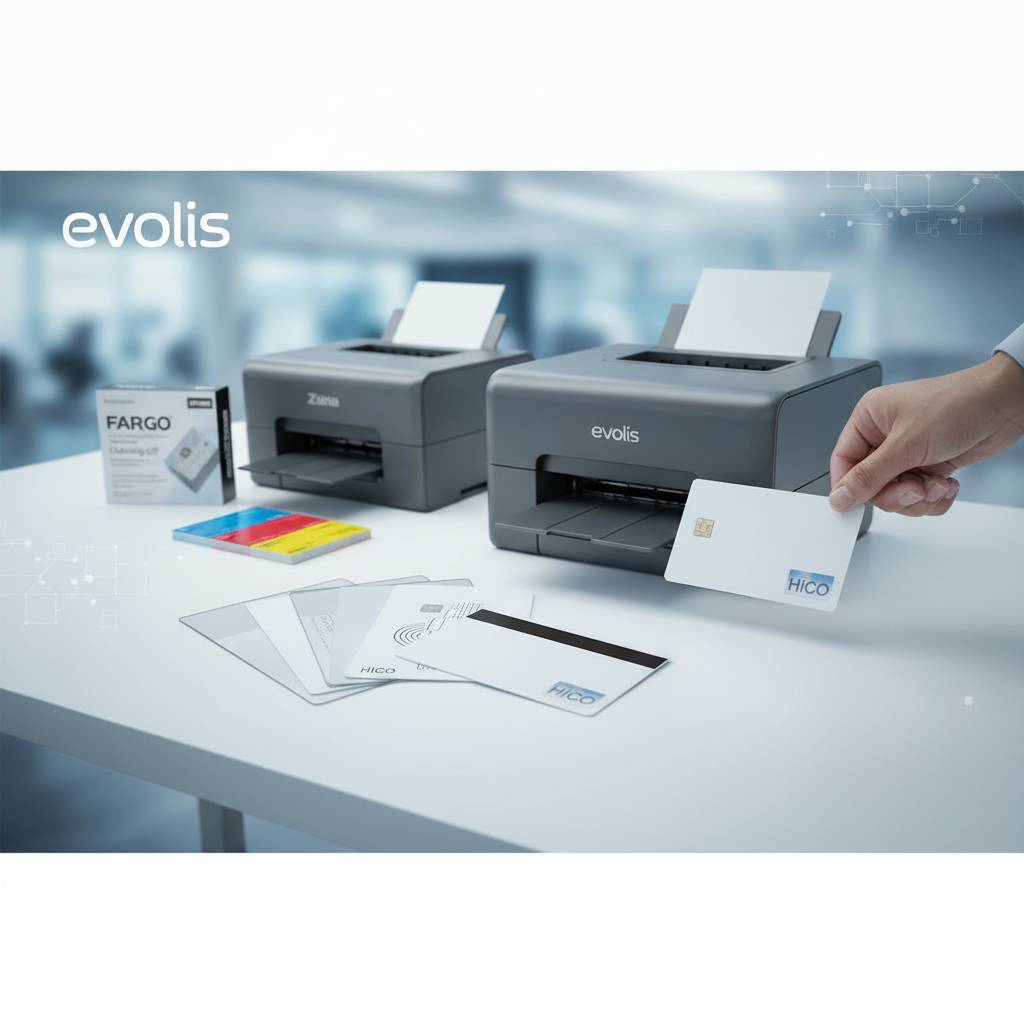 The card printer gets most of the attention, but the blank card stock you choose is equally important. Card quality affects print clarity, durability, swipe reliability, and overall professional appearance. Not all PVC cards are manufactured to the same tolerance, and inconsistent card thickness or surface coating causes printer jams, poor image saturation, and shortened card life.
Plastic Card ID stocks CR80 blank PVC cards built to ISO 7810 standards - consistent 30 mil thickness, clean flat surface for dye-sublimation printing, and compatibility across all major card printer brands. Buying in bulk brings per-card costs down substantially over time, which is one of the core economic arguments for running your own program.
Standard Blank White PVC Cards
The white CR80 blank card is the foundation of most in-house programs. It accepts full-color photo printing, barcodes, text, and logos with excellent clarity. These are the workhorses of employee ID, membership, and loyalty card programs nationwide. They're available in quantities from small starter packs to cases of 1,000 or more.
For organizations printing single-sided cards - a common setup for basic employee badges or simple membership credentials - white blank cards represent the most cost-effective and reliable choice in the entire catalog.
Magnetic Stripe Cards: HiCo vs. LoCo
Magnetic stripe cards add a functional layer to the credential - the stripe on the back can store cardholder data, access codes, or loyalty point balances that readers can interrogate electronically. Choosing between HiCo (High Coercivity) and LoCo (Low Coercivity) is an important technical decision.
HiCo stripes are more resistant to demagnetization from everyday exposure to magnetic fields - wallets, phones, bags - and are the correct choice for access control and ID programs where data integrity matters. LoCo stripes work well in lower-security applications like hotel key cards or short-term event passes where the card has a limited lifespan. CPE stocks both formats in the standard CR80 size.
Specialty Card Options: RFID, Clear, and Colored Stock
Beyond standard white PVC, Plastic Card ID offers an impressive range of specialty card stock that can elevate your program significantly. Clear and frosted PVC cards create a premium feel for membership and loyalty applications. Colored stock cards - available in a range of base colors - eliminate the need to flood-print a background color, saving ribbon life and improving print consistency.
RFID and proximity cards bring contactless functionality to your program. These cards contain an embedded chip and antenna that communicate with compatible readers without physical contact. Applications include building access control, time and attendance tracking, cashless payment programs in closed environments like corporate cafeterias, and hotel room access. Contactless technologies supported by Plastic Card ID include MIFARE DESFire and standard 125kHz proximity formats.
Ribbons, Supplies, and Keeping Your Program Running
A card printer without the right ribbon and supplies is just hardware. Ribbon selection is one of the most overlooked aspects of setting up an in-house program, yet it directly affects print quality, card durability, and cost-per-card calculations. Each printer brand uses proprietary ribbon cartridges, so matching ribbon to printer is non-negotiable.
Full-color YMCKO ribbons (Yellow, Magenta, Cyan, blacK, Overlay) are the standard for photo ID cards, producing vibrant, durable images with a protective overlay panel. Monochrome ribbons - black, silver, gold, or white - are appropriate for single-color printing applications and are significantly less expensive per card than full-color options.
Cleaning Kits: Protecting Your Printer Investment
Card printers accumulate dust, card debris, and ribbon residue over time - and a dirty printer produces poor print quality and jams before eventually causing more serious mechanical failures. A regular cleaning schedule is the single best maintenance practice for extending printer life. Most manufacturers recommend cleaning every 1,000 cards printed, or whenever changing a ribbon.
Plastic Card ID stocks cleaning kits compatible with Evolis, Zebra, and Fargo printers, including cleaning cards, cleaning swabs, and cleaning rollers. Keeping a cleaning kit on hand costs very little and pays for itself many times over in avoided service calls and printer longevity. Contact CPE at 800.835.7919 to confirm which cleaning kit is correct for your specific printer model.
Card Carriers, Sleeves, and Mailing Services
For organizations that mail cards to members, employees, or customers, presentation matters. A card delivered in a professional carrier or sleeve makes a measurably stronger impression than a card rattling loose in an envelope. Plastic Card ID supplies card carriers and protective sleeves that make issuance and distribution look polished and intentional.
For programs with high mailing volume, Plastic Card ID also offers card affixing and mailing services - a practical option for seasonal member renewals, loyalty program launches, or large-scale ID card distributions where in-house mailing logistics become a bottleneck.
Building Your Reorder Rhythm
One of the operational disciplines that separates smoothly running card programs from chaotic ones is a consistent reorder schedule. Running out of blank cards or ribbon mid-program - especially during onboarding seasons, events, or membership drives - creates unnecessary stress and delays that undermine the entire value of operating in-house.
Plastic Card ID makes reordering easy with a straightforward catalog and the ability to establish account relationships that simplify repeat purchases. Tracking ribbon yield against card volume gives you reliable data for forecasting supply needs two to four weeks in advance, which is all the lead time most programs require.
Budgeting Your In-House Card Program: What to Expect
One of the most common questions organizations ask when considering an in-house card program is simply: what will this cost? The answer varies meaningfully based on printer tier, card volume, and encoding requirements - but the economics almost always favor in-house production over outsourcing within the first 12-18 months for organizations issuing more than a few hundred cards annually.
Entry-level desktop card printers suitable for light to moderate use typically fall in the $500-$1,200 range. Mid-tier printers with encoding modules and dual-sided printing run $1,200-$3,500. High-volume and retransfer printers for demanding programs can reach $5,000-$10,000 or more. Blank CR80 PVC cards cost cents per card at volume. Full-color YMCKO ribbons typically yield 200-500 prints per cartridge depending on the model.
Calculating Your Per-Card Cost
Per-card cost for an in-house program includes card stock, ribbon consumption, and a prorated share of printer depreciation. For a mid-tier single-sided program producing 200 cards per month, total per-card cost including supplies commonly falls in the $0.50-$1.50 range - dramatically lower than outsourced card production costs for equivalent volume.
Smart buyers also factor in the value of eliminated vendor lead times. A card that used to take a week to receive now takes minutes to produce. For programs managing employee onboarding, event credentials, or membership issuance, that speed has real dollar value beyond the supply cost comparison.
Starter Program Recommendations by Organization Size
- Small businesses and nonprofits (under 100 cards/month): Entry-level Evolis or Zebra ZC100, white blank CR80 cards, YMCKO ribbon, basic card design software.
- Mid-size organizations (100-500 cards/month): Evolis Primacy 2 or Zebra ZC300, dual-sided capability, optional magnetic stripe encoder, ribbon and cleaning kit inventory.
- Large enterprises and institutions (500 cards/month): Fargo HDP series or Zebra ZXP Series, laminator module, encoding options (mag stripe, RFID, smart card), high-capacity card hoppers, dedicated card software platform.
- Access control programs: Proximity or RFID card stock, printer with compatible encoding module, coordination with access control system vendor for reader compatibility.
- Membership and loyalty programs: Magnetic stripe HiCo cards, dual-sided printing, card carriers for mailing, reorder plan for seasonal volume spikes.
Frequently Asked Questions About Starting a Card Program
Do I need special software to design and print cards? Most printers come with basic card design software, and more capable platforms like Cardpresso or Fargo Swift ID are available at modest cost. For organizations with existing databases, most software connects directly for variable data printing - pulling names, photos, and ID numbers automatically.
Can I add encoding capabilities to an existing printer? In most cases, encoding modules (magnetic stripe, RFID, smart card) are not field-upgradeable on existing printer hardware. If encoding is a future possibility, choosing a printer that supports module upgrades from the factory is the smarter initial investment. CPE can help you identify which printer models support field-upgradeable encoding.
Advanced Card Features for Growing Programs
As in-house card programs mature, many organizations discover opportunities to add sophistication that the initial setup didn't require. The infrastructure you build at launch should be capable of growing with you - which is exactly why choosing the right foundational equipment matters so much at the beginning.
Advanced features available through Plastic Card ID include casino player tracking cards, hotel key card systems, RFID smart cards with MIFARE DESFire technology, custom die-cut card shapes, and luxury metal cards in stainless steel, brass, and gold finishes for organizations where premium presentation is part of the value proposition.
RFID and Contactless Smart Cards
RFID cards communicate with readers wirelessly, typically at 13.56 MHz (smart card) or 125 kHz (proximity) frequencies. They're used extensively in building access control, time and attendance systems, cashless vending, and transit applications. MIFARE DESFire cards represent the current standard for high-security contactless credential programs, combining strong encryption with fast read speeds.
Transitioning from a proximity card program to a MIFARE DESFire program typically requires new card stock, reader upgrades, and credential provisioning steps - but the security improvement is substantial. Plastic Card ID supplies both proximity and smart card formats and can guide organizations through the transition process.
Metal Cards and Premium Presentation Options
For VIP membership programs, executive credentials, premium loyalty tiers, or any application where the card itself needs to communicate exceptional value, metal cards deliver an experience that plastic simply cannot replicate. The weight, finish, and sound of a metal card create a tangible impression that reinforces brand premium positioning.
Plastic Card ID offers luxury metal cards in stainless steel, brass, and gold finishes. These are specialty items with longer production lead times and higher per-card costs, but for the right program - casino VIP, private club membership, executive ID - the investment pays dividends in member perception and program prestige.
Custom Die-Cut and Specialty Shapes
Standard CR80 cards serve most programs perfectly well. But some applications benefit from a distinctive shape - a key fob format for access control, a mini card for children's programs, or a custom shape that reflects a brand identity in an unexpected and memorable way. Die-cut cards require pre-production planning and larger minimum order quantities, but the differentiation they create can be significant.
Organizations considering specialty shapes should work through the requirements with Plastic Card ID early in the planning process to ensure printer compatibility, since non-standard card shapes require specific printer configurations or separate encoding hardware outside the standard desktop card printer environment.
Start Your Program Today With Plastic Card ID
 Plastic Card ID has spent over 25 years doing one thing exceptionally well: helping U.S. businesses and organizations build card programs that work - from first purchase to ongoing supply, from simple badge programs to sophisticated multi-technology credentialing systems. More than 100,000 customers and 50 million cards later, the experience shows in every recommendation and every product in the catalog.
Whether you're starting a program from scratch, upgrading aging equipment, or scaling a program that has outgrown its original infrastructure, CPE has the products, knowledge, and genuine interest in your long-term success to make it work. The right program is closer than you think, and the right partner makes all the difference.
Call 800.835.7919 today to speak with a card program specialist at Plastic Card ID. Get real answers, honest recommendations, and everything you need to start printing professional-quality credentials in-house - on your schedule, at your pace, fully under your control.
Previous Page