Are Blank Plastic Cards Recyclable? PVC Limitations Explored
Table of Contents []
- What Every Business Should Know Before Buying Blank Plastic Cards - Plastic Card ID
- The Real Story on PVC: Material Properties and Honest Limitations
- Blank CR80 Cards: The Workhorse of Every In-House Card Program
- Advanced Card Technologies: RFID, Smart Chips, and Specialty Options
- Card Printers and Supplies: The Complete In-House Solution
- Loyalty, Membership, and Gift Cards: The Business Case for Going Plastic
- Frequently Asked Questions: PVC Cards, Recycling, and Program Planning
- Partner With Plastic Card ID for Every Card Your Business Needs
What Every Business Should Know Before Buying Blank Plastic Cards - Plastic Card ID
Here is a question that comes up more often than you might expect: are blank plastic cards recyclable, and what are the real PVC limitations businesses need to plan around? Before diving into the answer, consider this - the wrong assumptions about card materials can lead to program headaches, compliance gaps, and disposal surprises. Understanding what your cards are made of is not just responsible; it is smart business strategy.
PVC plastic cards are the backbone of ID programs, loyalty systems, access control, and membership operations across the United States. They are durable by design, engineered to survive daily handling, wallet friction, and years of repeated use. That durability is precisely what makes them valuable - and also what creates specific end-of-life considerations worth understanding upfront.
| Property | PVC Plastic Cards | Paper Cards |
|---|---|---|
| Thickness (CR80) | 30 mil standard | Varies, typically thinner |
| Durability | High - years of use | Low - degrades quickly |
| Recyclable via Standard Bin | No - specialty recycler required | Yes (uncoated) |
| Print Quality | Excellent, photo-grade | Limited |
| Encoding Capability | Mag stripe, RFID, chip | Barcode only |
The Real Story on PVC: Material Properties and Honest Limitations
Polyvinyl chloride - PVC - is not a material that apologizes for what it is. It is one of the most widely used plastics in the world precisely because it performs. For card manufacturing, PVC offers dimensional stability, excellent surface adhesion for printing, flexibility without brittleness, and compatibility with magnetic stripe, RFID, and chip encoding. The CR80 format at 30 mil thickness is the global ISO 7810 standard for a reason: it works, consistently and reliably.
That said, PVC does carry genuine limitations that buyers should factor into their programs. The material does not degrade in landfill conditions on any meaningful human timescale. It cannot go into curbside recycling bins. And if cards are laminated or contain embedded electronics - like RFID antennas or smart chips - standard mechanical recycling becomes more complex. These are real constraints, not rumors, and any honest supplier will tell you exactly this upfront.
What PVC Actually Contains and Why It Matters
Standard blank plastic cards are composed of laminated PVC layers, sometimes with a polyester core in higher-durability versions. The additives in PVC - plasticizers, stabilizers, colorants - vary by manufacturer and application. For most business card programs, the card composition is straightforward PVC laminate, which performs predictably across card printers and encoding equipment.
Where composition becomes more complex is in specialty cards. Clear frosted cards may use composite materials. RFID and contactless cards embed antenna coils between card layers. Smart chip cards include a microprocessor module. These additions increase functionality dramatically, but they also mean the card cannot be treated as a simple single-material item at end of life. Knowing this helps programs plan disposal procedures in advance rather than scrambling later.
Are Blank Plastic Cards Recyclable? The Honest Answer
The short answer is: not through standard municipal recycling. PVC is classified as resin code 3, and most curbside programs do not accept it. Blank PVC cards, including ID cards, loyalty cards, and access credentials, need to go to specialty plastic recyclers that handle PVC specifically. Some card manufacturers and industry programs offer take-back initiatives, but these are not universal.
For businesses running large-scale card programs - say, a hotel chain cycling through thousands of key cards annually or a retailer retiring a gift card batch - partnering with a specialty recycler ahead of time is the operationally smart move. It is not complicated; it just requires a small amount of advance planning that most businesses do not think about until the moment arrives. Building this into your card program lifecycle from the start is simply good management.
PVC Limitations in Specific Card Applications
There are a handful of application-specific limitations worth knowing. In extremely high-temperature environments - think cards left in a car dashboard in direct summer sun - PVC cards can warp. This is not a typical issue for most card programs, but it is relevant for outdoor event credentials or vehicle-stored access badges. Standard CR80 cards tolerate normal operational environments without issue.
Chemical resistance is another consideration. Prolonged exposure to certain solvents or harsh cleaning agents can degrade the card surface or affect magnetic stripe integrity. For most employee ID and loyalty card applications, this is never a factor. For cards used in industrial environments or food service settings with frequent cleaning, it is worth selecting cards with appropriate surface treatments or overlaminate protection through your card printer ribbon setup.
Blank CR80 Cards: The Workhorse of Every In-House Card Program
Walk through almost any mid-size business running an in-house card program, and you will find blank CR80 PVC cards sitting in a supply drawer somewhere. They are the raw material from which employee badges, member cards, event passes, and access credentials are made. The blank card is a platform - a standardized, printer-ready surface waiting to become whatever your operation needs it to be.
At 30 mil thickness, the CR80 format fits every standard card printer on the market - Evolis, Zebra, Fargo, and others - without modification or adaptation. Organizations that print cards in-house gain total design control and dramatically lower per-card costs over time compared to ordering pre-printed cards for every batch. A box of 500 blank cards plus a ribbon gives you the flexibility to print exactly what you need, when you need it.
The Case for In-House Card Printing
The economics of in-house card printing become compelling quickly. Consider a company that issues employee ID badges as part of onboarding. Ordering custom pre-printed cards from an outside vendor adds lead time and per-card cost. With a card printer, a box of blanks, and the right ribbons, a badge can be printed and ready in under two minutes. Speed, control, and cost savings compound over time.
There are other advantages beyond economics. Security-sensitive organizations can ensure that card production never leaves their facility. Healthcare organizations printing patient cards can maintain HIPAA-aligned data handling throughout the process. Educational institutions printing student IDs can update designs each semester without reordering minimum quantities from an outside vendor. The blank card, in the right program, is a remarkably versatile asset.
Choosing the Right Blank Card Stock for Your Printer
Not all blank cards are identical, and matching card stock to your printer model matters. Printer manufacturers calibrate feed mechanisms, print heads, and encoding systems for specific card thicknesses and surface characteristics. Using off-spec cards can result in feed jams, uneven print quality, or failed encoding. CPE sources blank card stock that is compatible with leading printer brands to ensure consistent results.
Surface finish is another variable. Glossy PVC cards offer the crispest, most vibrant full-color prints - ideal for photo ID cards and premium loyalty programs. Matte or textured finishes reduce fingerprinting and can improve the appearance of single-color or two-color prints. Composite PVC-polyester cards offer added durability for high-abuse applications like manufacturing floor badges or gym membership cards that take serious daily punishment.
Magnetic Stripe Cards: HiCo vs. LoCo and When It Matters
Blank magnetic stripe cards come in two coercivity levels: HiCo (high coercivity) and LoCo (low coercivity). HiCo cards retain magnetic data far more reliably in proximity to everyday magnetic fields - purses, phones, other cards - making them the standard choice for ID, loyalty, and access programs that need consistent read performance over the card's lifespan.
LoCo cards are suitable for shorter-term applications where the card will not be exposed to magnetic interference and will not be used for an extended period. Hotel key cards, temporary event access passes, and short-duration promotional cards are common LoCo use cases. CPE supplies both HiCo and LoCo options, and the team can help buyers choose correctly based on application requirements and expected card lifespan. Contact the team at 800.835.7919 for guidance on coercivity selection.
Advanced Card Technologies: RFID, Smart Chips, and Specialty Options
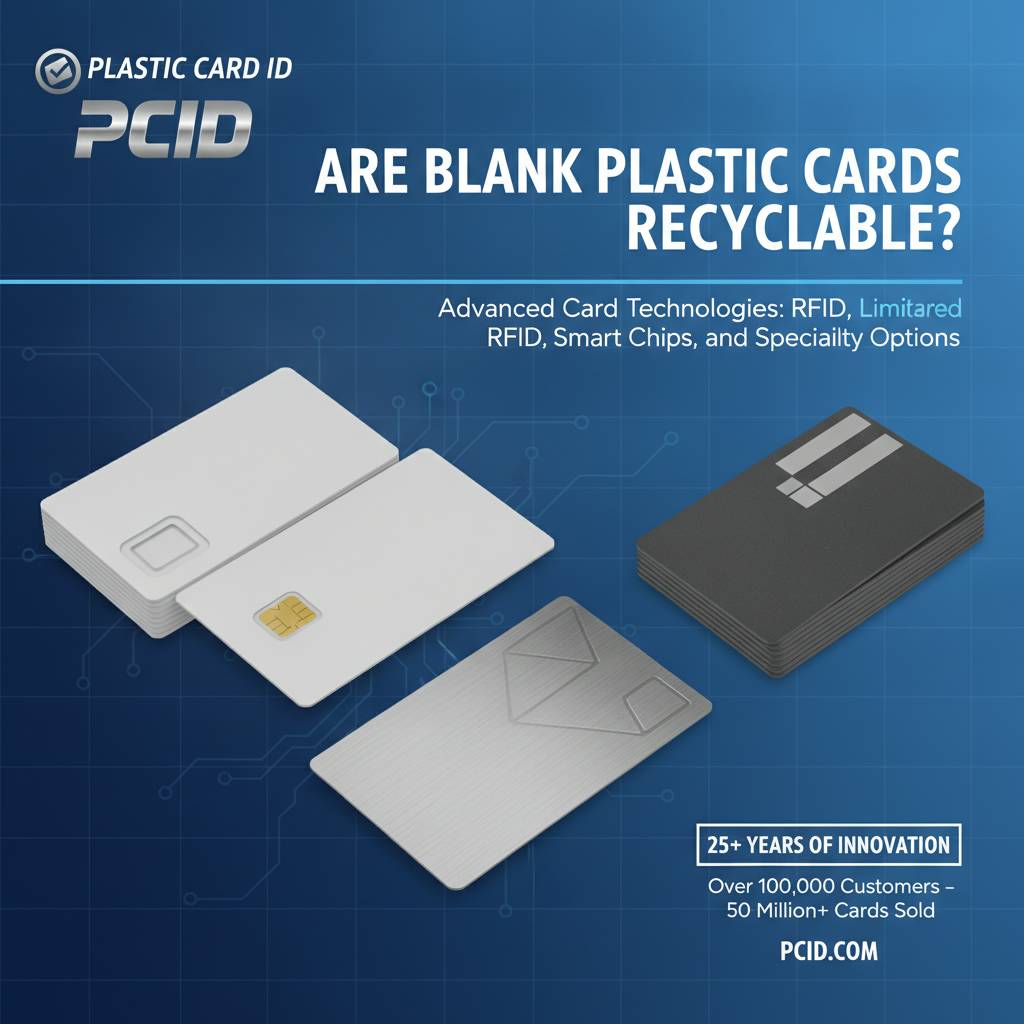 Not every card program is a simple print-and-hand-out operation. Many organizations require cards that do something - open doors, authenticate identities, track loyalty points at a reader, or interface with access control systems. This is where RFID, proximity, and smart chip cards enter the picture, and where the blank card concept expands into something significantly more sophisticated.
RFID cards embed an antenna and microchip within the card body. When the card passes near a compatible reader, it transmits a unique identifier without any contact required. Proximity cards operate on 125 kHz frequency and are widely used in traditional access control systems. Contactless smart cards - including MIFARE DESFire - operate at 13.56 MHz and support encrypted data exchange, making them suitable for higher-security environments and multi-application programs.
MIFARE DESFire and High-Security Contactless Applications
MIFARE DESFire cards represent the current standard for serious contactless card programs. They support AES encryption, multi-application architecture, and faster transaction speeds compared to older MIFARE Classic technology. Casino player tracking systems, university campus ID programs, transit access systems, and corporate security environments have all migrated toward DESFire for its combination of security depth and operational reliability.
For organizations building or upgrading an access control or identification system, choosing the right RFID frequency and protocol from the start prevents costly retrofits later. A 125 kHz proximity card program cannot simply be swapped to 13.56 MHz contactless without reader infrastructure changes. This is a systems decision, not just a card purchasing decision, and it deserves careful planning with a knowledgeable supplier.
Hotel Key Cards, Casino Cards, and High-Volume Specialty Programs
Hotel key cards are one of the highest-volume card applications in the United States. A mid-size hotel can cycle through tens of thousands of key cards annually, factoring in lost cards, extended stays, and rekeying. The economics of key card purchasing at volume require a supplier who can deliver consistently without quality variance. CPE serves hotel programs of all sizes with reliable turnaround and volume pricing that makes large-scale procurement straightforward.
Casino player cards carry their own set of requirements: they need to survive a demanding environment, integrate with player tracking systems, and hold up under frequent reader interactions. Card quality at the magnetic stripe or chip interface is non-negotiable in casino environments where a failed card read is a guest service failure. Premium card stock and proper encoding quality are the foundation of a card program that casino operations can depend on.
Clear, Frosted, and Custom Die-Cut Cards for Distinctive Programs
Sometimes a card needs to do more than function - it needs to make a statement. Clear plastic cards offer a striking visual effect, with designs appearing to float on transparent stock. Frosted cards provide a soft, premium aesthetic that works exceptionally well for boutique membership programs, upscale retail loyalty cards, and branded VIP credentials. These are not novelty options; they are legitimate card stock choices used by brands that understand presentation value.
Custom die-cut cards break the CR80 rectangle entirely. A card shaped like a key, a car silhouette, or a company logo becomes a marketing object as much as a functional card. For product launches, VIP events, or premium membership tiers, a custom shape communicates that the program is distinctive. Metal cards in stainless steel, brass, and gold take this concept further, delivering a weight and feel that plastic simply cannot replicate for the highest-tier programs.
Card Printers and Supplies: The Complete In-House Solution
A blank card program without the right printer is an incomplete program. CPE carries a full lineup of card printers from the three brands that define the industry: Evolis, Zebra, and Fargo. Each manufacturer brings a slightly different engineering philosophy, price point, and feature set, giving buyers genuine options rather than a one-size-fits-all recommendation.
Evolis printers are known for their compact footprint, user-friendly operation, and strong performance in low-to-mid-volume environments. Zebra brings enterprise-grade reliability and a broad feature range to high-volume and security-focused applications. Fargo printers have a strong presence in ID and access card programs, with HDPii and DTC series models serving everything from small nonprofits to large government-adjacent operations. Matching printer to program volume and card complexity is the first step to a successful in-house setup.
Ribbons, Cleaning Kits, and Consumable Supplies
A printer is only as good as the consumables running through it. Print ribbons determine image quality, durability, and whether cards receive a protective topcoat that resists scratching and UV fading. YMCKO ribbons - cyan, magenta, yellow, black, and overlay - are the standard for full-color photo ID and loyalty card printing. Monochrome ribbons cover single-color text and barcode printing at a significantly lower cost per card.
Cleaning kits are not optional maintenance - they are the reason card printers maintain consistent print quality over years of operation. Printhead contamination from card dust and debris is the leading cause of premature printhead failure, which is an expensive repair. Regular cleaning extends printer life and protects print quality, and the cost of a cleaning kit is trivial compared to a printhead replacement or service call. CPE supplies the cleaning kits, cards, and ribbons to keep programs running without interruption.
Card Carriers, Sleeves, and Mailing Services
Getting a card to its recipient in good condition requires more than just printing it well. Card carriers protect printed cards during mailing and communicate brand presence at the moment of delivery. A well-designed carrier turns a card distribution moment into a brand experience - particularly valuable for loyalty program launches, membership renewals, or gift card programs where first impressions matter.
Card affixing and mailing services take the fulfillment burden off organizations that need to distribute cards at scale. Rather than managing in-house envelope stuffing, addressing, and postage for a large member base or gift card campaign, organizations can hand that workflow to CPE and receive a turnkey distribution solution. For organizations scaling a loyalty or membership program, this is often the operational detail that separates a smooth launch from a logistical scramble.
Loyalty, Membership, and Gift Cards: The Business Case for Going Plastic
Here is a number worth pausing on: retailers who switch from paper to plastic gift cards see sales increases of 35-50%. That is not a marginal improvement - that is a program transformation. The reasons are straightforward. A plastic gift card lives in a wallet. It is visible, durable, and gets used. A paper certificate gets folded, lost, or forgotten in a drawer within days.
Loyalty programs face exactly the same dynamic. A plastic loyalty card carried in a wallet is a persistent, daily reminder of a brand relationship. A paper punch card is a liability - easy to fake, easy to lose, and easy to discard. Organizations that invest in plastic loyalty card programs consistently report higher redemption rates and stronger customer retention metrics than those relying on paper alternatives. The card itself becomes part of the value proposition.
Membership Cards That Signal Legitimacy
There is something about holding a plastic membership card that paper simply cannot replicate. The weight, the finish, the permanence - they signal that an organization is real, established, and worth belonging to. Gyms, professional associations, clubs, faith communities, and cultural institutions all benefit from issuing plastic membership cards rather than paper certificates or printouts. Perception shapes behavior, and a well-produced card changes how members perceive their relationship with an organization.
Membership cards also serve as passive marketing. A card visible in a wallet prompts questions from observers and becomes a conversation starter. A card with an elegant design or distinctive finish commands attention in a way that paper never will. For organizations building community and identity around membership, the card is not an administrative afterthought - it is a tangible expression of belonging worth getting right.
Gift Card Programs for Retailers and Small Businesses
Starting a gift card program does not require a large minimum order or a complicated technology platform. Blank white PVC cards printed in-house with a gift card design and a barcode or magnetic stripe can serve a small retail operation just as effectively as a large-scale program. CPE supplies blank mag stripe cards compatible with common retail point-of-sale systems, making it feasible for small businesses to run professional gift card programs without enterprise-level investment.
For businesses ready to step up to custom-printed gift cards in volume, the catalog expands considerably. Custom full-color printing, holographic overlaminates, custom shapes, and premium finishes are all available for programs that want to make a stronger brand statement at point of purchase. A gift card is a sales vehicle as much as it is a payment instrument, and the design investment pays dividends at every checkout counter, shelf display, and gift-giving moment.
Frequently Asked Questions: PVC Cards, Recycling, and Program Planning
Buyers come to CPE with a consistent set of questions when planning card programs. Below are the most common, answered directly and without spin. Clarity at the planning stage prevents program headaches later.
Common Questions About PVC Card Limitations and Disposal
- Can I put PVC cards in my curbside recycling bin? No. PVC (resin code 3) is not accepted in standard municipal recycling programs. Cards need to go to specialty plastic recyclers who handle PVC specifically.
- Do embedded components like RFID chips or magnetic stripes affect recyclability? Yes. Cards with embedded electronics or multi-material lamination are more complex to process and typically require recyclers who specialize in composite plastics or e-waste adjacent materials.
- How long do PVC cards typically last in active use? Standard CR80 PVC cards in normal use conditions last three to five years or more. High-abuse applications may see wear sooner, which is where composite or laminated cards offer better longevity.
- Do card printers require specific card brands? Printer manufacturers recommend cards tested to their specifications. Using off-brand or non-compliant cards can cause feed issues and void warranties. CPE supplies cards compatible with Evolis, Zebra, and Fargo printers.
- What is the minimum order quantity for blank PVC cards? Blank card orders can start quite small - programs running as few as 50 cards a month are well within scope. Volume pricing improves at higher quantities, but there is no prohibitive minimum for organizations getting started.
For questions not covered here, the team is available to walk through program requirements and make recommendations based on real-world experience with card programs of every type and scale.
Planning a Card Program: Key Decisions Before You Order
Before placing a first order, it helps to answer a few foundational questions. What is the card for? How many cards per month or per year? Will cards be encoded with magnetic stripe, RFID, or chip data? Will printing happen in-house or at order time? How long is each card expected to be in active use? These decisions shape every specification choice that follows, from card stock to printer model to ribbon type.
Organizations upgrading existing programs have their own set of decisions. Existing printer infrastructure may constrain card stock choices. Existing reader infrastructure constrains RFID frequency options. A loyalty program migrating from paper to plastic may need to bridge both systems temporarily during transition. Walking through these scenarios with a knowledgeable supplier at the outset is far more efficient than discovering incompatibilities after the order arrives.
Working With CPE as a Long-Term Card Program Partner
The relationship that CPE builds with clients is not transactional - it is operational. Card programs evolve: designs change, volumes shift, technology upgrades, organizations grow. A supplier who understands a client's program history can respond quickly when changes are needed, flag when card stock or ribbon specifications need updating, and proactively suggest better solutions as they become available. That is a different value proposition than a bulk online order from an anonymous distributor.
Over 100,000 customers and more than 50 million cards represent an enormous base of real-world program experience. That experience is available to every client, whether they are ordering 500 blank cards for the first time or scaling a loyalty program into the hundreds of thousands of cards per year. The depth of catalog - from plain white CR80 blanks to luxury metal cards - means that program requirements can be met and scaled without switching suppliers as needs grow. Reach the team directly at 800.835.7919 to discuss your program needs.
Partner With Plastic Card ID for Every Card Your Business Needs
 Whether the question is about PVC limitations, recyclability, blank card compatibility, or building a card program from scratch, Plastic Card ID brings 25-plus years of hands-on expertise to every conversation. The catalog is deep, the team is knowledgeable, and the commitment is to making your card program work - not just to processing an order and moving on.
From blank CR80 white PVC cards to RFID smart cards, from Evolis desktop printers to luxury stainless steel metal cards, every program need is covered under one roof. Loyalty, membership, access control, gift cards, event credentials, employee ID - the full scope of business card applications is served, supported, and stocked.
Call Plastic Card ID today at 800.835.7919 and let the team help you build a card program that works as hard as your business does.
Previous Page