Blank Plastic Cards for Gift Card Programs: Getting Started
Table of Contents []
- Why Plastic Card ID Is the Go-To Source for Blank Plastic Cards for Gift Card Programs
- The Real Business Case for Plastic Gift Cards
- Understanding Blank CR80 Cards and What Makes Them the Program Workhorse
- Magnetic Stripe Cards for Gift Card Programs: HiCo vs. LoCo
- Card Printers and Supplies: Building Your In-House Card Production Capability
- Industries That Benefit Most from Blank Plastic Gift Card Programs
- Frequently Asked Questions About Blank Plastic Cards for Gift Card Programs
- Get Your Gift Card Program Running with Plastic Card ID
Why Plastic Card ID Is the Go-To Source for Blank Plastic Cards for Gift Card Programs
Picture this: a customer walks into your store, grabs a sleek plastic gift card from a display, and hands it to a cashier. That small card - glossy, rigid, CR80-standard - just triggered a purchase that a paper coupon never could. Blank plastic cards for gift card programs are not a commodity. They are a revenue engine, and the difference between a thriving gift card program and a forgotten one often starts with the card itself.
Plastic Card ID has spent over 25 years supplying blank and custom plastic cards to businesses across the United States. With more than 100,000 customers served and over 50 million cards sold, they understand what it takes to build a card program that actually performs - whether you need 50 cards a month or tens of thousands at a time.
This page is for decision-makers who want real answers: what types of blank cards exist, what specifications matter, how magnetic stripes and smart chips fit into gift card programs, and why switching from paper to plastic consistently delivers measurable sales gains. Let's get into it.
| Card Type | Best Use Case | Encoding Option |
|---|---|---|
| Blank CR80 PVC (30 mil) | In-house printing, full design control | None (print-ready) |
| HiCo Magnetic Stripe | Point-of-sale gift card redemption | High coercivity mag stripe |
| LoCo Magnetic Stripe | Short-term loyalty, hotel key programs | Low coercivity mag stripe |
| Smart Chip (RFID/Contactless) | Tap-to-redeem, loyalty integration | MIFARE, proximity chip |
| Clear / Frosted PVC | Premium brand presentation | Optional mag stripe overlay |
The Real Business Case for Plastic Gift Cards
It is easy to underestimate what a physical card does psychologically. A plastic gift card sitting in someone's wallet is a constant, tangible reminder of your brand. Paper certificates get folded, forgotten, or thrown away. Plastic stays. It rides along in a wallet for weeks or months, surfacing every time the cardholder reaches for cash or another card.
The numbers support this instinct. Retailers that switch from paper gift certificates to plastic gift cards routinely see sales increases in the range of 35-50%. That is not a marginal improvement - that is a program transformation. When the physical form factor changes, customer behavior changes with it. Recipients are more likely to use the card, more likely to spend above the card's value, and more likely to return to your business again.
Why Paper Gift Certificates Fall Short
Paper certificates have a fundamental problem: they feel disposable. Customers may misplace them, damage them in a wash cycle, or simply forget they exist. There is no barcode reliability, no consistent magnetic stripe, and no professional presentation at the point of sale. A wrinkled paper certificate handed to a cashier creates friction - plastic eliminates it.
Beyond the customer experience, paper programs are operationally messy. Tracking redemptions requires manual processes. Fraud protection is minimal. When a plastic card with a magnetic stripe or barcode is involved, your POS system handles verification automatically, balances are tracked digitally, and your team spends less time managing exceptions.
Gift Cards as a Strategic Revenue Tool
Gift cards are one of the few retail products that generate revenue before any goods or services are delivered. When someone buys a $50 gift card, you have that cash in hand immediately. Studies consistently show that a significant percentage of gift cards are never fully redeemed - a phenomenon known as breakage - which represents pure margin for the issuing business.
Beyond breakage, gift card buyers almost always spend more than the card's value during redemption. The recipient perceives the card as "free money," lowering psychological spending resistance. This overspend effect is one of the most compelling reasons to formalize a plastic card program, and it starts with sourcing the right blank cards.
Connecting Card Quality to Brand Perception
The cards your business puts into customers' hands are a direct reflection of your brand standards. A thick, rigid 30 mil CR80 card signals permanence and professionalism. Thin, flimsy alternatives communicate the opposite. Card stock quality is a brand statement - and CPE supplies cards that make the right impression every single time.
Customization matters too. When you control the printing in-house, your card can carry your exact logo, colors, seasonal artwork, or promotional messaging without waiting on a third-party print vendor. That agility is a competitive advantage, especially for businesses that run frequent promotions or change card designs seasonally.
Understanding Blank CR80 Cards and What Makes Them the Program Workhorse
The CR80 format is the ISO 7810 standard - the same dimensions as a credit card. At 3.375 inches by 2.125 inches and 30 mil thick, these cards fit every standard wallet slot, badge holder, and card printer on the market. That universality is not accidental. It is why blank CR80 PVC cards have become the foundational component of in-house card programs across virtually every industry vertical.
When you purchase blank CR80 cards, you are buying flexibility. A single card stock can become a gift card today, an employee badge tomorrow, and a loyalty card next month - depending only on what gets printed or encoded onto it. This multi-purpose versatility drives down your per-card cost over time and simplifies inventory management considerably.
Card Thickness, Composition, and Why Specifications Matter
Not all PVC cards are created equal. The 30 mil specification refers to card thickness, and it is the standard that most card printers and POS terminals expect. Cards that deviate from this thickness - even slightly - can jam printers, fail to encode properly, or wear out faster under daily handling. CPE supplies cards that meet ISO 7810 tolerances consistently, so your printer and your program run without disruption.
Card composition also affects printability. High-quality PVC stock accepts dye-sublimation and direct-to-card printing cleanly, producing sharp graphics and vibrant color. Inferior materials can result in uneven ink absorption, smearing, or fading over time. For a gift card that needs to look great for months in a customer's wallet, material quality is not optional.
Colored Stock, Clear Cards, and Specialty Options
White is the default, but it is far from the only option. Plastic Card ID offers colored PVC stock, clear cards, frosted cards, and specialty formats including custom die-cut shapes and luxury metal cards in stainless steel, brass, and gold. Clear and frosted cards, in particular, create a premium visual effect that positions your gift card program as upscale and distinctive.
Metal cards represent the highest tier of brand differentiation. A stainless steel or gold-finish gift card is not just functional - it is a collectible. Recipients are far less likely to discard a metal card, which means your brand stays in circulation longer. For high-end retailers, luxury hospitality brands, or exclusive membership programs, metal cards are an investment with real retention value.
How Many Cards Do You Actually Need?
Plastic Card ID serves programs of every scale. Small businesses running 50-card monthly programs get the same quality and attention as enterprise clients ordering tens of thousands at a time. The key is matching your order volume to your actual usage so you are not over-investing in inventory or running short during peak seasons like the holidays.
A practical starting point is to estimate your monthly gift card sales over the previous year, add a buffer for seasonal spikes, and then calculate how your in-house printing capacity aligns with demand. CPE can help you work through these numbers and recommend the right card type and volume for your situation. Call 800.835.7919 to talk through your program specifics with a knowledgeable team member.
| Feature | HiCo (High Coercivity) | LoCo (Low Coercivity) |
|---|---|---|
| Magnetic Strength | 4000 Oe | 300 Oe |
| Durability | High - resists demagnetization | Moderate - shorter lifespan |
| Best For | Gift cards, loyalty cards, ID cards | Hotel keys, short-term access |
| Stripe Color | Black | Brown or black |
Magnetic Stripe Cards for Gift Card Programs: HiCo vs. LoCo
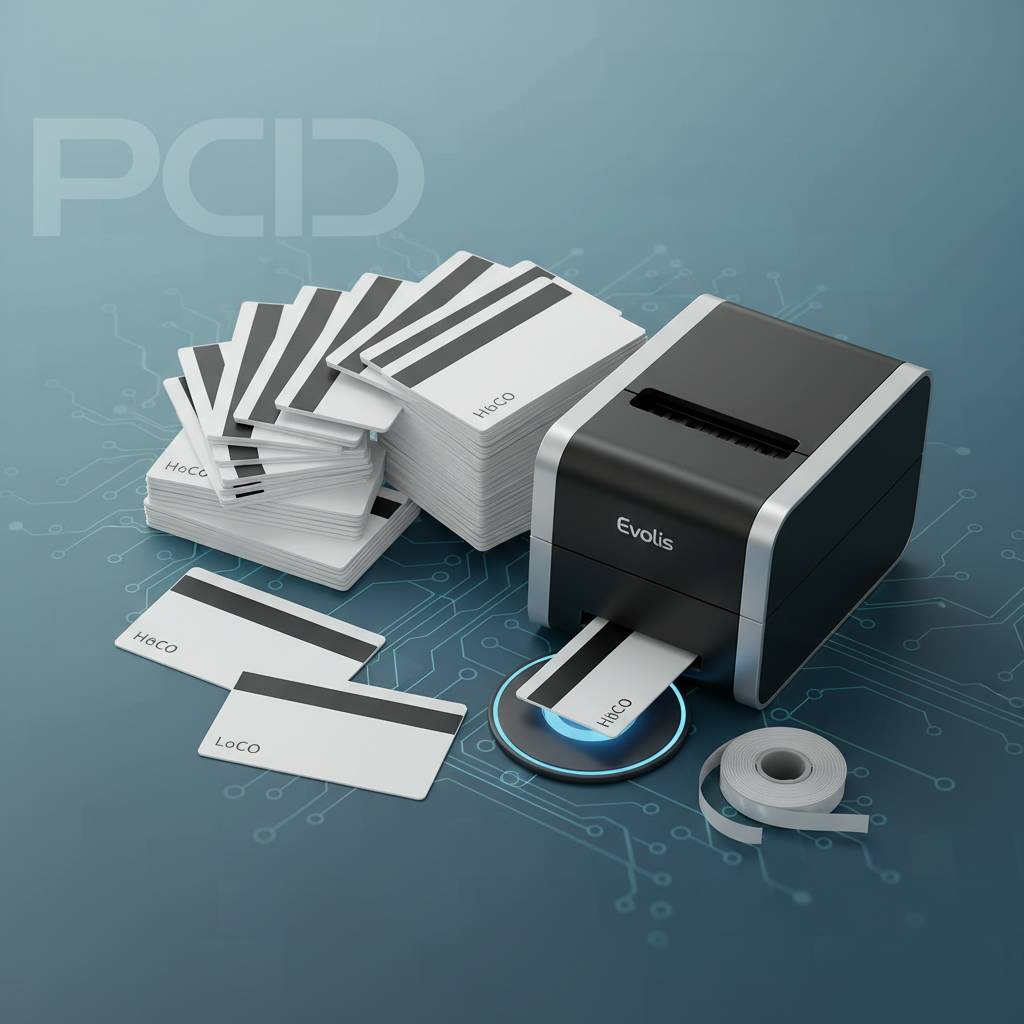 When your gift card program involves point-of-sale redemption through a card reader, you need a magnetic stripe card. The stripe stores encoded data - card numbers, account references, or any identifier your POS system uses to look up balances. Choosing between HiCo and LoCo is one of the most consequential technical decisions in setting up a card program.
High coercivity magnetic stripe cards are the standard choice for gift card programs. Their 4000 Oe magnetic strength means the encoded data resists accidental demagnetization from common sources like phone magnets or proximity to other cards. For a gift card that might live in a customer's wallet for months before redemption, that durability is essential. LoCo cards, by contrast, are better suited for short-term applications where card lifespan is measured in days or weeks.
Encoding Your Magnetic Stripe Cards
Magnetic stripe cards ship blank - meaning the stripe is present but not yet encoded. Encoding happens at the time of card initialization, either through your card printer (if it has an encoding module) or through a dedicated card encoder. Your POS gift card software typically handles the encoding process automatically when you activate a new card at the register.
This workflow is one of the most compelling arguments for bringing card production in-house. When you own the printer and the blank card inventory, you can encode and activate cards on demand rather than waiting for pre-encoded batches from an outside vendor. On-demand activation also means you are not holding activated card liability in your stockroom.
Three-Track Stripe Capabilities and Program Compatibility
Standard magnetic stripe cards carry up to three data tracks, each with different encoding specifications. Most retail gift card programs use Track 1 and Track 2, which carry alphanumeric and numeric data respectively. Track 3 is available for additional data storage but is less commonly used in gift card applications. Your POS software documentation will specify which tracks your system reads and writes.
Compatibility between your blank card stock, your printer's encoding module, and your POS software is a critical setup consideration. Plastic Card ID carries magnetic stripe cards tested for use with Evolis, Zebra, and Fargo card printers - the leading brands in in-house card production - ensuring seamless integration across your entire program stack.
RFID and Smart Chip Cards: The Next Generation of Gift Card Technology
Contactless technology is no longer a novelty. RFID and proximity cards allow tap-to-read transactions without physical contact between card and reader, creating a faster, more frictionless customer experience. Smart chip cards using MIFARE DESFire encryption offer an advanced level of data security that is increasingly relevant as businesses modernize their card programs.
For gift card programs specifically, contactless integration enables faster checkout and opens doors to loyalty program integration where a single card handles both gift value and points accumulation. The convergence of gift, loyalty, and access functions into a single smart card is one of the more exciting directions in card program design right now. CPE can supply the card stock; your software platform connects the functionality.
Card Printers and Supplies: Building Your In-House Card Production Capability
A blank card program is only as effective as the printing equipment behind it. Plastic Card ID carries a full lineup of card printers from Evolis, Zebra, and Fargo - three brands that collectively represent the gold standard in desktop and mid-volume card printing. Each brand offers models suited to different output volumes and feature requirements, from basic single-sided color printing to dual-sided printing with lamination and magnetic stripe encoding.
Choosing the right printer depends on your monthly card volume, the complexity of your card designs, and whether you need encoding capabilities built in. Investing in the right printer upfront saves money and operational friction over the long term, and CPE is equipped to help you match the right hardware to your program's needs.
Printer Ribbons and Consumables
Card printers use specialized ribbons - YMCKO (yellow, magenta, cyan, black, overlay) being the most common for full-color card production. Ribbon yield varies by printer model and card design complexity. High-graphic designs consume more ink per card than simple text-and-logo layouts. Keeping an adequate ribbon inventory on hand prevents production interruptions, especially heading into high-demand periods.
Plastic Card ID supplies printer ribbons, cleaning kits, and all necessary consumables for the printer brands they carry. Buying supplies from the same source as your hardware ensures compatibility and removes the risk of substandard third-party consumables causing printer damage or print quality issues. Call 800.835.7919 to set up a standing order for supplies and keep your program running uninterrupted.
Cleaning Kits and Printer Maintenance
Card printers are precision instruments. Dust, debris, and residue from card stock accumulate on print heads and rollers over time, degrading print quality and shortening printer lifespan. Regular cleaning using manufacturer-recommended cleaning kits is the single most impactful maintenance practice you can adopt to protect your printer investment.
Most printers include cleaning prompts based on card count cycles. Following these prompts consistently - rather than deferring maintenance - is the best way to maintain consistent output quality. Plastic Card ID carries cleaning kits for all supported printer brands, making it simple to stay on schedule without sourcing supplies from multiple vendors.
Card Carriers, Sleeves, and Mailing Services
Producing the card is only one part of a gift card program. Getting cards to customers - whether through direct mail, in-store display, or employee distribution - requires additional infrastructure. Card carriers (the paper folders that hold cards for display or mailing) and card sleeves (protective envelopes) complete the professional presentation that makes your program credible.
Plastic Card ID also offers card affixing and mailing services, which means you can outsource the fulfillment side of your card program entirely if in-house mailing is not practical. This service is particularly valuable for businesses launching seasonal campaigns or membership programs that require mass distribution on a defined timeline.
Industries That Benefit Most from Blank Plastic Gift Card Programs
Gift card programs are not exclusive to retail. Virtually any business that offers goods, services, or experiences can run a successful gift card program - and the industries that have embraced plastic cards most aggressively tend to share one trait: they recognize that the card itself is a marketing asset, not just a payment mechanism.
From specialty retail to hospitality to healthcare and beyond, the application of blank plastic cards for gift card programs spans a remarkably broad landscape. What follows are the verticals where CPE sees the highest program activity and the most consistent results.
Retail and Specialty Stores
Retail is the natural home of the gift card, and for good reason. Seasonal gifting, birthday purchases, and "I'm not sure what they want" shopping scenarios all drive gift card demand. Specialty retailers in categories like beauty, home goods, outdoor gear, and apparel see particularly strong gift card adoption because customers in those categories shop with strong brand loyalty.
For retail operators, blank card programs allow seasonal design changes without vendor lead times. You can design a holiday card in October, load blank stock into your printer, and have fresh-designed cards ready for November display - all without a custom print order.
Restaurants, Cafes, and Food Service
Restaurant gift cards are consistently among the top-gifted items in the United States, particularly around the holidays and for special occasions like birthdays and anniversaries. A plastic gift card from a beloved local restaurant carries genuine emotional value - and drives repeat visits every time it is used. In-house card programs give food service operators the flexibility to print new card designs for different occasions without committing to large pre-printed runs.
Blank HiCo magnetic stripe cards are the standard choice for restaurant programs, integrating cleanly with most restaurant POS systems. For operators running multiple locations, a unified card program reinforces brand consistency and simplifies balance management across sites.
Hospitality, Spas, and Wellness
Hotels, resorts, spas, and wellness businesses have embraced plastic cards across multiple functions simultaneously. A single property might use blank cards for gift programs, loyalty rewards, room key access, and employee identification. The ability to source all card stock from a single supplier like Plastic Card ID - and print each card type in-house using the same printer - creates significant operational efficiency.
Casino operations represent a specialized subset of hospitality with their own card program requirements, including player tracking cards that integrate with casino management systems. Plastic Card ID supplies casino player cards designed for these high-use, high-volume environments where card durability and encoding precision are non-negotiable.
- Hotels and resorts: Gift cards, loyalty cards, and key card programs from one supplier
- Day spas: Gift card programs that drive new client acquisition through gifting
- Fitness studios: Membership cards and gift programs that reinforce recurring revenue
- Casino operators: Player tracking cards with robust encoding and high durability
- Entertainment venues: Event credentials, VIP access cards, and prepaid admission cards
Frequently Asked Questions About Blank Plastic Cards for Gift Card Programs
Decision-makers evaluating blank card programs for the first time - or reconsidering an existing program - tend to have a consistent set of questions. The answers below address the most common concerns directly and practically.
What is the minimum order quantity for blank cards?
Plastic Card ID serves programs of all sizes. Whether you need a small starting batch or a large ongoing supply, the catalog accommodates your volume. Small businesses just launching a program are not penalized with prohibitive minimums, and high-volume buyers benefit from pricing efficiencies that improve as order quantities scale. The best way to get current pricing and availability information is to contact CPE directly.
Starting small is completely reasonable. Many successful programs begin with a modest card order, validate the model with real customer behavior, and then scale up once the program proves its value. Blank card programs are uniquely suited to this iterative approach because the card stock itself is not pre-printed - there is no design lock-in.
Do I need special software to run a gift card program?
The cards themselves are the physical infrastructure; the software is the operational layer that tracks balances, processes redemptions, and generates reports. Most modern POS systems - Square, Clover, Lightspeed, and many others - have built-in gift card management features that work with magnetic stripe cards. Your specific software will determine which card specifications you need, particularly regarding magnetic stripe track configuration.
The card and the software are separate decisions, but they must be compatible decisions. CPE can advise on card specifications, but your POS provider is the right resource for software setup questions. Getting both sides right before launching is the key to a smooth program rollout.
What is the difference between a gift card program and a loyalty card program?
Gift cards carry stored monetary value that customers redeem for goods or services. Loyalty cards track purchase behavior and reward customers with points, discounts, or perks over time. They are distinct programs with different software backends, but they often use the same physical card stock - blank HiCo magnetic stripe CR80 cards - and can even be combined onto a single card that functions as both.
Many businesses run parallel programs using the same card printer and the same blank card inventory, printing different designs for each program. This is one of the more practical expressions of the flexibility that in-house card programs offer. Call 800.835.7919 to explore how a combined card inventory can support both your gift and loyalty program needs from a single card stock order.
Get Your Gift Card Program Running with Plastic Card ID
 Twenty-five years and more than 50 million cards supply a certain clarity about what works. Blank plastic cards for gift card programs are not a complicated proposition - but getting the specifications right, choosing the correct magnetic stripe type, matching your card stock to your printer, and scaling your inventory intelligently are decisions that benefit from experience. That experience is exactly what Plastic Card ID brings to every client relationship.
Whether you are launching a gift card program for the first time, upgrading from paper certificates, or expanding a card program that has outgrown its current supplier, CPE has the inventory, the expertise, and the logistical reach to serve your business across the United States. From blank CR80 PVC cards to HiCo magnetic stripe cards, clear and frosted options, smart chip cards, and the full range of Evolis, Zebra, and Fargo card printers - everything your program needs is in one place.
Ready to build a card program that actually drives revenue? Contact Plastic Card ID today at 800.835.7919 and speak with a specialist who can match the right cards, printers, and supplies to your specific program goals.
Previous Page