Minimum Order Quantities for Blank Plastic Cards Explained
Table of Contents []
- What Plastic Card ID Wants You to Know About Minimum Order Quantities for Blank Plastic Cards
- Breaking Down Blank Card Types and Their Minimum Orders
- Understanding Volume Pricing Tiers for Blank Plastic Cards
- RFID, Smart Chip, and Proximity Card Minimums
- Card Printers, Ribbons, and the Full Ecosystem Behind Your Card Program
- Buyer Tips: Getting the Most From Your Blank Card Order
- Partner With Plastic Card ID for Every Blank Card Program Need
What Plastic Card ID Wants You to Know About Minimum Order Quantities for Blank Plastic Cards
Here is a question that lands in our inbox constantly: how few cards can I actually order? It sounds simple, but the answer shapes everything - your budget, your timeline, your entire card program strategy. Whether you are a yoga studio printing 75 membership cards or a regional hospital system ordering 40,000 staff ID badges, the minimum order quantity question is the first real decision you make.
At Plastic Card ID, we have spent over 25 years watching businesses trip over this question unnecessarily. Some over-order, sitting on pallets of blank PVC cards they never use. Others under-order, scrambling to restock at the worst possible moment. This page exists to cut through that confusion with real numbers, real context, and the kind of practical guidance that only comes from serving more than 100,000 customers across every industry imaginable.
Why Minimum Orders Matter More Than You Think
Minimum order quantities - MOQs - are not just a supplier convenience. They reflect real production economics. Card stock, packaging, quality inspection, and fulfillment all carry baseline costs that do not scale linearly with quantity. Understanding that dynamic helps you make smarter purchasing decisions rather than simply hunting for the lowest number on a spec sheet.
A business ordering 100 blank CR80 cards pays a higher per-card cost than one ordering 5,000 - but that does not mean small orders are a bad idea. For startups, seasonal programs, or pilot launches, a smaller initial order is often the strategically correct move. It lets you test your card printer setup, confirm your design workflow, and validate your program before committing significant capital.
The CR80 Standard and Why It Dominates
Blank CR80 cards - 3.375 inches by 2.125 inches, 30 mil thick, ISO 7810 compliant - are the workhorse of virtually every in-house card program in the United States. They fit every standard card printer, every standard wallet slot, and every standard card reader. When people say "plastic card," this is almost always what they mean.
At CPE, our blank CR80 white PVC cards are available in quantities starting as low as 50 cards per order for standard stock. That accessibility is intentional. We believe that a coffee shop with two locations deserves the same quality card stock as a national retail chain - they just need it in smaller volumes, and we have structured our catalog accordingly.
Call Us Before You Order the Wrong Quantity
Seriously. More orders get complicated by quantity miscalculations than by any other factor. If you are unsure whether to order 500 or 2,000 cards, a quick conversation with our team can save you money and headaches. Reach us at 800.835.7919 and we will walk you through the right quantity for your printer, your program, and your storage capacity.
We are not trying to upsell you on volume you do not need. Our business model is built on long-term relationships, not one-time transactions. A client who orders the right amount and succeeds with their card program comes back. That is the relationship we are here to build.
| Card Type | Typical Minimum Order | Best Use Case | Notes |
|---|---|---|---|
| Blank White PVC CR80 | 50 cards | ID badges, loyalty, membership | Most popular starting point |
| HiCo Magnetic Stripe | 100 cards | Gift cards, hotel keys, loyalty | HiCo preferred for longevity |
| LoCo Magnetic Stripe | 100 cards | Short-term access, event passes | Lower coercivity, budget option |
| Clear / Frosted PVC | 100 cards | Premium branding, VIP passes | Striking visual effect |
| RFID / Proximity Cards | 25-50 cards | Access control, smart systems | Frequency must match your reader |
| Colored PVC Stock | 100 cards | Tiered programs, departments | Color-coding made easy |
Breaking Down Blank Card Types and Their Minimum Orders
Not all blank plastic cards are created equal - and not all minimum order structures are identical across card types. The technology embedded in or applied to a card (or deliberately absent from it) directly affects how we source, inventory, and ship those cards. Knowing the difference between your options before you order saves time, money, and a surprising amount of frustration.
Let us walk through the primary categories we carry and how MOQs work across each. This is the kind of transparency that CPE is built on - we would rather you understand our catalog deeply than place an order that does not serve your actual program needs.
Blank White PVC Cards: The Entry Point
Standard blank white CR80 PVC cards represent the most flexible starting point in our catalog. With no embedded technology, no magnetic stripe, and no special coating, these cards are ready for your printer, your encoder, or your laminator straight out of the box. Minimum orders typically start at 50 cards, making them ideal for organizations testing a new card program without significant upfront commitment.
The per-card economics improve substantially as quantity increases. Ordering 500 cards versus 50 can cut your per-card cost by a meaningful margin - often 30-40% depending on stock thickness and finish. For established programs running monthly card cycles, ordering in quantities of 1,000 or 5,000 at a time is simply smarter budgeting.
Magnetic Stripe Cards: HiCo vs. LoCo Considerations
Magnetic stripe cards add a layer of encoding capability that blank white cards lack. The two primary variants are High Coercivity (HiCo) and Low Coercivity (LoCo). HiCo cards resist demagnetization better, making them the preferred choice for hotel keys, gift cards, and loyalty programs where cards change hands and get stored near other magnets regularly. LoCo cards work well for shorter-duration, controlled-environment uses.
Both HiCo and LoCo magnetic stripe cards carry a typical minimum order of 100 cards through our catalog. The stripe is pre-applied to the card stock; your card printer or encoder then writes the actual data. This two-step process means the blank card you order is genuinely blank - the stripe encodes nothing until you program it.
Specialty Cards: Clear, Frosted, and Colored Stock
Clear and frosted PVC cards occupy a premium tier in the blank card category. They print differently than white stock - colors appear more translucent on clear cards, creating effects that white cards simply cannot replicate. These are popular for VIP membership programs, upscale retail loyalty cards, and event credentials where visual distinctiveness matters. MOQs here typically start at 100 cards.
Colored PVC stock - available in a range of solid colors - is a practical tool for organizations that color-code their card programs. Different departments get different card colors. Tier-one loyalty members receive gold-tinted stock; tier-two gets blue. Color-coding through card stock is one of the simplest operational efficiencies a mid-size organization can implement, and it requires no additional printing step.
Understanding Volume Pricing Tiers for Blank Plastic Cards
Volume pricing is not a gimmick or a sales trick. It reflects genuine manufacturing and fulfillment economics that Plastic Card ID passes directly to our customers. When you order more, the fixed costs of processing your order spread across more units - and the per-card price drops. That is just math, but understanding how the tiers work helps you time your orders strategically.
Most of our blank card categories follow a tiered structure with meaningful price breaks at 500, 1,000, 2,500, and 5,000 cards. Some specialty categories break differently. Smart buyers map their anticipated monthly usage to these tiers and order at the highest tier they can absorb without over-accumulating inventory. A small business using 200 cards per month might find ordering 1,000 at a time more cost-effective than ordering 200 five separate times.
Calculating Your True Per-Card Cost
The sticker price per card is not your true cost. Factor in shipping, handling, and the time cost of placing repeat small orders. A 500-card order that ships for a flat rate might end up cheaper per card than five 100-card orders placed individually over five months. This is the kind of calculation CPE encourages every customer to make honestly before placing an order.
For businesses with consistent, predictable card needs, establishing a standing order cadence often makes the most sense. Order quarterly. Order semi-annually. Match your order frequency to your storage capacity and your cash flow cycle. Predictable card inventory management removes a low-level operational stressor that adds up over time.
Price Ranges Across Common Blank Card Orders
While exact pricing varies by card type and current volume, here is a general orientation for budgeting purposes. A small order of 100 standard blank white CR80 cards might range from $8-$18. A 500-card order typically falls in the $25-$55 range. Magnetic stripe cards run slightly higher - 100 HiCo cards might range from $15-$30 depending on stripe configuration. Specialty cards like clear PVC carry a premium that can put 100 cards in the $30-$60 range.
These are ballpark figures, and actual pricing is visible in our current catalog. The important takeaway is that even small orders are priced accessibly - we designed our MOQ structure precisely so that small businesses are not priced out of running professional card programs.
When Bulk Ordering Makes Clear Sense
There are specific scenarios where bulk ordering is obviously the right call. A franchise system rolling out a unified loyalty card program across 80 locations should not be ordering 200 cards at a time. A university issuing ID cards to a 15,000-student incoming class has no business thinking in units below 5,000. At CPE, we support bulk programs with pricing structures that make large-scale issuance genuinely viable, not just technically possible.
Call us at 800.835.7919 to discuss volume pricing for orders above 5,000 cards. We handle programs in the tens of thousands regularly, and our fulfillment infrastructure is built for it. Large-scale card programs are a specialty, not an exception, at our operation.
RFID, Smart Chip, and Proximity Card Minimums
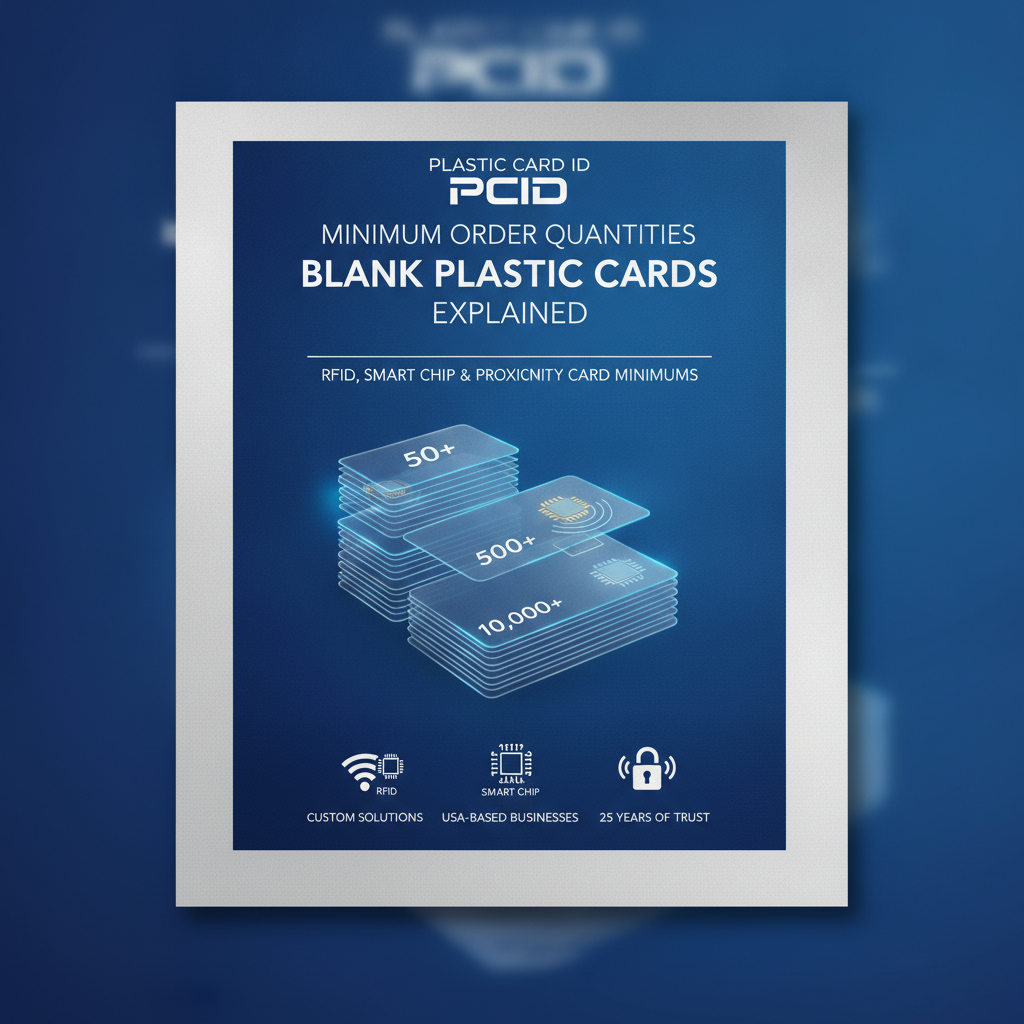 Advanced card technology - RFID, smart chip, proximity - introduces procurement complexity that goes beyond standard blank PVC. These cards carry embedded components that must be compatible with your existing infrastructure. A 125 kHz proximity card will not communicate with a 13.56 MHz reader. MIFARE DESFire cards require specific encoder configurations. Getting the technology match right matters more than getting the price right.
That said, minimum orders for RFID and proximity cards at Plastic Card ID are often lower than customers expect. Starting quantities of 25-50 cards are available for many proximity and contactless card SKUs. This allows system administrators to pilot a new access control configuration before committing to full deployment inventory. Pilot, test, confirm - then scale.
Proximity Cards for Access Control
Proximity cards - operating at 125 kHz using formats like HID, EM4100, or equivalent - are the backbone of physical access control systems in offices, manufacturing facilities, and educational campuses across the United States. Blank proximity cards arrive with a factory-programmed unique ID but no access permissions assigned. Your access control software assigns those permissions when the card is enrolled.
MOQs for proximity cards start at 25-50 cards in our catalog, supporting small office deployments as well as large institutional rollouts. The blank proximity card is a neutral tool - what it unlocks depends entirely on your system configuration, not on anything we ship to you.
RFID Smart Cards and Contactless Technology
RFID smart cards operating at 13.56 MHz - including MIFARE Classic, MIFARE DESFire, and other NFC-compatible formats - serve a broader range of applications than simple access control. They power cashless payment systems in corporate cafeterias, multi-function employee badges, casino player tracking programs, and smart library card systems.
MIFARE DESFire in particular supports multi-application deployment on a single card, meaning one card can serve as an access credential, a stored-value instrument, and a loyalty identifier simultaneously. This multi-function capability is genuinely transformative for organizations running multiple card programs. Minimums on DESFire-capable cards tend to be slightly higher due to component costs, but remain accessible for pilot programs.
Hotel Key Cards and Casino Player Cards
Hotel key cards and casino player cards represent specialized subsets of the magnetic stripe and RFID card categories. Hotel key cards typically use HiCo magnetic stripe technology encoded by the property management system at check-in. Casino player cards often incorporate magnetic stripes, smart chips, or both, depending on the gaming floor management system in use.
- Hotel key cards: Minimum orders typically 100 cards; standard CR80 format; HiCo stripe pre-applied
- Casino player tracking cards: May require custom specification; contact us for program-specific guidance
- Compatibility matters: Always confirm your lock system or gaming system vendor before ordering specialized cards
- Blank stock allows full design control: Print your property branding in-house using your card printer
- Bulk reorder programs available: Properties cycling hundreds of cards monthly benefit from scheduled delivery arrangements
Card Printers, Ribbons, and the Full Ecosystem Behind Your Card Program
A blank plastic card is only as useful as the printer and supplies supporting it. This is why Plastic Card ID carries a full lineup of card printers from three of the industry's leading manufacturers: Evolis, Zebra, and Fargo. Each brand offers models suited to different print volumes, encoding requirements, and budget ranges. Your card printer and your blank card stock must be matched deliberately, not assumed to be interchangeable.
Beyond the printer itself, a functioning card program requires ribbon cartridges, cleaning kits, card holders, sleeves, and often mailing supplies if you distribute cards to remote locations. We carry all of it. One supplier relationship covering your full card program infrastructure is simpler, more reliable, and often more cost-effective than piecing together supply chains from multiple vendors.
Choosing the Right Printer for Your Volume
Card printer selection should align with your projected monthly print volume. Desktop single-sided printers are well-suited for programs printing under 500 cards per month. Dual-sided printers add flexibility for badge programs requiring information on both faces. High-throughput printers with automated feeders and hoppers serve programs printing thousands of cards weekly without manual intervention.
Evolis printers are popular for their compact footprint and reliability in small-to-medium programs. Zebra printers offer robust encoding options and are frequently specified in enterprise environments. Fargo printers excel in ID card programs requiring high security features including laminates and holographic overlays. Each brand has a distinct strength profile - matching the printer to the program is the exercise our team does daily.
Ribbons, Cleaning Kits, and Consumables
Printer ribbons are consumables with their own ordering logic. A full-color YMCKO ribbon typically prints 200-500 cards per ribbon, depending on coverage density. A monochrome black ribbon yields more - often 1,000 or more prints. Ordering ribbons in sync with your card stock orders ensures you never face the scenario of having cards but nothing to print them with.
Cleaning kits extend printer life significantly. Dust, debris, and residue accumulate on printer rollers and print heads over time, degrading print quality and ultimately damaging hardware. A routine cleaning cycle every 1,000 cards or so is a simple maintenance practice that protects a meaningful equipment investment. CPE carries cleaning kits for all printer brands we sell.
Card Carriers, Sleeves, and Mailing Fulfillment
For organizations distributing cards to members, employees, or customers by mail, the physical packaging around the card matters. Card carriers - folded paper inserts that hold the card securely - allow you to add personalized messaging, instructions, or branding to the card delivery package. Card sleeves protect printed surfaces during mailing and handling.
Plastic Card ID also offers card affixing and mailing services for programs that need cards sent directly to recipients without handling every piece in-house. This turnkey fulfillment option is particularly valuable for loyalty and membership programs with large initial distributions or ongoing monthly issuance cycles.
Buyer Tips: Getting the Most From Your Blank Card Order
After 25 years and more than 50 million cards sold, we have seen every ordering mistake possible. None of them are catastrophic, but most are avoidable. The tips below come directly from patterns we observe in customer orders - what works, what complicates things, and what the smartest buyers consistently do differently.
The best card program operators treat blank card inventory like any other critical supply. They know their monthly usage. They know their reorder lead time. They maintain a buffer stock and they do not wait until they are down to their last 20 cards to reorder. These are not sophisticated supply chain practices - they are just habits that prevent operational disruptions.
Five Things Smart Buyers Always Do
- Match card technology to your reader or encoder before ordering - never assume compatibility across brands or frequencies
- Order a test quantity first when launching a new card stock or card type, then scale to volume once performance is confirmed
- Calculate total program cost, not just card cost - factor in ribbons, printer maintenance, and any encoding or mailing overhead
- Store blank cards properly - cool, dry, away from direct sunlight and magnetic fields; improper storage degrades print quality before a card is ever used
- Establish a reorder point based on your usage rate and typical fulfillment time; running out of cards is always avoidable with basic inventory discipline
These five habits separate organizations that run smooth, professional card programs from those that scramble repeatedly. None of them require sophisticated procurement infrastructure - they require only a little planning and the willingness to treat your card supply seriously.
Common Mistakes That Complicate Orders
The most common ordering mistake is confusing card types. Ordering LoCo magnetic stripe cards for a hotel key system that requires HiCo creates immediate operational problems. Ordering standard proximity cards for a system that requires a specific facility code encoding creates the same problem. Specification errors cost more than the cards themselves once you factor in the time spent identifying the mistake and re-ordering.
The second most common mistake is under-ordering for a growing program. A retailer launching a gift card program in three locations might correctly order 300 cards at launch - but if the program takes off and they are scrambling to reorder within six weeks, a slightly larger initial order would have been smarter. Conservative initial orders make sense; dramatically conservative orders that ignore realistic growth projections just create reorder friction.
Working With CPE for Long-Term Program Success
We are not a transactional vendor. The clients who get the most from their relationship with us are the ones who treat us as a program partner - calling to discuss new card types they are considering, asking about compatibility before committing to a printer purchase, looping us in when their card program is evolving. That is the kind of relationship we have built with thousands of organizations over 25 years.
Whether your program runs 50 cards a month or 50,000, our team brings the same level of attention to making it work. Scale does not determine the quality of support you receive from us - your program matters regardless of its size, and we staff accordingly.
Partner With Plastic Card ID for Every Blank Card Program Need
You came here with a question about minimum order quantities. We hope you leave with something more useful: a clear picture of how blank plastic cards actually work, how the economics of ordering scale, and how a reliable supply partner makes your card program run better over time. Plastic Card ID has been that partner for over 100,000 businesses and organizations across the United States - and we are ready to be that partner for yours.
From 50 blank white CR80 cards for a startup loyalty program to tens of thousands of HiCo magnetic stripe cards for a national retail rollout, our catalog and our team are built to serve you. Card printers, ribbons, cleaning kits, RFID smart cards, proximity access cards, clear PVC specialty stock, casino cards, hotel key cards - it is all here, from one source, backed by decades of real-world program experience.
Ready to Start or Expand Your Card Program?
Do not guess at quantities, card types, or technology specifications. Our team answers questions like yours every single day, and we genuinely enjoy helping organizations get their card programs right. A conversation takes five minutes and can save you the cost of a misaligned order.
Call Plastic Card ID today at 800.835.7919 - let us match you with the right blank card solution for your program, your volume, and your budget.
Why Our Customers Come Back
Over 25 years and more than 50 million cards, the reason our customers return is straightforward: we get it right, we are easy to work with, and we carry everything they need in one place. The card program that works smoothly is the one nobody has to think about - and that is exactly what CPE is here to build for you.
Consistency, quality, and real partnership - that is what blank card procurement looks like when it is done right. We look forward to proving it to you on your first order, and on every order after that.
Previous Page