Blank Plastic Card Pricing Guide: What to Expect
Table of Contents []
- Your Complete Blank Plastic Card Pricing Guide from Plastic Card ID
- Blank Card Types and What Each One Costs You More
- Card Printers: How Equipment Investment Shapes Your Total Program Cost
- Value-Added Services That Affect Your Total Card Program Budget
- The Real ROI Case for Blank Plastic Cards
- Buyer Tips: Getting the Most from Your Blank Card Budget
- Start Your Blank Card Program with Plastic Card ID Today
Your Complete Blank Plastic Card Pricing Guide from Plastic Card ID
Pricing a blank plastic card program should not feel like deciphering a foreign language - yet for most buyers, the first quote they receive raises more questions than it answers. What is a CR80? Why does a magnetic stripe add cost? Does quantity actually move the needle on price? These are legitimate questions, and the answers matter because your card program budget hinges on them.
Plastic Card ID has spent over 25 years supplying blank and custom plastic cards to businesses, nonprofits, schools, and organizations of every size across the United States. With more than 50 million cards sold and over 100,000 customers served, the team here has seen every kind of card program - and every kind of pricing confusion. This guide cuts through it cleanly.
Why Card Pricing Is Not One-Size-Fits-All
The moment you move beyond a plain white PVC card, variables start stacking up. Card type, encoding features, quantity tier, turnaround time, and any specialty finish all interact to produce your final per-card cost. Understanding each variable independently is the fastest path to a smarter buying decision.
That said, the base economics are genuinely favorable. Blank plastic cards cost far less per unit than most buyers expect, especially at moderate quantities. A box of 500 standard CR80 cards often lands well under $50 - a number that surprises first-time buyers who have been using costly pre-printed alternatives or outsourced card vendors.
The CR80 Standard: The Foundation of Every Price Discussion
The CR80 format - 3.375 inches by 2.125 inches, 30 mil thick - is the ISO 7810 standard that governs credit cards, driver's licenses, and virtually every professional ID card in circulation. When you buy blank cards for in-house printing or encoding, you are almost certainly buying CR80 cards. This format feeds every major card printer on the market.
Pricing for plain white CR80 PVC cards at Plastic Card ID begins at genuinely competitive entry-level quantities and drops meaningfully as volume increases. The per-card cost at 5,000 units is a fraction of what you pay for 100 units - which is why understanding your monthly volume before ordering is the single most useful thing you can do to optimize your budget.
How Quantity Tiers Drive Your Per-Card Cost
Volume pricing is where the real savings live. Most card suppliers - including CPE - structure pricing in quantity brackets. Common breakpoints land around 100, 250, 500, 1,000, 2,500, 5,000, and 10,000 units. Each step up in quantity drops the per-card price, sometimes dramatically.
Consider: an organization printing employee ID badges might need 200 cards per year. But if the per-1,000 price is 40% lower than the per-200 price, pre-purchasing and storing cards is a legitimate cost strategy. Blank cards store well. They do not expire. A shelf of inventory is a hedge against price increases and a guarantee of operational continuity.
| Quantity | Est. Price Per Card | Est. Total Range | Best For |
|---|---|---|---|
| 100 | $0.18-$0.30 | $18-$30 | Small pilots, testing |
| 500 | $0.10-$0.18 | $50-$90 | Small businesses, starter programs |
| 1,000 | $0.07-$0.12 | $70-$120 | Growing card programs |
| 5,000 | $0.04-$0.08 | $200-$400 | Mid-size organizations, retailers |
| 10,000 | $0.03-$0.06 | $300-$600 | Mass programs, enterprise |
Blank Card Types and What Each One Costs You More
Plain white PVC is the starting point. Everything else - a magnetic stripe, an RFID chip, a colored core, a frosted finish - layers additional cost onto that baseline. The key is knowing which features your program actually requires, because paying for encoding technology you will never use is a common and entirely avoidable budget leak.
The catalog at Plastic Card ID is deliberately broad. From plain CR80 white to MIFARE DESFire smart cards, from frosted clear PVC to luxury stainless steel metal cards, the range exists because different programs have genuinely different needs. Matching card type to program purpose is the single biggest pricing lever most buyers never pull.
Magnetic Stripe Cards: HiCo vs. LoCo and What You Pay for the Difference
Magnetic stripe cards come in two coercivity grades: High Coercivity (HiCo) and Low Coercivity (LoCo). HiCo stripes are harder to accidentally erase - they resist interference from everyday magnetic sources like purse clasps and phone cases. LoCo stripes are more economical and sufficient for short-term use cases like event access or temporary credentials.
In terms of pricing, magnetic stripe cards typically run $0.05-$0.15 more per card than plain PVC at equivalent quantities. That delta is modest, and for most loyalty, membership, or gift card programs, HiCo magnetic stripe is the professional standard worth the marginal investment. You get reliable swipe reads, longer card life, and compatibility with virtually all standard card readers.
RFID, Proximity, and Smart Chip Cards: Premium Technology, Purposeful Pricing
Contactless cards - proximity cards, standard RFID, and smart chip cards including MIFARE DESFire - occupy the premium tier of blank card pricing. The technology embedded in the card (an antenna coil, a chip, or both) drives cost upward, often significantly. A standard 125kHz proximity access card may run $0.50-$2.00 per card at moderate quantities. MIFARE DESFire smart cards can exceed that depending on chip configuration and order volume.
These cards are standard in commercial access control, hotel key systems, casino player tracking, and secure employee ID programs. If your application requires contactless authentication or encrypted data storage, the premium is not optional - it is the product. CPE supplies these across a broad volume range, and pricing scales favorably at higher quantities just as it does with standard PVC.
Specialty Cards: Clear, Frosted, Colored, and Metal
Clear and frosted PVC cards command a modest premium over standard white stock - typically in the range of 20-50% more per card at equivalent quantities. They are popular for membership cards, VIP credentials, and any application where the visual impression of the card itself carries weight. Colored PVC stock (black, gold, silver, and custom colors) occupies a similar premium bracket.
At the top of the specialty tier sit luxury metal cards in stainless steel, brass, and gold. These are not everyday volume items - they are prestige pieces for executive memberships, high-value loyalty programs, and premium brand experiences. Pricing for metal cards reflects both material cost and production complexity, typically ranging from several dollars to $20 or more per card depending on material, finish, and quantity. Contact Plastic Card ID directly for metal card quotes at 800.835.7919.
Card Printers: How Equipment Investment Shapes Your Total Program Cost
Buying blank cards is only part of the equation for organizations that print in-house. The card printer you choose determines your print quality ceiling, your ribbon cost structure, and your long-term maintenance overhead. Getting this decision right at the start saves significant money over the life of a card program.
Plastic Card ID carries a curated selection of card printers from three of the industry's most respected manufacturers: Evolis, Zebra, and Fargo. Each brand has a distinct market position, and choosing between them is genuinely consequential for your total cost of ownership.
Entry-Level Printers: Right for Small Programs, Wrong for Scale
Entry-level card printers from Evolis and Fargo typically range from $300-$800. They print single-sided cards at moderate speed and are entirely appropriate for organizations printing 50-500 cards per month. Think small retailers issuing loyalty cards, nonprofits printing member IDs, or schools creating student credentials. The per-card print cost at this level runs roughly $0.30-$0.60 including ribbon depreciation.
The caution here is scale. Entry-level printers are not designed for continuous high-volume runs. If your program is growing, buying up in printer tier from the start is almost always cheaper than replacing equipment 18 months later. CPE can help you model the break-even point between entry-level and mid-tier printers based on your projected monthly volume.
Mid-Range and Professional Printers: The Sweet Spot for Most Organizations
Mid-range card printers - typically $800-$2,500 - from Zebra and Evolis cover the vast majority of serious card programs. Dual-sided printing, faster throughput, lamination modules, and encoding capabilities (magnetic stripe, smart card, RFID) are available at this tier. Organizations printing 500-5,000 cards per month find that mid-range printers deliver the best balance of capability and cost.
Zebra's ZC series and Evolis' Primacy and Zenius lines are workhorses in this category. They are built for reliability, have strong ribbon and supply ecosystems, and carry manufacturer support networks that protect your investment. A well-maintained mid-range printer can run for years without significant service costs - and Plastic Card ID carries the ribbons, cleaning kits, and consumables to keep yours running optimally.
Ribbons, Cleaning Kits, and Consumables: The Hidden Cost Line
Printer ribbons are a recurring cost that many buyers underestimate when budgeting a card program. A full-color YMCKO ribbon yields approximately 200-500 prints depending on printer model and image coverage. At $40-$80 per ribbon, that translates to $0.10-$0.40 per card in ribbon cost alone - a number that must be factored into your total per-card economics.
Cleaning kits are a smaller but important line item. Regular cleaning cycles extend printer head life measurably, and a neglected print head is an expensive replacement. Plastic Card ID supplies brand-matched cleaning kits for all supported printer lines. Factoring consumables into your annual card program budget from day one prevents unpleasant mid-year surprises.
Value-Added Services That Affect Your Total Card Program Budget
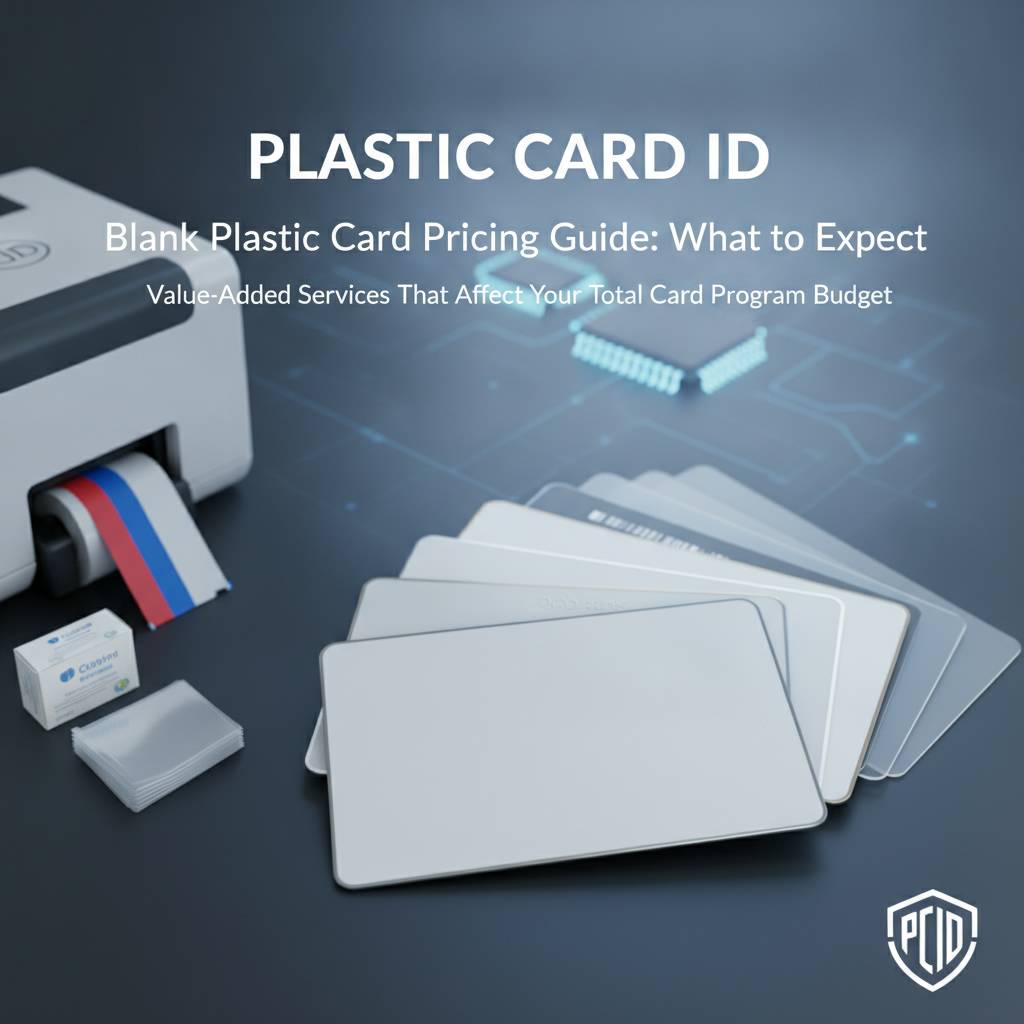 Beyond cards and printers, the true cost of a card program often includes services that organizations forget to price until they are already in motion. Card carriers, protective sleeves, and mailing fulfillment are not afterthoughts - they are operational requirements for programs that distribute cards to cardholders at scale.
Plastic Card ID operates as a genuine one-stop shop for card programs, and that scope has real dollar-value implications for buyers. Consolidating your card stock, printers, ribbons, carriers, and mailing services under one vendor eliminates coordination overhead, reduces shipping costs, and simplifies the procurement process considerably.
Card Carriers and Sleeves: Small Cost, Big Impact on Perceived Value
A plastic card inserted into a well-designed card carrier communicates professionalism before the recipient ever looks at the card itself. Card carriers range from simple paper sleeves to branded folded carriers with custom messaging. At volume, carrier costs are modest - often $0.05-$0.20 per unit - but their effect on recipient perception is disproportionately large.
Protective card sleeves serve a different function: they extend card life by shielding the surface from scratches and dirt during everyday carry. For loyalty cards, membership cards, and gift cards that live in wallets, sleeve protection translates directly into fewer reprints and lower ongoing card replacement costs. A $0.03 sleeve that doubles a card's useful life is one of the best ROI line items in any card budget.
Card Affixing and Mailing Services
For programs that mail cards to members, customers, or employees, CPE offers card affixing and mailing services that eliminate the need for in-house fulfillment infrastructure. Cards can be affixed to carriers, inserted into envelopes, and mailed directly to recipients - a service that is worth pricing carefully against the cost of doing it yourself.
At scale, outsourced card mailing makes economic sense more often than buyers expect. When you factor in staff time, postage management, and the logistics of maintaining accurate mailing lists, the per-card cost of outsourced fulfillment often rivals or beats in-house operations. Contact Plastic Card ID at 800.835.7919 to discuss mailing volume and get a program-specific estimate.
The Real ROI Case for Blank Plastic Cards
Pricing a blank card program in isolation - without considering what the program generates in return - is the wrong frame. The better question is not "how much do these cards cost?" but "what revenue or efficiency does this card program produce?" The answer, across dozens of documented use cases, is compelling.
Retailers who switch from paper gift certificates to plastic gift cards routinely report sales increases of 35-50%. Loyalty programs built on plastic cards that live in wallets outperform paper punch cards on virtually every metric - redemption rate, repeat visit frequency, and average transaction value. Membership and ID programs that use plastic signal permanence and legitimacy that paper simply cannot replicate.
Gift Card Programs: The Clearest ROI in Retail
For retail businesses, a gift card program is one of the highest-return investments available. Plastic gift cards are displayed at checkout, sold online, and given as gifts - each one is a pre-paid store visit plus a potential new customer acquisition. The card itself, costing pennies, generates transactions that can be multiples of its face value over its lifetime through breakage, overspending, and repeat visits.
Getting started does not require a massive initial investment. A starter gift card program using blank HiCo magnetic stripe cards, an entry-level printer, and a compatible point-of-sale system can be operational for well under $1,000 in setup cost. The payback period on a well-run retail gift card program is typically measured in weeks, not years.
Loyalty and Membership Programs: Long-Term Value Per Card
A loyalty card that lives in a customer's wallet is a recurring marketing touchpoint that costs nothing after the initial card issuance. Every time a customer opens their wallet, your brand is present. Every swipe reinforces the relationship. The per-card cost - even for a HiCo magnetic stripe card at small quantities - is negligible against the lifetime value of a returning customer.
Membership programs at gyms, associations, clubs, and professional organizations benefit from plastic cards for a different but equally tangible reason: a plastic member card signals that the organization takes itself seriously. Applicants and new members who receive a plastic credential perceive greater value in their membership than those who receive paper equivalents. That perception influences renewal rates, referral behavior, and overall program stickiness.
Access Control and Employee ID Cards: Efficiency and Security Value
Proximity and RFID access cards replace key-based building access with a system that is faster, more auditable, and more controllable. Lost cards are deactivated digitally. Access levels can be updated without physical key exchange. The administrative efficiency alone - particularly in organizations with frequent staff turnover - justifies the higher per-card cost of proximity technology within the first operational year.
Employee ID cards, even plain printed CR80 cards, carry compliance and liability value that is difficult to quantify but very real. In regulated industries, visitor management and staff identification are not optional. Blank CR80 cards printed in-house give organizations full control over credential design, encoding, and issuance timing - advantages that outsourced card programs rarely match on cost or speed.
Buyer Tips: Getting the Most from Your Blank Card Budget
Twenty-five years of supplying card programs has given Plastic Card ID a clear view of where buyers waste money and where smart purchasing decisions pay dividends. The tips below are distilled from patterns observed across thousands of customer programs, from small nonprofits to large retail chains.
Five Smart Moves Before You Place Your First Card Order
- Calculate your 12-month volume before ordering: Even a rough estimate of annual card need helps you identify the right quantity tier and potentially pre-purchase at a lower per-card price.
- Do not over-specify your card technology: A plain white PVC card is perfectly capable of serving as an employee ID, loyalty card, or event credential when printed correctly. Pay for encoding only when your system actually requires it.
- Match your printer to your volume ceiling, not your current volume: Buying up in printer capability now is almost always cheaper than replacing equipment 18 months into a growing program.
- Budget for consumables from day one: Ribbons, cleaning kits, and card carriers are recurring costs that belong in your card program budget, not in the surprise expense column.
- Test before you scale: Order a sample quantity of any specialty card (clear, frosted, RFID, metal) before committing to a large run. Verify compatibility with your printer and reader hardware before the bulk purchase.
Common Pricing Mistakes and How to Avoid Them
The most common pricing mistake in blank card programs is optimizing for the lowest per-card price without considering total program cost. A cheap card that requires expensive ribbon to print properly, or that wears out quickly and requires frequent replacement, is rarely the bargain it appears to be. Total cost of ownership - not sticker price - is the right metric.
A second common error is purchasing card printers based on upfront price alone. Ribbon yield, print speed, encoding capability, and manufacturer support infrastructure all affect the real cost of printing over a printer's lifespan. CPE sales staff are equipped to walk through total cost of ownership calculations for any printer in the catalog - a conversation that reliably saves buyers money over the long run.
When to Call Instead of Ordering Online
For standard blank CR80 cards in common quantities, online ordering is efficient and fast. But for specialty cards - MIFARE DESFire, metal cards, custom die-cut shapes, casino player cards, hotel key systems - a direct conversation produces better outcomes. Program-specific requirements, system compatibility questions, and large-volume pricing are all better addressed by a knowledgeable human than by a product page.
The team at Plastic Card ID is reachable at 800.835.7919 and has the experience to help you configure a card program that fits your budget, your technology stack, and your operational requirements without unnecessary upsells or feature padding. Every card program is different, and the best pricing guidance comes from a conversation, not a catalog.
Start Your Blank Card Program with Plastic Card ID Today
Whether you are launching a new loyalty program, upgrading your access control credentials, setting up an in-house employee ID system, or scaling a gift card operation across multiple retail locations, Plastic Card ID has the inventory, expertise, and service infrastructure to make it work. The right blank card, at the right price, in the right quantity is a call or click away.
From a single box of 500 plain white CR80 cards to a multi-thousand-unit order of MIFARE DESFire smart cards with full mailing fulfillment, the scale of your program is not a limitation here - it is simply a variable to optimize around. Over 100,000 customers across the United States have trusted CPE to supply their card programs with consistency, reliability, and competitive pricing. Your program is next.
Call Plastic Card ID now at 800.835.7919 to speak with a card program specialist, request a custom quote, or get expert guidance on building a blank card program that fits your budget and scales with your growth.
Previous Page