Blank Smart Chip Cards Overview: Types Applications
Table of Contents []
- Blank Smart Chip Cards: Everything Plastic Card ID Wants You to Know Before You Buy
- What Exactly Is a Blank Smart Chip Card?
- MIFARE Technology: The Platform Behind Most Contactless Programs
- Applications Where Blank Smart Chip Cards Deliver Real Results
- Choosing the Right Card Printer for Smart Chip Personalization
- Building a Smart Card Program: Practical Buyer Guidance
- Why Businesses Across the USA Trust Plastic Card ID
Blank Smart Chip Cards: Everything Plastic Card ID Wants You to Know Before You Buy
There is something quietly powerful about a smart chip card. It sits in your wallet, no thicker than a standard credit card, yet packed with processing capability that can authenticate identities, control access to secure areas, store loyalty points, and communicate wirelessly - all without a battery. If your organization is exploring blank smart chip cards for the first time, or scaling an existing program, the decisions you make upfront will shape years of operational performance.
This guide breaks down everything relevant to blank smart chip cards: what they are, how the technologies differ, which applications they serve best, and how to build a card program that scales with your business. Whether you are issuing 100 cards a month or printing tens of thousands, understanding your options means spending smarter and building better.
| Card Type | Interface | Common Use | Read Range |
|---|---|---|---|
| Contact Smart Card (ISO 7816) | Physical contact | Logical access, government ID | Direct insertion |
| Contactless Smart Card (ISO 14443) | RFID / NFC | Access control, transit, events | 0-10 cm |
| MIFARE Classic | Contactless RFID | Loyalty, membership, hotel keys | 0-10 cm |
| MIFARE DESFire EV2/EV3 | Contactless RFID | High-security access, casino, transit | 0-10 cm |
| Dual Interface | Contact Contactless | Enterprise ID, secure facilities | Direct 0-10 cm |
What Exactly Is a Blank Smart Chip Card?
A blank smart chip card is a standard CR80 PVC card - the same dimensions as a driver's license, following ISO 7810 specifications at 3.375 x 2.125 inches and 30 mil thickness - with an embedded integrated circuit. That chip can store and process data, execute cryptographic algorithms, and communicate with reader hardware either through direct contact or via radio frequency. The card arrives unprinted, giving organizations full control over how it looks once personalized in-house or through a bureau.
The "blank" designation is critically important for buyers. It means the card ships without any custom graphics, organization name, or encoded data. Your team, or your card printer, handles personalization after purchase. This model dramatically reduces per-card costs compared to fully custom-printed orders, and it gives organizations the agility to print on demand rather than ordering massive batches with artwork locked in.
The Chip Inside: Contact vs. Contactless Technology
Contact smart cards use a gold-plated pad on the card surface - that small metallic square you see on chip-based cards. When inserted into a reader, electrical contacts connect the chip directly to the terminal. This interface is robust, reliable, and used extensively in logical access control and secure credentialing where the physical insertion step adds a layer of deliberate authentication.
Contactless smart cards embed an antenna loop within the card body that communicates with readers via radio frequency, typically at 13.56 MHz. Tap the card within range of a reader and the transaction completes in milliseconds. No swiping, no inserting, no fumbling - which is why contactless cards dominate high-throughput environments like building access, transit, and event credentialing. Most modern deployments favor contactless or dual-interface cards for exactly this reason.
Memory, Processing, and What the Chip Actually Does
The chip in a smart card is not a passive memory chip like those found in basic RFID key fobs. It contains a microprocessor, RAM, ROM, and EEPROM - a full computing environment capable of running applications. This allows the card to execute commands, enforce access rules, and perform cryptographic operations entirely on-card, without relying solely on the reader or backend system to handle security logic.
Memory capacity varies by product. Entry-level chips may offer 1KB-4KB of user memory, sufficient for simple loyalty point storage or basic access credentials. Advanced chips like MIFARE DESFire EV2 offer 2KB-8KB of organized memory structured into applications and files - a model that lets a single card serve multiple programs simultaneously. A university might run student ID, library access, dining credits, and parking validation all on one card with logically separated memory sectors.
Standards That Govern Smart Card Compatibility
Interoperability depends on standards, and the smart card world has several you should recognize. ISO 7816 governs contact smart cards - defining the physical characteristics, electrical interface, and communication protocol. ISO 14443 defines contactless smart cards operating at 13.56 MHz, and most modern access control and NFC systems operate within this standard. ISO 15693 covers a slower, longer-range contactless variant used in asset tracking and library systems.
When sourcing blank smart chip cards, confirming standard compliance ensures the cards will work with your existing reader infrastructure. CPE stocks cards compliant with the major standards, so compatibility conversations with your access control vendor or card management software provider can proceed with confidence. Buying outside established standards is how card programs get stranded - incompatible cards, frustrated users, expensive retrofits.
MIFARE Technology: The Platform Behind Most Contactless Programs
If you have tapped a card to enter an office building, board a transit system, or check into a hotel room, there is a reasonable chance that card was built on MIFARE technology. Developed by NXP Semiconductors and widely adopted globally, MIFARE represents a family of contactless smart card chips that now spans multiple generations and security tiers. Understanding where each tier fits helps organizations choose correctly rather than over-specifying or under-protecting their programs.
The MIFARE ecosystem ranges from the basic Ultralight chip - used in disposable tickets and wristbands - up through MIFARE Classic for mid-tier loyalty and access, and ultimately to MIFARE DESFire for enterprise-grade secure applications. Each step up the ladder brings stronger cryptography, more flexible memory architecture, and better resistance to cloning attacks. Choosing the right MIFARE tier is not about spending more - it is about matching security requirements to real risks.
MIFARE Classic: Reliable Workhorse for Mid-Tier Programs
MIFARE Classic cards use a proprietary encryption scheme and sector-based memory organization. Available in 1KB and 4KB variants, they have been deployed in hundreds of millions of cards worldwide and remain a practical choice for loyalty programs, membership clubs, and lower-security access control where the threat model does not require advanced cryptography. Most existing MIFARE Classic reader infrastructure will accept these cards without modification.
That said, organizations should be aware that MIFARE Classic encryption has been publicly analyzed and documented weaknesses exist. For applications where card cloning represents a meaningful threat - secure facilities, casino player cards, healthcare - stepping up to DESFire is the responsible choice. For a gym membership or retail loyalty program, Classic remains cost-effective and operationally solid.
MIFARE DESFire: Advanced Security for Demanding Applications
MIFARE DESFire EV2 and EV3 cards represent the current high-water mark for contactless smart card security in commercial deployments. They use AES-128 encryption, mutual authentication protocols, and a flexible application directory structure that allows multiple independent applications to coexist on one card. This is the architecture that casinos, hospitals, universities, and government facilities reach for when they need assurance that their access credentials cannot be easily duplicated.
DESFire EV3 adds further improvements including transaction timers, proximity checks, and enhanced anti-cloning protections. For organizations building long-term card programs where security is a genuine operational requirement, these cards deliver the protection that justifies the incremental cost over Classic-tier products. CPE carries DESFire-compatible blank cards ready for encoding and personalization through compatible card printers and encoding stations.
Dual Interface Cards: One Card, Two Worlds
Dual interface cards combine a contact chip (ISO 7816) and a contactless antenna (ISO 14443) in a single card body. They let the same credential work across contact card readers - common in IT logical access control scenarios - and contactless readers for physical door access. Enterprise environments increasingly mandate this format so that one employee badge handles every authentication scenario without requiring separate credentials.
The engineering involved in fitting both interfaces into a 30 mil card body is non-trivial, which is reflected in higher unit costs relative to single-interface cards. However, for organizations replacing multiple card credentials with a single converged badge, the operational simplicity and user experience gains are significant. Contact 800.835.7919 to discuss dual interface options that fit your infrastructure requirements.
Applications Where Blank Smart Chip Cards Deliver Real Results
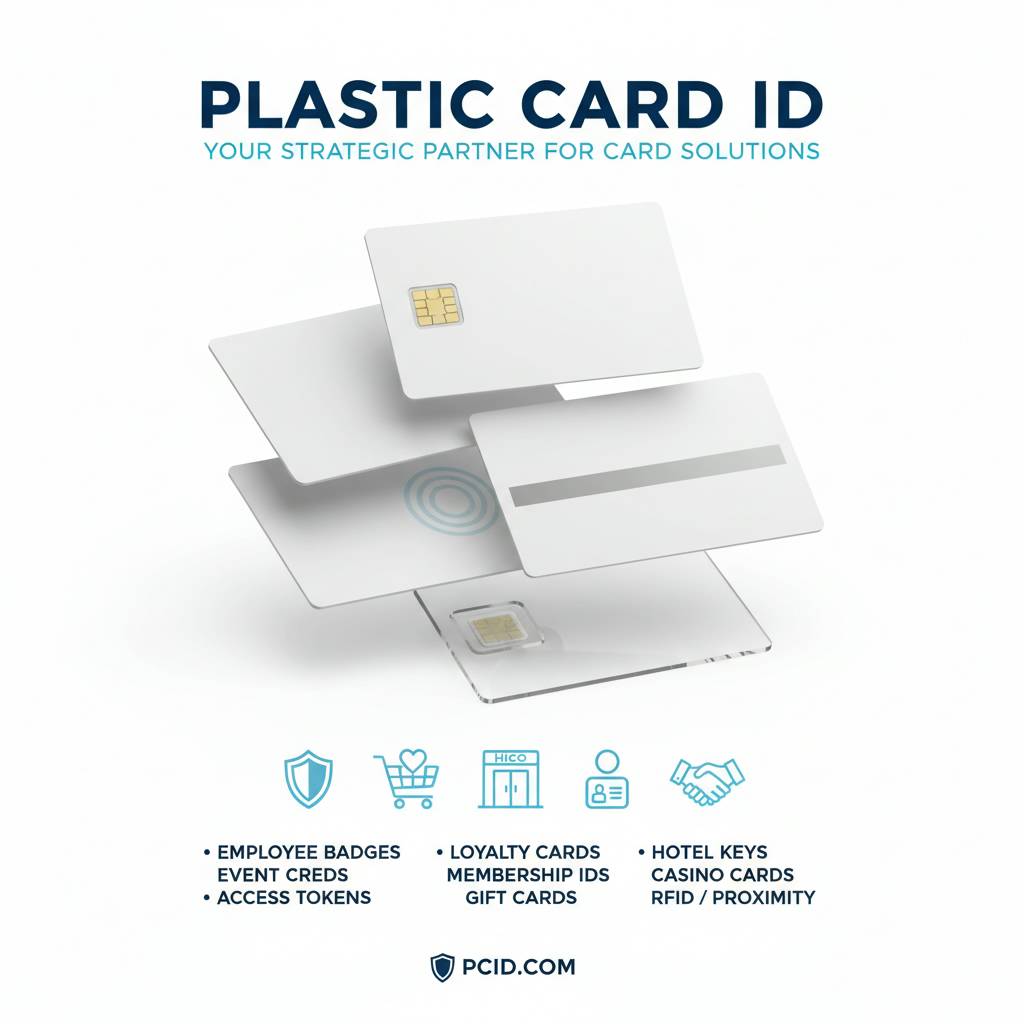 The versatility of smart chip card technology means a single product line can serve radically different organizational needs. What changes is how the card is encoded, what software manages the backend, and what readers are deployed. The blank card itself - standardized, stackable, ready for your personalization workflow - is the constant. Here is where smart chip cards earn their place in serious card programs.
Access Control and Physical Security
Smart chip cards have largely displaced proximity cards (125 kHz) in new access control installations because they offer substantially stronger security. Where a basic prox card broadcasts a fixed ID number that any capable reader can capture, a smart card engages in a cryptographic handshake that verifies both the card's authenticity and the reader's authorization. This mutual authentication means a cloned card number alone is not enough to gain entry.
Organizations managing employee access across multiple facilities, sensitive data areas, or after-hours zones benefit immediately from the granular control that smart card-based access systems enable. Access rules can be updated in the backend software without physically retrieving or replacing cards - a meaningful operational advantage when staff roles change frequently. Physical security that keeps pace with organizational change is exactly what smart chip access programs deliver.
- Assign access rights by department, clearance level, or time window
- Audit entry and exit events with timestamped logs
- Remotely revoke access the moment an employee leaves the organization
- Integrate with HR systems for automated credential management
- Issue visitor credentials that expire automatically after defined periods
Loyalty and Membership Programs
Plastic loyalty cards sitting in a customer's wallet outperform paper punch cards in every measurable dimension - retention rates, redemption frequency, and average transaction value. Smart chip loyalty cards go a step further by enabling secure, tamper-resistant point storage and multi-application functionality. A retailer could encode loyalty balance, membership tier, and a stored value function all on a single card without exposing that data to manipulation.
Membership organizations - fitness clubs, professional associations, warehouse clubs, museums - find smart chip cards particularly compelling for their ability to carry verifiable member data that cannot be altered by the cardholder. Membership status, expiration dates, and access entitlements encoded into secure chip memory present at reader interactions rather than relying solely on visual inspection of printed card data.
Casino Player Cards and Hospitality Applications
Casino player card programs are among the most demanding smart card applications in commercial use. They require cards that can withstand high-frequency use, resist cloning, carry encoded player account identifiers, and integrate with sophisticated player tracking and rewards systems. MIFARE DESFire-based blank cards provide the security foundation, while in-house personalization through card printers delivers the custom-branded appearance casinos require.
Hotel key card programs represent another high-volume hospitality application. Blank contactless smart cards encoded at check-in to activate specific rooms and amenity access are now standard in mid-range to luxury properties. The blank card model gives hotel operators the flexibility to print their own branding in-house while keeping inventory simple - one SKU of blank cards serves every room type.
Choosing the Right Card Printer for Smart Chip Personalization
A blank smart chip card requires a card printer capable of encoding the chip in addition to printing graphics. Not all card printers include encoding capability - single-sided dye-sublimation printers handle print only, while models equipped with smart card encoding modules can write data to the chip during the same print pass. Matching printer capability to card type is essential before purchasing either product.
CPE carries card printers from Evolis, Zebra, and Fargo - three manufacturers that collectively cover the full range of deployment scales, from desktop single-card issuance to high-volume production printing. Each brand offers models with optional or integrated smart card encoding modules for both contact and contactless interfaces. Pairing the right printer with the right blank smart chip card eliminates compatibility friction from day one.
Evolis Printers for Smart Card Programs
Evolis printers are known for compact footprints, intuitive operation, and strong software integration. Models like the Primacy 2 and Zenius support optional encoding modules for MIFARE and other smart card technologies. For organizations issuing cards at the desk - HR onboarding, membership enrollment, event registration - Evolis desktop printers handle the workflow efficiently without requiring dedicated IT infrastructure.
The Evolis Premium Suite software provides a user-friendly design environment for card templates and manages encoding parameters through a single interface. Print and encode in one pass, hand the card to the cardholder, and move on - that is the operational rhythm Evolis printers are built for. Ribbon costs, cleaning kit schedules, and consumable management are straightforward, keeping total cost of ownership predictable.
Zebra and Fargo for Higher-Volume Deployments
Zebra and Fargo (now part of HID Global) printers are the workhorses of enterprise and institutional card programs. Zebra's ZC and ZXP series handle retransfer printing for edge-to-edge coverage and vibrant color, with encoding modules available for both contact and contactless smart cards. Fargo's HDP series uses a similar retransfer process favored in government ID and high-security credentialing programs.
For organizations printing hundreds or thousands of cards per month, these platforms offer lamination modules for added card durability, dual-sided printing in a single pass, and batch-processing capability that integrates with enterprise identity management systems. The investment in a higher-capacity printer is recovered quickly when card volumes justify it - and CPE can help you model that break-even point before you commit.
Ribbons, Cleaning Kits, and Keeping Printers Running
Card printers are precision instruments and their performance is directly tied to consumable quality and maintenance discipline. Using off-brand ribbons in an Evolis or Zebra printer can cause print defects, head damage, and voided warranties. CPE supplies OEM-matched ribbons for every printer brand in the catalog, ensuring color consistency and mechanical compatibility print after print.
Cleaning kits - typically consisting of cleaning cards and swabs impregnated with isopropyl alcohol - should be run on a schedule aligned with the printer manufacturer's recommendations, typically every 1,000-2,500 cards printed. Skipping cleaning cycles is the single most common cause of premature printhead failure, which is an expensive and avoidable cost. Stocking cleaning kits alongside ribbons keeps programs running without unplanned downtime.
Building a Smart Card Program: Practical Buyer Guidance
Organizations approaching their first smart card program often underestimate the planning required before the first card is ordered. The card itself is just one component - readers, software, network infrastructure, encoding workflows, and staff training all factor into a successful deployment. Thinking through these dependencies before ordering blank smart chip cards saves considerable rework cost later.
Conversely, organizations that have run proximity card or magnetic stripe card programs and are upgrading to smart cards have most of the infrastructure fundamentals already in place. The transition is largely about replacing readers, updating software, and swapping card stock. Upgrades from legacy card technology to smart chip are rarely as disruptive as they initially appear - especially with the right supplier supporting the transition.
Frequently Asked Questions About Blank Smart Chip Cards
Buyers consistently arrive with the same practical questions, and answering them clearly accelerates decision-making. Below are the questions that come up most often when organizations are evaluating blank smart chip card purchases.
- Can I print on a blank smart chip card with any card printer? You can print on smart chip cards with any dye-sublimation card printer, but encoding the chip requires a printer with the appropriate encoding module.
- What is the minimum order quantity for blank smart chip cards? Programs can start small - quantities as low as 50 cards are available, making pilot programs and small-scale deployments practical without large upfront commitments.
- Will smart chip cards work with my existing readers? Compatibility depends on the reader's frequency and protocol support. MIFARE-based cards require readers that support 13.56 MHz ISO 14443 communication. Confirming reader specifications before ordering cards is strongly recommended.
- How durable are blank smart chip cards? Standard CR80 PVC smart chip cards are designed for years of daily use. The chip and antenna are laminated within the card body, protected from everyday handling wear.
- Can the chip on a blank smart chip card be re-encoded? Most smart card chips support re-encoding within their defined memory structure, allowing credentials to be updated without issuing new physical cards, depending on the application architecture.
Card Carriers, Sleeves, and Mailing Services
The moment a smart chip card leaves your facility and enters a cardholder's hands, its physical protection becomes your brand's responsibility. Card carriers - folded paper holders that accompany cards in mailings - protect the card surface and provide a vehicle for welcome messaging, activation instructions, or program terms. CPE supplies card carriers designed to fit standard envelope formats and complement card issuance workflows.
Card sleeves provide ongoing protection against scratches, static, and wallet-to-card contact that can, over time, degrade print quality and antenna function. For organizations issuing high-value or high-security smart chip cards, supplying sleeves alongside the card communicates care and professionalism. The marginal cost per sleeve is negligible relative to the impression it creates with new cardholders. To discuss card carriers, sleeves, and affixing and mailing services, call 800.835.7919.
Scaling From Pilot to Production
Most successful card programs begin as pilots - a limited deployment to test reader compatibility, enrollment workflow, and cardholder experience before committing to large inventory. Blank smart chip cards purchased in smaller quantities for a pilot can be sourced from the same product line used for full-scale production, ensuring that lessons learned in the pilot translate directly to the scaled program without requalification.
As programs grow, per-card pricing typically improves at volume thresholds, and the printer infrastructure investment becomes easier to justify. Organizations that start with desktop Evolis printers for 100 cards per month often find themselves adding higher-capacity Zebra or Fargo systems once monthly volumes cross into the thousands. Planning for growth from the beginning means choosing card stock and printer platforms that scale rather than ones that require replacement as the program matures.
Why Businesses Across the USA Trust Plastic Card ID
Over 100,000 customers and 50 million cards sold is not a statistic that accumulates from transactional one-time orders - it reflects relationships built over 25 years of consistently delivering what organizations actually need, when they need it, at prices that make card programs economically viable. CPE operates as a strategic partner in the card programs of retailers, healthcare organizations, universities, casinos, hotels, corporate campuses, and membership clubs across all 50 states.
The catalog depth matters too. Blank smart chip cards sit alongside blank PVC cards, magnetic stripe cards in HiCo and LoCo configurations, proximity cards, clear and frosted specialty cards, colored PVC stock, luxury metal cards in stainless steel, brass, and gold, and a complete lineup of card printers, ribbons, and accessories. Everything a card program needs, from a single supplier that understands card programs end-to-end - that is the operational advantage of working with CPE.
A Catalog Built for Every Program Scale
Small organizations running 50-card-per-month programs need accessible entry points - low minimum orders, clear product specifications, and reliable delivery. Large organizations running tens of thousands of cards per month need pricing that reflects volume, consistent product quality lot to lot, and a supplier relationship that can accommodate urgent orders when program demands spike. CPE serves both ends of that spectrum without treating smaller buyers as afterthoughts.
The same blank smart chip card that a 20-person professional services firm uses for employee access control is available to a 5,000-employee corporate campus ordering in bulk. Product consistency across order sizes means organizations can scale their programs without requalifying card stock at every volume tier. That kind of catalog reliability is only possible with the supply chain depth that comes from 25 years in the industry.
Metal Cards, Specialty Formats, and Beyond
Not every card program calls for standard PVC. Luxury brands, premium membership clubs, VIP programs, and organizations making deliberate brand statements increasingly reach for metal cards - stainless steel, brass, or gold - that communicate exclusivity through tactile experience. CPE supplies metal card options alongside the full PVC catalog, serving programs where the card itself is as much a brand artifact as a functional credential.
Specialty formats including clear plastic cards, frosted cards, and custom die-cut shapes round out the options for organizations where visual differentiation is part of the program strategy. A clear card with a smart chip embedded creates a striking visual effect that standard white PVC cannot replicate. When the card needs to make an impression before it is even scanned, specialty formats deliver that moment.
Getting Started Is Easier Than You Think
Many organizations delay smart card program implementation because the technology feels complex. In practice, a well-supported deployment breaks down into manageable steps: confirm reader compatibility, select the appropriate blank smart chip card, choose or upgrade a card printer with encoding capability, configure encoding parameters in card management software, and begin issuing. CPE supports buyers through each step - not just the card purchase.
Whether you are replacing an aging proximity card system, launching a new loyalty program, building out a casino player card infrastructure, or issuing employee badges for the first time, the path forward starts with a conversation. Expert guidance, a comprehensive catalog, and 25 years of card program knowledge are available to you right now.
Ready to get your smart chip card program off the ground? Call Plastic Card ID today at 800.835.7919 - your partner in building card programs that work, scale, and last.
Previous Page