Blank Plastic Cards for Employee ID Badges: What You Need
Table of Contents []
- Blank Plastic Cards for Employee ID Badges - Plastic Card ID
- Why Blank CR80 Cards Are the Workhorse of In-House ID Programs
- Magnetic Stripe Cards for Employee Badges That Do More
- RFID and Proximity Cards for Contactless Access Control
- Card Printers That Complete the In-House Employee Badge Program
- Card Carriers, Sleeves, and Accessories That Complete the Badge Solution
- Frequently Asked Questions About Blank Plastic Cards for Employee ID Badges
- Partner With Plastic Card ID for Your Employee ID Badge Card Program
Blank Plastic Cards for Employee ID Badges - Plastic Card ID
Walk into almost any professional office, hospital, school, or warehouse and you will notice something consistent: employees wearing plastic ID badges. Not paper tags in plastic sleeves, not hand-written name cards - actual printed, durable plastic cards that communicate authority, identity, and belonging. Getting that program right starts with one deceptively simple decision: choosing the right blank plastic cards for employee ID badges.
Plastic Card ID has spent over 25 years supplying blank and custom plastic cards to businesses across the United States, serving more than 100,000 customers and shipping over 50 million cards. That kind of track record does not happen by accident. It happens because organizations trust us to deliver consistent, print-ready card stock that performs flawlessly with the printers and encoding equipment they already own - or equipment we help them select.
| Card Type | Best Use Case | Encoding Option | Notable Feature |
|---|---|---|---|
| Blank CR80 PVC (White) | Standard employee ID | None (print only) | Full print-surface coverage |
| HiCo Magnetic Stripe | Access ID combined | Magnetic stripe data | High coercivity, durable data |
| Proximity / RFID | Contactless access control | RFID chip antenna | Tap-to-enter convenience |
| Smart Chip Cards | Secure multi-function ID | Contact or contactless chip | Advanced data storage |
| Clear / Frosted PVC | Premium badge aesthetics | Print only or encoded | Distinctive visual identity |
Why Blank CR80 Cards Are the Workhorse of In-House ID Programs
The CR80 standard - 3.375 inches by 2.125 inches, 30 mil thick - is the globally recognized credit-card size that fits perfectly in wallets, badge holders, lanyards, and card printers. Every major printer manufacturer designs around it. Every badge accessory is built for it. When you choose blank CR80 PVC cards, you are choosing a format that is essentially universal, which matters enormously when you are running a program at scale.
Blank cards give organizations total design control. Want to update the badge layout next year without sitting on 10,000 pre-printed cards you cannot use? Print on demand. Need to add a new department color code? Reload the design software and print. The flexibility is a genuine operational advantage that pre-printed cards simply cannot offer at the same per-unit economics.
The CR80 Format: What the Numbers Actually Mean
Thirty mil refers to the card's thickness - 0.030 inches - which is the ISO 7810 ID-1 standard. This is the same thickness as a bank card, which is not coincidental. It is the thickness that card printers, encoding heads, and laminating modules are calibrated for. Deviating from this spec causes jams, misprints, and encoding errors that cost time and money.
White PVC offers a clean, neutral printing surface that allows color fidelity to remain accurate across full-bleed designs, photo IDs, and barcode fields. Color accuracy matters on an employee ID badge - a muddy photo or an unreadable barcode is a credibility problem and a functional failure at the same time.
Print-On-Demand vs. Pre-Printed: A Cost Reality Check
Many organizations new to card programs assume pre-printed cards save money. Often they do not. Pre-printed runs require minimum quantities, lock in a single design, and create waste when employees leave, roles change, or branding updates. Blank card programs paired with an in-house printer allow you to print exactly what you need, when you need it.
Over a 12-month period, a mid-size company printing 200 employee badges per month will typically recover the cost of a card printer within the first few months compared to outsourcing every batch. Lower per-card cost over time is one of the most compelling arguments for building an in-house ID badge program around blank PVC card stock.
Shelf Life, Storage, and Batch Planning
Blank PVC cards store well. Keep them in a cool, dry environment away from direct sunlight and they will remain print-ready for years. This makes bulk purchasing genuinely practical - buy a case of 500 or 1,000 cards, reduce your per-card cost, and draw from inventory as needed. CPE makes bulk ordering easy, with straightforward pricing that rewards volume without penalizing smaller buyers who are still scaling their programs.
Smart organizations track card inventory the same way they track other consumables. When stock dips below a threshold, reorder. The simplicity of blank card replenishment - compared to coordinating pre-printed artwork approvals with a vendor - is an underappreciated operational efficiency that adds up across months and years of running a program.
Magnetic Stripe Cards for Employee Badges That Do More
Sometimes a badge needs to be more than a visual identifier. When an employee badge doubles as an access card, time-clock credential, or cafeteria account card, you need a card that carries data - and that means magnetic stripe technology. HiCo (high coercivity) and LoCo (low coercivity) magnetic stripe cards each have their place in employee ID programs, and choosing the right one is more important than most buyers initially realize.
HiCo magnetic stripe cards resist accidental data erasure far better than LoCo cards. In environments where badges are carried near other magnetic sources - wallets packed with other cards, equipment with strong motors, or industrial settings - HiCo is almost always the right specification. The slightly higher cost per card is negligible against the operational disruption of an employee whose badge stops working mid-shift.
HiCo vs. LoCo: The Practical Decision
LoCo cards operate at 300 Oersteds of coercivity, while HiCo cards run at 2,750 Oersteds or higher. In plain terms, HiCo data is significantly harder to scramble through incidental magnetic exposure. For most corporate ID and access applications, HiCo is the default recommendation - and it is the specification most access control systems are calibrated to read reliably.
LoCo has legitimate applications in short-term or controlled environments - event credentials used once or twice, for example. But for a recurring employee ID program where cards might be carried and used daily for two to five years, HiCo is the obvious specification. The card should outlast the employee's tenure, not wear out after six months of daily use.
Encoding Options and In-House vs. Vendor Encoding
Magnetic stripe encoding can happen in-house if your card printer includes a magnetic stripe encoding module - a standard add-on for most Evolis, Zebra, and Fargo printers in the mid-range and above. Alternatively, CPE can supply pre-encoded cards for organizations that do not yet have encoding capability in-house. Either path works; the right choice depends on your update frequency and volume.
Organizations that add and offboard employees frequently benefit most from in-house encoding capability because they can issue, modify, and revoke credentials in real time. Organizations with stable, long-tenured workforces that update badges infrequently may find vendor encoding more cost-effective when factoring in printer investment.
Combining Magnetic Stripe with Visual ID Printing
A magnetic stripe card is still a printed card - the stripe occupies a defined area on the card back, leaving the front available for full-color employee photo printing, name, title, department, barcode, and logo. The combination of visual identification and encoded access data in a single card is precisely why magnetic stripe employee badges have become standard in corporate, healthcare, and institutional environments.
Call 800.835.7919 to discuss which magnetic stripe specification matches your access control system, printer model, and card program scale. The right conversation upfront saves significant time compared to discovering a spec mismatch after ordering.
RFID and Proximity Cards for Contactless Access Control
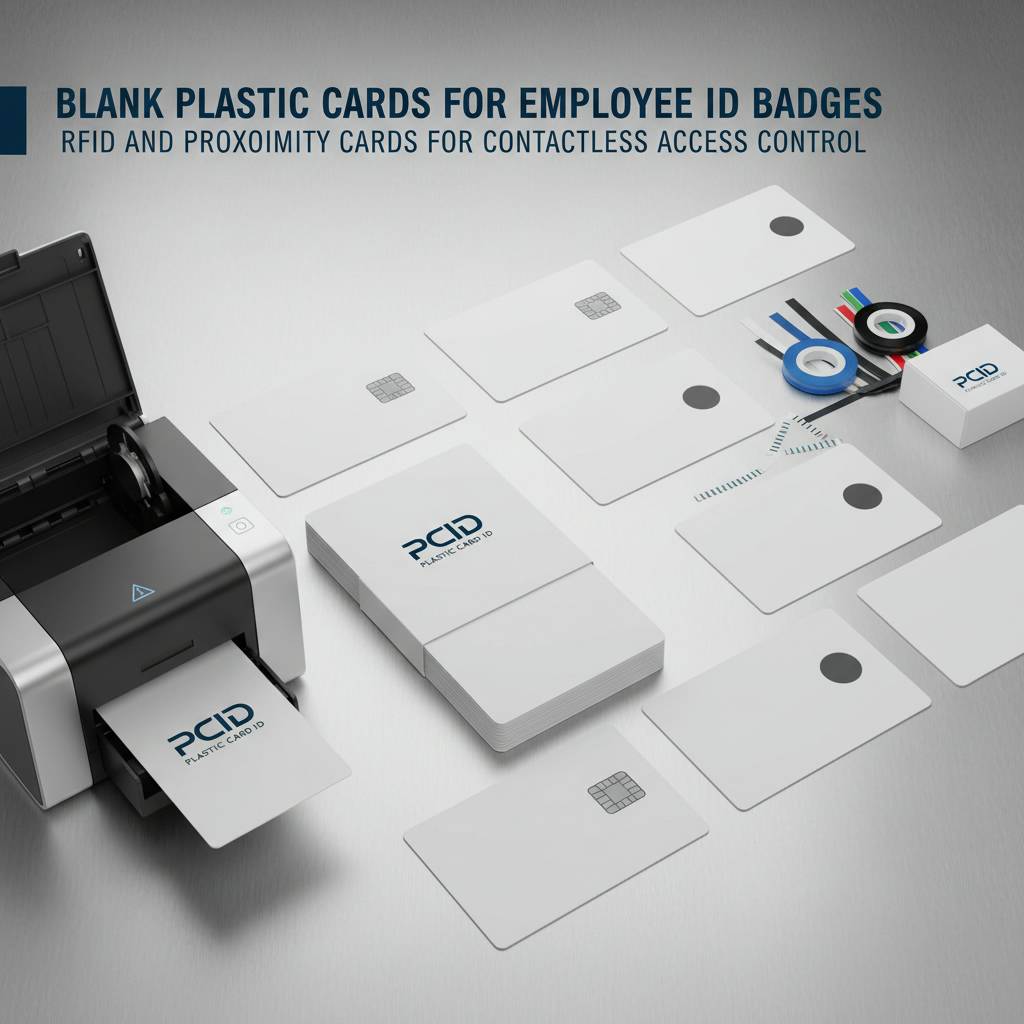 The workplace has changed. Touchless, frictionless entry is no longer a luxury specification reserved for high-security facilities - it is an expectation in modern offices, healthcare environments, schools, and anywhere employee flow through secure doors is a daily operational reality. Proximity cards and RFID smart cards deliver exactly that: tap-to-enter convenience backed by reliable, encoded identity verification.
Proximity cards operate at 125 kHz and are the classic contactless badge technology found in hundreds of thousands of access control systems across the country. RFID smart cards - including MIFARE DESFire and similar platforms - operate at 13.56 MHz and offer far greater data storage, encryption capability, and multi-application support. Choosing between them depends on your existing reader infrastructure as much as on your security requirements.
125 kHz Proximity Cards: Proven, Compatible, Reliable
Proximity cards have been the workhorse of commercial access control for decades, and for good reason. The technology is mature, widely supported, and compatible with readers from virtually every major access control manufacturer. If your building already has proximity readers installed, a proximity card is the straightforward solution - no infrastructure change required.
These cards look identical to a standard CR80 badge and can be printed with the same full-color employee photo and identification information as any other plastic card. The internal antenna and chip are completely embedded - invisible from the outside. Employees get a single card that serves as both visual ID and access credential.
MIFARE and High-Security RFID for Advanced Environments
MIFARE DESFire and similar 13.56 MHz smart card platforms bring encryption, mutual authentication, and multi-sector data storage to employee ID programs. In environments where data security is a genuine concern - government contractors, financial institutions, research facilities, healthcare systems with strict access tiering - these cards provide a meaningful security upgrade over proximity-only technology.
Multi-application smart cards can store access control credentials, time-and-attendance data, cafeteria account information, and logical access tokens on a single card. Instead of an employee carrying three different credentials, they carry one. That consolidation is operationally cleaner, reduces credential management complexity, and employees genuinely appreciate the simplicity.
Selecting the Right Card for Your Reader System
The most important rule in contactless card selection is compatibility: your cards must match your readers. This seems obvious, but the number of organizations that have purchased cards incompatible with their installed reader base is remarkable. CPE helps clients avoid this problem by asking the right questions before fulfilling any contactless card order - what reader brand, what frequency, what format, what facility code or site code parameters are in use.
Getting this right the first time protects your investment and eliminates the frustration of cards that do not work with existing infrastructure. Whether you are building a new access control program from scratch or expanding an existing one, the card selection conversation is a critical step that deserves real attention and knowledgeable guidance.
- 125 kHz proximity cards work with the majority of installed access control readers in US commercial buildings
- 13.56 MHz smart cards offer encryption and multi-application capability for high-security or multi-function programs
- MIFARE DESFire is the leading standard for advanced contactless employee ID programs requiring strong data security
- Visual printing on contactless cards is fully supported - the antenna does not interfere with full-color printing
- Custom encoding (facility codes, card numbers, employee data) can be handled in-house or configured by CPE prior to shipment
Card Printers That Complete the In-House Employee Badge Program
Blank cards are only part of the equation. To run an efficient in-house ID badge program, you need a card printer that matches your volume, quality requirements, and feature set. Plastic Card ID carries a full lineup of card printers from three of the industry's most trusted manufacturers - Evolis, Zebra, and Fargo - each with distinct strengths that suit different organizational profiles.
Selecting the wrong printer creates frustrating bottlenecks. An underpowered single-sided printer in a high-volume corporate environment means constant job queues and maintenance interruptions. An over-specified industrial printer in a small nonprofit issuing 30 cards a month is costly overkill. Right-sizing the printer to the program is a decision worth investing time in - and it is exactly the kind of guidance CPE provides as a strategic partner rather than a transactional vendor.
Evolis Printers: Elegant, Compact, and Highly Capable
Evolis printers are widely respected for their build quality, print consistency, and ease of use. Models range from the compact desktop Primacy series - ideal for organizations printing dozens to a few hundred cards per month - to higher-output options for busier programs. Evolis ribbon technology delivers crisp, color-accurate output that makes employee photos and text look sharp and professional.
For organizations where the printer lives on a reception desk or HR office counter, the Evolis form factor is genuinely elegant - compact enough not to dominate a workspace, capable enough to produce professional-grade ID badges on demand. The first impression an employee badge makes on visitors, clients, and colleagues reflects directly on your organization's professionalism.
Zebra and Fargo: Volume, Versatility, and Enterprise-Grade Output
Zebra card printers are engineered for reliability under sustained use, with models designed for medium to high-volume programs where consistent output over thousands of cards per year is the expectation rather than the exception. Healthcare systems, universities, and large corporate environments with high employee turnover particularly benefit from Zebra's robust construction and low maintenance requirements.
Fargo printers are celebrated for print quality that approaches near-photographic results, making them a preferred choice for programs where visual identity cards double as customer-facing credentials or security badges that need to look genuinely authoritative. Call 800.835.7919 to get a printer recommendation tailored to your program volume, feature requirements, and budget range. The right printer choice today prevents costly upgrades tomorrow.
Ribbons, Cleaning Kits, and Consumables
A card printer performs only as well as its consumables allow. Genuine manufacturer ribbons - not third-party substitutes - ensure print head longevity, color calibration accuracy, and lamination adhesion that aftermarket ribbons often cannot match reliably. Plastic Card ID stocks ribbons for Evolis, Zebra, and Fargo printers so clients can source cards and consumables from a single supplier rather than juggling multiple vendor relationships.
Cleaning kits - cleaning cards, rollers, and swabs designed for specific printer models - are a non-negotiable maintenance item that most organizations underutilize. A biweekly cleaning routine adds years to a print head's operational life and maintains the card output quality that makes an in-house program worth running. Consumables are not an afterthought - they are a core component of program reliability.
Card Carriers, Sleeves, and Accessories That Complete the Badge Solution
The card itself is the core, but how it is presented, protected, and worn matters more than most people initially consider. A beautifully printed employee ID badge scratched beyond recognition after two months of daily use signals negligence, not professionalism. Card accessories - carriers, sleeves, lanyards, badge reels - protect the investment in every card you print and project a polished, consistent appearance across your workforce.
Plastic Card ID stocks a full range of card accessories so clients can build complete badge programs from a single source. Combining card stock, printer consumables, and badge accessories into a single order stream simplifies procurement, reduces vendor management overhead, and ensures consistent accessory availability that keeps the program running smoothly.
Protective Sleeves and Card Carriers
Vinyl card sleeves protect printed card surfaces from scratching, moisture, and the kind of daily mechanical wear that accumulates in pockets and badge holders. For organizations where cards serve dual roles - ID badge and access credential - keeping the card surface clean and undamaged is particularly important because worn or scratched surfaces can occasionally interfere with magnetic stripe readers at close proximity.
Card carriers serve a different function - they provide a mailing-safe housing for cards being distributed through postal mail. Organizations issuing membership cards, welcome kits, or credentials to distributed workforces use card carriers to present new badges professionally and protect them in transit. The first contact an employee or member has with their card shapes their perception of the program's quality.
Affixing and Mailing Services for Distributed Workforces
Not every organization issues cards face-to-face. Franchises, multi-location businesses, remote workforces, and membership organizations often need to mail cards to recipients across the country. CPE offers card affixing and mailing services that handle the physical fulfillment side of distributed card programs - cards properly mounted to carriers, inserted into mailers, and sent to recipient lists provided by the client.
This service eliminates a genuinely tedious internal workload. Mailing hundreds or thousands of employee cards manually is a time-consuming process that pulls HR staff away from higher-value work. Outsourcing the fulfillment logistics to a partner who does this routinely is a straightforward operational decision for any organization at meaningful scale.
Frequently Asked Questions About Blank Plastic Cards for Employee ID Badges
Organizations new to in-house ID badge programs frequently arrive with similar questions. The answers are not complicated, but they matter - the right foundation knowledge makes the difference between a program that runs seamlessly and one that creates recurring headaches. Below are the questions CPE hears most often, answered directly.
What Is the Right Blank Card Specification for a Standard Employee Badge?
For a purely visual employee ID badge - photo, name, title, department, logo, barcode - a standard white CR80 PVC card at 30 mil thickness is the correct specification. It works with every major card printer, accepts full-color dye-sublimation printing, and produces a professional result at the lowest per-card cost. If the badge needs to function as an access credential as well, add a HiCo magnetic stripe, proximity chip, or RFID smart card specification based on your reader infrastructure.
Card thickness matters. Thinner cards (20 mil) are sometimes used for temporary credentials or event badges; 30 mil is the standard for durable, multi-year employee ID programs. Thirty mil is the specification your card printer is designed around - deviating from it without explicit printer compatibility confirmation creates unnecessary risk of equipment damage or print quality failures.
How Many Cards Should We Order at Once?
Volume decisions depend on three factors: monthly issuance rate, storage capacity, and per-card pricing goals. A company issuing 50 new or replacement badges per month might order 500 cards at a time - a 10-month supply that allows them to take advantage of volume pricing without overstocking. Larger organizations issuing 200 or more cards monthly may find ordering in 1,000 or 2,500-card case quantities meaningfully reduces their per-card cost.
Blank PVC cards store well when kept in a dry, temperature-stable environment. There is no meaningful degradation risk in maintaining a 6-12 month supply on hand. The operational benefit of always having cards available - never waiting on a reorder when an urgent badge issuance arises - justifies carrying a reasonable inventory buffer. CPE is happy to help calculate an order cadence that balances cost efficiency with practical inventory management.
Can We Print Color Photos on Blank Cards In-House?
Yes - this is precisely the purpose of in-house card printing. Dye-sublimation card printers from Evolis, Zebra, and Fargo print full-color, photo-quality images directly onto blank white PVC card stock. The output is a finished employee ID badge with accurate skin tones, sharp text, and vibrant logo colors - indistinguishable from cards produced by commercial card printing services, but produced on your premises in minutes.
Full-color dye-sublimation printing on blank CR80 cards is the backbone of virtually every in-house ID badge program in operation today. The combination of high-quality output, immediate issuance capability, and lower per-card economics compared to outsourced printing makes it the dominant approach for organizations managing ongoing employee badge programs of any meaningful scale.
- Standard white CR80 PVC cards work with all major dye-sublimation card printers
- HiCo magnetic stripe cards add encoded access or data capability to the printed badge
- Proximity and RFID cards enable contactless access control through the same badge
- Smart chip cards support multi-application use cases requiring higher data security
- Clear and frosted PVC options create a visually distinctive badge for premium programs
- Card accessories - sleeves, carriers, lanyards - complete the badge program from issuance to daily use
Partner With Plastic Card ID for Your Employee ID Badge Card Program
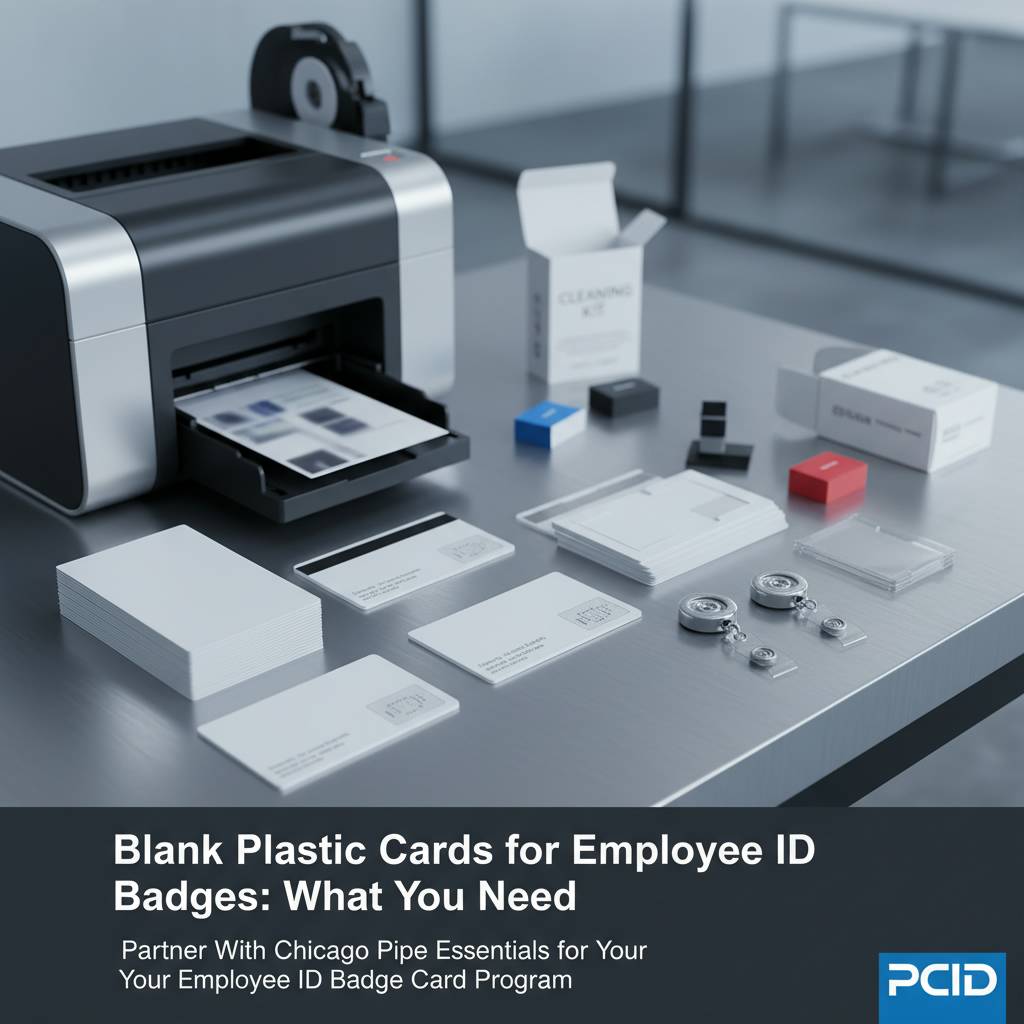 Twenty-five years. Over 100,000 customers. More than 50 million cards shipped. Those numbers do not reflect a company that simply processes orders - they reflect a company that has built genuine expertise in helping organizations of every size and type run successful card programs. From the 50-employee company printing its first batch of staff ID badges to the multi-location enterprise managing tens of thousands of credentials annually, Plastic Card ID brings the same depth of knowledge and commitment to the partnership.
Blank plastic cards for employee ID badges are deceptively simple products that power remarkably important operational functions. Every time an employee swipes a badge, taps a card reader, or shows their ID to a visitor, the quality of that card reflects on the organization that issued it. Getting the card specification right, the printer selection right, and the program structure right from the beginning pays dividends for years.
Ready to build or upgrade your employee ID badge program? Contact Plastic Card ID today at 800.835.7919 - our card program specialists are ready to help you select the right blank cards, encoding options, printers, and accessories to run a program that works exactly the way your organization needs it to.
Previous Page