How Many Blank Plastic Cards Do I Need to Order?
Table of Contents []
- How Many Blank Plastic Cards Do I Need to Order? A Practical Guide from Plastic Card ID
- Understanding CR80 Blank Cards and Why Quantity Planning Matters
- How to Calculate the Right Blank Card Order Quantity
- Factors That Change Your Ideal Order Quantity
- Blank Card Varieties and How Type Affects Quantity Decisions
- Smart Buying Tips: Getting the Most from Your Card Order
- Why Plastic Card ID Is the Right Partner for Your Card Program
How Many Blank Plastic Cards Do I Need to Order? A Practical Guide from Plastic Card ID
It sounds simple. You need cards. But the moment you sit down to figure out exactly how many blank plastic cards to order, the question multiplies into a dozen smaller ones. Are you printing in-house or outsourcing? Will you reorder frequently or stockpile? Are these employee badges, loyalty cards, event credentials - or all three? Getting your order quantity right the first time saves money, prevents shortages, and keeps your card program running without interruption.
This guide walks through everything that shapes the answer - card type, print volume, buffer stock, program scale, and the math behind smart bulk buying. Whether you are running a boutique gym with 200 members or a regional retail chain managing tens of thousands of gift cards, the logic applies. CPE has helped businesses across the United States work through exactly this question for over 25 years.
| Program Type | Recommended Starting Quantity | Suggested Buffer Stock |
|---|---|---|
| Small Membership Club | 250-500 cards | 10-15% |
| Employee ID Program | Current headcount 20% | 15-20% |
| Retail Gift Card Launch | 1,000-5,000 cards | 20-25% |
| Event Credential / Badge | Registered attendees 15% | 10% |
| Loyalty Program Rollout | 2,500-10,000 cards | 20-30% |
| Hotel Key Card Stock | 3x total room count | 25% |
Understanding CR80 Blank Cards and Why Quantity Planning Matters
The standard blank plastic card - a CR80, 30 mil thick, conforming to ISO 7810 - is the foundation of virtually every in-house card program in the country. These cards fit any standard wallet, work in all major card printers, and can be printed, encoded, or laminated to serve almost any purpose. They are versatile, affordable at volume, and immediately ready to transform into something specific the moment your printer touches them.
That versatility is exactly why quantity planning deserves real attention. Ordering too few means you run out mid-program, face a gap between print batches, and risk issuing inconsistent cards if a product run changes. Ordering too many - especially if you are a small operation - ties up budget in idle inventory. The sweet spot is different for everyone, but the variables that shape it are universal.
The Role of Blank Cards in Your Daily Operations
For organizations that print cards in-house, blank PVC stock is a consumable - just like printer ribbon. You need it consistently available, in the right quantities, before the moment you need to print. Running out of blank cards the morning you are onboarding 40 new employees is not a small inconvenience; it disrupts real workflows and creates real costs.
Blank cards can hold magnetic stripes, smart chips, RFID antennas, or simply receive a vivid full-color print. The card you order blank today could become an access credential, a loyalty card, a training badge, or an ID card - depending entirely on your process. That flexibility makes planning ahead critical: you want the right card type in stock, not just any card.
CR80 vs. Specialty Blank Card Formats
Not every program runs on standard white PVC. CPE offers clear and frosted blank cards, colored PVC stock in multiple shades, and pre-encoded magnetic stripe blanks in both HiCo and LoCo formats. The blank card format you choose affects minimum viable quantities, storage requirements, and how your printer interacts with the stock.
HiCo magnetic stripe cards, for example, are preferred for gift card and loyalty programs where data security and durability matter. LoCo cards suit lower-stakes applications like hotel keys or event passes. Ordering the wrong stripe type in large quantities is a costly mistake - one that a knowledgeable supplier will help you avoid before checkout, not after.
How Card Thickness and Material Affect Quantity Decisions
Standard 30 mil CR80 cards stack, store, and feed through printers predictably. Thicker cards - like 40 mil - are less common but used where rigidity matters, such as luxury membership or VIP credentials. Thinner overlaminates or specialty substrates may have different storage needs and shelf lives to consider when buying in bulk.
If your program involves clear or frosted cards, those materials may require specific printer settings and should be tested with your hardware before committing to a large order. Buying a smaller test batch first, then scaling up once your print process is confirmed, is a practical approach that CPE recommends for first-time specialty card buyers.
How to Calculate the Right Blank Card Order Quantity
The formula sounds straightforward, but the inputs are where people make mistakes. Start with your active cardholder count, add anticipated new enrollments over your target period, factor in attrition and replacement, and then build in a buffer. That buffer exists for printer test prints, damaged cards, encoding errors, and the unexpected spike in demand you did not see coming.
A good rule of thumb: plan for a 90-day supply at minimum. For programs with seasonal demand peaks - retail gift cards ahead of the holidays, event badges in spring conference season - extend that to 120 to 180 days of forward stock. The per-card cost savings from larger orders almost always justify the storage requirement.
Calculating for Employee ID and Access Control Programs
Take your current employee headcount. Add the projected headcount growth over the next six months. Multiply by 1.2 to account for reprints, name changes, department changes, lost cards, and damaged cards. That is your minimum order quantity. For organizations with high turnover - hospitality, retail, healthcare staffing - the replacement multiplier should climb toward 1.35 to 1.5.
Access control cards that carry RFID or proximity technology deserve special attention. These cards are encoded at the time of issuance, meaning blank RFID stock must be on hand before you can issue a single credential. Running out of RFID blank cards means employees or visitors cannot be credentialed - a security gap, not just an inconvenience. Carry deeper stock here than you think you need.
Calculating for Loyalty and Membership Programs
Loyalty card programs often have a launch surge followed by a steady enrollment drip. For a launch, estimate the size of your current customer base that will actively enroll, double it for optimism, and order accordingly. Retailers that switch from paper punch cards to plastic loyalty cards frequently report enrollment increases of 30 percent or more - meaning your actual demand may well exceed conservative projections.
Membership programs for gyms, clubs, associations, and professional organizations tend to have more predictable enrollment rates. Monthly new member counts, multiplied by twelve, give you an annual baseline. Add 15-20 percent for walk-in signups, replacement requests, and member upgrades. Plastic membership cards project legitimacy and permanence that paper alternatives simply cannot match - which is precisely why retention rates improve when organizations make the switch.
Calculating for Event, Gift, and Promotional Card Programs
Event credentials and badges are time-bound and relatively easy to plan: registered attendees plus a 10-15 percent overage for last-minute registrations and on-site walk-ins. The real planning challenge is print-readiness - cards need to be on hand days before the event, not ordered the week of. Lead times matter, and buffer stock is not optional for live events.
Gift card programs operated by retailers require a different kind of math. Card inventory must support not just initial activation but ongoing sale and replacement. Retailers switching from paper gift certificates to plastic gift cards consistently see sales increases in the range of 35-50 percent - a figure that means your first order should be generous. Understock a gift card launch and you will leave revenue on the counter.
Factors That Change Your Ideal Order Quantity
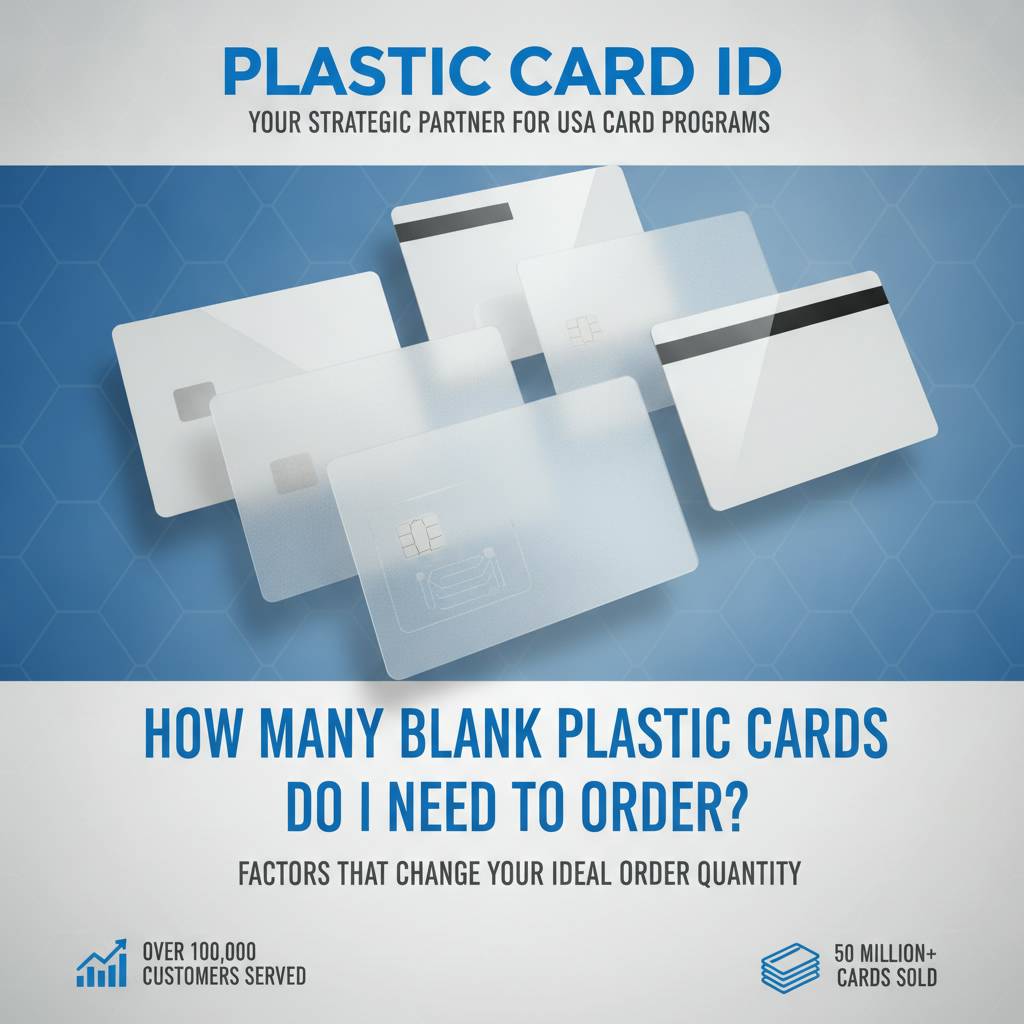 Beyond raw math, several operational realities shape the right number. Printer throughput is one: a single-sided direct-to-card printer running at 150 cards per hour has a different replenishment cadence than a dual-sided retransfer printer running at 300 cards per hour. Know your printer's real-world output, not just its spec sheet peak.
Storage environment matters too. Blank PVC cards should be stored flat, at room temperature, away from direct sunlight and humidity. Most businesses find that a case of 500 cards occupies minimal shelf space - ordering a few thousand cards at once is rarely a storage problem for organizations with any kind of back-office area. The cost savings from bulk pricing frequently dwarf the minor inconvenience of storing additional inventory.
Printer Ribbon and Card Stock Ratios
One detail that catches new card program managers off guard: your ribbon supply and your card supply must stay in sync. A YMCKO ribbon panel typically yields 250-300 prints. If you order 1,000 blank cards, you need approximately 3-4 ribbons on hand to print them. Ordering cards without factoring ribbon inventory means your card stock may sit idle while you wait for ribbon replenishment.
CPE supplies printer ribbons from Evolis, Zebra, and Fargo - the same printer brands whose hardware drives the majority of in-house card programs across the country. Bundling your card stock order with ribbon and cleaning kit replenishment is one of the simplest ways to keep your program running smoothly without scrambling for supplies at inconvenient moments.
Seasonal Spikes and Promotional Campaigns
If your business runs seasonal promotions - holiday gift card pushes, back-to-school membership drives, annual conference badges - plan your card orders around those windows, not after them. Order 60-90 days before the campaign starts. Blank card lead times are typically short, but adding print-and-prep time means you cannot afford to cut timing too close.
For businesses running recurring promotions, it often makes sense to build a standing inventory that covers both base operations and seasonal peaks. A modest overstock of blank cards costs far less than expedited shipping or a program interruption during your highest-demand period of the year. Think ahead by a full quarter at minimum.
Multi-Location Programs and Centralized vs. Distributed Printing
Organizations with multiple locations face a choice: print centrally and distribute cards, or equip each location with its own printer and card stock. Centralized printing typically means larger, less frequent orders at the print hub. Distributed printing means each site maintains its own smaller inventory - which multiplies your total card consumption and requires coordinated restocking across sites.
Call 800.835.7919 to talk through the right approach for multi-site programs. The logistics of card stock distribution, printer standardization, and bulk pricing tiers all factor into a multi-location strategy. CPE has experience supporting programs ranging from two-location boutique retailers to national franchise networks.
Blank Card Varieties and How Type Affects Quantity Decisions
Not all blank cards are interchangeable, and ordering a mix of types without a clear plan leads to mismatched inventory. Standard white PVC, HiCo magnetic stripe, LoCo magnetic stripe, proximity RFID, smart chip, clear, frosted, and colored stock all serve different functions. An employee ID program running on standard white CR80 stock has completely different inventory needs than a hotel key card program running on LoCo magnetic stripe blanks.
Understanding which card types your various programs require - and keeping them properly separated and labeled in storage - is basic operational hygiene that prevents expensive printing errors. Feeding an RFID card through a printer configured for standard PVC, or vice versa, is the kind of mistake that blank card inventory confusion causes.
Standard White PVC Blanks
The most commonly ordered blank card in the country. White CR80, 30 mil, prints cleanly on any major card printer and accepts dye-sublimation or direct-to-card printing beautifully. For organizations that print employee IDs, membership cards, student IDs, or any card that gets a full-color design, this is your daily driver. Buy these in quantities that match three to six months of projected print volume for the best per-card pricing without excessive overstock.
Bulk pricing tiers typically begin at 500 cards and improve meaningfully at 1,000, 2,500, and 5,000 card thresholds. The difference in per-card cost between a 250-card order and a 2,500-card order can be significant - sometimes cutting your unit cost nearly in half at higher tiers.
Magnetic Stripe and RFID Blank Cards
These cards carry encoded data layers that make them suitable for access control, payment-adjacent programs, loyalty tracking, and facility management. HiCo magnetic stripe cards resist demagnetization and are standard for gift card and loyalty programs. LoCo cards are sufficient for hotel keys and event credentials where replacement is easy and expected.
RFID and proximity blank cards - including MIFARE DESFire and standard 125kHz formats - are used in access control, time and attendance, and contactless identification programs. These cards are more expensive per unit than standard PVC, which makes right-sizing your order quantity even more important. Overstocking expensive encoded blanks is a budget concern; understocking them is a security program concern. Balance accordingly.
Specialty Blanks: Clear, Frosted, and Colored Stock
Clear and frosted cards create a visual impression that standard white PVC cannot achieve. Used for VIP passes, premium membership credentials, and specialty marketing programs, these cards command attention in a wallet. Colored PVC stock - available in a range of hues - allows organizations to color-code departments, access levels, or membership tiers without printing a background color on every card.
These specialty blanks typically have slightly higher minimums and longer lead times than standard white PVC. Plan your order with more lead time, and consider whether a standing reorder arrangement makes sense for ongoing programs. CPE can help you set up reorder schedules that keep specialty stock flowing without requiring you to manually track inventory levels at every turn.
Smart Buying Tips: Getting the Most from Your Card Order
Buying blank plastic cards efficiently is part operational planning, part relationship management with your supplier. The organizations that run the smoothest card programs are not the ones that scramble to reorder when stock runs out - they are the ones that treat card stock as managed inventory, the same way they manage office supplies or product packaging. Predictable replenishment cycles beat reactive emergency orders every time.
A few practical habits make a measurable difference. Track your monthly card consumption by program type. Set a reorder trigger - say, when stock drops below a 30-day supply. Know your lead times so you are never caught short. And build a relationship with a supplier who knows your programs well enough to flag issues you might not think to ask about.
Bulk Pricing Tiers and When to Jump Up a Quantity Break
Card pricing is not linear. The jump from 500 cards to 1,000 cards often yields a per-card savings that more than covers the cost of the additional 500 cards you may not need immediately. If you are placing an order and you are close to a pricing tier threshold, do the math: sometimes spending slightly more upfront results in a lower total cost and a healthier inventory buffer.
- 250-499 cards: Entry-level pricing, suitable for pilot programs or very small operations
- 500-999 cards: First meaningful pricing break, appropriate for small to mid-size programs
- 1,000-2,499 cards: Mid-tier pricing, most common for growing membership and ID programs
- 2,500-4,999 cards: Significant per-card savings, ideal for retail gift and loyalty launches
- 5,000 cards: Volume pricing that dramatically lowers per-card cost for large-scale programs
When in doubt, call the team at 800.835.7919 and ask directly: what is the next pricing break, and how many cards away am I from reaching it? That single question has saved CPE's customers real money on countless orders.
First-Time Buyers: Start Smart, Scale Confidently
If you are launching a new card program, resist the temptation to either drastically underorder out of caution or massively overorder out of enthusiasm. A well-planned first order covers your immediate need, includes a reasonable buffer, and positions you for your first reorder before you experience a shortage. A 90-day supply is the standard recommendation for first-time blank card buyers starting a new program.
Test your printer settings, your card design, and your encoding process with a small batch before committing to a full production run. Most quality issues surface in the first 10-20 cards of a new setup. Identify them early, adjust your process, and then scale confidently. CPE can advise on printer compatibility, card type selection, and order quantities before you commit to anything.
Reorder Timing and Avoiding Program Gaps
Set your reorder point before you reach critical low stock. For most programs, reordering when you have 3-4 weeks of stock remaining gives adequate buffer for order processing and shipping. For programs with longer lead times - custom-encoded RFID blanks, for example - extend that buffer to 6-8 weeks. Running out of cards mid-program is almost always more expensive than carrying a modest surplus.
Consider setting calendar reminders tied to your average monthly consumption. If you print 200 cards per month and just received 1,000 cards, set a reminder to reorder in approximately 3.5 months. Automate the thinking so that card stock replenishment becomes a routine, scheduled action rather than a reactive scramble when the last card feeds through the printer.
Why Plastic Card ID Is the Right Partner for Your Card Program
Plastic Card ID has been doing this for over 25 years, supporting more than 100,000 customers across the United States and delivering more than 50 million cards. That scale of experience means the team has seen virtually every card program configuration, every planning mistake, and every operational challenge that comes with running cards at any scale. They bring that knowledge to every customer interaction - from the business ordering 50 cards a month to the enterprise moving tens of thousands per quarter.
The product catalog spans everything your program could require: standard and specialty blank PVC cards, HiCo and LoCo magnetic stripe stock, RFID and proximity cards, smart chip cards, clear and frosted blanks, colored PVC, and the full lineup of Evolis, Zebra, and Fargo card printers. Printer ribbons, cleaning kits, card carriers, sleeves, and card affixing and mailing services round out a genuinely complete supply solution. No need to patch together multiple vendors - everything ships from one trusted source.
A True One-Stop Card Supply Partner
The advantage of working with a single supplier for cards, printers, and consumables goes beyond convenience. It means your supplier understands your complete program, can flag compatibility issues before they become problems, and can coordinate replenishment across card types and supplies in a way that keeps everything synchronized. That coordination has real operational value that many organizations do not appreciate until they have managed multi-vendor card supply chaos.
CPE serves businesses and organizations across every sector: retail, hospitality, healthcare, education, corporate, government, events, fitness, and more. Specialty programs including casino player cards, hotel key card programs, and advanced RFID access control are fully supported alongside everyday employee ID and loyalty card programs.
Getting Expert Guidance on Your Order Quantity
Still not sure exactly how many blank plastic cards you need? That is the right question to bring directly to the team. Experienced card program specialists can walk through your use case, enrollment projections, printer throughput, and program growth trajectory to recommend a quantity that genuinely fits your operation - not a generic number that may not serve you well.
Contact 800.835.7919 to speak with a knowledgeable representative who has helped thousands of organizations plan their first card order or optimize an existing program. The conversation is practical, efficient, and focused entirely on getting your card program right. There is no obligation, just expert guidance from people who have seen it all.
Advanced Card Options for Growing Programs
As your card program matures, your needs may evolve beyond standard blank PVC. Luxury metal cards in stainless steel, brass, and gold are available for premium membership and VIP programs where the card itself communicates status and exclusivity. Custom die-cut shapes break from the standard CR80 form factor for marketing and promotional applications that demand attention.
MIFARE DESFire and other advanced contactless RFID smart card formats support high-security access control and multi-application programs that go well beyond basic proximity entry. Whatever direction your program grows, Plastic Card ID has the inventory, expertise, and supplier relationships to support it - from the first 250-card pilot order to a national rollout in the tens of thousands.
Ready to get your card order right the first time? Reach out today and let Plastic Card ID help you build a smarter card program.
Call 800.835.7919 now and speak with a card program specialist who can walk you through exactly how many blank plastic cards your operation needs - and help you order with confidence.
Previous Page