CR80 Card Size Standard Guide: Dimensions Specifications
Table of Contents []
- The CR80 Card Size Standard: Everything You Need to Know - Plastic Card ID
- What Is the CR80 Card Size Standard and Why Does It Exist?
- CR80 Blank Card Varieties: More Choices Than You Might Expect
- Card Printers Built for the CR80 Standard
- CR80 Card Applications Across Industries
- Frequently Asked Questions About CR80 Card Size
- Why Plastic Card ID Is the Partner Your Card Program Deserves
The CR80 Card Size Standard: Everything You Need to Know - Plastic Card ID
Pull any card from your wallet right now. That driver's license, hotel key, gym membership card, or employee badge? Nearly every one of them shares the same physical dimensions - and that is not a coincidence. The CR80 format is the backbone of the global card industry, a standard so deeply embedded in how we do business that most people never think to question it. But for organizations building card programs from scratch, understanding exactly what CR80 means - and why it matters - is the difference between a professional program and a frustrating, costly mistake.
Plastic Card ID has spent over 25 years supplying blank and custom plastic cards to businesses across every industry in the United States. With more than 50 million cards sold and over 100,000 customers served, the team at CPE has answered every conceivable question about card sizing, card stock, and card compatibility. This guide consolidates that knowledge into one authoritative resource.
| Specification | CR80 Standard Value | Notes |
|---|---|---|
| Width | 3.375 inches (85.6 mm) | ISO 7810 ID-1 standard |
| Height | 2.125 inches (53.98 mm) | ISO 7810 ID-1 standard |
| Thickness | 0.030 inches (30 mil / 0.76 mm) | Standard PVC card thickness |
| Corner Radius | 0.125 inches (3.18 mm) | Matches standard wallet slots |
| ISO Standard | ISO 7810 ID-1 | International compliance |
| Material | PVC (standard) | Compatible with card printers |
What Is the CR80 Card Size Standard and Why Does It Exist?
The CR80 designation sounds technical, but its purpose is beautifully simple: universal interchangeability across the entire card ecosystem. A card that is CR80-compliant will fit in every standard wallet slot, every card printer tray, every card holder, lanyard badge sleeve, and card reader that was designed for the ID-1 format. No adjustments, no modifications, no guesswork. This is why it became the default - and why deviating from it requires deliberate, informed decision-making.
Formally codified under ISO 7810 as the ID-1 format, the CR80 standard was developed to bring consistency to an industry that desperately needed it. Before standardization, cards came in wildly different sizes across regions and industries. That chaos created compatibility nightmares for card issuers and cardholders alike. The solution was an internationally agreed-upon set of physical dimensions that any manufacturer, printer, or issuer could follow - resulting in the 3.375 x 2.125 x 0.030 inch card that now lives in billions of wallets worldwide.
The ISO 7810 Connection
ISO 7810 is the international standard governing the physical characteristics of identification cards. Within it, four card formats are defined - ID-1 through ID-4 - but ID-1, which corresponds exactly to CR80, is by far the most widely used in commerce, access control, loyalty programs, and identification. The others (like ID-2, a passport-sized format, or ID-3, a visa-sized card) serve specialized roles but never achieved the wallet-ubiquity of ID-1.
For businesses in the United States, ISO 7810 compliance is not just about international standards - it is about practical compatibility. Card printers built for CR80 cards are calibrated to exact tolerances. Load a non-standard card into a desktop printer from Evolis, Zebra, or Fargo, and you risk jams, misprints, and damage to the print head. Sourcing ISO 7810-compliant blank cards from a reputable supplier eliminates this risk entirely.
What Does 30 Mil Actually Mean?
Thickness is frequently the most misunderstood part of the CR80 spec. "30 mil" does not refer to millimeters - it refers to thousandths of an inch. So a 30 mil card is 0.030 inches thick, which is approximately 0.76 mm. This is the thickness of a standard credit card, and it is the thickness that virtually every card printer on the market is designed to accept without any configuration changes.
Some organizations experiment with thicker cards - 40 mil or even 60 mil stock - for specialty applications where rigidity and premium feel are priorities. These cards exist and have real use cases, but they require printer compatibility checks and sometimes manual feed adjustments. For organizations running high-volume card programs, sticking with standard 30 mil CR80 stock is nearly always the most practical, cost-effective choice.
Corner Radius: The Detail That Trips Up Custom Designs
CR80 cards have a rounded corner radius of 0.125 inches (3.18 mm). This seemingly minor detail has significant implications for graphic designers creating card artwork. Design files that do not account for corner rounding will have clipped artwork at the corners - a common and easily avoidable mistake when working with templates that do not reflect the final card shape.
Reputable suppliers provide design templates that include bleed areas, safe zones, and accurate corner radius guides. When ordering blank stock for in-house printing, the physical cards you receive will already have rounded corners - your desktop card printer does not trim or round; it prints onto pre-cut, pre-rounded CR80 blanks. Understanding this workflow upfront prevents surprises at every stage of the card production process.
CR80 Blank Card Varieties: More Choices Than You Might Expect
Not all CR80 cards are created equal, even when they share identical dimensions. The blank card category is far more nuanced than most buyers initially realize. Material composition, surface finish, overlay coatings, and embedded technology all vary within the CR80 form factor - and each variation serves a different purpose within an organization's card program. Choosing the right blank card type from the start determines how well the end product performs in the real world.
CPE stocks one of the most comprehensive selections of CR80 blank cards available from a single U.S. supplier. Whether you need plain white PVC for a simple ID badge program, frosted translucent cards for a boutique membership offering, or HiCo magnetic stripe cards for access control, the right blank is available and ready to ship. Understanding each type - and when to use it - is essential knowledge for any card program manager.
Plain White PVC CR80 Cards
The white CR80 PVC card is the foundational product of the in-house card printing industry. These cards provide a blank white surface that accepts dye-sublimation or direct-to-card printing with crisp, vibrant results. They are the workhorse of employee badge programs, event credential systems, membership cards, and loyalty programs run by organizations that want full design control and lower per-card costs than outsourced pre-printed cards.
Buying blank white CR80 cards and printing in-house is a strategic decision that pays dividends at scale. Once a card printer is in place, the cost per card drops significantly - and design changes can be implemented immediately without waiting for a print run from an outside vendor. For organizations that update card designs seasonally, or that need to issue cards on-demand for new members or employees, this flexibility is invaluable.
Magnetic Stripe CR80 Cards (HiCo vs. LoCo)
Magnetic stripe CR80 cards add a thin stripe of magnetic recording material to the back of a standard blank card. This stripe stores encoded data - account numbers, access credentials, loyalty points balances, and more - that can be read by swipe readers. Two variants exist: High Coercivity (HiCo) and Low Coercivity (LoCo), and choosing the wrong one for an application is a common and costly mistake.
HiCo stripes require stronger magnetic fields to encode and are more resistant to accidental erasure from everyday magnetic sources like bag clasps or refrigerator doors. HiCo is the correct choice for hotel key cards, access control, and loyalty cards that will be used daily. LoCo cards encode more easily and are suitable for short-term use cases like event credentials or temporary passes where longevity of the stripe is not a concern. CPE stocks both, and the team can help organizations determine the right specification for their specific application.
RFID, Proximity, and Smart Chip CR80 Cards
The CR80 form factor accommodates considerably more than magnetic stripes. RFID cards, proximity cards, and smart chip cards all exist within the same familiar credit-card dimensions. Contactless technology embedded in CR80 cards allows for tap-and-go access control, cashless transactions within closed systems, and data storage that far exceeds what a magnetic stripe can hold.
Advanced offerings include MIFARE DESFire technology, which provides encrypted, high-security contactless communication suitable for corporate access control, campus ID systems, and casino player cards. Proximity cards operating at 125 kHz are the standard workhorse of commercial door access systems, compatible with the vast majority of installed card readers across U.S. commercial real estate. All of this technology fits within the same CR80 envelope that holds your gym membership card - remarkable engineering that most end users never think about.
Card Printers Built for the CR80 Standard
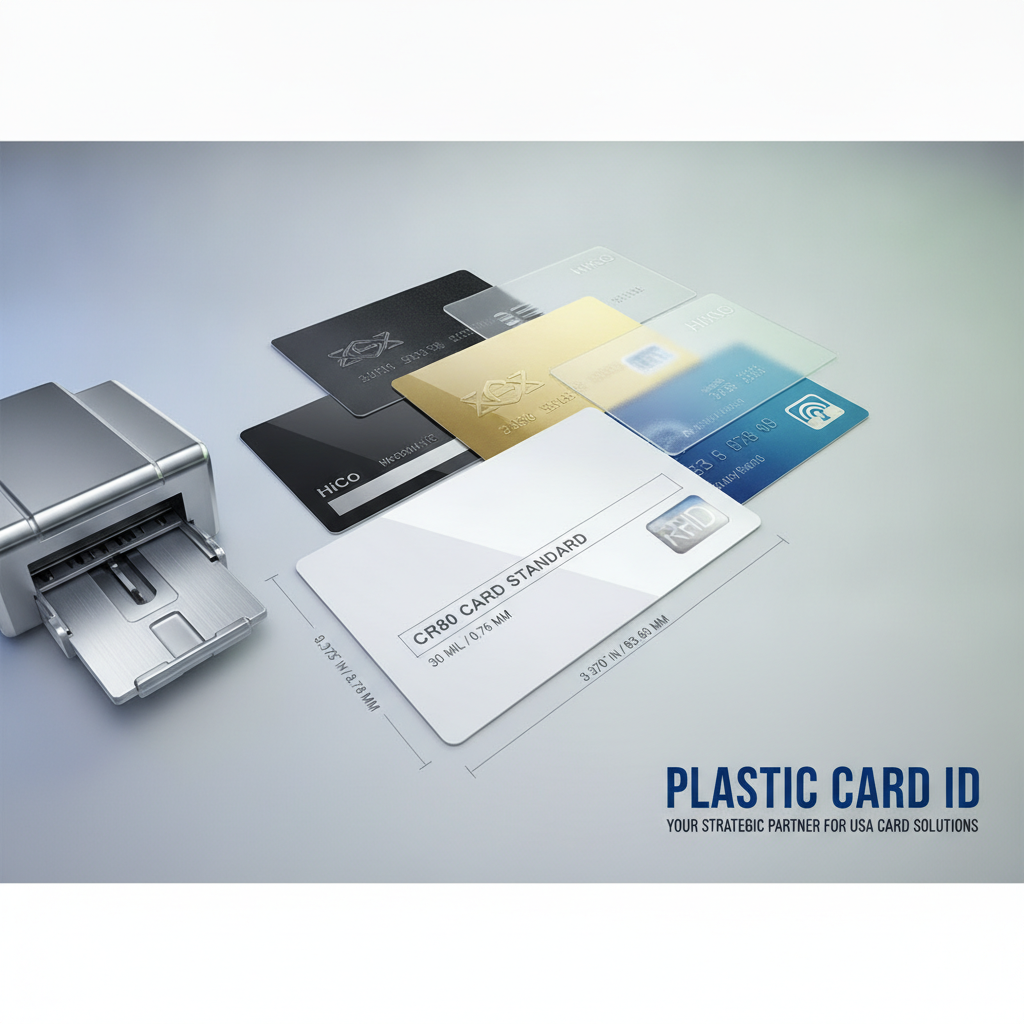 A blank CR80 card is only half the equation for an in-house card program. The other half is the printer that transforms that blank into a finished, functional card. Desktop card printers from the industry's leading manufacturers - Evolis, Zebra, and Fargo - are all engineered around the CR80/ISO 7810 ID-1 format as their primary card size. This means out-of-the-box compatibility with standard blank stock, no special setup required.
Selecting the right printer model depends on print volume, desired print quality, encoding requirements, and budget. Entry-level single-sided printers handle low-volume badge programs efficiently and affordably. Mid-range dual-sided models are ideal for employee ID programs where both card faces carry important information. High-throughput retransfer printers deliver edge-to-edge photographic print quality for premium membership cards, casino player cards, and high-visibility credential programs.
Evolis Card Printers
Evolis is a French manufacturer known for stylish, compact printer designs that perform with precision. Their Primacy and Primacy 2 models are popular for medium-volume programs, while the Avansia retransfer printer is a top choice for organizations requiring the absolute best print quality on their CR80 cards. Evolis printers are compatible with the full range of CR80 blank card types - plain PVC, mag stripe, and contactless smart cards.
Ribbon compatibility is an important operational consideration for any Evolis deployment. Each Evolis printer model uses specific ribbon formats, and using the correct ribbon type ensures consistent color output and optimal print head life. CPE supplies the full range of Evolis-compatible ribbons, cleaning kits, and maintenance supplies to keep programs running without interruption.
Zebra and Fargo: Workhorses for High-Volume Programs
Zebra card printers, particularly the ZC and ZXP series, are widely deployed in enterprise environments where reliability and throughput are the primary concerns. Zebra's robust construction and extensive service network make them a practical choice for organizations printing hundreds or thousands of CR80 cards per month. The ZXP Series 7 retransfer model, in particular, is trusted in healthcare, government, and large corporate environments.
Fargo printers - now under the HID Global umbrella - are a mainstay of the security and access control market. Their HDP (High Definition Printing) retransfer technology delivers exceptional image quality on CR80 cards, and deep integration with HID's credential ecosystem makes Fargo printers a natural fit for organizations already running HID access control infrastructure. Choosing between Zebra and Fargo often comes down to existing infrastructure and volume requirements - both are excellent choices for serious card programs.
Printer Supplies and Accessories That Keep Programs Running
Printer hardware is a one-time capital investment, but consumables are an ongoing operational cost. Ribbons, cleaning kits, and card carriers represent the recurring supply chain that every in-house card program depends on. Sourcing these supplies from the same vendor that supplies blank cards simplifies procurement, reduces shipping overhead, and ensures compatibility - no guessing whether a ribbon is the right formulation for a specific printer model.
Value-added services from CPE extend beyond supplies to include card affixing and mailing - useful for organizations distributing cards to remote employees, widespread membership bases, or large customer lists. A true one-stop shop approach eliminates the vendor coordination overhead that plagues card programs managed across multiple suppliers. When ribbon, blank cards, cleaning supplies, and mailing services all come from a single account, program management becomes dramatically simpler.
CR80 Card Applications Across Industries
The CR80 standard's universal adoption means it has permeated virtually every industry that issues cards to people. From the healthcare waiting room to the casino floor, from the corporate lobby to the boutique fitness studio, the same physical format serves wildly different purposes. Understanding the breadth of applications helps organizations see possibilities they may not have considered - and occasionally reveals opportunities to add card-based programs that drive measurable business results.
Retailers that have transitioned from paper gift certificates to plastic CR80 gift cards have documented sales increases of 35-50%. That statistic is not incidental - plastic cards are kept, used, and spent. Paper certificates get lost, forgotten, or thrown away. The physical permanence of a CR80 card is a functional business advantage, not a cosmetic one. The same principle applies to loyalty programs: a plastic loyalty card that lives in a wallet is consulted and used; a paper punch card that lives in a junk drawer is not.
Employee ID and Access Control
Employee ID cards represent one of the largest use cases for CR80 blank cards in the United States. Organizations of every size - from twenty-person startups to multinational corporations - issue printed ID badges to employees for identification, security, and access control purposes. A printed CR80 badge with a photo, name, title, and department communicates professionalism and signals that the organization takes security seriously.
Blank CR80 cards give HR and facilities teams the ability to issue badges on-demand - a capability that becomes especially valuable in high-turnover environments or during rapid hiring phases. When a new employee starts Monday morning, an ID badge can be printed and encoded at the desk rather than waiting weeks for an outside vendor to produce and ship pre-printed cards. This operational agility is one of the most compelling arguments for in-house card printing programs.
Loyalty, Membership, and Gift Card Programs
Loyalty programs built around CR80 plastic cards consistently outperform digital-only alternatives in terms of customer engagement and repeat visit rates. There is something tangible about receiving a physical card - it represents membership, belonging, and value in a way that an app notification simply does not replicate. Independent retailers, fitness studios, restaurants, and service businesses all benefit from issuing physical loyalty cards to their best customers.
Membership organizations - from professional associations to country clubs to community centers - rely on CR80 cards to establish the legitimacy and permanence of membership. A laminated paper certificate says "welcome." A professionally printed plastic membership card says "you belong here." Gift cards built on CR80 stock are shelf-displayable, giftable, and reloadable in ways that paper gift certificates are not. The CR80 card format is the physical foundation of customer relationship programs that work.
Hospitality, Events, and Specialty Applications
Hotel key cards are CR80 cards with LoCo or HiCo magnetic stripes encoded with temporary room access credentials. Casino player cards track gaming activity, comps, and loyalty points on mag stripe or smart chip CR80 stock. Event credentials for conferences, festivals, and trade shows use CR80 badges with or without technology embedded, providing attendees with professional identification that also serves as a keepsake or lanyard badge.
Specialty CR80 variants - clear plastic cards, frosted cards, custom die-cut shapes, and luxury metal cards in stainless steel, brass, or gold - serve high-end applications where the card itself is part of the brand experience. A matte gold metal card delivered with an exclusive membership offer communicates a level of prestige that no paper document can approach. These premium options occupy a different price tier but deliver brand impact far beyond their cost.
Frequently Asked Questions About CR80 Card Size
Years of working with over 100,000 customers means CPE has fielded virtually every question imaginable about CR80 cards. The following questions represent the most common points of confusion for organizations setting up card programs for the first time - as well as buyers who thought they understood the standard but discovered a detail they had missed.
Common CR80 Questions Answered
- Is CR80 the same as a credit card size? Yes. The CR80 / ISO 7810 ID-1 format was designed to match the dimensions of bank cards. Your Visa, MasterCard, and store cards are all CR80-sized, which is why they fit interchangeably in wallet slots.
- Can I print CR80 cards on a regular inkjet printer? No. Desktop card printers use dye-sublimation or direct-to-card thermal transfer technology specifically calibrated for rigid PVC card stock. Standard paper printers cannot handle 30 mil PVC cards.
- What is the minimum order quantity for blank CR80 cards? CPE can accommodate programs of nearly any scale - from small organizations needing 50 cards per month to mass production orders in the tens of thousands. Contact the team to discuss the right quantity for your program.
- Do CR80 cards work with all card printers? Standard 30 mil CR80 cards are compatible with virtually all desktop card printers on the market. Thicker specialty cards (40 mil, 60 mil) require compatibility verification with your specific printer model.
- What is the difference between HiCo and LoCo magnetic stripe cards? HiCo cards are more resistant to accidental magnetic erasure and are preferred for applications where cards will be used repeatedly over a long period. LoCo cards are suitable for short-term or single-use applications.
- Can CR80 cards be custom die-cut into other shapes? Yes. While the standard CR80 format is rectangular with rounded corners, custom die-cutting within the approximate CR80 area is available for specialty applications. Note that non-standard shapes are not compatible with standard card printer trays.
How to Choose the Right CR80 Card for Your Program
The selection process begins with the end use case. An employee badge program that requires photo printing but no encoding simply needs plain white CR80 PVC blanks. An access control system needs magnetic stripe or RFID cards compatible with the installed readers. A loyalty program that will run through a swipe-based POS system needs HiCo mag stripe blanks. Mapping the technology requirement first prevents the frustration of ordering the wrong card type.
Print volume and printer model compatibility are the next considerations. Not every printer handles every card type - particularly smart chip and RFID cards, which require printers equipped with encoding modules. Getting the card specification and printer specification right simultaneously is where an experienced supplier adds enormous value. The team at CPE guides buyers through this compatibility matrix every day.
Ordering in Volume vs. On-Demand: What Makes Sense?
Organizations with predictable, high card volumes benefit from ordering blank CR80 stock in larger quantities to reduce per-card cost. For programs issuing thousands of cards per month, buying in bulk and printing on-demand provides the best unit economics while maintaining the flexibility to change designs between print runs. Smaller programs may find that ordering in moderate quantities strikes the right balance between cost and storage practicality.
For organizations that do not yet have in-house printing capability, CPE offers card affixing and mailing services that handle the production and distribution side entirely. This is particularly useful for membership organizations launching their first physical card program, or for companies distributing cards to remote employee populations. The goal is always a card program that functions reliably at whatever scale the organization requires - and there is a supply model to match every scenario. Call 800.835.7919 to speak directly with a card program specialist about volume pricing and ordering options.
Why Plastic Card ID Is the Partner Your Card Program Deserves
Suppliers are easy to find. Partners with 25 years of accumulated expertise, a catalog spanning every card type and printer brand, and a genuine commitment to helping clients build successful programs - those are considerably rarer. Plastic Card ID has earned the trust of over 100,000 U.S. businesses and organizations not by being the cheapest option in the market, but by being the most knowledgeable and reliable one. That is a distinction worth understanding before making a purchasing decision.
Whether you are setting up your first 50-card-per-month employee badge program or scaling a loyalty card initiative to tens of thousands of cards monthly, the infrastructure, expertise, and inventory at CPE are built to support you at every stage. From the first blank CR80 card ordered to the ribbons and cleaning kits that keep the program running years later, the relationship is designed to compound in value over time - not just fulfill a one-time transaction.
A Catalog Built for Serious Card Programs
The CPE catalog spans every meaningful category in the plastic card industry. Blank PVC cards in white, clear, frosted, and colored stock. Magnetic stripe cards in HiCo and LoCo configurations. Proximity and RFID cards including MIFARE DESFire contactless smart cards. Casino player cards and hotel key cards. Luxury metal cards in stainless steel, brass, and gold for premium membership programs. Card printers from Evolis, Zebra, and Fargo across every performance tier.
The depth of this catalog is not accidental - it reflects deliberate investment in the full spectrum of what U.S. card programs need. Accompanying supplies include printer ribbons for all major printer models, cleaning kits, card carriers, card sleeves, and card affixing and mailing services. Procurement that once required multiple vendors is consolidated into a single account, a single point of contact, and a single relationship built on mutual understanding of what the program requires to succeed.
Experience That Translates to Better Outcomes
Over 50 million cards sold across 25-plus years of operation is not just a marketing number - it is evidence of systematic problem-solving at scale. Every card type, every printer compatibility issue, every encoding challenge, every design question that a new customer brings to CPE has almost certainly been encountered and resolved before. This institutional knowledge is what separates a strategic partner from a commodity supplier.
New customers building their first card program benefit from guidance that short-circuits the trial-and-error learning curve. Established customers scaling existing programs benefit from a supplier who already understands their requirements and can anticipate needs before they become problems. The relationship model at Plastic Card ID is built around long-term program success - which is why so many of those 100,000 customers have been ordering for years, not just once.
Serving the Entire United States
From independent retailers in small-town America to national corporations running multi-location ID programs, Plastic Card ID serves businesses and organizations across all 50 states. The focus is exclusively on U.S.-based card programs - not financial credit or debit card processing, not international markets, but the full spectrum of identity, access control, loyalty, membership, marketing, and event card solutions for American businesses and organizations. This focus keeps the expertise sharp and the supply chain reliable.
Regional consultations are available by phone, and the team is equipped to support programs of any complexity - from a simple blank card order to a full card program buildout including printers, ribbons, supplies, and mailing services. No program is too small to receive expert guidance, and no program is too large to be handled with precision and care. That commitment is the constant across 25 years of card program partnerships.
Ready to build or upgrade your card program? Connect with Plastic Card ID today and get expert guidance from the team that has helped over 100,000 U.S. organizations run successful card programs. Call 800.835.7919 now - the right blank CR80 card, the right printer, and the right partner are one conversation away.
Previous Page