ISO Standard Plastic Card Thickness: 30 Mil vs 20 Mil
Table of Contents []
- What Plastic Card ID Wants You to Know About Plastic Card Thickness
- Why 30 Mil Is the Industry Workhorse
- When 20 Mil Cards Have a Legitimate Role
- Choosing the Right Card Thickness for Your Program
- Card Thickness Across Specific Card Types and Applications
- Frequently Asked Questions About Card Thickness
- Partner with Plastic Card ID for Your Card Program Needs
What Plastic Card ID Wants You to Know About Plastic Card Thickness
There is a question that comes up constantly - and surprisingly, it trips up even experienced buyers: does card thickness actually matter? The short answer is yes, profoundly. The slightly longer answer involves understanding why two numbers - 30 mil and 20 mil - can make or break your card program before a single card is ever printed.
Whether you are launching a new loyalty program, upgrading your employee ID system, or ordering event credentials for thousands of attendees, the physical thickness of your plastic card shapes how it feels, how it performs in printers and readers, and what message it sends the moment someone holds it. CPE has spent over 25 years helping businesses navigate exactly these decisions - and thickness is always part of the conversation.
This guide unpacks everything meaningful about ISO standard plastic card thickness, specifically the 30 mil standard versus the thinner 20 mil alternative - when each makes sense, how they interact with different card programs, and what smart buyers consistently get right that first-time buyers often miss entirely.
The ISO 7810 Standard and Why It Exists
The ISO 7810 standard is not arbitrary bureaucracy. It exists because card-based systems - readers, printers, laminators, wallets, cardholders - were all designed around a single consistent physical format. The CR80 card at 3.375 inches by 2.125 inches and 30 mil thick is the universal baseline that makes interoperability possible across industries and borders.
When a hotel installs a key card reader, when a gym mounts an access control panel, when a retailer sets up a POS system with a magnetic stripe reader - every one of those devices was engineered assuming a 30 mil card. Deviation from that standard is not just a minor inconvenience; it can cause feed errors, encoding failures, and premature wear on expensive equipment.
Understanding the standard is not about following rules for their own sake. It is about protecting your investment in hardware, ensuring your cards work reliably from day one, and delivering a professional product that functions exactly as intended throughout its lifecycle.
What "Mil" Actually Means in Card Manufacturing
A "mil" is one-thousandth of an inch - not a millimeter. This is a source of genuine confusion that leads to misordered products and program headaches. A 30 mil card is 0.030 inches thick, which translates to approximately 0.76 millimeters. That is the thickness of a standard credit card, driver's license, or hotel key card.
A 20 mil card, by contrast, is 0.020 inches - roughly 0.51 millimeters. That is a meaningful reduction. You can feel the difference immediately when you hold both cards side by side, and equipment designed for standard 30 mil cards will detect it too. Some printers and encoders will reject thinner cards outright; others will feed them inconsistently.
Knowing the distinction empowers smarter purchasing. When CPE helps a client spec out a card program, thickness is discussed early, alongside intended use, printing method, and encoding requirements. Getting it right upfront prevents costly reprints and workflow disruptions down the line.
CR80 vs. CR79 and Other Card Format Variations
Beyond thickness, card formats vary in other dimensions too. The CR79 card, for example, shares the same length and width as CR80 but is slightly smaller overall - designed specifically for overlaminates and certain embedded applications. Understanding format families helps buyers select the right product without overcomplicating the decision.
The CR80 at 30 mil remains the dominant format by an enormous margin. For most business applications - ID badges, loyalty cards, membership cards, access credentials, gift cards - it is the correct choice without qualification. Alternative formats serve specific technical purposes and should be selected deliberately, not by accident.
When you order from CPE, the product listings make these distinctions clear. There is no guesswork required. But understanding the underlying logic helps clients ask better questions and make more confident decisions - which is exactly the kind of partnership that has sustained relationships with over 100,000 customers across the United States.
| Specification | 30 Mil (Standard) | 20 Mil (Thin) |
|---|---|---|
| Thickness (inches) | 0.030" | 0.020" |
| Thickness (mm) | 0.76 mm | 0.51 mm |
| ISO 7810 Compliant | Yes (CR80) | No |
| Compatible with Standard Card Printers | Universal | Selective / Verify First |
| Magnetic Stripe Encoding Support | Full (HiCo and LoCo) | Limited |
| Perceived Quality / Durability | Premium, Professional | Economy, Lightweight |
| Best Use Case | ID, Loyalty, Access, Gift, Membership | Inserts, Overlaminates, Specialty Uses |
| Typical Price Range (per 500 cards) | $18-$45 | $14-$32 |
Why 30 Mil Is the Industry Workhorse
Ask any card program manager with more than a few months of experience, and they will tell you the same thing: 30 mil cards simply work. They feed reliably through Evolis, Zebra, and Fargo printers. They swipe cleanly through magnetic stripe readers. They sit flush in standard cardholders, lanyards, and badge sleeves. There is a reason the industry converged on this standard decades ago and has never meaningfully moved away from it.
Beyond pure functionality, the physical weight and rigidity of a 30 mil card communicates something important to the person holding it. Loyalty cards that sit in wallets outperform paper punch cards - and 30 mil plastic cards that feel substantial outperform flimsy alternatives in retention, perceived value, and day-to-day use. Physicality is psychology. The card that feels right gets used more.
30 Mil Cards in Loyalty and Gift Card Programs
The data is not subtle: retailers who switch from paper-based gift card systems to plastic cards see sales increases in the range of 35-50%. The card becomes a physical embodiment of stored value - something to hold onto, to hand as a gift, to display at point of sale. Paper wilts; plastic persists. And at 30 mil thickness, plastic cards can survive a full wallet cycle of everyday carry without warping or cracking.
Loyalty programs face a different challenge - getting customers to actually carry the card. A card that feels cheap or bends too easily is a card that gets left in a junk drawer or thrown away. The standard 30 mil CR80 card fits precisely into a standard wallet slot because it was designed to. That is not a coincidence; it is engineering working on behalf of your program's retention rates.
For gift card programs, the presentation dimension matters enormously. When a customer hands a gift card to a friend or family member, that card is briefly an ambassador for your brand. A card that looks and feels like a credit card elevates the gift in a way that a thin insert simply cannot replicate. 30 mil is not just functional; it is strategic.
Employee ID and Access Control Applications
When it comes to employee ID badges and physical access control, 30 mil is not just preferred - in many cases, it is required. Proximity card readers and RFID-enabled door systems are calibrated for standard thickness cards. Smart chip cards, MIFARE DESFire cards, and other contactless credentials are built on 30 mil substrates as a matter of manufacturing necessity, given the internal components they must house.
Employee-facing cards carry an implicit communication about organizational seriousness. A flimsy badge signals improvisation. A solid, well-printed 30 mil ID card signals permanence, investment, and respect - both for the employee carrying it and for any external party who might inspect it. When a contractor presents credentials at a job site, or a staff member shows their badge at a secure entrance, card quality is part of the security conversation.
The durability factor also matters economically. Thicker cards resist delamination and edge cracking during daily use. They withstand the mechanical stress of repeated swiping, tapping, and badge-clip attachment. Replacing cards less frequently saves money even if the per-card cost is marginally higher than a thinner alternative. Over a program lifecycle, 30 mil consistently wins the total cost calculation.
Blank 30 Mil Cards as the Foundation of In-House Printing
Blank CR80 cards at 30 mil are the most versatile product in any card program toolkit. They give organizations complete design control, allow on-demand printing of individualized cards, and reduce per-card cost significantly compared to pre-printed custom runs when volume needs are variable or ongoing. A single box of blank white PVC cards can become employee badges, visitor credentials, event passes, or membership cards - depending entirely on what is printed onto them that day.
Pair those blank cards with a desktop card printer from Evolis, Zebra, or Fargo, and you have an in-house production capability that scales from 50 cards a month to several thousand without changing your workflow significantly. The economics of in-house printing become compelling surprisingly quickly, particularly for organizations with ongoing or unpredictable card needs. CPE can help clients calculate the break-even point for printer acquisition versus continued outsourcing.
When 20 Mil Cards Have a Legitimate Role
It would be misleading to dismiss 20 mil cards entirely. They serve genuine purposes - just narrower ones than buyers sometimes assume when they encounter a lower price point and reach for the familiar logic of "cheaper is fine." Thinner cards are a tool, not a default. Used in the right application, they deliver real value; used incorrectly, they create operational problems that cost far more than the savings on the card itself.
The key is being intentional. Choosing 20 mil because it is slightly less expensive, without verifying printer compatibility and use-case appropriateness, is how card programs end up with feed jams, encoding failures, and unhappy cardholders. Choosing 20 mil because the specific application calls for it - that is smart procurement.
Specialty Inserts and Overlaminate Applications
The most technically valid application for 20 mil cards is as an insert within a laminated card construction. In this scenario, a thinner core card is sandwiched between laminate layers to achieve a final thickness close to or at the 30 mil standard. This construction method allows for certain embedded features or visual effects that cannot be achieved with a single-substrate 30 mil card.
Specialty constructions of this type are used in specific security credentials, certain government-adjacent ID applications, and high-end custom card programs where design complexity justifies the additional manufacturing steps. For most business applications, these are overkill - but for clients with specific technical requirements, understanding the option is worthwhile. CPE can advise on whether a specialty construction is genuinely necessary or whether a standard 30 mil card achieves the same result more simply.
Short-Lifecycle and Disposable Credential Uses
Event credentials intended for single-use or extremely short-term deployment represent another context where 20 mil cards can make sense. If a card will be used for one day at a conference and then discarded, the durability premium of 30 mil provides less practical benefit. The card simply does not need to survive months of wallet carry or daily badge-reader cycling.
Even here, though, the decision is not automatic. Event cards that are designed to feel premium create a better attendee experience - and for certain events, that experience is part of what organizers are selling. Trade shows, VIP events, executive conferences, and high-profile product launches often benefit from the quality signal that a standard-weight card provides. The savings on card material may be negligible compared to the impression impact.
Printer Compatibility: A Non-Negotiable Checkpoint
Before ordering 20 mil cards for any application, verify compatibility with every piece of hardware in your card production and deployment workflow. This means the card printer, any encoding hardware, any laminator, and any reader or terminal the card will be used with. Most major card printers - including popular models from Evolis, Zebra, and Fargo - specify acceptable thickness ranges in their documentation.
Feeding a 20 mil card through a printer calibrated for 30 mil can result in inconsistent print registration, card jams, and in some cases, mechanical damage to the feed rollers. The cost of a service call or a voided warranty can dwarf the savings from choosing thinner cards. Reach out to Plastic Card ID at 800.835.7919 if you have questions about compatibility before you place your order - it is the kind of upstream guidance that prevents downstream problems.
Choosing the Right Card Thickness for Your Program
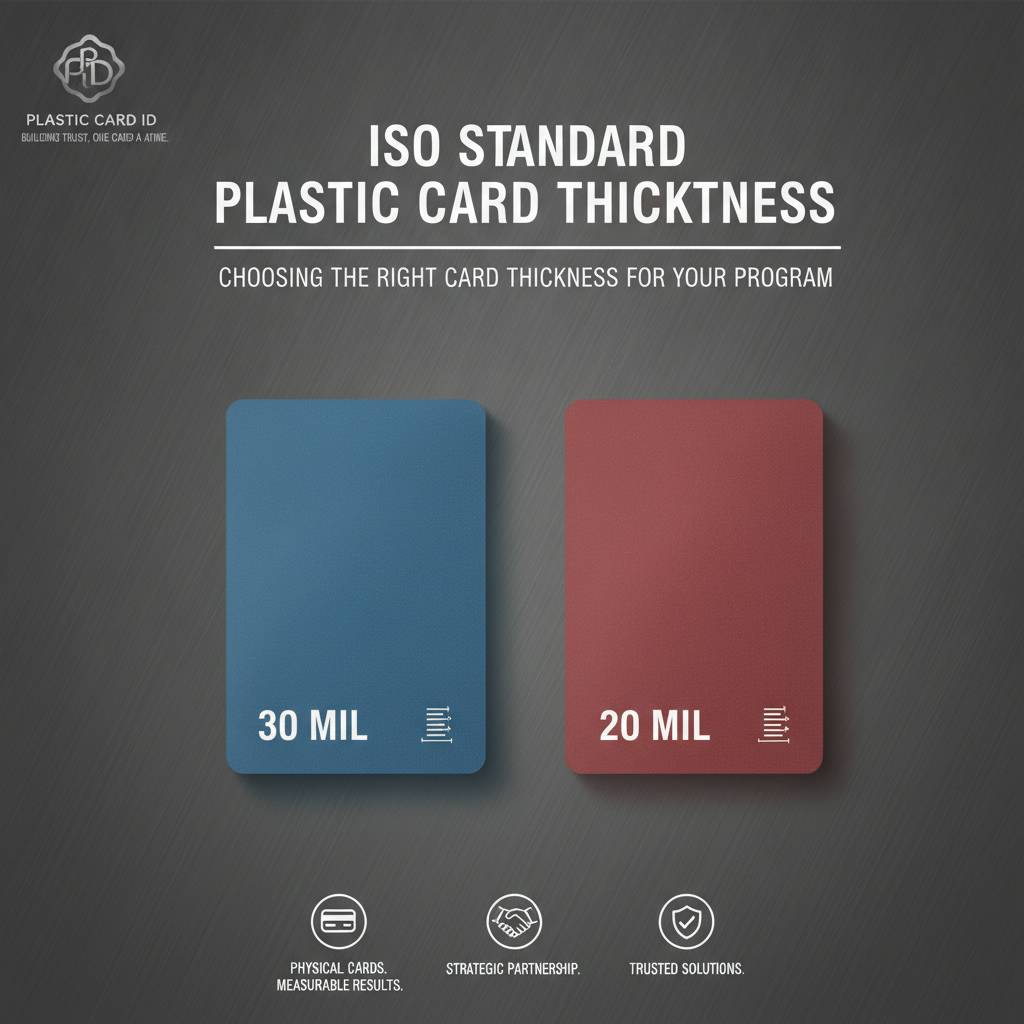 Decision paralysis is real - and the card supply market does not make things easier by listing dozens of product variations without always explaining the practical implications. Here is a straightforward framework that CPE recommends for clients working through this decision for the first time or revisiting it after a program change.
The framework is not complicated, but it does require honest answers about how the card will be used, what equipment is in the workflow, and what impression the card needs to make. Skipping any of those three considerations is where thickness decisions go wrong.
The Three-Question Thickness Decision Framework
First: will this card go through a standard card printer, magnetic stripe encoder, RFID encoder, or smart chip reader? If yes to any of these, start with 30 mil and deviate only if you have a specific, documented reason to do otherwise. The risk of compatibility failure with non-standard thickness is real and significant.
Second: will this card be carried in a wallet, attached to a lanyard, used in a badge holder, or handled repeatedly over weeks or months? Again, 30 mil is the right answer. The durability, rigidity, and professional feel of standard-thickness cards are not luxuries - they are functional requirements for cards that need to survive daily use.
Third: is this card being used in a specialty construction, an overlaminate assembly, or a true single-use scenario where durability is demonstrably irrelevant? Only if the answer to this third question is clearly yes does 20 mil become a reasonable consideration - and even then, hardware compatibility must be verified. Following this framework prevents the vast majority of thickness-related ordering mistakes.
Volume, Budget, and Long-Term Program Economics
Cost-per-card calculations require more variables than thickness alone. Order volume, printing method, encoding requirements, and supplementary materials like ribbon and cleaning kits all factor into total program cost. At larger volumes, the per-card price difference between 20 mil and 30 mil narrows - sometimes to the point of irrelevance relative to other line items in the program budget.
For programs running 50 to 500 cards per month, the per-card savings from choosing 20 mil over 30 mil might amount to a few dollars per order. Against the cost of a printer service call, a batch reprint due to feed errors, or the replacement cost of cards that delaminate prematurely, that savings disappears quickly. Total program economics consistently favor 30 mil for most business applications.
- Blank white PVC 30 mil cards: Lowest per-card cost for in-house printing programs with full design flexibility
- Magnetic stripe 30 mil cards (HiCo and LoCo): Essential for gift card, loyalty, and access programs using stripe-based encoding
- RFID and proximity cards (30 mil): Required for contactless access control; non-negotiable on thickness
- Smart chip cards (30 mil): Chip module housing requires standard substrate thickness
- Clear and frosted 30 mil cards: Specialty visual options that maintain full printer and reader compatibility
- Colored stock 30 mil cards: Pre-colored substrates for programs that do not require full-color printing
- 20 mil cards: Appropriate only for verified specialty constructions or confirmed single-use scenarios
Working with a Card Supplier Who Knows the Difference
There is a meaningful difference between a supplier who takes your order and ships product, and a strategic partner who helps you spec the right product before you order. CPE operates as the latter - asking the questions that surface potential problems before they become expensive realities, and offering guidance based on 25 years of real-world card program experience across over 100,000 customers.
That accumulated experience is genuinely valuable. It means recognizing the customer who is about to order 20 mil cards for a program that will run through standard card printers, and flagging the issue before it becomes a support call and a reorder. It means knowing which Evolis or Zebra or Fargo printer model has specific thickness tolerances that matter for a given application. Expertise like this is not listed on a spec sheet, but it shapes outcomes significantly.
Card Thickness Across Specific Card Types and Applications
Understanding how thickness interacts with different card types reveals why the 30 mil standard was adopted so broadly and why deviating from it carries real operational risk. From casino player cards to hotel key systems to employee access badges, the thickness specification is tied directly to the technology embedded in or used with the card.
The following breakdown covers the most common card types in commercial use and explains the thickness implications for each. This is practical knowledge that makes procurement conversations faster and more productive.
Magnetic Stripe Cards: HiCo and LoCo at 30 Mil
Magnetic stripe cards come in two coercivity levels: High Coercivity (HiCo) at 2750 Oe and Low Coercivity (LoCo) at 300 Oe. HiCo stripes are more resistant to data corruption from everyday magnetic fields - making them the right choice for long-lived cards like employee IDs, loyalty cards, and hotel keys. LoCo cards are appropriate for shorter-lifecycle applications like event access or single-use hotel keys in certain systems.
Both HiCo and LoCo magnetic stripe cards are manufactured on 30 mil substrates. The magnetic stripe itself is laminated to the card surface as part of the manufacturing process, and the tolerances for stripe positioning and encoder head contact are calibrated for standard thickness. Attempting to encode a 20 mil card on a standard encoder is an invitation to encoding errors and stripe damage.
RFID, Proximity, and Smart Chip Cards
Contactless card technologies - RFID, proximity, and smart chip - all involve internal components embedded within the card body. An antenna coil, a chip module, or both must be housed within the card substrate without creating surface irregularities that interfere with printing, reading, or handling. This internal construction is simply not possible at 20 mil; the physical space does not exist.
Advanced options like MIFARE DESFire cards, used in high-security access control and transit applications, are built on 30 mil substrates as a matter of physical necessity. Casino player cards, hotel key systems using RFID technology, and corporate access control badges all follow the same rule. For any card that carries internal technology, 30 mil is the only viable option.
Specialty Cards: Clear, Frosted, Colored, and Metal
Specialty visual options - clear PVC, frosted finishes, pre-colored stock, and die-cut custom shapes - are almost universally manufactured at 30 mil. This is because the visual and tactile premium these cards are intended to deliver is inseparable from their physical weight and rigidity. A clear card that flexes visibly communicates the opposite of the luxury or technical sophistication it was chosen to convey.
Metal cards in stainless steel, brass, and gold represent the apex of the card quality spectrum. These are not 30 mil PVC cards - they are metal, by definition thicker and heavier - but they occupy the same functional footprint as CR80 and serve programs where maximum perceived value is the primary objective. For brands that want their card to stop a conversation, metal cards deliver in ways that no plastic substrate can match, regardless of thickness.
Frequently Asked Questions About Card Thickness
These are the questions that come up in real conversations with buyers who are either entering the card program world for the first time or revisiting decisions they made years ago and are now questioning. Honest, practical answers matter more than marketing language - and that is how CPE approaches every client interaction.
Will My Card Printer Work with 20 Mil Cards?
Maybe - but you need to check before ordering. Most desktop card printers from Evolis, Zebra, and Fargo specify an acceptable card thickness range in their user documentation. Some models list 30 mil as the only supported thickness; others support a range from 20 to 40 mil. The answer depends entirely on your specific printer model, and assuming compatibility without checking is a common and avoidable mistake.
If you are unsure, the safest path is to contact Plastic Card ID at 800.835.7919 before ordering. Providing your printer make and model takes about thirty seconds and eliminates the risk of ordering product that will not function correctly in your existing workflow. A quick verification call is always worth the time it takes.
Is There a Visual Difference Between 30 Mil and 20 Mil Cards?
Side by side, yes - particularly when you pick them up. The 30 mil card has the firmness of a credit card or driver's license. The 20 mil card feels noticeably more flexible, more like a stiff piece of cardstock than a proper plastic card. Most people without direct experience in the card industry can feel the difference immediately, even if they cannot quantify it.
For applications where the card will be seen and touched by customers, clients, members, or employees, this tactile difference has real brand implications. Card quality is perceived instantly and subconsciously - a point that experienced card program managers understand deeply and that first-time buyers sometimes underestimate until they see their cardholders' reactions.
Can I Mix Thicknesses in the Same Card Program?
Technically yes, but practically it introduces complexity that rarely pays off. If your program uses in-house printing, mixing thicknesses means either recalibrating your printer for different batches or maintaining two separate stock types and managing them carefully to avoid mix-ups. For most organizations, the administrative overhead is not worth any cost savings.
A cleaner approach is to standardize on 30 mil across all card types in a given program unless there is a specific, documented technical reason for a different specification on one particular card type. Standardization simplifies inventory, simplifies training, and eliminates the class of errors that come from the wrong card getting fed into the wrong workflow. Simplicity in card program operations is a feature, not a compromise.
Partner with Plastic Card ID for Your Card Program Needs
Over 25 years. More than 50 million cards shipped. Over 100,000 customers across the United States who have trusted CPE with programs ranging from 50 cards a month to mass production in the tens of thousands. That is not a track record built on transactions - it is built on the kind of informed, engaged partnership that helps clients make the right decisions and build programs that work.
Whether you are ordering blank 30 mil white PVC cards for an in-house ID program, sourcing HiCo magnetic stripe cards for a new loyalty initiative, speccing out RFID credentials for an access control upgrade, or simply trying to understand whether 30 mil or 20 mil is right for your application - the right conversation starts with a company that knows the answers from real experience, not guesswork.
A Full Catalog Built Around What Works
The Plastic Card ID catalog covers every card type a serious business program needs: blank PVC in white and color, magnetic stripe in HiCo and LoCo, RFID and proximity cards, smart chip cards, clear and frosted options, custom shapes, and luxury metal cards. Printer hardware from Evolis, Zebra, and Fargo. Ribbons, cleaning kits, card carriers, sleeves, and card mailing services. Everything a card program needs, from first card to finished delivery, from a single trusted source.
The catalog is broad because real programs have varied needs - but the guidance that comes with it narrows choices quickly and confidently. There is no reason to navigate card procurement alone when a team with this depth of experience is available to help. Reach out to Plastic Card ID at 800.835.7919 and start the conversation that builds a better card program.
Serving USA Businesses of Every Scale
From single-location small businesses ordering their first 100 employee ID cards to multi-site enterprises running continuous loyalty programs across dozens of locations, Plastic Card ID serves the full spectrum. The ordering process scales cleanly, pricing reflects volume sensibly, and the advice is equally relevant whether you are a first-time buyer or a seasoned program manager looking for a more dependable supplier relationship.
Identity programs, access control systems, loyalty and reward cards, membership cards, gift card programs, event credentials, casino player cards, hotel key systems - these are the programs that drive real business results, and they are built on the foundation of the right card, specified correctly from the start. 30 mil is almost always that foundation.
Ready to get your card program right from the ground up? Contact Plastic Card ID today at 800.835.7919 and put 25 years of card expertise to work for your business. From blank 30 mil cards to fully encoded smart credentials, Plastic Card ID delivers the product, the knowledge, and the partnership your program deserves.
Previous Page