Difference Between Blank Cards and Pre-Printed Cards
Table of Contents []
- Blank Cards vs. Pre-Printed Cards: What Plastic Card ID Wants You to Know Before You Order
- What Exactly Is a Blank Plastic Card?
- What Pre-Printed Cards Offer and When They Win
- Matching Your Program Type to the Right Card Format
- The Role of Card Printers in a Blank Card Strategy
- Advanced Card Technologies Available in Blank Format
- Frequently Asked Questions About Blank and Pre-Printed Cards
- Partner With Plastic Card ID for Your Card Program - Whatever Direction You Choose
Blank Cards vs. Pre-Printed Cards: What Plastic Card ID Wants You to Know Before You Order
Walk into almost any business that issues cards - a gym, a hotel, a corporate office, a retail store running a loyalty program - and you will find plastic cards doing serious work. But here is a question that trips up buyers at every experience level: should you order blank cards or pre-printed cards? The answer is not as obvious as it sounds, and getting it wrong can cost you time, money, and flexibility down the road.
This page breaks down the real differences, the real tradeoffs, and the real-world scenarios where each option wins. Whether you are launching a new card program from scratch or scaling one that already exists, understanding this distinction will sharpen every decision you make from here on.
| Feature | Blank Cards | Pre-Printed Cards |
|---|---|---|
| Upfront Cost | Lower per-card cost | Higher, includes design/print setup |
| Print Control | Full in-house control | Vendor-controlled output |
| Personalization | On-demand, one at a time | Batch runs, fixed design |
| Lead Time | Fast - print when needed | Production and shipping cycle |
| Minimum Order | As low as 50 cards | Typically 250-500 cards |
| Best For | ID, access, badges, loyalty | Gift cards, mass promotions |
What Exactly Is a Blank Plastic Card?
A blank plastic card is a CR80-standard PVC card - the same dimensions as a credit card, 3.375 inches by 2.125 inches and 30 mil thick - that ships to you with no printed design on its surface. It may have encoding built in (magnetic stripe, RFID chip, proximity antenna) or it may be a plain white card with nothing on it at all. The card is a canvas, not a finished product. What gets printed on it is entirely up to you.
This is the workhorse format for in-house card programs across the country. Organizations of every type - hospitals printing staff badges, schools issuing student IDs, retailers running loyalty programs - keep a supply of blank cards and a card printer on-site, printing exactly what they need, when they need it. The blank card format hands control back to the issuer.
The CR80 Standard and Why It Matters
CR80 refers to the ISO 7810 ID-1 specification - the globally recognized standard for card dimensions. When a card is CR80 and 30 mil thick, it fits every standard wallet, badge holder, card reader, and printer designed for plastic cards. Compatibility is built into the format itself. There is no guessing whether the card will fit your printer or your customer's wallet.
Deviating from CR80 (using thicker, thinner, or differently sized cards) creates immediate compatibility issues with card printers and most reader hardware. Unless you are ordering a specialty die-cut card with a specific purpose, CR80 blank cards should be your default starting point. CPE stocks them in every configuration - plain white, colored stock, clear, frosted, and more.
Blank Card Varieties Worth Knowing
Not all blank cards are structurally identical, even when they share the same outer dimensions. The base card stock varies significantly depending on what the card needs to do. Plain white PVC cards are the most common. Colored PVC stock comes pre-tinted in colors like black, red, blue, and gold, giving your printed design a distinctive base layer without additional cost per card.
Beyond color, there are functional variants: HiCo and LoCo magnetic stripe cards for encoding cardholder data, RFID cards embedded with contactless chips for access control, proximity cards for door readers, and smart chip cards supporting advanced data storage. Each of these starts as a "blank" - unprinted - but carries embedded functionality from the factory.
What Blank Cards Are Not
It is worth being direct about scope. Blank plastic cards from CPE are not financial instruments. They are not credit cards, debit cards, or payment network cards. They are identity, access, loyalty, membership, and marketing tools built for USA-based businesses and organizations. The distinction matters for buyers who may confuse card types during product research.
Similarly, blank cards are not finished products ready for immediate distribution. They require printing, encoding, or both before being issued to cardholders. That step either happens on-site with your own card printer or through a fulfillment partner - but the blank card itself is the raw material, not the deliverable.
What Pre-Printed Cards Offer and When They Win
Pre-printed cards arrive at your door with a design already applied. The front may carry your brand colors, logo, promotional artwork, or a background image. Some pre-printed cards also have variable data printed during production - sequential numbering, barcodes, or even cardholder names if the order includes personalization at the print house. Pre-printed cards are finished products designed for immediate or near-immediate distribution.
The use case is specific and important: when you have a large volume of cards with a consistent design and no need for on-demand personalization, pre-printed cards can deliver a polished, professional product at a competitive price per card. Gift card programs, event admission passes, and large promotional campaigns are scenarios where pre-printed cards shine brightest.
Volume Economics of Pre-Printed Cards
Pre-printed cards typically become cost-effective at higher quantities. Setup fees for artwork, plate preparation, and print runs are amortized across the total order, so a run of 5,000 cards carries far less per-card cost than a run of 200. The larger the batch, the stronger the economic argument for pre-printed cards. Small runs, however, often cost more per card than an equivalent blank card plus in-house printing.
Buyers comparing costs should factor in not just card price but also the full cycle: design file preparation, proofing time, production lead time, and shipping. For a business that needs 500 branded gift cards every quarter, that full cycle is predictable and manageable. For a business that needs to add new employee IDs every week, the cycle becomes a bottleneck.
Design Consistency Across Large Batches
One genuine advantage of pre-printed cards is color consistency across a large order. Commercial card printing equipment calibrated for a specific Pantone or CMYK profile delivers uniform color across thousands of cards in a single batch - something desktop card printers struggle to replicate at scale. If your brand identity demands pixel-perfect color accuracy across large volumes, pre-printed production is the stronger choice.
That said, modern card printers from manufacturers like Evolis, Zebra, and Fargo have closed that gap considerably for short-run and medium-volume programs. For most in-house programs printing 50-500 cards monthly, the color output from a quality desktop card printer is more than adequate and represents significantly faster turnaround than waiting on a pre-printed batch.
Limitations That Buyers Often Overlook
Pre-printed cards are static. Once the batch ships, the design is locked. If your logo changes, your promotional period ends, or your cardholder data schema updates, you are left with cards you cannot use. Inventory waste from design changes is a real cost that rarely appears in initial budget projections but accumulates painfully over time. Design rigidity is the hidden cost of pre-printed card programs.
There is also the reorder cycle to consider. Running out of pre-printed cards at an inconvenient moment - a busy retail season, a high-traffic event - means waiting for production and shipping. Blank cards with an in-house printer eliminate that risk entirely. You print when you need to, in the quantities you need, on your timeline.
Matching Your Program Type to the Right Card Format
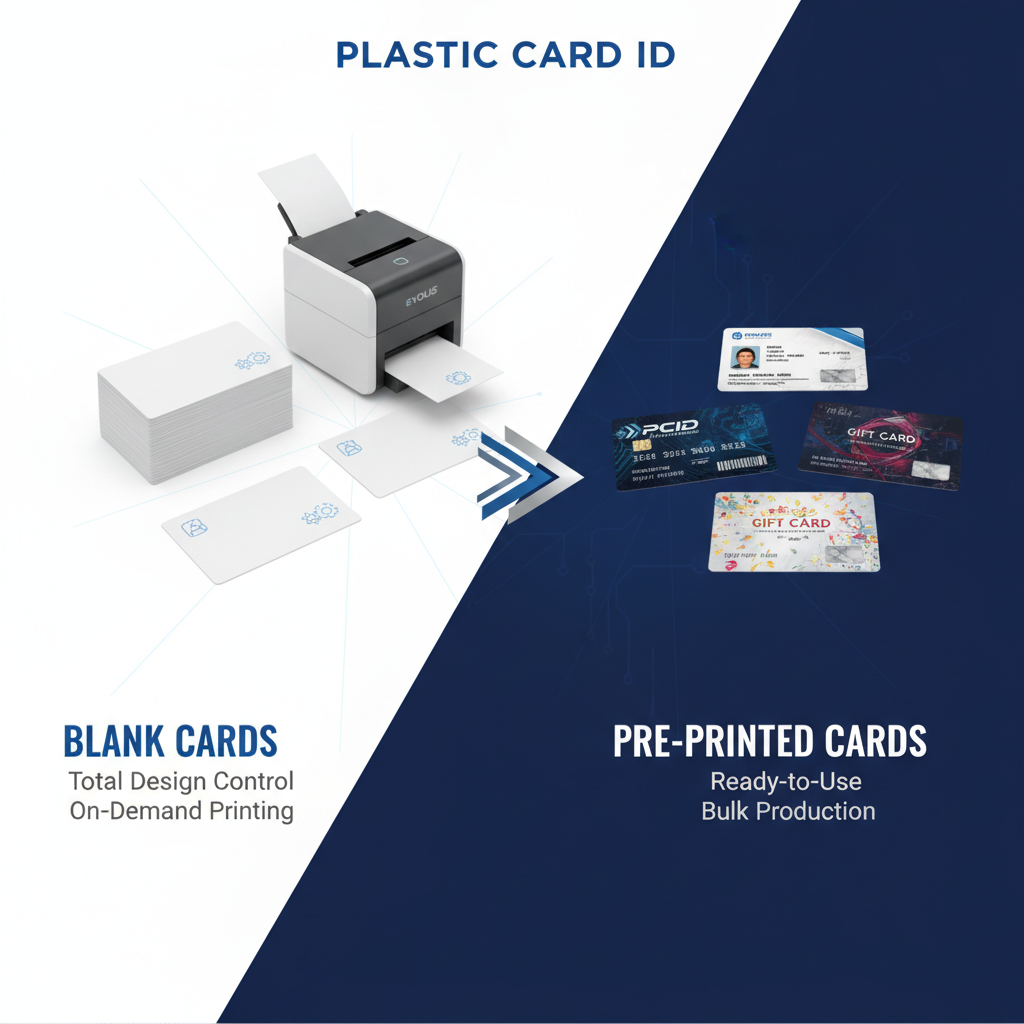 The clearest way to resolve the blank vs. pre-printed debate is to map your program type against what each format delivers. Different card programs have fundamentally different operational rhythms, and the card format that works brilliantly for one program creates friction in another. Let us walk through the most common program types and what actually fits.
Employee ID and Access Control Programs
Employee ID programs are among the strongest arguments for blank cards and in-house printing. New hires arrive on unpredictable schedules. Employees leave and cards must be deactivated and replaced. Job titles change. Departments reorganize. Every one of these events triggers a card update, and waiting on a pre-printed card order each time is operationally disruptive and expensive.
Blank cards - particularly those with HiCo magnetic stripes or RFID chips for access control - combined with a card printer on-site give HR and security teams the ability to issue, replace, and revoke credentials in real time. The total cost of ownership over 12-24 months almost always favors this approach over pre-printed batches. Call 800.835.7919 to discuss the right blank card and printer combination for your team size.
Retail Gift Card Programs
Gift cards are a different story. A retailer launching or refreshing a gift card program typically wants a consistent branded design across a production run of several thousand cards - cards that will sit in a display rack, be handed over counters, and potentially be featured in promotional materials. That is a classic pre-printed card scenario. Retailers switching from paper gift certificates to plastic gift cards consistently report 35-50% increases in gift card sales.
The card design itself becomes a marketing asset. A well-designed gift card in a customer's wallet is a recurring brand impression. For this use case, the investment in professional pre-printed production is justified by the revenue uplift and the brand exposure the physical card delivers over its lifespan.
Loyalty and Membership Card Programs
Loyalty cards and membership cards can go either direction, depending on program scale and personalization requirements. A gym issuing numbered membership cards to a rolling roster of 200-400 members benefits from blank cards with an in-house printer - the flexibility to print a card for a new member within minutes, on the spot, is a customer experience advantage. Loyalty cards that live in wallets consistently outperform paper punch cards on repeat visit rates.
A national retail chain rolling out a loyalty program to hundreds of locations simultaneously may find pre-printed cards more practical for the initial deployment. The key question is always this: how often does your cardholder data or design change, and how quickly do you need to respond when it does? That single question determines the right format more reliably than any other factor.
| Program Type | Recommended Format | Key Reason |
|---|---|---|
| Employee ID / Access | Blank In-House Printer | Frequent updates, on-demand issuance |
| Retail Gift Cards | Pre-Printed (large runs) | Consistent design, volume economics |
| Loyalty / Membership | Blank or Pre-Printed | Depends on scale and update frequency |
| Event Credentials | Blank In-House Printer | Last-minute additions, on-site printing |
| Hotel Key Cards | Pre-Printed or Blank RFID | Brand design, RFID encoding at check-in |
The Role of Card Printers in a Blank Card Strategy
Blank cards do not print themselves. If you are building an in-house card program around blank PVC cards, a card printer is the other half of the equation. Choosing the right printer for your volume, card type, and output quality requirements is as important as choosing the right blank card stock. Get the printer wrong and even the best blank cards will underdeliver.
Entry-Level to Enterprise: Matching Printer to Volume
Card printers from Evolis, Zebra, and Fargo span a wide range of capabilities and price points. Entry-level single-sided printers handle low volumes efficiently - programs printing 50-200 cards per month find these more than adequate, and their compact footprint suits office environments. Mid-range dual-sided printers handle higher volumes and more complex card designs. Enterprise-level systems support encoding, lamination, and high-speed production for programs in the thousands per month.
The printer you need is not necessarily the most advanced one available. Matching printer capacity to actual program volume prevents both under-investment and over-spending. CPE carries the full range and can help you find the right fit for where your program is today - and where it is likely to go within the next two to three years.
Consumables, Ribbons, and Ongoing Costs
Beyond the printer itself, in-house programs require printer ribbons, cleaning kits, and sometimes card carriers or sleeves. These ongoing consumables are real costs that factor into the total economics of a blank card program. Factoring in ribbon yield per card and cleaning kit frequency gives you an accurate picture of true per-card cost - one that, in most program types, still compares favorably to pre-printed card procurement over time.
Full-color YMCKO ribbons handle the majority of card designs. If your program uses only text, barcodes, or monochrome artwork, single-color or two-panel ribbons are significantly more cost-efficient per card. Discussing your design requirements before purchasing ribbons in bulk can generate meaningful savings. Call 800.835.7919 for guidance on ribbon selection for your specific printer and card program.
On-Site Printing and Instant Issuance
One underappreciated benefit of blank cards and in-house printing is the customer experience win that comes from instant card issuance. A new gym member who walks out with their membership card in hand has a meaningfully different experience than one who is told their card will arrive by mail in 7-10 business days. Instant issuance is a retention and satisfaction driver, not just an operational convenience.
For event credentials, the advantage is even clearer. Last-minute attendees, name changes, and VIP additions happen at every event. Having a blank card supply and a printer on-site means those situations are handled in seconds rather than creating lines, confusion, or the awkward workaround of handwritten badges.
Advanced Card Technologies Available in Blank Format
Blank does not mean basic. Some of the most sophisticated card technologies available ship in blank format, ready for your printer and encoder. Understanding what is available - and what each technology enables - opens up card program possibilities that go well beyond a simple printed piece of plastic.
RFID, Proximity, and Smart Chip Cards
RFID cards and proximity cards are issued blank from the manufacturer - the chip and antenna are embedded in the card body, but no cardholder data is encoded until you program the card for your specific system. This means you can stock blank RFID cards and encode them on demand as new credentials are needed. Contactless technology including MIFARE DESFire supports advanced access control, cashless payment within closed systems, and high-security credential management.
Hotel key cards, casino player cards, and building access systems all operate on this model. The card arrives blank. The system encodes it at issuance. Each card is unique in function despite being physically identical before encoding. This is a powerful operational architecture that blank card programs make possible.
Magnetic Stripe Encoding: HiCo vs. LoCo
Magnetic stripe cards come in two encoding densities. HiCo (High Coercivity) stripes are harder to accidentally erase and are the standard for applications where cards will be exposed to other magnetic fields - near other cards in a wallet, near electronic devices, or in high-use environments. LoCo (Low Coercivity) stripes are easier to encode and re-encode, making them suitable for short-term applications like hotel room keys where the encoding changes with each guest stay.
- HiCo cards are recommended for loyalty cards, membership cards, employee IDs, and any long-term credential.
- LoCo cards are suitable for hotel key cards, event passes, and other short-duration or frequently re-encoded applications.
- Both formats are available as blank cards, ready for your in-house encoder or printer-encoder combination.
- Most standard card printers support magnetic stripe encoding as a built-in option or upgrade module.
Specialty Blank Cards: Clear, Frosted, and Metal
Beyond white PVC, the blank card category includes clear plastic cards, frosted translucent cards, and even luxury metal cards in stainless steel, brass, and gold. Clear and frosted cards create striking visual effects when printed - the transparency interacts with the printed design in ways that solid white PVC simply cannot replicate. These specialty blanks give designers a completely different visual canvas without departing from standard CR80 dimensions.
Metal cards occupy a different tier entirely. Stainless steel, brass, and gold metal cards signal exclusivity and permanence in a way no plastic card can match. VIP membership programs, premium loyalty tiers, corporate client gifting, and luxury brand credentials are natural homes for metal cards. They are available through CPE for programs where the card itself needs to communicate exceptional value.
Frequently Asked Questions About Blank and Pre-Printed Cards
Buyers researching the blank vs. pre-printed question tend to arrive with a consistent set of follow-up questions. Here are the ones that come up most frequently - with direct, practical answers.
Can I Mix Blank and Pre-Printed Cards in My Program?
Yes, and many programs do exactly this. A retailer might use pre-printed cards for their standard gift card design - ordered in large runs to keep costs low - while using blank cards and an in-house printer for employee badges, back-office credentials, and event passes. The two formats are not mutually exclusive, and a thoughtful mix often delivers the best overall cost and flexibility profile.
The key is identifying which parts of your card program are stable (consistent design, predictable volume) and which are dynamic (frequent personalization, unpredictable timing). Stable components are good candidates for pre-printed production. Dynamic components almost always benefit from blank card flexibility.
What Is the Minimum Order for Blank Cards?
Minimum orders start as low as 50 cards, making blank card programs accessible to small organizations and businesses that are just launching a card program and not yet sure of their volume requirements. This low entry point is one of the reasons blank card programs are popular with startups, nonprofits, schools, and small retailers. You do not need to commit to thousands of cards to get started.
As your program grows, per-card pricing improves at higher quantities. Organizations that start with 500 cards and scale to 5,000 cards per order see meaningful cost reductions as volume increases, all while maintaining the flexibility that blank cards provide.
How Do I Know Which Option Saves More Money Long-Term?
The honest answer: it depends on your update frequency. A program with a static design and high, predictable volume will save money with pre-printed cards over time. A program with frequent design changes, variable cardholder data, or unpredictable timing will save money - and avoid waste - with blank cards and in-house printing. The total cost calculation must include wasted inventory from outdated pre-printed batches, a line item that is easy to underestimate at the outset.
- Calculate your annual card volume and determine whether it is consistent or variable.
- Estimate how often your card design or cardholder data changes.
- Factor in the cost of a card printer and annual consumables against the markup on pre-printed production.
- Account for reorder lead time and the cost of running out of cards unexpectedly.
- Consider the flexibility value of being able to print one card immediately versus waiting for a batch order.
Partner With Plastic Card ID for Your Card Program - Whatever Direction You Choose
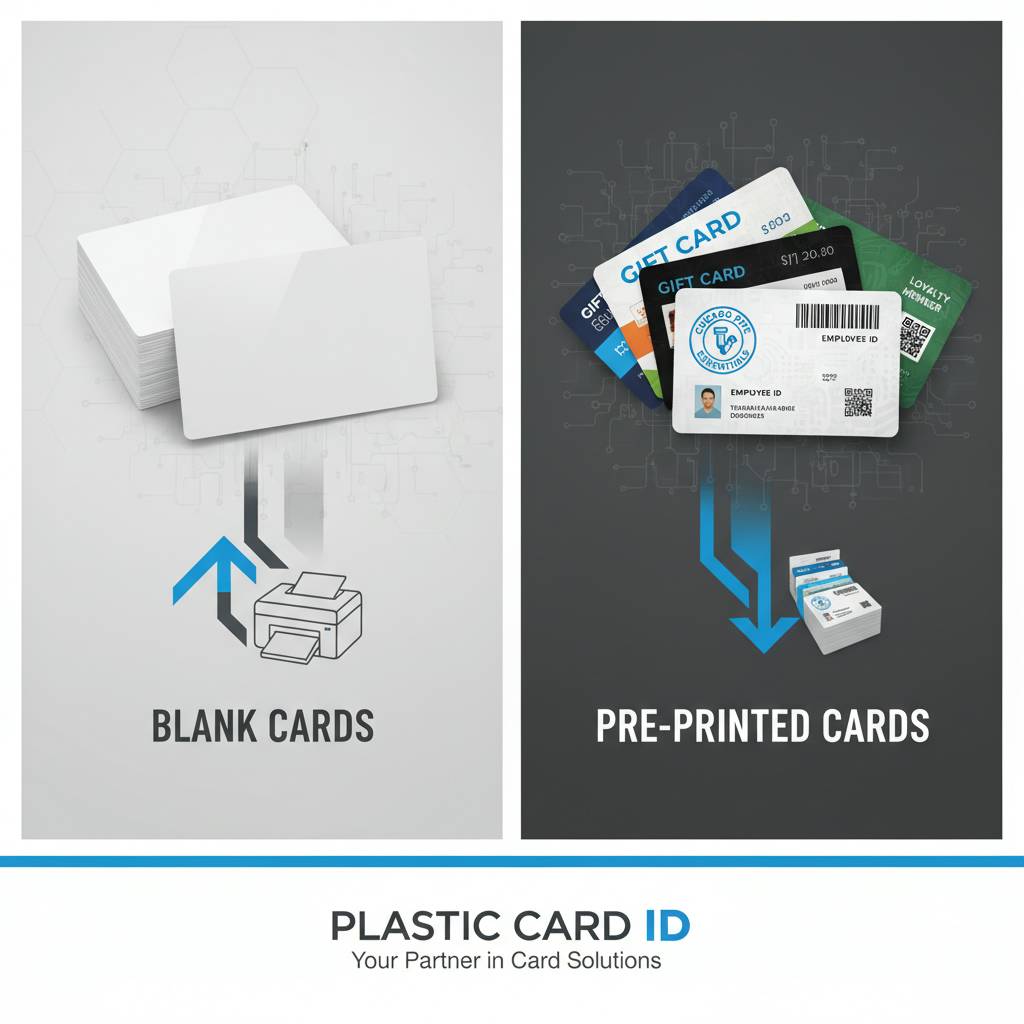 The blank vs. pre-printed question does not have a universal right answer. It has the right answer for your specific program, your specific volume, your specific operational rhythm. Plastic Card ID has spent over 25 years helping businesses across the United States figure out exactly which answer that is - and then supplying everything needed to execute it well, from the cards themselves to the printers, ribbons, and accessories that make a card program run reliably.
With more than 100,000 customers served and over 50 million cards supplied, CPE brings real-world experience across every card program type: employee ID, access control, loyalty, membership, gift, event, hotel key, casino player, and more. The catalog spans blank white PVC, colored stock, clear, frosted, magnetic stripe, RFID, smart chip, proximity, and specialty formats including metal cards - all available in the quantities your program actually needs, not the minimums that benefit someone else's production schedule.
Ready to find the right card format for your program? Call Plastic Card ID today at 800.835.7919 - talk directly with someone who knows cards, knows programs, and knows how to help you make the right call.
Previous Page