Smart Chip vs Magnetic Stripe Security Comparison
Table of Contents []
- Smart Chip vs Magnetic Stripe Security: What Plastic Card ID Wants You to Know Before You Choose
- Understanding How Magnetic Stripe Cards Actually Work
- Smart Chip Card Technology: Security Architecture Explained
- Head-to-Head: Security Comparison Across Real Use Cases
- Choosing the Right Card for Your Organization: A Buyer's Framework
- The Plastic Card ID Catalog: Cards, Printers, and Everything Between
- Frequently Asked Questions: Smart Chip vs Magnetic Stripe Security
Smart Chip vs Magnetic Stripe Security: What Plastic Card ID Wants You to Know Before You Choose
There is a question that comes up constantly in conversations about card programs, and it rarely gets a straight answer: which card technology actually protects your organization better - smart chip or magnetic stripe? The answer is not as simple as "chip wins every time." The real story depends on what you are protecting, how you are using the card, and what your infrastructure already supports.
At Plastic Card ID, we have spent decades helping businesses and organizations across the United States build card programs that work - not just on day one, but for years. That experience gives us a genuinely useful perspective on this comparison, one grounded in real-world deployments rather than marketing brochures. So let us dig into the actual security mechanics, practical tradeoffs, and smart decision-making around these two dominant card technologies.
| Feature | Magnetic Stripe (HiCo) | Smart Chip (Contact/Contactless) |
|---|---|---|
| Data Storage Capacity | 140 bytes (3 tracks) | Up to 64KB or more |
| Cloning Resistance | Low - data is static and readable | High - encrypted, dynamic authentication |
| Reader Compatibility | Near-universal legacy support | Requires chip-compatible readers |
| Typical Cost Per Card | Lower - well-established supply chain | Higher - advanced component costs |
| Best For | Loyalty, gift, access, ID programs | High-security access, RFID, smart environments |
| Physical Durability | Good - stripe can demagnetize over time | Excellent - chip embedded in PVC body |
Understanding How Magnetic Stripe Cards Actually Work
Magnetic stripe technology has been around since the 1960s, and there is something almost remarkable about how thoroughly it has endured. The concept is straightforward - a ferromagnetic material is applied to the back of the card in a stripe, and data is encoded into that stripe as a series of magnetic flux changes. When the card is swiped through a reader, those changes are interpreted as digital information.
The reliability of magnetic stripe cards in everyday environments is genuinely hard to overstate. Point-of-sale systems, hotel key locks, gym entry readers, library systems - the infrastructure built around mag stripe is enormous. For organizations running loyalty programs, membership cards, or basic access control, this ubiquity is a legitimate operational advantage that smart chip technology has not yet fully displaced.
HiCo vs LoCo: The Encoding Difference That Matters
Not all magnetic stripes are equal. High coercivity (HiCo) stripes use stronger magnetic fields to encode data, making them far more resistant to accidental erasure from everyday magnets. If your card is going to live in a wallet alongside other cards, keys, or magnetic clasps, HiCo is simply the responsible choice. CPE stocks both variants, but HiCo is the recommendation for almost every serious card program.
Low coercivity (LoCo) cards encode at lower field strengths, which makes them easier to write to with simpler hardware - but also easier to accidentally wipe. They have legitimate uses in short-term or controlled environments, like hotel key cards that are reprogrammed for each guest. Understanding which coercivity level your readers and printers support is a foundational step in building a functional card program.
What Magnetic Stripe Cannot Do: The Security Ceiling
Here is where the honest conversation gets important. Magnetic stripe data is static and unencrypted at the card level. The data encoded on a track does not change between reads. It cannot authenticate itself to the reader, and it cannot verify that the reader is legitimate. This means that a device capable of reading magnetic stripes can also clone them - and that is a real vulnerability in high-stakes environments.
For many card programs, this vulnerability is largely theoretical. A loyalty card or gym membership card does not carry sensitive personally identifiable information tied to financial accounts. The practical risk of someone cloning your coffee shop loyalty card is minimal. But for employee access control to sensitive facilities, or for any card carrying high-value privileges, the static-data limitation of magnetic stripe becomes a genuine security consideration worth weighing carefully.
Magnetic Stripe Cards in Real Programs: Where They Shine
Retailers that deploy plastic gift cards with magnetic stripes consistently report strong performance. Switching from paper gift certificates to plastic mag stripe cards has driven sales increases of 35-50% for many retail clients - not because the technology is flashy, but because the physical card creates a gift-giving experience that paper simply cannot replicate. The card is kept, displayed, and remembered.
Loyalty programs see similar dynamics. A plastic loyalty card that lives in a wallet is consulted, used, and retained far longer than a paper punch card. The magnetic stripe encodes a customer account number that ties into your POS or loyalty platform. Simple, proven, and extremely cost-effective to produce at scale - from 50 cards up to tens of thousands per run.
Smart Chip Card Technology: Security Architecture Explained
Smart chip cards operate on a fundamentally different security model. Rather than storing static data on a passive surface, the chip is an active microprocessor. It can store encrypted data, execute programs, and - critically - participate in a cryptographic authentication handshake with the reader before any data is exchanged. That handshake is the core of why chip cards are so much harder to clone.
When a smart chip card communicates with a reader, it does not simply transmit its stored data. It proves to the reader that it holds the correct cryptographic key, without ever actually revealing that key. This mutual authentication means that even if someone intercepts the communication between the card and the reader, they cannot use that intercepted data to create a functional clone. The security model is architecturally superior to magnetic stripe in environments where cloning or interception attacks are realistic threats.
Contact vs Contactless: Two Flavors of Smart Chip
Contact smart cards require physical insertion into a reader - the gold contacts on the card face mate with contacts in the reader slot, completing the circuit. This is the technology behind most modern EMV payment cards, employee ID badges with PKI certificates, and government identification. Contact chips offer high data capacity and strong security, but the physical insertion requirement affects throughput in high-volume access scenarios.
Contactless smart cards communicate via radio frequency, typically at 13.56 MHz. Tap the card near a reader and the transaction completes in under 100 milliseconds. RFID smart cards using protocols like MIFARE DESFire are the standard in enterprise access control, transit systems, and casino player tracking. The DESFire platform specifically offers AES-128 encryption, making it among the most secure contactless card technologies commercially available outside of classified environments.
RFID and Proximity Cards: Where They Differ
Proximity cards - sometimes called prox cards - are often confused with smart cards, but they are meaningfully different in their security architecture. A standard 125 kHz proximity card broadcasts its facility code and card number in the clear. No encryption, no mutual authentication. It is simply a more convenient version of magnetic stripe in terms of its security posture, though far harder to accidentally demagnetize.
True RFID smart cards at 13.56 MHz with encryption represent a genuine security upgrade over both magnetic stripe and proximity technology. If your organization is evaluating an access control upgrade, this distinction matters enormously. The hardware investment in 13.56 MHz readers pays for itself in the security quality you receive - especially for facilities with regulated access requirements or high-value assets to protect.
MIFARE DESFire and Enterprise-Grade Card Security
MIFARE DESFire EV2 and EV3 chips represent the current high-water mark for commercial contactless smart card security. They support AES-128 and 3DES encryption, diversified keys per card, and mutual authentication protocols that make card cloning computationally infeasible with current technology. For casino operators, healthcare facilities, corporate campuses, and data centers, this level of security is not optional - it is the baseline.
CPE supplies MIFARE DESFire compatible cards and works with organizations to match chip specifications to their existing or planned reader infrastructure. Choosing the right chip family for your environment prevents costly compatibility mismatches down the road. Not all 13.56 MHz cards are interchangeable - chip type, memory structure, and encoding format all affect whether a card will work with a given reader platform.
Head-to-Head: Security Comparison Across Real Use Cases
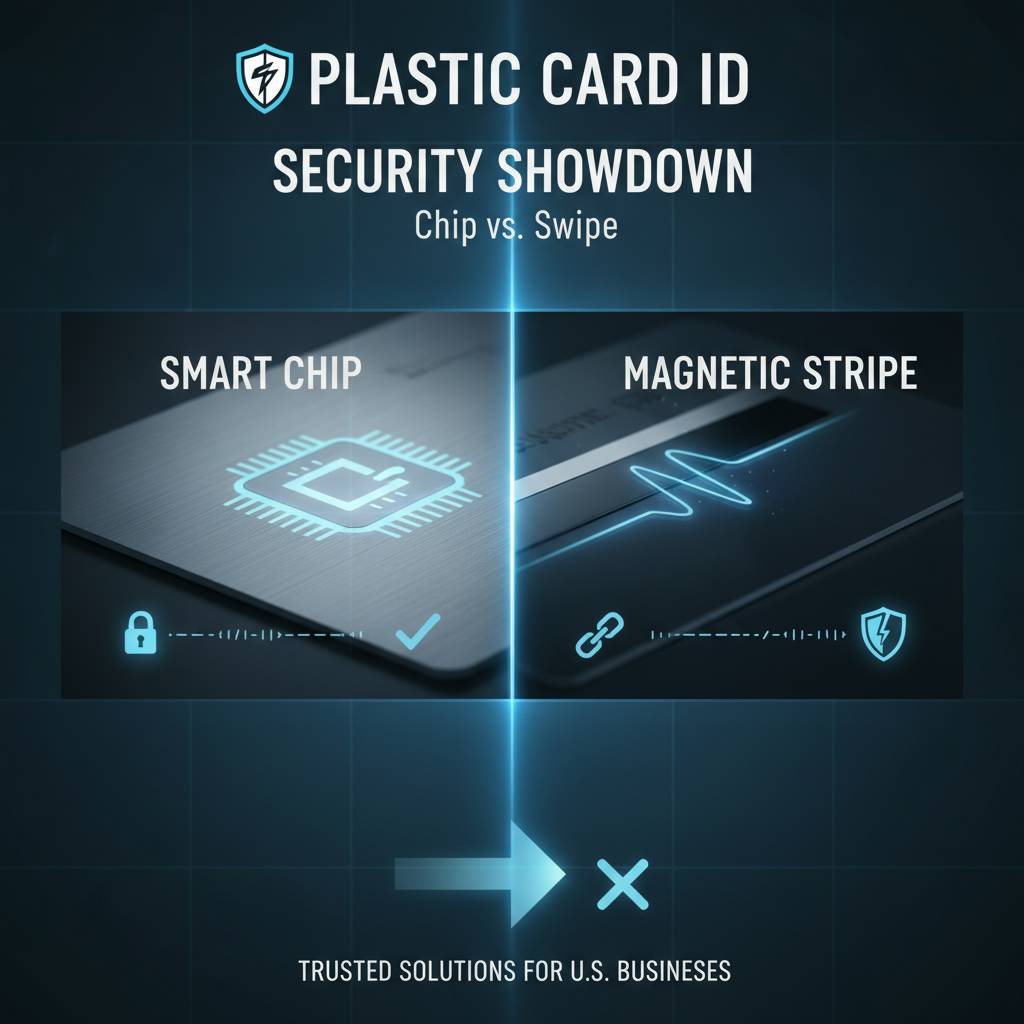 Abstract security comparisons are useful only to a point. What most organizations actually need is a concrete answer to a practical question: given what I am using this card for, which technology gives me the right balance of security and cost? The answer varies more than most vendors will admit, and getting it wrong in either direction costs money - either through unnecessary complexity or through security gaps that create real exposure.
Consider two scenarios side by side. A regional grocery chain running a loyalty program processes millions of swipes per year with HiCo magnetic stripe cards. The data on each card is a customer account number, nothing more. The risk profile is low, the infrastructure is mature, and the per-card cost is favorable. Meanwhile, a pharmaceutical company managing access to a controlled-substance storage facility needs every door event logged, authenticated, and auditable - magnetic stripe simply is not appropriate for that environment.
Loyalty and Gift Card Programs
For loyalty and gift card programs operated by US-based retailers, restaurants, and service businesses, magnetic stripe remains a highly competent and cost-effective choice. The security requirements for these cards are moderate - account number integrity matters, but cryptographic authentication is not typically in the threat model. HiCo encoding provides adequate durability, and the reader ecosystem is universally available.
That said, organizations with sophisticated loyalty platforms that want to encode additional data layers - tiered membership status, encrypted identifiers, or contactless convenience features - may benefit from hybrid cards that combine a magnetic stripe with a contactless chip. These cards serve both legacy infrastructure and modern reader installations simultaneously, which can be valuable during a phased technology transition.
Employee ID and Access Control
Employee ID and physical access control is where the security gap between magnetic stripe and smart chip becomes most operationally significant. A magnetic stripe access card can be cloned with consumer-grade hardware available online. For any facility where that risk is unacceptable, the upgrade path leads directly to contactless smart cards with encrypted authentication.
The decision is not purely about card technology either - it requires evaluating the reader infrastructure, the access control software, and the card management system. Organizations running Wiegand-based reader systems with standard proximity cards can often upgrade to 13.56 MHz readers that support both proximity and smart card formats, enabling a gradual transition without ripping out existing hardware all at once.
- Magnetic stripe access cards: Suitable for lower-security environments, high reader compatibility, low cost per card.
- Proximity (125 kHz) cards: Convenient, no physical contact required, but security is equivalent to magnetic stripe.
- 13.56 MHz contactless smart cards (MIFARE Classic): Better security than proximity, but known vulnerabilities in older MIFARE Classic implementations.
- MIFARE DESFire EV2/EV3: Current best-in-class for commercial access control security.
- Contact smart cards (ISO 7816): Highest data capacity, strong PKI support, appropriate for logical access alongside physical access.
Hotel Key Cards and Hospitality Applications
Hotel key cards present a fascinating middle case. The majority of properties still use magnetic stripe encoding, often LoCo, because hotel lock systems are purpose-built around that technology and the guest experience tolerates the occasional demagnetized card. The security model for a hotel key card is different from an enterprise access card - the room lock itself enforces the security, and key cards are reprogrammed constantly.
Higher-end properties and newer hotel builds increasingly use 13.56 MHz contactless key systems. The guest experience improves meaningfully - tap to enter, no swiping, no orientation issues. And the security profile improves as well. RFID-based hotel key systems are significantly harder to clone than their magnetic stripe equivalents, which matters for guest confidence and liability considerations in premium hospitality environments.
Choosing the Right Card for Your Organization: A Buyer's Framework
Walking through a purchasing decision systematically saves time and avoids expensive mistakes. The first question is not "which technology is better" - it is "what does this card need to do, and what infrastructure does it need to work with?" Those two answers narrow the field considerably before you ever look at a price sheet.
Budget matters, but it should be evaluated across the full program lifecycle, not just the per-card cost. A smart chip card may cost more per unit than a magnetic stripe card of equivalent size, but if it eliminates one security incident or one infrastructure replacement cycle, the math shifts. Total cost of ownership is the right frame for this decision, not unit price alone.
Assessing Your Threat Model Honestly
Most organizations do not need to defend against sophisticated adversaries running active interception attacks. For the vast majority of loyalty programs, membership cards, event credentials, and basic employee ID programs, magnetic stripe offers entirely adequate security at a price point that supports large-scale deployment. Being honest about your actual threat environment prevents over-engineering that adds cost without adding meaningful protection.
For organizations in regulated industries - healthcare, finance, government contracting, defense supply chains - the calculus is different. Compliance requirements may mandate specific authentication mechanisms, and the cost of non-compliance far exceeds the premium for smart chip technology. In those environments, smart chip cards are not a luxury; they are a compliance and risk management necessity.
Questions to Ask Before You Order
What readers do you currently have, and what standards do they support? What data needs to live on the card versus in a connected system? How long does each card need to function reliably? Will cards be used in environments that expose them to magnets, chemicals, or physical stress? Does your program require over-the-air or remote card management? Each of these questions shapes the right technology answer.
Call CPE at 800.835.7919 and walk through your program requirements with someone who has helped organizations across every industry build card programs that work. The right card specification comes from understanding your workflow, not from defaulting to whichever technology sounds most impressive in a spec sheet.
Hybrid Cards: When You Need Both Technologies
The choice between smart chip and magnetic stripe is not always binary. Hybrid and combi cards are available that incorporate both a magnetic stripe and a chip - contact, contactless, or both - on a single CR80 card body. These cards are particularly useful for organizations transitioning between technology generations, or for programs that need to interface with both modern and legacy reader infrastructure simultaneously.
A university campus card, for example, might carry a magnetic stripe for legacy vending machine compatibility, a proximity chip for door access, and a contact chip for library authentication - all on one card. Multi-technology cards reduce the number of cards a person needs to carry, which directly improves adoption rates and program engagement. The per-card cost is higher, but the consolidation value is real.
The Plastic Card ID Catalog: Cards, Printers, and Everything Between
Building a card program requires more than selecting a card technology. You need cards, a printer capable of encoding and printing them, ribbons, cleaning kits to keep that printer running reliably, and often card carriers, sleeves, or mailing services to get finished cards to their recipients. Plastic Card ID supplies all of it - from blank CR80 PVC stock to fully specified smart card blanks to printers from Evolis, Zebra, and Fargo.
Having a single supplier for your entire card program reduces friction significantly. When the ribbon you order is matched to the printer you own, and the cards are specified to work with both, compatibility problems become rare. Our team understands the full stack, and that knowledge shows up in fewer support calls and more programs that work exactly as intended from the first batch forward.
Card Printers for Every Program Scale
For organizations doing in-house card personalization, the printer choice matters as much as the card choice. Entry-level desktop printers from Evolis are well-suited for programs printing 50-500 cards per month - employee badges, membership cards, event credentials. Mid-range and high-throughput models from Zebra and Fargo handle larger volumes with faster cycle times and more robust encoding options including dual-sided printing and magnetic stripe encoding in a single pass.
Smart card encoding requires a printer equipped with a smart card contact station or contactless encoding antenna. Not every printer supports every chip type, and confirming compatibility before purchasing is essential. CPE can match a printer to your specific card specification, ensuring that the encoding hardware supports your chip type, encoding format, and volume requirements without overspending on capabilities you will never use.
Supplies, Accessories, and Card Mailing Services
Printer ribbons, cleaning kits, and card sleeves are not afterthoughts - they are what keeps a card program running smoothly over time. A dirty print head produces streaky cards. The wrong ribbon for a given printer or card surface produces adhesion failures. Keeping the right supplies on hand, matched to your specific printer and card stock, is a detail that separates programs that consistently produce professional results from those that struggle with quality inconsistencies.
For organizations that need finished cards delivered directly to cardholders, Plastic Card ID offers card affixing and mailing services. The ability to outsource the physical fulfillment step is especially valuable for membership organizations, loyalty program launches, and any scenario where personalized cards need to reach hundreds or thousands of recipients without burdening internal staff with a time-consuming manual process.
Ready to build a card program that gets the technology right from the start? Contact Plastic Card ID today and let us help you specify the right card, the right encoding technology, and the right printing solution for your exact requirements.
Frequently Asked Questions: Smart Chip vs Magnetic Stripe Security
Organizations evaluating card technology for the first time - or reconsidering an existing program - tend to have consistent questions. The answers below reflect the kind of practical guidance that comes from decades of helping real programs succeed, not theoretical comparisons drawn from product spec sheets.
Can a magnetic stripe card be cloned easily?
Yes, relatively easily - with consumer-grade hardware. The data on a magnetic stripe is static and unencrypted at the card level, which means any device capable of reading the stripe can also copy it to a blank card. For most loyalty and membership programs, this is a low-probability risk. For access control to sensitive areas, it is a material vulnerability that justifies the upgrade to encrypted smart card technology.
The practical risk depends entirely on what an attacker gains by cloning the card. A cloned loyalty card gets them free coffee. A cloned employee access card gets them into a server room. Calibrating your security investment to the actual consequences of a breach is the rational approach, and it leads to very different answers depending on your use case.
Are smart chip cards compatible with my existing readers?
That depends entirely on what readers you have. Smart chip cards are not universally backward-compatible with magnetic stripe infrastructure. Contact smart cards require a reader with a chip slot. Contactless smart cards require a reader with an RFID antenna operating at the correct frequency and supporting the correct communication protocol. Proximity readers designed for 125 kHz cards will not read 13.56 MHz smart cards.
Before specifying smart chip cards for any program, auditing your existing reader infrastructure is a necessary step. The good news is that many modern multi-technology readers support both proximity and smart card protocols, making hybrid transitions feasible without full hardware replacement. A conversation with a knowledgeable supplier saves significant time and money at this stage of the decision process.
What is the typical price difference between mag stripe and smart chip cards?
Magnetic stripe cards are among the most cost-effective card formats available, particularly at volume. Smart chip cards carry a higher per-unit cost due to the chip component and more complex manufacturing process. The gap varies by chip type - a basic contact smart card costs more than a HiCo mag stripe card, while MIFARE DESFire cards carry a meaningful premium over both. At high volumes, per-card costs decrease across all categories.
For most programs, the relevant comparison is total program cost over a multi-year period, including reader infrastructure, card management software, personalization hardware, and ongoing card supply. Per-card cost is one input into a larger equation, and optimizing only on that variable often leads to suboptimal total outcomes. Speak with CPE about your specific volume and timeline to get accurate pricing for your program.
Make the call that gets your card program right. Reach out to Plastic Card ID at 800.835.7919 - our team is ready to guide you through the smart chip vs magnetic stripe decision with the kind of practical, experience-based advice that comes from over 25 years and more than 50 million cards sold across the United States.
Previous Page