Blank Magnetic Stripe Cards Explained: HiCo vs LoCo
Table of Contents []
- What Every Business Should Know About Blank Magnetic Stripe Cards - Plastic Card ID
- The Science Behind the Stripe - How Magnetic Stripe Cards Actually Work
- HiCo Magnetic Stripe Cards - Built for Programs That Cannot Afford Failures
- LoCo Magnetic Stripe Cards - The Right Tool for Short-Lifecycle Applications
- Choosing the Right Blank Card Stock for Your Magnetic Stripe Program
- Frequently Asked Questions About HiCo and LoCo Magnetic Stripe Cards
- Partner With Plastic Card ID for Your Magnetic Stripe Card Program
What Every Business Should Know About Blank Magnetic Stripe Cards - Plastic Card ID
Swipe. That single motion carries more information than most people realize. Behind every magnetic stripe card lies a carefully engineered data layer - invisible to the eye, essential to operations. Whether you are running a gym membership program, a hotel key system, a loyalty rewards setup, or an employee access control network, the magnetic stripe on your card is the quiet engine making it all work.
The choice between HiCo and LoCo magnetic stripe technology is not cosmetic. It is functional. It determines how long your data survives, which environments your cards can handle, and whether your readers will perform reliably six months from now. CPE has helped tens of thousands of businesses navigate exactly this decision - and the difference in outcomes is measurable.
This guide exists because too many buyers order the wrong stripe type, discover the problem after printing thousands of cards, and have to start over. Understanding the fundamentals before you buy protects your investment and keeps your card program running without interruption.
| Feature | HiCo (High Coercivity) | LoCo (Low Coercivity) |
|---|---|---|
| Coercivity Rating | 2750 Oe | 300 Oe |
| Data Durability | Very High - Long-term use | Moderate - Short to mid-term |
| Resistance to Magnetic Fields | Excellent | Limited |
| Common Applications | Access control, loyalty, ID | Hotel keys, event passes |
| Encoding Equipment | HiCo encoder required | Standard encoder compatible |
| Cost | Slightly higher per card | Lower per card |
The Science Behind the Stripe - How Magnetic Stripe Cards Actually Work
A magnetic stripe card is not magic - it is physics. The dark band on the back of a card contains millions of microscopic iron-based particles suspended in a resin coating. When an encoder applies a magnetic field across that stripe, those particles align in specific patterns representing binary data. Swipe the card through a reader, and the reader detects those alignments and converts them back into readable information.
What separates HiCo from LoCo is the amount of magnetic force required to change or erase those particle alignments. Coercivity, measured in Oersteds (Oe), is that resistance. A high coercivity stripe at 2750 Oe takes significant magnetic force to alter - the kind of force you will not accidentally encounter in daily life. A low coercivity stripe at 300 Oe is far more susceptible to the ambient magnetic fields found in purses, near speakers, or alongside other cards.
Understanding Magnetic Tracks: Track 1, Track 2, and Track 3
Most magnetic stripe cards include up to three data tracks. Track 1 holds alphanumeric data - names, account identifiers, and cardholder information - at a density of 210 bits per inch. Track 2, the most commonly read track, carries numeric data at 75 bpi and is the standard for most point-of-sale and access systems. Track 3 is rarely used in commercial card programs but technically supports read-write applications.
For the majority of business applications - loyalty programs, membership cards, employee IDs, and access credentials - Tracks 1 and 2 provide more than enough capacity. Knowing which tracks your reader or system actually uses is critical before you order cards, because encoding the wrong track wastes time and creates reader errors that frustrate both staff and customers.
What Coercivity Means for Your Day-to-Day Card Program
Think about where your cards will live. A hotel key card spends a few nights in a room pocket before being returned or discarded. Occasional exposure to minor magnetic interference is acceptable because the card has a short lifespan by design. A gym membership card, however, might sit in the same wallet as a cell phone for three years. It needs to survive thousands of micro-exposures to magnetic fields without losing its encoded data.
This is exactly why coercivity choice is a practical, operational decision rather than a technical afterthought. Choosing the wrong coercivity leads to card failures, read errors, and frustrated customers - all of which erode the credibility of your program before it ever matures.
How the Encoding Process Differs Between HiCo and LoCo
Standard card printers equipped with a basic magnetic stripe encoder typically write LoCo stripes. To encode HiCo cards, the printer or encoding station must have a high coercivity encoder - a component specifically capable of generating the stronger magnetic field required to align HiCo particles. Most professional-grade card printers from brands like Evolis, Zebra, and Fargo offer HiCo encoding as a standard or upgrade option.
Attempting to encode a HiCo card with a LoCo encoder results in an under-encoded stripe - the data will appear to write but will read back incorrectly or fail entirely at the reader. This is one of the most common mistakes in in-house card production setups, and it is entirely avoidable with the right equipment from the start. Call 800.835.7919 and a specialist can confirm your printer's encoding capability before you invest in any card stock.
HiCo Magnetic Stripe Cards - Built for Programs That Cannot Afford Failures
High coercivity cards are the professional-grade choice for any program that expects its cards to be used repeatedly over months or years. The 2750 Oe rating means the encoded data is stable against everyday magnetic exposure - wallet magnets, bag clasps, refrigerator doors, and the general electromagnetic noise of modern life. For businesses issuing employee ID badges, loyalty rewards cards, membership credentials, or access control tokens, HiCo is almost always the correct selection.
The stripe on a HiCo card typically appears black or dark brown, which is the standard visual identifier. Some programs prefer a silver or gold stripe for aesthetic reasons - these are available in HiCo formulations as well. The color of the stripe does not change the coercivity; both black and silver HiCo stripes deliver the same 2750 Oe resistance to data corruption.
Best Use Cases for HiCo Cards in Business Programs
Retail loyalty programs represent one of the strongest arguments for HiCo card investment. A loyalty card that fails to scan at checkout is not just an inconvenience - it is a trust-destroying moment at the exact point where you want a customer feeling rewarded. HiCo cards virtually eliminate scan failures caused by magnetic degradation over a typical card lifecycle of two to five years.
Other high-value HiCo applications include employee ID and access control badges, fitness club memberships, transit passes, university identification, and recurring service membership cards. Any program where the same card gets swiped dozens or hundreds of times needs HiCo reliability. The marginal cost difference between HiCo and LoCo stock is trivial compared to the operational cost of re-issuing failed cards.
- Employee access badges - Swiped or read multiple times daily across high-traffic entry points
- Retail loyalty and rewards cards - Long-term wallet residents facing daily electromagnetic exposure
- Gym and fitness membership cards - High-frequency use in environments with electronic equipment
- University and campus ID cards - Multi-year use across numerous campus reader systems
- Recurring service memberships - Monthly or weekly use for clubs, associations, and subscription services
- Casino player cards - Continuous swiping through high-volume gaming environments
HiCo Performance in Demanding Environments
Certain business environments introduce elevated magnetic interference - manufacturing facilities, server rooms, casino floors, medical offices with imaging equipment nearby. In these settings, even LoCo cards that might perform adequately in a typical retail space begin failing within weeks. HiCo stripes resist demagnetization far more effectively, keeping card programs operational in spaces where ordinary cards would quickly become unreliable.
It is also worth noting that physical wear - not just magnetic exposure - degrades stripe performance over time. HiCo cards used in high-swipe programs benefit from proper card sleeves and holders that protect the stripe surface from scratches and debris. CPE carries a full range of card sleeves and carriers designed to extend card lifespan across all stripe types.
Ordering HiCo Blank Cards for In-House Printing Programs
For organizations that print cards in-house, blank HiCo magnetic stripe cards in CR80 format (3.375 x 2.125 inches, 30 mil thickness, ISO 7810 standard) are the foundation of a cost-effective, scalable program. Buying blank stock in bulk keeps per-card costs low, and printing on demand eliminates the minimum order constraints that come with pre-printed custom cards.
This model gives organizations complete design flexibility - update the card artwork, add a new department code, or change encoding parameters without ordering a fresh run of pre-printed cards. For organizations managing multiple card designs across departments or locations, in-house printing with blank HiCo stock is frequently the most economical and responsive approach. 800.835.7919 is available for bulk pricing on HiCo blank card stock at any volume level.
LoCo Magnetic Stripe Cards - The Right Tool for Short-Lifecycle Applications
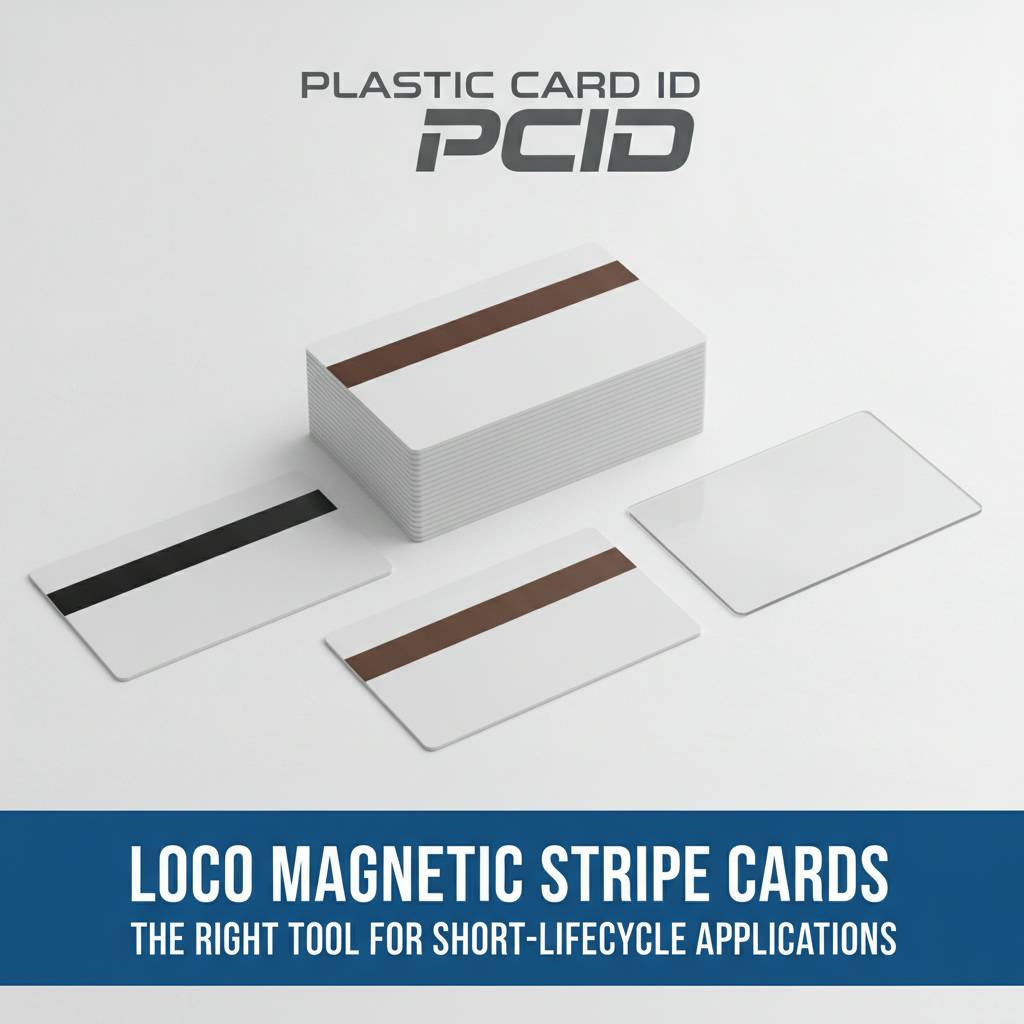 Low coercivity cards are not inferior products - they are purpose-built for applications where short card life is expected and planned for. Hotel key cards are the canonical example: a guest checks in, uses the card for two nights, and the card is returned or left behind. There is no need for the encoded data to survive years of wallet storage. LoCo cards are issued in enormous volumes by hospitality businesses precisely because they are cost-effective for disposable use cases.
The 300 Oe coercivity of LoCo cards also makes them easier to re-encode - a meaningful advantage in hotel and event settings where the same physical card gets reprogrammed multiple times before retirement. Rewritable LoCo cards can be erased and re-encoded dozens of times, making them surprisingly economical for high-turnover environments when managed with appropriate tracking systems.
Where LoCo Cards Deliver Real Value
Beyond hospitality, LoCo cards serve event management programs well. Conference badges, temporary visitor passes, day-pass memberships, and tradeshow credentials all benefit from LoCo's lower cost and adequate short-term data stability. When cards are issued for a weekend event and collected afterward, the reduced stripe durability is irrelevant - the program goal is met cleanly and economically.
Promotional gift cards with short redemption windows also represent a strong LoCo use case. A seasonal promotional card intended for single or occasional use across a three-month window does not require HiCo durability. Matching coercivity to program lifecycle is one of the simplest ways to manage card program costs without sacrificing performance.
LoCo Card Limitations to Understand Before You Commit
The single most important limitation of LoCo cards is their vulnerability to incidental magnetic exposure. A LoCo card stored next to a magnetic closure in a purse or wallet can lose its encoded data within weeks. Customers who experience this interpret it as a card failure - and they are not wrong, technically, but the failure is a result of mismatched application rather than a defective product.
Businesses that issue LoCo cards for programs requiring multi-year use often find themselves replacing cards repeatedly, driving up the true per-card cost well beyond the initial savings. The math on LoCo versus HiCo almost always favors HiCo for any application with a card lifecycle exceeding six months. Understanding this before ordering prevents one of the most common and costly mistakes in card program management.
LoCo and the Hotel Key Card Ecosystem
Hotel key card systems are specifically engineered around LoCo technology. The door lock encoders used in most commercial hospitality systems write LoCo data, and the cards are sized and formatted to ISO 7810 CR80 standards - the same dimensions as a standard credit card. Blank LoCo cards ordered in volume from CPE integrate directly with most major hotel door lock systems without modification.
For hotel operators running in-house encoding through their property management system, blank LoCo stock in quantity allows complete operational control. Cards can be encoded at check-in, cancelled remotely if lost, and re-encoded for new guests without touching the physical card stock. This workflow keeps operational costs low while maintaining a professional guest experience that reflects well on the property.
| Application | Recommended Stripe Type | Typical Card Lifecycle |
|---|---|---|
| Hotel Key Cards | LoCo | Days to weeks |
| Event and Conference Passes | LoCo | 1-7 days |
| Retail Loyalty Cards | HiCo | 2-5 years |
| Employee ID and Access Badges | HiCo | 1-4 years |
| Gym and Fitness Memberships | HiCo | 1-3 years |
| Seasonal Promotional Cards | LoCo | 1-6 months |
Choosing the Right Blank Card Stock for Your Magnetic Stripe Program
The stripe type is only part of the card stock decision. Beyond HiCo or LoCo, buyers need to consider the base card material, thickness, and any additional features that align with their printing or encoding setup. Standard CR80 PVC cards at 30 mil thickness are the universal baseline - they work with virtually every card printer and encoder on the market and deliver the professional rigidity that plastic card programs demand.
For programs requiring additional visual distinction, magnetic stripe cards are available in clear and frosted PVC bases, pre-colored stock in a range of colors, and specialty configurations like dual-interface cards that combine a magnetic stripe with an RFID or smart chip layer. The combination of magnetic stripe and contactless technology in a single card is increasingly common in access control and membership applications that benefit from supporting both legacy swipe readers and modern tap-based systems.
CR80 Standard - Why It Matters for Compatibility
ISO 7810 compliance is not a bureaucratic formality - it is a practical guarantee. CR80-standard cards at 3.375 x 2.125 inches and 30 mil thickness fit every standard card printer, every wallet slot, every card holder, and every badge reel on the market. Deviation from this standard - even by a fraction - creates compatibility issues across the entire card management ecosystem, from printing to cardholder use.
All magnetic stripe blank cards from CPE are manufactured to CR80 specification. This consistency ensures that every card you print integrates seamlessly into your existing printer setup and cardholder infrastructure without modification, adjustment, or workarounds. It is one of those foundational details that quietly protects program quality across hundreds of thousands of card issuances over time.
Matching Card Stock to Printer Specifications
Not every card printer handles every card type with equal results. Some printers are optimized for standard white PVC stock and may produce inconsistent results with pre-colored or clear cards without ribbon or settings adjustment. Before ordering colored or specialty base stock with magnetic stripes, confirming compatibility with your specific printer model prevents waste and ensures print quality meets your standards.
Evolis, Zebra, and Fargo printers - all available through CPE - each have documented compatibility specifications for card stock, stripe type, and ribbon combination. A quick call to 800.835.7919 connects you with a specialist who can match your printer model to the correct card stock and encoding configuration before you place an order.
Ribbon Selection for Magnetic Stripe Card Programs
Card ribbons are the consumable that most directly affects print quality and card durability. For programs printing on magnetic stripe cards, ribbon selection matters because the wrong ribbon can introduce static or heat effects that subtly degrade the stripe coating during printing - even before encoding happens. Professional-grade ribbons designed for use with magnetic stripe card stock minimize this risk entirely.
YMCKO ribbons (Yellow, Magenta, Cyan, Black, Overlay) are the standard choice for full-color card printing with a protective overlay that extends both the printed surface and the stripe integrity. Monochrome ribbons in black or silver are appropriate for programs printing only text or simple graphics. Choosing the right ribbon is as important as choosing the right card stock - both contribute to the finished card's long-term performance in your readers.
Frequently Asked Questions About HiCo and LoCo Magnetic Stripe Cards
The questions businesses ask most often about magnetic stripe cards cluster around a few practical concerns - compatibility, encoding, durability, and cost. The answers below reflect what CPE hears most frequently from the thousands of organizations that contact the team each year seeking guidance on card program setup and expansion.
Getting clear answers before purchasing saves time, money, and the frustration of discovering a mismatch after cards are already ordered. These are not edge-case scenarios - they are the everyday realities of running a card program, and understanding them upfront separates well-run programs from reactive ones.
Can I Use HiCo Cards in a LoCo Reader System?
This is one of the most common compatibility questions. The answer requires nuance. Most modern magnetic stripe readers are capable of reading both HiCo and LoCo encoded cards because readers detect magnetic flux changes rather than apply a specific coercivity threshold. However, older or lower-grade readers may be optimized for LoCo signals and can occasionally misread HiCo-encoded data.
The safest approach is to test a sample batch of encoded HiCo cards in your existing reader infrastructure before committing to a full order. If your reader system was installed in the last decade and comes from a recognized commercial brand, HiCo-to-LoCo reader compatibility is rarely an issue. When in doubt, test before you scale - it is always the right move.
How Many Swipes Will a HiCo Card Survive?
Under normal use conditions - clean card surface, properly maintained readers, no unusual magnetic exposure - a well-produced HiCo magnetic stripe card can reliably survive thousands of swipes without data degradation. Some programs report consistent performance at 5,000 or more read cycles. The practical limiting factor is usually physical wear to the card body rather than data integrity on the stripe.
Card sleeves and holders extend the swipe life of any magnetic stripe card by protecting the stripe surface from abrasion caused by wallet friction, pocket debris, and rough handling. For high-frequency access control applications, combining HiCo card stock with proper card protection accessories is a low-cost strategy that meaningfully extends card program ROI.
What Happens If My Encoder and Card Coercivity Do Not Match?
Encoding a HiCo card with a LoCo encoder produces cards that appear to encode correctly but fail at the reader. The encoded data exists on the stripe, but the particle alignment is incomplete because the encoder could not generate sufficient magnetic field strength to fully align HiCo particles. These cards often read back empty or produce partial data errors.
Encoding a LoCo card with a HiCo encoder typically produces a fully functional card - HiCo encoders generate sufficient field strength to write LoCo stripes correctly. However, this wastes the encoder's capacity and introduces the question of whether you should have been using LoCo cards in the first place. Matching encoder capability to card coercivity is the foundational step in any new card program setup.
Partner With Plastic Card ID for Your Magnetic Stripe Card Program
Magnetic stripe card programs succeed when the fundamentals are aligned - the right coercivity for your application, the right card stock for your printer, the right encoder for your infrastructure, and a supplier who understands all of it well enough to guide you clearly. Plastic Card ID has spent more than 25 years building exactly that kind of expertise across more than 100,000 customer relationships and 50 million cards shipped across the United States.
Whether you are launching a new loyalty program with 500 cards a month or scaling an enterprise access control system into the tens of thousands, the support structure behind your card order matters as much as the cards themselves. A supplier who can answer your encoder compatibility question, confirm your ribbon selection, and match your card stock to your printer in a single conversation is a genuine operational asset - and that is exactly what CPE delivers every day.
Every Card Type. Every Encoder Configuration. One Source.
From blank HiCo and LoCo magnetic stripe cards in standard white, clear, frosted, and pre-colored stock - to RFID smart cards, proximity access cards, casino player cards, hotel key cards, and specialty options like custom die-cut shapes and luxury metal cards - the catalog at Plastic Card ID covers every serious card program need for USA-based businesses and organizations.
Add card printers from Evolis, Zebra, and Fargo; printer ribbons matched to your card stock; cleaning kits that maintain reader and printer performance; card carriers, sleeves, and holders; and card mailing and affixing services that complete the fulfillment loop. This is not a transactional supplier relationship - it is a strategic partnership built around helping your card program succeed at every stage of its life.
Get the Right Cards for Your Program - Starting Today
The fastest way to confirm your card stock, stripe type, and encoding setup is a direct conversation with a specialist who handles these questions every day. No configurator can replace that conversation when the specifics of your reader system, printer model, and program lifecycle are all factors in the recommendation.
Contact Plastic Card ID today at 800.835.7919 to speak with a card program specialist who will match you with the right HiCo or LoCo magnetic stripe card stock, encoding configuration, and supporting supplies for your specific program - and back every recommendation with over 25 years of expertise serving businesses across the United States.
Previous Page