What Is a LoCo Magnetic Stripe Card? Full Guide
Table of Contents []
- What Is a LoCo Magnetic Stripe Card? A Complete Guide by Plastic Card ID
- Why Businesses Choose LoCo Magnetic Stripe Cards
- How to Identify a LoCo Magnetic Stripe Card
- LoCo Cards Within a Broader Card Program Strategy
- Frequently Asked Questions About LoCo Magnetic Stripe Cards
- Sourcing LoCo Magnetic Stripe Cards From Plastic Card ID
What Is a LoCo Magnetic Stripe Card? A Complete Guide by Plastic Card ID
Most people swipe cards dozens of times a week without thinking twice about what happens in that fraction of a second. Behind the scenes, a thin strip of magnetic oxide particles - encoded with data - transfers information to a reader almost instantly. But not all magnetic stripes are created equal. Some cards use high-coercivity encoding. Others use low-coercivity encoding. Understanding that difference is not just technical trivia; it shapes which card your business actually needs.
LoCo magnetic stripe cards are one of the most widely used card types across retail loyalty programs, membership systems, gift card programs, and event credentials. They are practical, affordable, and perfectly matched to a wide range of everyday applications. This guide breaks down exactly what LoCo means, how it compares to HiCo, and how CPE helps businesses across the United States choose and source the right cards every time.
The Magnetic Stripe Explained
A magnetic stripe card works by storing data in tiny magnetized particles embedded in a ferromagnetic material - that dark or sometimes gold-tinted stripe you see running across the back of the card. When a card reader head passes over the stripe, it detects the orientation of those particles and interprets them as binary data. The process is simple, reliable, and decades-proven.
What differentiates LoCo from HiCo is the amount of magnetic force - coercivity, measured in Oersteds (Oe) - required to encode and read that data. LoCo cards operate at approximately 300 Oe, while HiCo cards operate at approximately 2750 Oe. Lower coercivity means the data is easier to write and easier to erase. That characteristic defines both where LoCo excels and where it falls short.
LoCo vs. HiCo: The Core Distinction
Think of coercivity like the grip strength of the card's data storage. LoCo cards hold data with a lighter grip - sufficient for controlled environments, short-term uses, or applications where cards are reprogrammed regularly. HiCo cards hold data with a significantly stronger grip, resisting interference from everyday magnetic fields like those near speakers, laptop bags, or magnetic clasps.
For many businesses, LoCo is entirely appropriate. Hotel key cards, for example, are among the most famous LoCo applications globally - those cards get reprogrammed for every guest, and they rarely need to survive longer than a week. Gift card programs, loyalty reward cards, and temporary event credentials are other textbook fits. Choosing the right coercivity is one of the most impactful decisions in any card program.
How LoCo Cards Are Encoded
LoCo magnetic stripe cards require a compatible card printer equipped with a magnetic stripe encoding module. The printer writes data to the stripe during the card personalization process. Because LoCo requires less magnetic force, encoding is smooth and the encoder components experience less wear over time compared to HiCo encoding.
Standard magnetic stripes typically include up to three tracks. Track 1 holds alphanumeric data at 210 bits per inch (bpi). Track 2 holds numeric data at 75 bpi. Track 3 is also numeric at 210 bpi. Most loyalty and gift card programs rely on Track 2 or a combination of Track 1 and Track 2. CPE offers LoCo cards pre-formatted across all standard track configurations, compatible with printers from Evolis, Zebra, Fargo, and other leading brands.
| Feature | LoCo Magnetic Stripe | HiCo Magnetic Stripe |
|---|---|---|
| Coercivity | 300 Oe | 2750 Oe |
| Stripe Color | Brown / Reddish-Brown | Black |
| Durability | Moderate | High |
| Best For | Hotel keys, gift cards, loyalty | Driver's licenses, financial, ID |
| Reprogrammability | Easy and frequent | Less frequent |
| Cost | Lower per card | Slightly higher per card |
Why Businesses Choose LoCo Magnetic Stripe Cards
The appeal of LoCo cards is deeply practical. For programs where cards are issued, used over a limited period, and then deactivated or replaced, there is simply no reason to pay a premium for high-coercivity durability. LoCo cards fit neatly into a cost-efficient operational model without sacrificing functionality in the applications they were designed for.
Retail gift card programs built on LoCo magnetic stripe technology have driven documented sales increases of 35-50% compared to paper alternatives. That is not a minor improvement. It represents a meaningful shift in purchasing behavior - customers keep plastic cards, lose paper less often, and return to use stored balances. The card itself becomes a persistent marketing touchpoint long after the initial purchase.
Gift Card and Loyalty Program Applications
When a customer receives a plastic gift card, something psychologically different happens compared to receiving a paper voucher. The card feels like currency. It gets placed in a wallet. It travels with the customer. LoCo magnetic stripe cards are perfectly suited for gift card programs because the POS systems that read them operate in controlled retail environments, far from the strong magnetic fields that might compromise a lower-coercivity stripe.
Loyalty programs benefit similarly. A loyalty card that lives in a customer's wallet beats a paper punch card every time - in perceived value, in durability, and in repeat-visit behavior. Encoding member IDs, point balances, or tier identifiers on a LoCo stripe gives businesses a clean, low-cost data layer that integrates with most loyalty software platforms without complexity.
Hotel Key Cards and Access Credentials
The hotel industry essentially built its modern key card infrastructure on LoCo magnetic stripe technology. Every time a hotel guest checks in, the front desk encodes a blank LoCo card with room access data tied to their stay dates and assigned room. When they check out - or when the reservation expires - that encoding becomes invalid. The card can be reprogrammed for the next guest.
This reprogrammability is a feature, not a compromise. It enables a high-turnover property to maintain a lean card inventory, reprogram on demand, and never worry about deactivating old physical credentials. For temporary access programs beyond hospitality - event venues, co-working spaces, temporary employee credentials - the same logic applies cleanly.
Membership and Club Cards
Organizations ranging from fitness clubs to warehouse retailers to professional associations use LoCo magnetic stripe cards as membership credentials. The stripe encodes a member ID that links to a database record containing all relevant account information. Swipe the card at check-in, and the system pulls the member's record, verifies standing, and logs the visit.
Contact 800.835.7919 to discuss membership card programs of any scale, from small clubs ordering 50 cards a month to national organizations running large-scale member enrollment programs. CPE has supported membership programs across virtually every industry vertical and understands the specific encoding and compatibility requirements each type of program demands.
How to Identify a LoCo Magnetic Stripe Card
Surprisingly few purchasing managers know how to visually distinguish a LoCo card from a HiCo card before ordering. The answer is straightforward once you know where to look. The magnetic stripe itself tells the story.
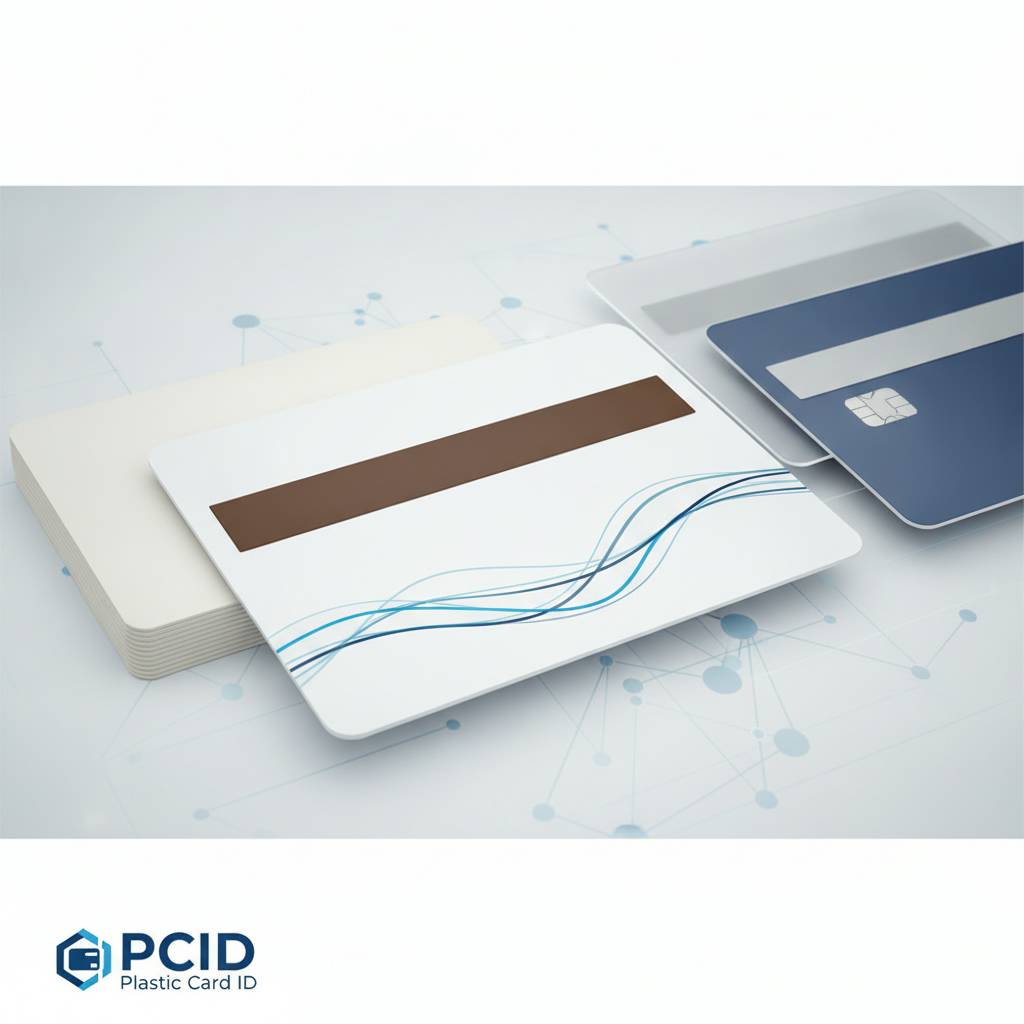
LoCo stripes are typically brown or reddish-brown in color. HiCo stripes are black. This color difference reflects the different iron oxide formulations used in each type. When you look at a card and see a brown stripe, you are looking at a LoCo card. Black stripe? That is almost certainly HiCo. This simple visual check can save businesses from ordering the wrong card type entirely.
Stripe Track Configuration and Specifications
Beyond coercivity and color, magnetic stripe cards are specified by their track configuration. Most standard CR80 cards (85.6mm x 54mm, 30 mil thickness - the ISO 7810 standard) are available with one, two, or three encoded tracks. Track 1 spans the top of the stripe and supports alphanumeric encoding. Track 2 is numeric only and is the most commonly used track in retail and hospitality applications. Track 3 is also numeric and less commonly used in modern programs.
When ordering LoCo cards from CPE, customers specify track configuration upfront. This ensures the blank cards arrive ready for encoding on their existing printer hardware without any compatibility issues. Ordering pre-striped blank cards that match your encoder specifications is a small step that avoids significant operational headaches down the line.
Compatible Card Printers for LoCo Encoding
Not every card printer includes magnetic stripe encoding as a standard feature - it is often a module that must be specified when purchasing the printer. Evolis, Zebra, and Fargo all offer single-sided and dual-sided card printers with optional LoCo and HiCo encoding modules. Some models offer switchable encoding, allowing a single printer to handle both LoCo and HiCo cards depending on the job.
For businesses already running a card printer without a magnetic stripe module, there are standalone encoding solutions as well. However, for most in-house card programs, a printer with an integrated encoding module offers the cleanest, most efficient workflow. CPE carries printers, ribbons, cleaning kits, and LoCo blank cards - allowing clients to build a complete, end-to-end in-house card production setup from a single source.
Common Mistakes When Ordering LoCo Cards
- Ordering HiCo when your encoder is set for LoCo: The encoder will write to the stripe, but read errors and failures may occur at point-of-sale if the encoding is inconsistent with the stripe's coercivity rating.
- Confusing track count with coercivity - these are separate specifications that must both be correct for cards to function properly.
- Purchasing LoCo cards for outdoor access control applications where magnetic interference is a real concern. HiCo or RFID/proximity cards are a better fit for those environments.
- Neglecting to order sufficient card stock in advance, causing production delays. Many businesses benefit from maintaining a 30-60 day buffer supply of blank LoCo cards.
- Assuming all brown-stripe cards are interchangeable - different suppliers may vary in stripe quality, oxide composition, and consistency. Sourcing from a trusted, high-volume supplier like CPE matters for consistent encoding performance.
LoCo Cards Within a Broader Card Program Strategy
 Few organizations run a single card type. A mid-size retailer might operate a LoCo-encoded gift card program alongside a proximity RFID employee access card program and a smart chip loyalty card initiative. Each program has distinct technology requirements, and managing them coherently requires a supplier who understands the full landscape.
CPE functions as a strategic partner across the entire card ecosystem - not simply a vendor fulfilling orders. Over 25 years and 50 million cards served, the team has developed a granular understanding of how different card technologies interact with different reader infrastructures, POS environments, and access control systems. That expertise translates into guidance that saves clients time, money, and the frustration of discovering incompatibilities after the fact.
Integrating LoCo Cards With RFID and Smart Card Programs
Some organizations need the simplicity of magnetic stripe for one application and the advanced capability of RFID or smart chips for another. RFID proximity cards and contactless smart cards - including MIFARE DESFire technology - offer significantly higher data capacity and contactless read capability. Where magnetic stripe cards require physical swipe contact, RFID cards work within a field, enabling tap-and-go or hands-free access scenarios.
A common hybrid approach pairs a LoCo stripe with an embedded RFID chip in a single card. This dual-technology card can function at a traditional magnetic stripe POS terminal while also working with contactless RFID readers in an access control system. Dual-technology cards give organizations maximum flexibility without requiring card holders to carry multiple credentials.
Scaling From Small Programs to High-Volume Production
Whether a business is ordering 100 LoCo gift cards to launch a pilot program or tens of thousands of cards for a national retail rollout, the fulfillment model needs to match the scale. CPE supports both extremes. Small organizations benefit from low minimum order quantities and fast turnaround. High-volume clients benefit from volume pricing tiers, consistent quality control, and reliable lead times that keep large programs running without interruption.
Value-added services extend the offering well beyond blank card stock. Card carriers - the printed sleeves and mailers that accompany cards at point of distribution - are available alongside card affixing and mailing services that turn bulk card orders into ready-to-ship customer packages. For businesses that do not want to manage the physical distribution of cards in-house, this fulfillment layer removes an entire operational burden.
Casino Player Cards and Specialty Applications
Certain industries have evolved card program requirements that go well beyond standard loyalty or access applications. Casino player tracking cards, for example, demand precise encoding, consistent read reliability across high-traffic swipe environments, and often integration with sophisticated player management systems. LoCo magnetic stripe cards are a common format in this space, particularly for programs with high card replacement turnover.
Specialty cards - clear plastic cards, frosted translucent stock, custom die-cut shapes, and luxury metal cards in stainless steel, brass, and gold - expand the palette for organizations that want their card program to make a distinct visual statement. A luxury metal card in a wallet carries an entirely different message than a standard PVC card - and for premium membership programs, VIP access, or high-value client relationships, that differentiation is worth every penny of the premium.
| Application | Recommended Card Type | Encoding |
|---|---|---|
| Retail Gift Cards | LoCo Magnetic Stripe | Track 1 Track 2 |
| Hotel Key Cards | LoCo Magnetic Stripe | Track 2 |
| Employee Access (Outdoor) | HiCo or RFID Proximity | HiCo / 125 kHz RFID |
| Loyalty Membership | LoCo or Dual-Tech | Track 2 Optional RFID |
| Casino Player Tracking | LoCo Magnetic Stripe | Track 1 Track 2 Track 3 |
Frequently Asked Questions About LoCo Magnetic Stripe Cards
Buyers new to magnetic stripe technology frequently encounter the same questions. Getting clear answers upfront prevents costly ordering mistakes and sets card programs on solid footing from day one. Here are the most common questions CPE receives about LoCo cards.
Understanding the fundamentals of LoCo technology empowers purchasing teams to make smarter decisions - not just for the initial order, but for the long-term scalability of their card programs. The questions below reflect real conversations from the Plastic Card ID customer base across 25 years of industry experience.
Can I encode a LoCo card on a HiCo encoder?
Technically, a HiCo encoder can write to a LoCo stripe, but the results are unreliable. The stronger magnetic field of a HiCo encoder can partially or fully destroy the data on a LoCo stripe by applying too much magnetic force. The encoded data may appear written but will fail on read. Always match the encoder setting to the card coercivity specification - LoCo encoders for LoCo cards, HiCo encoders for HiCo cards.
Most modern card printers with switchable encoding modules allow the operator to select the appropriate coercivity setting through software before each batch. If your printer supports both, ensure the correct profile is active before running a LoCo card batch. This simple step eliminates the most common source of encoding failures in mixed-card-type environments.
How long does data last on a LoCo magnetic stripe?
Under normal usage conditions - meaning the card is swiped in clean, calibrated readers and stored away from strong magnetic sources - LoCo stripe data can remain stable and readable for several years. For most applications, this lifespan comfortably exceeds the intended use period of the card itself. Hotel key cards are retired after a guest stay. Gift cards are used within months of issuance. Loyalty cards may last a few years before replacement.
The practical risk to LoCo data is not time-based degradation but environmental exposure. Proximity to strong magnets - bag closures, certain phone cases, large speaker drivers - can partially erase or corrupt a LoCo stripe. For programs where cards are carried in close proximity to such items regularly, HiCo or RFID alternatives deserve consideration. For most retail and hospitality applications, however, LoCo performs reliably throughout the card's intended lifespan.
What is the standard size for LoCo magnetic stripe cards?
Standard LoCo magnetic stripe cards are produced in the CR80 format: 3.375 inches by 2.125 inches, 30 mil thickness. This is the ISO 7810 ID-1 standard - the same size as a standard credit or debit card. This universal size ensures compatibility with virtually all card readers, card printers, card holders, sleeves, and wallet slots across the market. Blank CR80 LoCo cards give organizations maximum design flexibility while maintaining universal reader compatibility.
Custom sizes are available for specialized applications. Die-cut shapes - loyalty cards shaped like a product or brand icon, for example - can be produced with magnetic stripe encoding. However, custom dimensions require compatible custom card readers, which adds complexity and cost to the overall program. For the vast majority of applications, the standard CR80 LoCo card is the most practical and cost-effective choice.
Sourcing LoCo Magnetic Stripe Cards From Plastic Card ID
With over 100,000 customers and more than 50 million cards shipped across the United States, Plastic Card ID brings a depth of experience to LoCo magnetic stripe card sourcing that few suppliers can match. Every aspect of the procurement experience - product selection, technical guidance, compatible printer recommendations, and value-added fulfillment services - is designed to make running a card program straightforward rather than complicated.
The catalog spans every major card category: blank PVC cards, LoCo and HiCo magnetic stripe cards, RFID and proximity cards, smart chip cards, clear and frosted specialty stock, custom colors, luxury metal cards, and the full lineup of card printers and supplies from Evolis, Zebra, and Fargo. Everything a business needs to build and run a complete card program is available from a single, trusted source.
Ordering Process and Minimum Quantities
One of the practical advantages of working with CPE is the accessibility of the ordering process for organizations of every size. Small businesses and nonprofits running boutique card programs with modest monthly volumes have the same access to quality product as national retailers ordering at scale. Low minimum quantities mean there is no need to over-buy just to meet a threshold - programs can scale incrementally as they grow.
Volume pricing rewards larger orders with meaningful per-card cost reductions. For organizations projecting card usage into the tens of thousands per month, discussing pricing tiers upfront with the CPE team ensures the program budget is structured accurately from the start. Transparent pricing and clear lead times remove the guesswork from card program planning.
Printer Ribbons, Cleaning Kits, and Card Supplies
A LoCo magnetic stripe card is only as good as the quality of the print and encoding applied to it - and that quality depends heavily on maintaining the card printer properly. Printer ribbons must be matched precisely to the printer model and card substrate. Cleaning kits keep encoder heads and print rollers free of debris that causes read errors and print defects. Neglecting printer maintenance is one of the most common causes of card program quality problems that surface unexpectedly.
CPE stocks ribbons and cleaning supplies for Evolis, Zebra, Fargo, and other major printer brands - the same brands whose printers are available in the hardware catalog. This alignment means customers never need to cross-reference supplier compatibility lists. If the printer came from CPE, the ribbons and cleaning supplies available there are confirmed matches. Card carriers, sleeves, and card affixing services round out a complete fulfillment ecosystem.
Talk to the Plastic Card ID Team Today
Whether you are launching a first-time gift card program, replacing an aging hotel key card system, scaling up a loyalty initiative, or exploring dual-technology card options for a complex access control deployment, the CPE team is ready to help. With 25 years of hands-on experience across every card program type imaginable, the guidance available is practical, specific, and grounded in real-world program performance.
Reach the team directly at 800.835.7919 to discuss your specific requirements, get recommendations on LoCo card specifications, or request a quote for your program volume. No card program is too small to start, and no volume is too large to handle. The conversation is the first step toward a card program that delivers measurable results for your organization.
Ready to launch or upgrade your magnetic stripe card program? Call Plastic Card ID today at 800.835.7919 - your strategic card program partner for over 25 years, serving businesses across the USA with the products, expertise, and support that serious card programs demand.