Blank RFID Plastic Cards Guide: Types Applications
Table of Contents []
- Your Complete Blank RFID Plastic Cards Guide from Plastic Card ID
- What Exactly Are Blank RFID Plastic Cards?
- The RFID Frequency Spectrum - Choosing the Right Card for Your System
- How Blank RFID Cards Power Real Business Programs
- Buyer's Guide - What to Confirm Before You Order
- Advanced RFID Card Options for Specialized Programs
- Everything Else Your Card Program Needs - Plastic Card ID as Your One-Stop Shop
- Start Your RFID Card Program with Plastic Card ID Today
Your Complete Blank RFID Plastic Cards Guide from Plastic Card ID
Walk into any modern office building, hospital, university campus, or hotel and you'll encounter them within seconds - those small, wallet-sized plastic cards that unlock doors, track attendance, grant access, and identify people without a single swipe or insertion. RFID plastic cards are quietly running the infrastructure of modern organizations, and most businesses don't realize how accessible - or how transformative - a well-designed card program can be.
This guide cuts through the confusion. Whether you're equipping a 20-person startup with access badges or scaling a membership program to tens of thousands of cardholders, understanding blank RFID plastic cards will save you money, help you avoid costly compatibility mistakes, and give you a serious advantage in how you design and deploy your card program.
| Card Type | Frequency | Read Range | Common Use Cases |
|---|---|---|---|
| 125kHz Proximity | Low Frequency (LF) | 2-12 inches | Door access, time tracking |
| 13.56MHz Contactless | High Frequency (HF) | Up to 3 feet | Smart access, payments, transit |
| MIFARE Classic | 13.56MHz HF | Up to 3 feet | Campus cards, loyalty, ID |
| MIFARE DESFire | 13.56MHz HF | Up to 3 feet | High-security access, transit, government |
| UHF RFID | Ultra High Frequency | Up to 30 feet | Inventory, vehicle tracking, warehouses |
What Exactly Are Blank RFID Plastic Cards?
The term "blank" is doing real work here. A blank RFID plastic card is a standard CR80-sized card (85.6mm x 54mm, 30 mil thick - the same dimensions as your driver's license) with an embedded RFID chip and antenna, but no printed design on its surface. It arrives ready for your organization to print on, encode, and issue. The card's intelligence is entirely in the chip; the surface is a clean canvas.
This matters enormously for organizations that want control. A blank card gives you the freedom to print your own branding, employee photos, barcodes, and variable data on-demand using an in-house card printer, while still carrying the contactless technology that your access control, loyalty, or membership system demands. You're not waiting on a print vendor every time you onboard a new employee or sign up a new member.
The Anatomy of an RFID Card
Inside every RFID card is an antenna - a thin coil of wire - bonded to a microchip, all laminated between layers of PVC. When the card enters the electromagnetic field of a reader, the antenna harvests energy from that field and powers the chip just long enough to transmit its stored data. No battery, no contact required. The whole transaction happens in milliseconds.
The quality of that lamination, the gauge of the antenna wire, and the grade of the chip all determine how durable and reliable the card will be over thousands of read cycles. This is precisely why sourcing matters. A cheap card with a poorly bonded antenna will delaminate, fail reads intermittently, and cost you far more in replacements and operational headaches than a quality card ever would.
CR80 Standard and Why It Matters
ISO 7810 defines the CR80 standard - the global specification for ID-1 cards. Nearly every card reader, printer, wallet slot, badge holder, and card carrier in the professional world is built around this exact format. Choosing CR80-compliant RFID cards means your cards will work seamlessly with industry-standard printers from Evolis, Zebra, and Fargo without any modification or custom tooling.
Deviation from CR80 is a choice that should be made intentionally - custom die-cut shapes exist for marketing and specialty applications - but for workhorse card programs, the standard size is non-negotiable. Anything outside it creates compatibility headaches at every touchpoint in your card workflow.
Blank vs. Pre-Printed RFID Cards
Pre-printed cards from a commercial printer arrive with your design already on them. They look polished. The tradeoff is inflexibility - minimum order quantities, longer lead times, and no ability to add cardholder-specific data without a second printing step. Blank cards flip this equation entirely. Your upfront per-card cost may be comparable, but your operational flexibility expands dramatically.
Organizations running ongoing programs - employee badge programs, membership clubs, hotel key programs - find that blank RFID cards dramatically lower the cost and complexity of card issuance over time. You print what you need, when you need it, with exactly the data that belongs on each individual card. That's not a small advantage. That's the difference between a program you can manage and one that manages you.
The RFID Frequency Spectrum - Choosing the Right Card for Your System
This is where many organizations stumble. Ordering RFID cards without confirming compatibility with your existing readers is the single most expensive mistake you can make in card procurement. Different RFID systems operate at different frequencies, and a 13.56MHz card will never speak to a 125kHz reader no matter how many times you tap it.
Matching your card frequency to your reader infrastructure is non-negotiable. Before you order a single card, identify your reader brand and model, then confirm the frequency and card format it supports. CPE has helped organizations of every size navigate this exact challenge for over 25 years - and getting this right upfront is one of the most valuable things a knowledgeable supplier can offer.
Low Frequency 125kHz Proximity Cards
The 125kHz proximity card - often called a "prox card" - is the workhouse of legacy access control systems. HID, Kantech, Lenel, and dozens of other established access control platforms use this frequency. These cards are simpler in their data architecture, carry a fixed, read-only facility code and card number, and are exceptionally reliable for door access applications where security demands are moderate.
If your building already has 125kHz readers, these are your cards. Trying to upgrade to HF without also replacing your reader infrastructure is a costly and unnecessary exercise. Blank 125kHz proximity cards are available in standard CR80, and they print beautifully through any direct-to-card printer, giving you full design flexibility on a proven access technology platform.
High Frequency 13.56MHz Smart Cards
At 13.56MHz, the world expands significantly. This is the frequency of NFC, MIFARE, iCLASS, DESFire, and most modern contactless smart card systems. High-frequency cards support encrypted, multi-application use - a single card can simultaneously handle building access, cafeteria payments, library check-outs, and loyalty points depending on how the chip is partitioned and programmed.
For organizations investing in new infrastructure or upgrading aging systems, HF is almost always the right direction. The security capabilities, the data capacity, and the ecosystem of compatible readers and encoding equipment at this frequency simply outclass what 125kHz can offer. MIFARE DESFire in particular provides advanced cryptographic security that meets the requirements of high-security installations including government facilities and financial institutions.
Selecting the Right Chip Format Within 13.56MHz
MIFARE Classic 1K and 4K, MIFARE DESFire EV1 and EV2, NTAG, iCLASS - these are all 13.56MHz formats, but they are not interchangeable. Your software platform and reader hardware will specify exactly which chip format they support. Buying MIFARE Classic cards for a DESFire system means your entire order is useless before it ships.
Call your access control or loyalty platform vendor. Get the chip format specification in writing. Then match it to your card order. This single step prevents the most common and most expensive ordering mistake in the RFID card world. When in doubt, reach out to CPE - their team has matched card specifications to systems across virtually every major platform in the market.
How Blank RFID Cards Power Real Business Programs
 Theory is useful. Real-world application is where blank RFID plastic cards prove their value. Across industries and organization sizes, these cards are doing the hard work of identifying people, controlling access, rewarding loyalty, and driving engagement - quietly and reliably, day after day.
The organizations that deploy them well share a common trait: they thought through their card program before they ordered their first card. Format compatibility, printer selection, encoding workflow, cardholder data management - these decisions, made upfront, determine whether a card program becomes an asset or a headache. CPE exists precisely to help organizations get these decisions right.
Employee ID and Access Control Programs
An employee badge is far more than a name tag. In a properly designed program, a single blank RFID card - once printed and encoded - becomes the employee's identity credential, their building access token, their time and attendance record, and potentially their parking pass. The card is the employee's relationship with every system in your facility.
Blank cards give HR and security teams the ability to issue new badges on the spot during onboarding, reissue lost badges within minutes, and retire access instantly upon termination by deactivating the card number in the system rather than chasing down a physical key. The operational efficiency gains are significant. Organizations that have made this transition rarely look back.
Hotel Key Cards and Hospitality Applications
Hotel key cards are perhaps the most universally recognized RFID application. Guests check in, receive a card encoded to their room and stay duration, and use it throughout their visit. Behind the scenes, the same card can be configured to access the fitness center, control the elevator to their floor, and charge amenities to their room - all from a single blank RFID card encoded at the front desk.
Blank hotel key cards allow properties to print custom branding, sponsor messaging, or event information directly on the card surface. For boutique hotels and resorts, this is a brand touchpoint that lives with the guest for the duration of their stay. For conference properties, it's a sponsorship opportunity. The blank card, once again, becomes whatever your program needs it to be.
Loyalty and Membership Card Programs
Research consistently shows that physical loyalty cards outperform digital-only alternatives in program engagement. A card that lives in a wallet is a constant, passive reminder of your brand. Retailers switching from paper punch cards to plastic RFID loyalty cards regularly see measurable increases in redemption rates and repeat visit frequency.
RFID loyalty cards add a layer of functionality that paper and even barcode cards cannot match. Transaction speed at checkout is faster. The card cannot be easily counterfeited. And if your POS system supports it, the chip can store points data directly on the card, eliminating dependence on a central database lookup for every transaction. For high-volume retail environments, that speed advantage is operationally significant.
Buyer's Guide - What to Confirm Before You Order
Purchasing blank RFID cards without a checklist is how organizations end up with a pallet of cards they cannot use. The technical specifications that matter are narrow and unforgiving - there's no workaround for a frequency mismatch or an incompatible chip format. This section gives you the questions to answer before you place your first order.
- Frequency: Is your system 125kHz (LF) or 13.56MHz (HF)? Confirm with your reader manufacturer documentation.
- Chip format: Within HF, which format does your system require? MIFARE Classic, DESFire, iCLASS, NTAG, or another?
- Memory capacity: How much data will you write to the chip? Standard MIFARE Classic 1K handles most applications; data-intensive programs may require 4K.
- Encoding workflow: Will you encode cards with a desktop encoder, through your card printer, or at the reader? Each pathway has different equipment requirements.
- Print surface requirements: Do you need a glossy or matte finish? Single or dual-sided printing? Signature panel, magnetic stripe, or additional features alongside the RFID chip?
- Volume and ordering cadence: How many cards per month will you issue? This determines whether bulk pricing tiers or smaller frequent orders make more economic sense.
- Security features: Do any cards need to carry a magnetic stripe, holographic overlay, or other secondary authentication alongside the RFID chip?
Understanding Encoding Options
A blank RFID card ships with its chip in a factory-default state. Before the card works with your access control or loyalty system, the chip must be encoded with the data your system expects. This can happen at the time of card printing (if your printer has an integrated smart card encoder), at a separate desktop encoding station, or in some systems, automatically at the reader when the card is first presented.
Most professional card programs encode at the point of printing - it's efficient, it keeps the card issuance workflow in one step, and it ensures the card is ready for use the moment it comes out of the printer. Evolis, Zebra, and Fargo all offer printer models with integrated RFID encoding modules that handle this seamlessly.
Pairing Cards with the Right Printer
Not every card printer handles RFID cards identically. Printers with integrated smart card encoding stations - available across the Evolis Primacy, Zebra ZC series, and Fargo HDP5000 lineup - can read and write chip data as part of the single print cycle. Choosing a printer with integrated encoding capability is one of the highest-leverage decisions in your card program setup.
If you're calling 800.835.7919, the team at CPE can walk you through printer and card compatibility in detail, ensuring the printer, ribbon, card, and encoder you select function together as a complete, tested system rather than a collection of components that may or may not cooperate.
Volume Pricing and Program Scaling
Blank RFID cards are priced in volume tiers. Ordering 500 cards at once costs meaningfully less per card than ordering 50. For organizations with predictable monthly issuance volumes, establishing a regular bulk order cadence against a confirmed specification is one of the easiest ways to reduce card program operating costs without sacrificing anything on quality or capability.
Programs that start small and grow should plan their card specifications with scalability in mind. Locking in a chip format and card specification early - and building your reader and encoder infrastructure around it - means that scaling from 100 cards a month to 5,000 cards a month is a volume decision, not a compatibility redesign project.
Advanced RFID Card Options for Specialized Programs
Beyond the standard white CR80 blank, the world of RFID plastic cards includes specialty formats that open up new program possibilities. Understanding what's available helps you make intentional choices rather than defaulting to whatever happens to be most familiar.
Specialty RFID cards aren't extravagances - for the right application, they're exactly the correct tool. A casino player card that doubles as a loyalty credential and access token needs different capabilities than a basic door access badge. A hotel key card for a luxury property communicates something different when it's issued in a premium format.
MIFARE DESFire for High-Security Applications
MIFARE DESFire EV1 and EV2 represent the current standard in high-security contactless smart card technology. These chips use 128-bit AES encryption, support multiple independent applications on a single card, and provide mutual authentication between card and reader - meaning neither the card nor the reader will communicate with an unverified counterpart. For applications where card cloning or data interception represents a real threat, DESFire is the correct specification.
Government facilities, healthcare organizations, financial institutions, and high-security corporate campuses increasingly mandate DESFire-grade security. If your security posture requires it, or if your access control vendor specifies it, blank DESFire cards are available in standard CR80 format and print as cleanly as any other PVC card through compatible printers.
Combo Cards - RFID Plus Magnetic Stripe
Some programs need to bridge old and new infrastructure simultaneously. A combo card carries both an RFID chip and a magnetic stripe, allowing it to work with legacy mag-stripe readers and modern contactless readers on the same card. This is particularly useful during phased infrastructure upgrades, where not all reader locations have been converted to RFID simultaneously.
Combo cards are available in HiCo (high-coercivity) and LoCo (low-coercivity) magnetic stripe configurations. HiCo stripes are more resistant to accidental demagnetization from proximity to other magnets or electronic equipment - the right choice for employee badges and access cards that will be carried alongside phones and other cards. LoCo is suitable for lower-security, short-term credential applications.
Clear, Frosted, and Specialty Format RFID Cards
Clear and frosted PVC RFID cards bring visual impact to card programs where aesthetics and brand presentation matter alongside functionality. A clear card with an embedded RFID chip communicates sophistication. Used by boutique hotels, premium membership clubs, casinos, and corporate VIP programs, these cards create an impression at first handling that standard white cards simply don't achieve.
Custom die-cut RFID cards in non-standard shapes are also available for programs where differentiation is a deliberate strategy. For marketing events, brand launches, and high-profile membership programs, a card that doesn't look like every other card in the wallet is a brand asset in its own right. These specialty options sit alongside the standard CR80 catalog and are worth considering when your program calls for them.
Everything Else Your Card Program Needs - Plastic Card ID as Your One-Stop Shop
A card is only as effective as the program built around it. Blank RFID cards are the core, but a complete, functional card program involves ribbons matched to your printer model, cleaning kits that keep your printer running at peak quality, card carriers and sleeves that protect cards during distribution, and cardholder accessories that help cardholders actually keep their cards. CPE supplies all of it.
For organizations that need to distribute cards by mail, card affixing and mailing services are available - a genuine operational convenience that eliminates the need to build an in-house card fulfillment workflow. Whether you're mailing membership cards to new enrollees or distributing hotel keys to conference attendees in advance of arrival, this service handles the physical logistics so you don't have to.
Printer Ribbons and Consumables
Card printer ribbons are not interchangeable between printer models, and using the wrong ribbon is the fastest way to produce substandard cards or damage your printer. Ribbon selection should always be matched to both the printer model and the card surface being printed. Full-color YMCKO ribbons, monochrome black ribbons, and specialty formulations for overlaminates each have specific applications and compatibility requirements.
Cleaning kits - cards, rollers, and swabs formulated for card printer maintenance - are the single most overlooked element of card program operations. A dirty printer produces banding, streaking, and color inconsistency. Regular cleaning cycles, performed at the intervals specified by your printer manufacturer, protect your equipment investment and ensure every card that comes out of your printer looks as professional as the first one.
Card Accessories and Distribution Supplies
Cards need to be carried, protected, and displayed. Cardholders, lanyards, badge reels, card sleeves, and card wallets are the supporting cast that makes a card program functional in daily use. For access control programs, the difference between a flimsy badge holder and a quality one is the difference between a badge that's protected for years and one that cracks, fades, and needs replacement in months.
Card carriers - the printed carriers used to present cards during distribution or mailing - add a professional presentation layer that reinforces your brand at the moment of card issuance. For membership programs and loyalty programs, this first-impression moment matters. A card handed to a new member in a branded carrier communicates a level of professionalism that a card handed loose in an envelope simply cannot match.
Reach the Team That Knows Cards
After 25 years and more than 50 million cards shipped to over 100,000 customers across the United States, CPE has seen virtually every card program challenge that exists. Compatibility questions, volume pricing inquiries, printer selection guidance, encoding workflow planning - the team is equipped to answer all of it. Call 800.835.7919 to speak with someone who will give you straight answers rather than a sales pitch.
The goal is always a card program that works - reliably, affordably, and exactly as intended from the first card issued to the ten-thousandth. That requires more than just purchasing cards. It requires a supplier who understands your application, your infrastructure, and your goals well enough to recommend exactly the right products rather than simply fulfilling an order.
Your program deserves cards that perform. Get them from the team that's been doing this longer than most card programs have existed.
Start Your RFID Card Program with Plastic Card ID Today
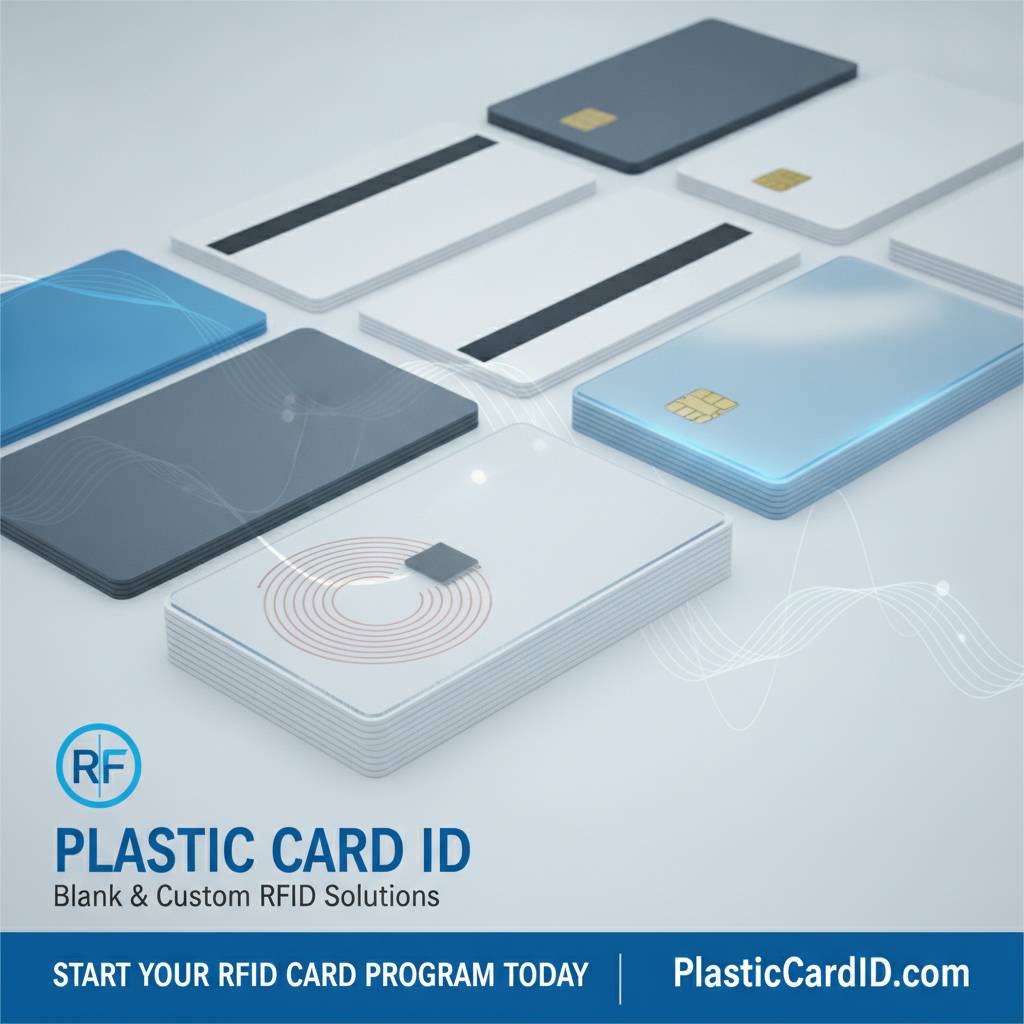 Blank RFID plastic cards are one of the most versatile, high-value tools available to organizations managing identity, access, loyalty, and membership programs. The technology is mature, the products are proven, and the operational advantages of an in-house card program built on quality RFID cards are well-documented across industries. What's left is making the right decisions for your specific program - and executing them with a supplier who won't let you get it wrong.
Plastic Card ID has been that supplier for organizations of every size, from small businesses issuing 50 cards a month to enterprise operations running tens of thousands of cards through their programs continuously. The catalog, the expertise, and the commitment to long-term partnership are all here. The only thing missing is your call.
Contact Plastic Card ID at 800.835.7919 today and let's build the RFID card program your organization deserves.