UV Ink Printing on Plastic Cards Explained
Table of Contents []
- UV Ink Printing on Plastic Cards: What Every Business Needs to Know - Plastic Card ID
- The Science Behind UV Ink on Plastic Cards
- Why Businesses Choose UV Ink Printing for Their Card Programs
- In-House UV Printing vs. Pre-Printed UV Cards: Making the Right Choice
- Buyer's Guide: What to Ask Before Ordering UV-Printed Cards
- UV Ink Printing and the Broader Card Program Ecosystem
- Connect with Plastic Card ID to Start Your UV Card Program Today
UV Ink Printing on Plastic Cards: What Every Business Needs to Know - Plastic Card ID
Most businesses choosing plastic cards focus on the obvious: design, color, encoding. But there's a layer of card security and sophistication that often goes unnoticed until you need it most - UV ink printing. Invisible to the naked eye under normal light, ultraviolet ink reveals hidden text, logos, and patterns only when exposed to a UV lamp. It's a quiet technology with a loud impact on security, brand integrity, and card program credibility.
Whether you're running an employee ID program, a loyalty card initiative, or an access control system, UV printing adds a dimension that standard printing simply cannot. CPE has helped more than 100,000 U.S. businesses design and source card solutions that go beyond the ordinary - and UV ink is increasingly central to what serious card programs demand.
| UV Ink Feature | Benefit | Best Application |
|---|---|---|
| Invisible under normal light | Hidden security layer | ID cards, event badges |
| Glows under UV lamp | Quick visual verification | Access control, member cards |
| Difficult to replicate | Counterfeit deterrence | Casino cards, VIP passes |
| Works on PVC card surface | Integrates with existing programs | Loyalty, gift, membership cards |
| Available with card printers | In-house printing capability | All card programs |
The Science Behind UV Ink on Plastic Cards
UV printing on plastic cards isn't magic - it's photochemistry. Ultraviolet-reactive inks contain fluorescent compounds that absorb UV wavelengths and re-emit them as visible light. On a PVC card surface, these inks bond effectively and remain stable through normal handling, card swiping, and wallet storage. The result is a feature that exists invisibly until a UV light source activates it.
What makes this genuinely remarkable for card programs is how inconspicuous the security feature remains in everyday use. A loyalty card looks completely standard to the customer holding it. But your security team, venue staff, or point-of-sale personnel with a UV lamp can instantly verify authenticity. This dual-layer presentation - normal by day, secure under UV - is exactly what sophisticated card programs are built on.
How UV Ink Bonds to PVC Card Surfaces
PVC cards - the CR80 standard at 30 mil thickness - provide an excellent substrate for UV ink because of their smooth, non-porous surface. During the printing process, UV ink is applied as a thin layer that cures under UV light exposure, creating a durable bond without penetrating the card material itself. This means the visible surface of the card remains clean and unaffected.
The curing process is fast, which is one reason UV printing integrates well with modern card printer ribbons available for brands like Evolis, Zebra, and Fargo. The ink sets almost instantly, reducing smearing and ensuring consistent results across large card runs. For businesses printing cards in batches of a few hundred or scaling up to tens of thousands, this consistency matters enormously.
UV Fluorescence vs. UV Ink - Understanding the Difference
There is sometimes confusion between cards that contain UV-reactive security threads or laminates versus those printed with UV ink directly. UV fluorescent printing applies the reactive compound as part of the print job itself - typically using a specialized ribbon panel in a card printer. This makes it accessible for in-house production without requiring industrial security printing equipment.
UV fluorescent laminates, by contrast, are overlays applied after printing that may include their own reactive patterns. Both approaches serve security purposes, but UV ink printing offers more flexibility in what can be rendered invisibly - including your logo, employee number, serial codes, or validation text. For most U.S. businesses running in-house card programs, UV ink via a card printer ribbon is the most practical and cost-effective entry point.
Card Printer Ribbons That Support UV Printing
Not every card printer ribbon supports UV panel printing, but many professional-grade options do. Ribbons featuring a "U" panel designation include the UV fluorescent layer as part of the ribbon sequence - alongside YMCK panels for full-color printing and K for black resin. Evolis, Zebra, and Fargo all offer ribbons with UV capability that CPE can supply to match your specific printer model.
Choosing the right ribbon is critical. A UV ribbon that doesn't match your printer model will produce inconsistent results or fail to cure properly. Reach out to 800.835.7919 to confirm compatibility for your printer model and card volume before committing to a ribbon order - it's the kind of detail that separates a smooth program from a frustrating one.
Why Businesses Choose UV Ink Printing for Their Card Programs
Security features on plastic cards serve two audiences simultaneously: they deter those who would copy or forge cards, and they reassure the legitimate holders that their credential means something. UV ink printing accomplishes both. A card that can be authenticated in seconds with a handheld UV lamp is a card that commands respect at every checkpoint, entry point, or redemption counter.
There's also a branding dimension that's easy to overlook. A hidden UV logo or tagline - invisible to competitors but accessible to those who know where to look - adds a layer of exclusivity that premium card programs use deliberately. It's the kind of detail that elevates a card from a simple transaction tool to a genuine brand asset.
Security Applications Across Industries
UV ink printing shows up across a surprising range of industries. Casino player cards use UV features to distinguish authentic cards from duplicates. Hotel key cards may incorporate UV elements for staff identification. Corporate ID cards use invisible employee numbers that security teams can verify independently of the printed surface. Event credentials for concerts, trade shows, and private events use UV validation to prevent pass-back fraud.
Each of these applications shares a common requirement: the need for a verification layer that is genuinely difficult to replicate without specialized equipment. A color photocopy of a card will not reproduce the UV feature. A photograph shared online gives no advantage to someone attempting to forge the card. This is the core value proposition of UV ink printing - it raises the bar for anyone trying to defeat your card security.
Loyalty and Membership Card Programs That Benefit from UV Features
Loyalty programs using plastic cards already outperform paper punch cards simply because they live in wallets instead of junk drawers. Adding UV printing takes this further by making the cards themselves more credible and harder to fraudulently reproduce. For membership organizations, this matters: a member who knows their card has hidden security features perceives it as more valuable than one without.
Retailers who have made the shift from paper loyalty systems to plastic cards with security features report measurable improvements in program participation and perceived value. A card that feels premium encourages premium behavior - customers carry it, protect it, and present it more reliably. UV printing is a low-cost way to reinforce that premium perception without redesigning your entire card program.
Event and Access Control Credentials
Multi-day events, private clubs, and controlled-access facilities all share a challenge: credentials need to be visually verifiable without slowing down entry. UV printing solves this elegantly. Staff equipped with a small UV flashlight can authenticate any card in under two seconds. No scanner required. No network dependency. Just light, ink, and a trained eye.
For events where counterfeiting is a real concern - festivals, exclusive conferences, VIP experiences - UV ink printing applied to PVC credentials is among the fastest ROI improvements a security team can make. The cost of the feature is marginal compared to the cost of managing fraudulent entry or replacing compromised credentials mid-event.
In-House UV Printing vs. Pre-Printed UV Cards: Making the Right Choice
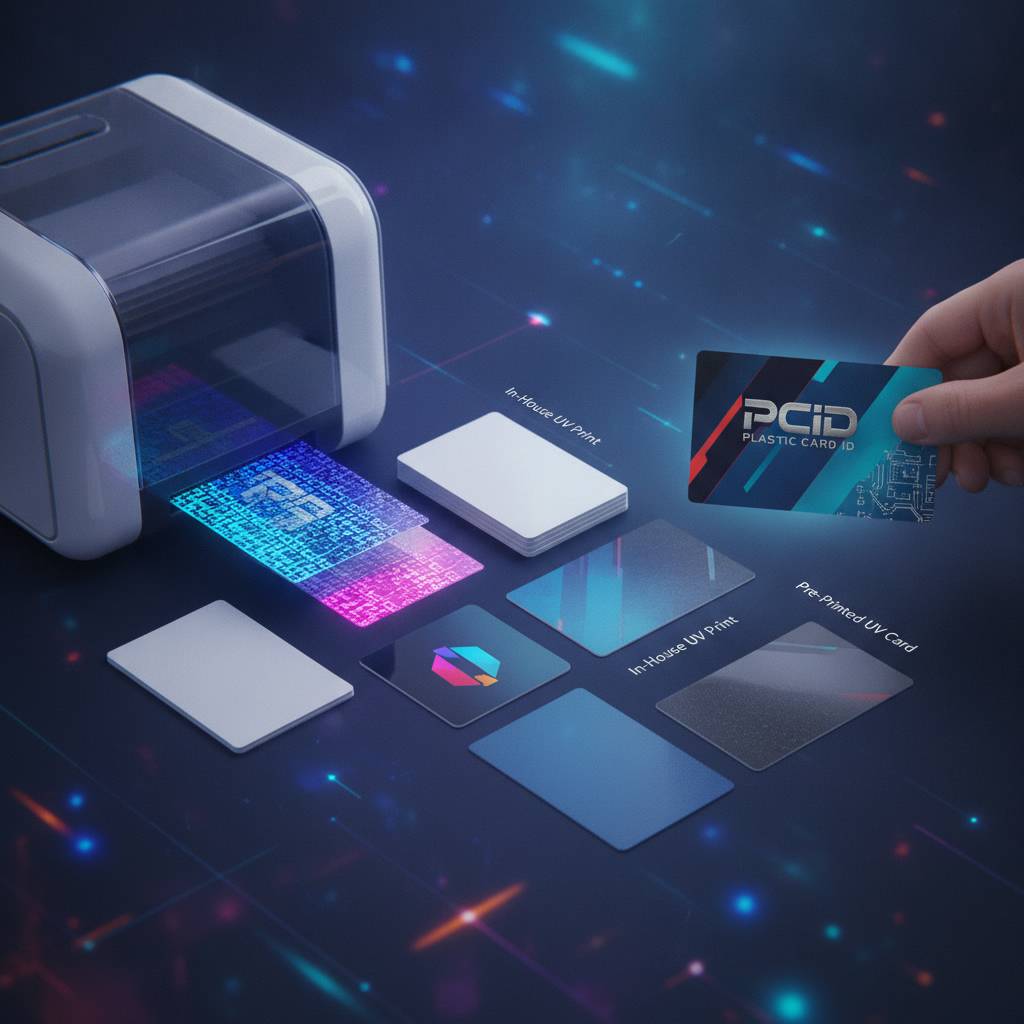 Businesses have two primary paths to UV-printed cards: print them in-house using a card printer with UV ribbon capability, or order pre-printed cards from a supplier with UV features already applied. Both options are valid, and the right choice depends on your card volume, personalization needs, and operational setup.
In-house printing gives you speed and control. You can produce individual cards on demand - useful for employee ID programs where new hires start immediately, or loyalty programs where cards are issued at point of sale. Pre-printed UV cards are more cost-effective at scale when the design is fixed and you need large quantities with consistent UV elements already in place.
Setting Up In-House UV Card Printing
Getting started with in-house UV printing requires three things: a compatible card printer, UV-capable ribbons, and blank PVC cards. Printers from Evolis, Zebra, and Fargo offer UV panel capability at various price points, with options suited to small-batch programs printing under 500 cards per month all the way up to high-volume production environments. CPE can help match you to the right printer based on your actual volume and UV requirements.
The setup cost is a real consideration. A mid-range card printer with UV capability typically falls in the $1,500-$4,000 range, with ribbons adding ongoing cost per card. But when you factor in design control, turnaround speed, and the elimination of minimum order requirements from external printers, in-house production frequently proves more economical within 12-18 months for programs printing more than a few hundred cards monthly.
When to Order Pre-Printed UV Cards
Pre-printed UV cards make the most sense when your design is stable, your volumes are high, and you don't need individual card personalization at point of production. Membership cards for associations, hotel key card blanks, and event credentials for large-scale events all fit this profile. You define the UV element during the design phase, and every card in the run carries that feature identically.
This approach also removes the operational overhead of managing a card printer, ribbons, and cleaning kits. For organizations without dedicated card production staff, pre-printed UV cards deliver security without complexity. Orders can scale from a few hundred to tens of thousands, with per-card costs dropping significantly at higher volumes.
Combining UV Printing with Other Card Technologies
UV ink printing doesn't exist in isolation - it combines naturally with other card features. A magnetic stripe card (HiCo or LoCo) can carry a UV security element alongside its encoded data. An RFID proximity card or smart chip card can incorporate UV printing as a visual security layer complementing its electronic authentication. Clear or frosted PVC cards can feature UV designs that interact visually with the card's transparency in distinctive ways.
This layering of technologies - magnetic encoding, chip data, UV printing, and physical card design - creates card programs that are genuinely difficult to circumvent at multiple levels simultaneously. Casino player cards, for example, routinely combine RFID tracking, magnetic encoding, and UV printing precisely because defeating all three simultaneously is impractical for bad actors.
Buyer's Guide: What to Ask Before Ordering UV-Printed Cards
Ordering UV-printed cards without asking the right questions first is how businesses end up with cards that don't perform as expected. The UV feature is invisible by design - which means a poorly executed UV print job may also be invisible in the wrong way: present but ineffective, or absent entirely. Knowing what to specify protects your investment.
Informed buyers get better cards. The questions below reflect what experienced card program managers ask before committing to an order - whether they're sourcing pre-printed cards or setting up in-house UV printing capability for the first time.
Key Questions Before You Order
- What UV wavelength is the ink designed to fluoresce at - 365nm or 395nm? This affects which UV lamps will activate it reliably.
- Can you specify custom UV artwork, or are standard UV panel options available only?
- How is UV printing quality controlled in the production run, and what is the rejection threshold for UV defects?
- Does the UV feature appear on one side of the card or both?
- Is the UV printing applied before or after lamination, and how does this affect durability?
- What is the minimum order quantity for UV-printed cards?
- Are UV ribbon panels available for your specific card printer model?
These questions don't require technical expertise to ask - they require the right supplier relationship to answer. CPE approaches every card program as a strategic partner, not a transaction processor. That means the answers come with context, recommendations, and follow-up support rather than a catalog page and a checkout button.
Understanding UV Print Quality Indicators
A well-executed UV print on a PVC card should glow brightly and uniformly under a UV lamp at the appropriate wavelength. Edges should be clean, text should be legible, and logos should render accurately. Weak fluorescence often indicates insufficient ink coverage or improper curing. Blurred edges may indicate a ribbon or print head alignment issue.
When evaluating samples, test UV cards under both 365nm and 395nm lamps - different applications and environments use different UV light sources, and knowing how your card performs under each is valuable information. A card that glows brilliantly under one wavelength but dimly under another is still usable, but staff need to know which lamp to use for reliable authentication.
Volume, Pricing, and Lead Time Considerations
UV-printed card pricing varies based on quantity, design complexity, and whether UV printing is the only special feature or part of a multi-technology card. At lower volumes - say, 250-500 cards - expect UV printing to add a meaningful but manageable per-card premium. At 5,000 cards and above, the premium shrinks considerably as setup costs amortize across the run.
Lead times for UV-printed cards are typically slightly longer than standard print runs due to the additional production step. Planning a buffer of one to two weeks beyond your standard card order timeline is advisable, especially for first orders where design approval and UV artwork review add steps. Reach out to 800.835.7919 early in your planning cycle to confirm current lead times and volume pricing.
UV Ink Printing and the Broader Card Program Ecosystem
UV ink printing is one feature within a larger ecosystem of card program capabilities. Businesses that understand the full range of what's available - and how features work together - build programs that outperform those assembled without that context. CPE exists precisely to provide that context, drawing on 25 years of experience and relationships with more than 100,000 U.S. businesses.
The catalog extends well beyond UV printing: blank CR80 PVC cards in standard white and custom colors, HiCo and LoCo magnetic stripe cards, RFID and proximity cards, smart chip cards including MIFARE DESFire, clear and frosted options, custom die-cut shapes, and luxury metal cards in stainless steel, brass, and gold. Every card type can be considered as a potential canvas for UV features where appropriate.
Integrating UV Cards into Access Control Systems
Access control systems typically rely on electronic authentication - proximity reading, smart chip verification, or magnetic stripe encoding. UV printing adds a physical verification layer that operates independently of the electronic system. This matters in scenarios where electronic readers fail, network connectivity is lost, or a manual override is required. Staff with a UV lamp can still authenticate credentials visually.
Redundant authentication layers are a sign of a mature, resilient security program. Organizations managing physical security for facilities, events, or controlled environments benefit from not being entirely dependent on electronic systems. UV printing is a simple, low-maintenance way to build that redundancy into your card stock itself.
Card Accessories That Support UV Card Programs
Running a UV card program effectively means having the right accessories in place. Card sleeves and cardholders protect UV-printed surfaces from scratching, which can degrade the fluorescent layer over time. Cleaning kits for card printers help maintain print head performance, which directly affects UV panel output quality. Card carriers used in mailing programs protect UV cards during transit.
CPE stocks printer ribbons, cleaning kits, card carriers, sleeves, and card affixing and mailing services - everything needed to run a complete card program without sourcing accessories from multiple vendors. A single supplier relationship simplifies reordering, reduces friction, and ensures compatibility across the components of your program.
Scaling Your UV Card Program Over Time
Card programs rarely stay the same size. A business starting with 200 UV-printed loyalty cards per month may grow to 2,000 within two years. The infrastructure decisions made at program launch - printer model, ribbon type, card stock - should anticipate that growth rather than requiring a complete system overhaul when volume increases. CPE designs programs for where clients are going, not just where they are today.
Scaling typically involves transitioning from manual card production to semi-automated or fully automated printing and encoding, revisiting ribbon choices for higher-volume options, and potentially shifting some card types from in-house printing to pre-printed stock for cost efficiency. Having a partner who has managed this transition with hundreds of other businesses is genuinely valuable - the mistakes have already been made by others, so you don't have to make them yourself.
Connect with Plastic Card ID to Start Your UV Card Program Today
UV ink printing on plastic cards is a practical, proven security technology that works across card programs of every size and industry. Whether you're starting fresh with your first card program, upgrading an existing one, or adding UV features to cards already in circulation, the path forward is straightforward when you have the right partner.
Plastic Card ID has spent over 25 years building card programs across every vertical - retail, hospitality, healthcare, corporate, events, gaming, and beyond. More than 50 million cards and 100,000 customer relationships later, the expertise available to you through CPE is unmatched in the U.S. market.
Call Plastic Card ID today at 800.835.7919 to discuss your UV card program requirements, request samples, or get pricing for your specific volume and card type. Your cards should work as hard as your business does - and Plastic Card ID will make sure they do.