How Holographic Overlaminates Protect Plastic Cards
Table of Contents []
- How Holographic Overlaminates Protect Plastic Cards - Plastic Card ID
- What Holographic Overlaminates Actually Are
- The Six Ways Holographic Overlaminates Protect Your Cards
- Holographic Overlaminates in Specific Card Program Types
- Choosing the Right Overlaminate for Your Card Printer
- Frequently Asked Questions About Holographic Overlaminates
- Why Partner with Plastic Card ID for Your Secure Card Program
How Holographic Overlaminates Protect Plastic Cards - Plastic Card ID
Pull a plastic card out of your wallet. Chances are, there is a thin, shimmering layer on its surface that catches light at just the right angle. That layer is doing serious work. Holographic overlaminates are one of the most effective card security technologies available today - and most people never think twice about them. At Plastic Card ID, we believe you should understand exactly what is protecting your cards and why it matters enormously.
Card fraud, credential tampering, and unauthorized duplication are real threats that cost organizations money, reputation, and trust. Whether you are issuing employee ID badges, membership cards, loyalty cards, or access control credentials, the integrity of that card needs to hold up under real-world conditions. Overlaminates are a critical layer in that defense - and understanding how they work puts you in a much stronger position when designing your card program.
| Overlaminate Type | Security Level | Best Use Case | Durability |
|---|---|---|---|
| Clear Matte Overlaminate | Basic | General ID, employee badges | Good |
| Glossy Clear Overlaminate | Basic | Loyalty cards, membership | Good |
| Holographic Overlaminate | High | Secure ID, access control, credentials | Excellent |
| Custom Holographic Overlaminate | Very High | Government ID, casino cards, VIP credentials | Excellent |
| UV-Reactive Overlaminate | High | Event credentials, security badges | Very Good |
What Holographic Overlaminates Actually Are
Let's get specific. A holographic overlaminate is a thin film - typically 0.5 to 1 mil thick - applied over the printed surface of a plastic card using heat and pressure. The holographic effect is created through a process called diffraction, where microscopic surface patterns scatter light into a spectrum of colors. This visual complexity is nearly impossible to replicate without industrial-grade equipment, making it a frontline deterrent against forgery and tampering.
These films are not decorative afterthoughts. They are engineered security components. The laminate bonds tightly to the card surface, and any attempt to remove or peel it back causes visible, irreversible damage to the card - immediately revealing tampering. That self-defeating property is precisely the point. A tampered card announces itself, which is exactly what a secure credential program needs.
The Science Behind the Shimmer
Holographic films work through a principle called microstructure diffraction grating. During manufacturing, a laser etches microscopic ridges and grooves into a metallic foil layer at varying angles and depths. When light hits these structures, different wavelengths reflect at different angles, producing the characteristic rainbow shimmer. Each variation in the pattern creates a unique visual signature that shifts depending on viewing angle and light source.
What makes this especially powerful as a security feature is that the micro-etching process is proprietary and expensive. Standard desktop printing or even commercial printing equipment cannot reproduce a holographic film. Any counterfeit attempt using conventional methods will produce a flat, non-shifting result that trained eyes - and even untrained ones - will immediately identify as fake.
Bonding Mechanics and Card Surface Compatibility
Overlaminates are applied using thermal lamination processes, where heat activates an adhesive layer that permanently fuses the film to the card. Most holographic overlaminates are designed to work with standard CR80 PVC cards, the ISO 7810-compliant format that CPE supplies in volume across its full product catalog. The bond is not merely surface-level - the adhesive penetrates micro-irregularities in the card surface, creating a mechanical lock.
Compatibility matters significantly. Certain card surfaces, particularly retransfer-printed cards or cards with specialty coatings, may require specific overlaminate formulations. Always confirm compatibility between your card printer, ribbon type, and overlaminate film before committing to a production run. This is a detail where working with an experienced supplier makes a measurable difference in program outcomes.
Standard vs. Custom Holographic Patterns
Off-the-shelf holographic overlaminates typically feature repeating generic patterns - globes, stars, geometric waves - that provide a high level of security without custom tooling costs. These are the right choice for most ID, access control, membership, and loyalty programs. They provide genuine protection at an accessible price point, generally ranging from $75-$200 depending on volume and ribbon type.
Custom holographic overlaminates, by contrast, feature organization-specific imagery - logos, text, unique geometric designs - that are registered to a single issuer. Custom patterns make duplication virtually impossible because the tooling itself is proprietary and held exclusively by the manufacturer. Government IDs, casino player cards, and high-security corporate credentials often use custom holographic overlaminates for exactly this reason.
The Six Ways Holographic Overlaminates Protect Your Cards
Security is not a single feature - it is a system. Holographic overlaminates provide protection across multiple threat vectors simultaneously, which is why they are a standard in serious card programs. Understanding all six protective mechanisms helps you appreciate what you are getting - and what you might be missing if you skip this layer.
When CPE works with clients on card program design, overlaminate selection is one of the conversations that often gets the most traction. Organizations that have experienced card fraud or credential abuse understand immediately. Those building programs from scratch sometimes need to see the full picture before the investment clicks into place.
Tamper Evidence
The most immediate protective function of a holographic overlaminate is tamper evidence. The film adheres with an aggressive bond that, when disturbed, either tears or leaves a destructive residue on the card surface. Attempts to peel away the laminate to modify printed information - changing a photo, altering an expiration date, swapping encoded data - are visible instantly. A tampered card cannot be made to look untampered again.
This property is particularly critical for employee ID badges and access control cards, where a single compromised credential could allow unauthorized physical access to restricted areas. The tamper-evident nature of holographic overlaminates creates a zero-tolerance environment - there is no subtle way to forge or modify a properly laminated card.
Abrasion and Wear Resistance
Beyond security, overlaminates dramatically extend card lifespan. Cards used daily in wallets, badge holders, and readers accumulate surface wear that degrades printed information and visual quality. A holographic overlaminate adds a hard, scratch-resistant protective layer that keeps printing crisp and readable far longer than an unlaminated card.
For high-frequency-use programs - employee badges swiped dozens of times daily, loyalty cards presented at every transaction, access credentials used in outdoor environments - this durability translates directly to lower replacement costs. Cards that last 3-5 years instead of 12-18 months reduce your per-card cost over the life of the program significantly. That is a financial argument as much as a security one.
UV and Chemical Resistance
Dye-sublimation and inkjet printed cards are vulnerable to ultraviolet light, which causes color fading and image degradation over time. Holographic overlaminates, particularly those with UV-blocking agents, shield the printed surface from UV exposure. Cards worn outdoors, attached to lanyards in sunlit environments, or stored near windows benefit enormously from this protection.
Chemical resistance is equally important in industrial, food service, healthcare, and hospitality environments where cards may come into contact with cleaning agents, solvents, or body care products. The laminate acts as a chemical barrier, preventing surface contamination from penetrating to the printed layer below. This is a detail that pays dividends in cards that stay professional-looking throughout their service life.
Holographic Overlaminates in Specific Card Program Types
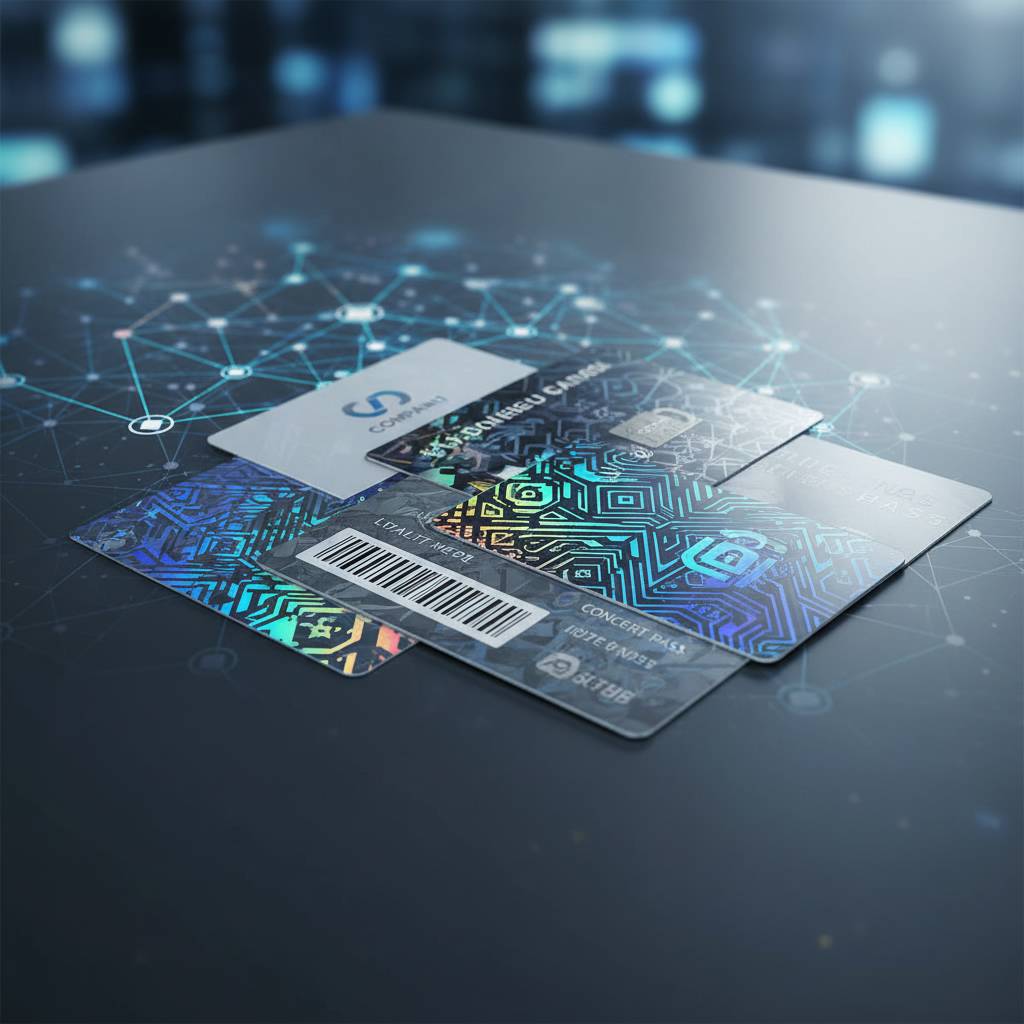 Different card programs face different threat profiles and usage conditions. The right overlaminate strategy depends on who is using the cards, where, and what the consequences of credential compromise look like. Here is how holographic overlaminates serve specific program categories that Plastic Card ID supports across the United States.
Employee ID and Access Control Cards
Employee ID programs represent one of the highest-stakes use cases for secure overlaminates. These cards determine who enters buildings, who accesses servers, who passes through security checkpoints. A forged or tampered employee badge is not just an administrative nuisance - it is a physical security breach. Holographic overlaminates, combined with RFID or magnetic stripe encoding, create a multi-layer security credential that is genuinely difficult to compromise.
For enterprise-scale programs, custom holographic overlaminates with company-specific imagery add an additional layer of authentication. Security personnel learn to recognize the specific shimmer pattern and design associated with legitimate credentials, making forgeries immediately conspicuous. This visual authentication layer works even when electronic readers are unavailable - a critical backup for power outages, system failures, or remote checkpoints.
Reach the team at Plastic Card ID by calling 800.835.7919 to discuss overlaminate options for your employee ID program and get expert recommendations matched to your card printer model and volume requirements.
Casino Player Cards and VIP Credentials
Casino environments are among the most demanding test beds for card security technology. Player cards track significant financial activity, and sophisticated fraudsters have strong incentives to counterfeit or manipulate them. Casino player cards demand the highest security overlaminate specifications available, typically custom holographic films combined with RFID encoding and UV-reactive security printing.
VIP credential programs at resorts, hospitality venues, and entertainment complexes face similar pressures. A counterfeited VIP card that grants unauthorized access to premium services represents direct financial loss and serious reputational risk. Holographic overlaminates serve as the visible, tactile proof of authenticity that staff can verify instantly, even under busy conditions where careful electronic verification might not always be practical.
Membership and Loyalty Card Programs
While membership and loyalty cards do not typically face the same fraud intensity as security credentials, overlaminate protection still provides important benefits. Brand presentation matters enormously in these programs - a glossy, shimmering card with a holographic overlaminate communicates quality and permanence that paper alternatives simply cannot match. Research consistently shows that plastic loyalty cards outperform paper punch cards in retention and redemption rates.
Holographic overlaminates on loyalty and membership cards also prevent duplication - a real concern for programs with meaningful rewards attached to card status. Members attempting to create duplicates for family members or resell high-tier status cards are deterred by the difficulty of replicating a laminated credential. For gift card programs, where physical cards represent stored monetary value, security overlaminates are essentially non-negotiable.
Choosing the Right Overlaminate for Your Card Printer
This is where theory meets practice. Not all overlaminates work with all card printers. The three major printer families that CPE supports - Evolis, Zebra, and Fargo - each have specific ribbon and overlaminate systems that are optimized for their respective hardware architectures. Using mismatched consumables is one of the most common causes of poor lamination quality, wasted cards, and premature printer maintenance issues.
Selecting the right consumables stack is not complicated when you have the right guidance. But getting it wrong is costly. The good news is that with decades of experience supplying cards and consumables across all major printer brands, Plastic Card ID has the expertise to match your program requirements to the right product combination efficiently.
Fargo HDP Printers and Overlaminate Films
Fargo HDP (High Definition Printing) printers use a retransfer printing process that first prints onto a clear film, which is then transferred onto the card surface. This process produces exceptionally sharp, edge-to-edge images - but it also means overlaminate specifications must account for the retransfer film layer already present on the card. Fargo-compatible overlaminate films are formulated to bond correctly with this surface chemistry.
The Fargo HDP platform is particularly popular for high-security ID programs because of its print quality and the range of overlaminate options available, including holographic and custom security laminates. HDP printing combined with holographic overlaminate represents a best-in-class security credential for organizations where credential integrity is paramount.
Evolis and Zebra Single-Pass Printer Overlaminates
Evolis and Zebra direct-to-card printers use a single-pass process where dye sublimation printing and lamination can occur in the same printer pass. Overlaminate patch films for these systems are precision-cut to card dimensions and wound into ribbons that the printer applies automatically. The process is fast, consistent, and well-suited for mid-volume programs printing hundreds to thousands of cards per month.
Both Evolis and Zebra offer their own branded overlaminate ribbons with holographic security features, and CPE stocks these consumables alongside compatible third-party options. Matching ribbon type to printer model ensures optimal adhesion temperature and application pressure, which are the two variables that most directly determine laminate bond quality and finished card appearance.
Buyer Tips: Getting the Most from Your Overlaminate Investment
- Always verify overlaminate compatibility with your specific printer model number before purchasing - not just the printer brand or family.
- Store overlaminate ribbons and films in a cool, dry environment away from direct sunlight to prevent adhesive degradation before use.
- Run test cards at the start of each new production batch to verify lamination quality before committing to a full run.
- Clean your printer's lamination rollers regularly using manufacturer-approved cleaning kits to prevent adhesive buildup that causes uneven application.
- For high-security programs, consider dual-sided holographic overlaminates that protect both card faces simultaneously.
- When evaluating overlaminate options, request samples to physically inspect shimmer quality, thickness, and peel resistance before ordering in volume.
Frequently Asked Questions About Holographic Overlaminates
Questions about holographic overlaminates come up consistently when organizations are designing or upgrading their card programs. Below are the most common questions Plastic Card ID receives, along with straightforward answers based on real-world program experience across more than 100,000 customers and 50 million cards supplied.
Do Holographic Overlaminates Affect Magnetic Stripe or RFID Function?
This is a critical technical question. For magnetic stripe cards, holographic overlaminates are applied to the card face only - not over the magnetic stripe on the card back. Properly applied overlaminates do not interfere with stripe readability. However, poor application or use of incompatible overlaminate materials can cause stripe read errors, which is one reason consumable compatibility matters so much.
For RFID and proximity cards, the antenna and chip are embedded within the card body itself, well below any surface laminate. Holographic overlaminates have no effect on contactless card performance, including high-frequency MIFARE DESFire smart cards and standard 125kHz proximity cards. Security overlaminates and electronic encoding are fully compatible technologies when correctly specified and applied.
To discuss your specific card configuration, call 800.835.7919 and a Plastic Card ID specialist will help you confirm compatibility for your exact printer and card type.
How Long Do Holographic Overlaminates Last?
Under normal use conditions, a properly applied holographic overlaminate extends card life to 3-5 years for frequently used cards and significantly longer for occasional-use credentials. The laminate itself does not degrade in normal ambient conditions, though prolonged exposure to extreme heat - like leaving cards in a closed car in summer - can eventually affect adhesion at the card edges.
For programs requiring maximum longevity, select overlaminates with enhanced UV resistance and chemical resistance ratings. Cards used in industrial environments, food service settings, or outdoor applications benefit from premium-grade overlaminate specifications. The investment in a slightly higher-grade overlaminate is almost always recovered in reduced card replacement frequency and lower overall program costs.
Can I Add Holographic Overlaminates to Cards I Print In-House?
Yes - this is exactly the model that most in-house card programs follow. You print your card design using your Evolis, Zebra, or Fargo printer, then apply the overlaminate in a subsequent pass (or simultaneously, depending on your printer model). In-house lamination gives you complete control over timing, card inventory, and design flexibility without dependence on external production schedules.
The key is having a printer that supports lamination - not all entry-level card printers include this capability. If you are currently using a print-only model and want to add holographic overlaminate to your program, upgrading to a printer with integrated lamination is the cleanest solution. CPE can walk you through the available options across all three major printer brands and help you find the right fit for your volume and budget.
Why Partner with Plastic Card ID for Your Secure Card Program
Plastic Card ID has spent over 25 years building card programs for organizations across every industry in the United States. From 50-card-per-month employee badge programs to tens-of-thousands-card gift card rollouts, the team understands what it takes to build a program that performs reliably, securely, and cost-effectively. Holographic overlaminates are one piece of that picture - but they are a piece that CPE takes seriously, because card security is not a place to cut corners.
The full product ecosystem matters here. Blank PVC cards, magnetic stripe cards in HiCo and LoCo configurations, RFID and proximity cards, smart chip cards with MIFARE DESFire technology, card printers from Evolis, Zebra, and Fargo, printer ribbons, cleaning kits, card carriers, sleeves, and card affixing and mailing services - everything a serious card program needs is available through a single trusted supplier. That eliminates the vendor coordination headaches that come with sourcing from multiple companies and ensures that every component in your program is compatible with every other component.
A True One-Stop Card Program Resource
What separates a strategic partner from a commodity supplier is the willingness to stay engaged beyond the initial sale. Plastic Card ID supports clients through program design, printer selection, consumable compatibility verification, reorder planning, and program scaling. When your program grows from 200 cards a month to 5,000, you should not need to find a new supplier - you should be working with one that grew with you.
The combination of deep product knowledge, long-term customer relationships, and a catalog that covers every stage of card program development is what has allowed CPE to serve over 100,000 customers and supply more than 50 million cards. That track record is not accidental. It is the result of treating every card program as an investment worth protecting.
Specialty and Advanced Card Solutions
Beyond standard PVC card programs, Plastic Card ID supports organizations with more complex or specialized needs. Clear and frosted plastic cards, custom die-cut shapes, luxury metal cards in stainless steel, brass, and gold, casino player card programs, hotel key card programs, and high-security access control credentials with advanced RFID encoding - the breadth of available solutions means virtually no card program requirement falls outside scope.
For organizations issuing credentials that need to project authority and permanence - executive membership cards, VIP event credentials, high-tier loyalty cards - metal card options represent a premium upgrade that dramatically elevates cardholder perception. These are cards that people keep, display, and value, which translates directly into stronger program engagement and brand association.
Getting Started with Your Card Program Today
Whether you are building a new card program from scratch, upgrading an existing program with better security features, or scaling an in-house operation that has outgrown its current setup, the starting point is a conversation with someone who knows the full landscape. The right card program is one that fits your volume, your security requirements, your budget, and your workflow - and getting all four variables right at the start saves significant time and money downstream.
Card programs that incorporate holographic overlaminates from the beginning are better positioned on every front - security, durability, brand presentation, and cost efficiency over the life of the program. Do not treat security as an upgrade to add later. Build it in from the start.
Ready to protect your card program with holographic overlaminates? Contact Plastic Card ID today at 800.835.7919 - your experienced partner for secure, professional plastic card programs across the United States.
Previous Page