Blank Plastic Cards Made in the USA: What to Know
Table of Contents []
- Why Plastic Card ID Is the Trusted Source for Blank Plastic Cards Made in the USA
- The Full Catalog: Every Blank Plastic Card Type Your Program Might Need
- What Blank Plastic Cards Actually Do for Your Business
- In-House Card Production vs. Outsourcing: Making the Right Call
- Industries Served and Real-World Applications
- Frequently Asked Questions About Blank Plastic Cards Made in the USA
- Partner With Plastic Card ID for Blank Plastic Cards Made in the USA
Why Plastic Card ID Is the Trusted Source for Blank Plastic Cards Made in the USA
There's a moment every business reaches - when the laminated paper badge or the hand-punched loyalty card just isn't cutting it anymore. Customers notice. Employees notice. The card sitting in someone's wallet tells a quiet story about your brand, and blank plastic cards made in the USA tell a far more confident story than anything printed on cardstock. That's exactly where Plastic Card ID comes in, with over 25 years of card supply experience and more than 50 million cards shipped to businesses across the country.
Plastic Card ID isn't simply a vendor you place an order with and forget. The team functions as a long-term strategic partner, helping organizations build card programs that scale from a modest run of 50 cards a month all the way to mass production numbering in the tens of thousands. Whether you're outfitting a regional gym chain with membership cards or equipping a corporate campus with access credentials, the infrastructure and inventory are already in place to serve you fast and consistently.
What makes blank plastic cards so powerful is the flexibility they hand back to you. A single card format - the standard CR80, 30 mil thick, fully ISO 7810 compliant - becomes whatever your operation needs it to be. Print it in-house, encode a magnetic stripe, load it with RFID data, or hand it to a new employee as a photo ID badge. The card itself is a blank canvas, and CPE gives you every tool to bring that canvas to life.
The CR80 Standard and Why It Matters
CR80 is the universal credit-card-size standard - 3.375 inches by 2.125 inches, 30 mil in thickness. Nearly every card printer on the market, every wallet slot, every card reader, and every badge holder is engineered around this dimension. When you stock CR80 blank cards, you're buying into a global infrastructure of compatible hardware and accessories without any guesswork involved.
The 30 mil thickness isn't arbitrary. It gives the card enough rigidity to survive repeated handling - swiped through a reader dozens of times, clipped to a lanyard, tucked into a wallet, dropped on a break room floor - without cracking, bending, or losing its print quality. Durability is the baseline expectation, and a quality PVC card meets it every single time.
Who Actually Buys Blank PVC Cards
The customer base for blank plastic cards is broader than most people assume. Retailers running gift card programs, schools issuing student IDs, clinics distributing patient loyalty cards, hotels encoding key access, event organizers credentialing staff and vendors - the list crosses virtually every industry vertical. CPE has served over 100,000 customers, and very few of those use cases look exactly alike.
What they share is the need for a reliable, consistent supply of quality blank cards and the printing or encoding equipment to customize them on demand. That combination - cards plus equipment plus supplies - is precisely what Plastic Card ID delivers under one roof, making the operational side of running a card program dramatically simpler.
Call Us to Build Your Card Program
Starting a card program or scaling an existing one raises questions that a product catalog alone can't answer. How many cards should you stock? Which magnetic stripe coercivity is right for your readers? Do you need RFID encoding, or will a simple printed card handle your use case? The team at Plastic Card ID has answered these questions thousands of times and can help you find the right configuration quickly. Reach out directly at 800.835.7919 - a real conversation with someone who knows cards saves time and budget.
Don't let the technical terminology slow you down. CPE makes it straightforward to identify exactly what you need, order confidently, and receive product that performs the way you expect.
| Card Type | Key Feature | Common Use Case |
|---|---|---|
| Blank PVC White CR80 | Standard 30 mil thickness | Employee badges, membership cards |
| HiCo Magnetic Stripe | 2750 Oe high coercivity | Hotel keys, access cards, loyalty |
| LoCo Magnetic Stripe | 300 Oe low coercivity | Short-term event credentials |
| RFID Proximity Card | Contactless 125kHz | Building access, time and attendance |
| Smart Chip Card | MIFARE DESFire and others | Campus IDs, secure facility access |
| Clear / Frosted PVC | Transparent or frosted finish | Premium VIP cards, specialty branding |
The Full Catalog: Every Blank Plastic Card Type Your Program Might Need
Stocking only one card format is rarely enough once a business expands its card programs beyond the basics. Plastic Card ID maintains a comprehensive catalog that covers the entire spectrum - from the most utilitarian white PVC blanks to advanced contactless smart cards and visually distinctive frosted and colored stock. Having a single supplier capable of filling all those categories isn't a luxury; it's a logistical advantage that reduces vendor management overhead significantly.
The catalog is organized around real-world application needs rather than abstract specifications. Every card type in the lineup has a defined purpose, and understanding which type matches your reader infrastructure, security requirements, and budget is exactly what the CPE team helps customers work through before placing an order. No upselling - just matching the right product to the right program.
Magnetic Stripe Cards: HiCo vs. LoCo
Magnetic stripe cards remain among the most widely deployed card formats in North America. The stripe on the back encodes data - loyalty account numbers, access credentials, membership IDs - that card readers decode instantly. The critical variable is coercivity: HiCo cards at 2750 Oe hold their encoding reliably in magnetically noisy environments and are the standard for hotel keys, gym memberships, and facility access. LoCo cards at 300 Oe work well for short-duration use where long-term data retention isn't required.
Ordering the wrong coercivity means your cards won't read reliably in your existing hardware. Plastic Card ID makes it easy to confirm which stripe type your readers require before you commit to a bulk order, saving the considerable frustration of discovering a mismatch after the fact. Matching coercivity to your reader system is a fundamental step that experienced programs never skip.
RFID, Proximity, and Smart Chip Cards
Contactless cards have become the backbone of modern access control. Proximity cards operating at 125kHz are compatible with the vast majority of legacy access control systems and are the go-to solution for building entry, time-and-attendance tracking, and parking management. Smart chip cards - including those using MIFARE DESFire technology - add encryption and multi-application capability, making them the preferred choice for university campuses, healthcare facilities, and high-security environments.
The distinction between proximity and smart chip matters enormously when specifying cards for a new system or upgrading an existing one. CPE stocks both formats in volume and can help customers confirm compatibility with named access control platforms. Investing in the right contactless technology upfront avoids costly card reprints and reader replacements down the line.
Specialty Formats: Clear, Frosted, Colored, and Die-Cut
Not every card program is utilitarian. Retail gift card programs, VIP membership tiers, and premium loyalty programs often benefit from cards that stand apart visually. Clear PVC cards allow any color printed beneath to show through with striking depth. Frosted finishes give a tactile premium feel that customers associate with high-value brands. Colored stock - available in a range of base colors - provides an instant visual differentiator without the cost of full custom printing on every batch.
For programs that truly want to make a statement, Plastic Card ID also offers luxury metal cards in stainless steel, brass, and gold. These aren't novelties - they're tools for communicating exclusivity at every card presentation. Die-cut custom shapes round out the specialty options, giving creative programs the freedom to move beyond the standard rectangle entirely.
Card Supplies and Printer Support
A card program is only as consistent as its supply chain. Plastic Card ID supports the full operational stack with printer ribbons, cleaning kits, card carriers, sleeves, and card affixing and mailing services. Card printers from Evolis, Zebra, and Fargo are available alongside the consumables those printers require, ensuring that a single supplier relationship covers both the hardware and the ongoing operational materials. Reach the team directly at 800.835.7919 for guidance on ribbon compatibility and printer maintenance schedules.
Cleaning kits in particular are frequently overlooked until print quality degrades or a printer jams unexpectedly. Proactive printer maintenance is one of the simplest ways to protect the quality of every card your organization produces and extend the life of equipment that represents a significant capital investment.
What Blank Plastic Cards Actually Do for Your Business
The business case for plastic over paper isn't theoretical - it's documented and repeatable. Retailers who make the switch from paper gift certificates to plastic gift cards consistently report sales increases in the 35-50% range. The card doesn't just hold a balance; it circulates, it gets passed along, it lives in a wallet alongside other cards and functions as a persistent brand impression every time that wallet opens.
Loyalty cards follow the same logic. A punch card in a pocket eventually gets forgotten, crumpled, or lost. A plastic loyalty card in a wallet is right there next to the customer's payment method - positioned at precisely the moment a purchase decision is being made. Physical card presence drives repeat visits in a way that app notifications and email reminders struggle to replicate consistently.
Employee Badges and ID Cards
For organizations managing staff access across facilities, a professionally printed plastic ID card is both a security tool and a cultural signal. It communicates that your organization takes identity and access seriously, that roles are clearly defined, and that your workforce is part of a credentialed, accountable team. A blank CR80 card fed through a direct-to-card printer becomes a full-color photo ID badge in under a minute.
The scalability of in-house badge production is a genuine operational advantage. When an employee is hired, promoted, or transferred, the updated badge is produced immediately - not ordered, waited on, and delayed. On-demand card production keeps security protocols current without administrative lag or per-card outsourcing costs that accumulate quickly in large organizations.
Membership and Access Control Programs
Gyms, clubs, coworking spaces, libraries, and professional associations all rely on membership cards to verify status and control access. A plastic card signals permanence and legitimacy in a way that a printed paper membership confirmation simply cannot. When a member hands their card to a front desk attendant or taps it against a reader, the interaction is instantaneous, professional, and reinforcing of the membership relationship.
Access control cards specifically - whether magnetic stripe or RFID - integrate directly with the access panels, turnstiles, and reader systems that manage who enters which spaces and when. Plastic Card ID has supplied access credentials for programs ranging from small office suites to sprawling multi-building campuses, with card volumes scaling to match every operational requirement.
Gift Cards, Loyalty Cards, and Retail Applications
- Gift cards in plastic format generate higher average load values than paper gift certificates because they feel more substantial and trustworthy to purchasers.
- Plastic loyalty cards placed in wallets remain top of mind at point of purchase, driving repeat transaction rates above digital-only alternatives in many retail segments.
- Referral cards, discount cards, and promotional cards in plastic last through repeated wallet handling without degrading or becoming unreadable.
- Magnetic stripe encoding on retail cards enables automated point tracking and balance management through standard POS reader hardware most retailers already own.
- Seasonal and limited-edition card designs produced on colored or specialty stock add collectability and perceived value to retail card programs.
In-House Card Production vs. Outsourcing: Making the Right Call
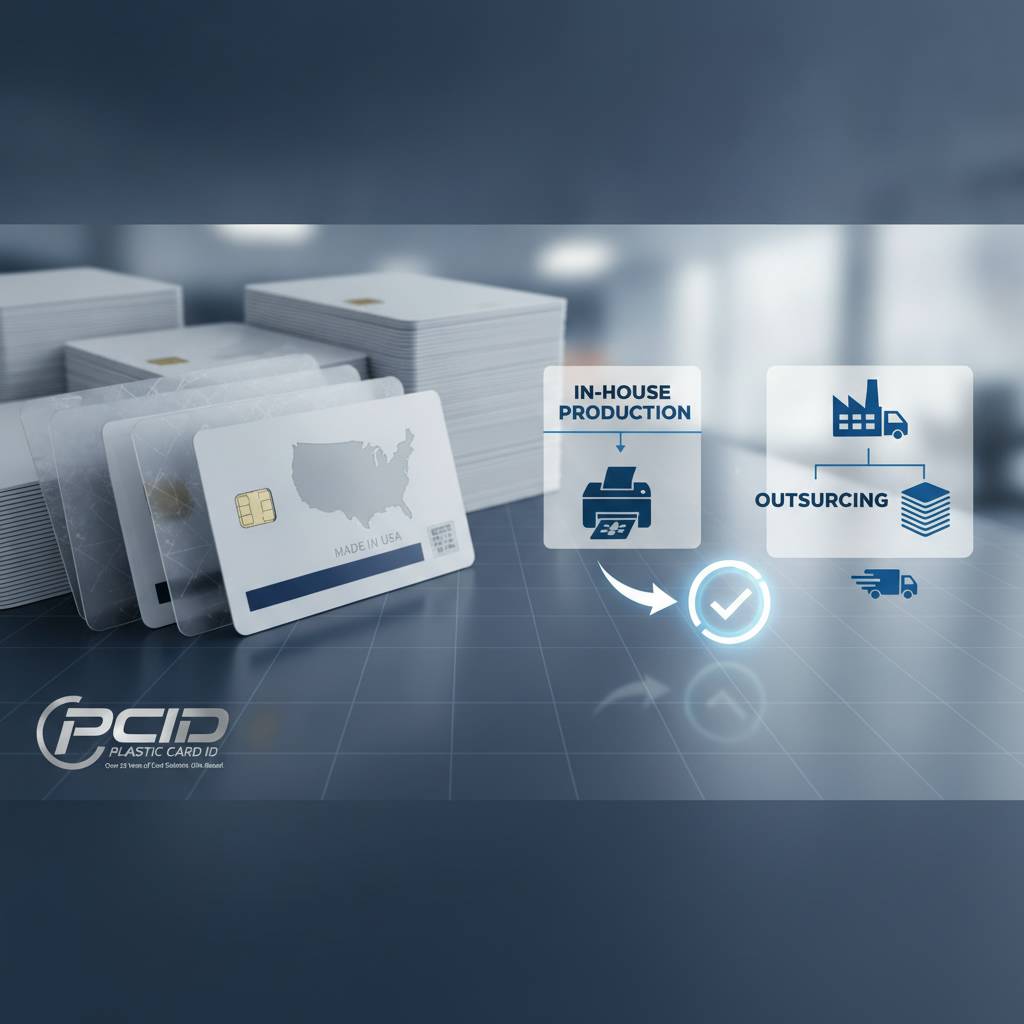 One of the more consequential decisions for any card program is whether to print and encode cards in-house or to outsource that production. Both models have merit, and the right answer depends on volume, design change frequency, turnaround requirements, and the sensitivity of the data being encoded. Plastic Card ID supports both approaches - supplying blank cards and printers for in-house programs and providing pre-printed options where outsourcing makes more sense.
In-house production offers speed and control. When you own the printer and stock the blank cards, a new employee badge or a replenished rack of loyalty cards is a same-day production event. The unit cost over time trends lower as volume increases, and design changes - updating a logo, swapping a color, adding a new department name - don't require reordering from an outside vendor.
When In-House Production Wins
Organizations that issue cards frequently, need personalization at the individual level, or require tight turnaround windows are strong candidates for in-house production. HR departments issuing employee badges, hotels encoding key cards at check-in, and event organizers credentialing staff on-site all benefit from having the production capability immediately available. The upfront investment in a card printer pays for itself quickly when the alternative is paying per-card outsourcing premiums at scale.
Plastic Card ID carries card printers from Evolis, Zebra, and Fargo - brands that represent the practical range from compact desktop units for low-volume environments to high-throughput models designed for enterprise-scale production. Printer selection is a conversation the CPE team is always ready to have.
Calculating Your Per-Card Cost
The total cost of producing a card in-house includes the card blank, the ribbon consumption per print, the prorated cost of cleaning and maintenance supplies, and the labor time involved. For most organizations producing more than a few hundred cards per month, in-house production cost-per-card drops well below outsourcing alternatives - often dramatically so at volumes above 1,000 cards per month.
Blank PVC cards in bulk orders reduce per-card cost significantly compared to small quantities. Buying in appropriate volume increments is one of the simplest ways to bring down program operating costs, and Plastic Card ID provides guidance on which order quantities make the most economic sense for different program sizes.
Hybrid Programs: The Flexible Middle Ground
Many sophisticated card programs use a hybrid model - blank stock and in-house printers for personalized, on-demand cards like employee badges, combined with pre-produced specialty stock like foil-stamped gift cards or premium membership cards ordered in seasonal batches. This approach captures the benefits of both models without requiring a single method to handle every card type in the program.
CPE has helped dozens of organizations structure hybrid card programs that match the right production method to the right card type. It's a more nuanced approach than defaulting to one model, and it consistently delivers better outcomes on both cost and quality dimensions. Contact the team at 800.835.7919 to map out the structure that fits your specific program.
Industries Served and Real-World Applications
Across more than a quarter century of operation and over 100,000 customers served, Plastic Card ID has developed deep familiarity with the card program requirements of virtually every major industry vertical in the United States. That institutional knowledge means faster, more accurate guidance when a new customer brings a use case to the table - because the team has almost certainly seen a close analogue before.
The range spans hospitality, healthcare, retail, education, corporate enterprise, government agencies, event management, gaming, and beyond. Each vertical has its own specific requirements around card format, encoding technology, volume cadence, and design. No two card programs are identical, but the underlying product and equipment needs tend to fall into recognizable patterns that CPE navigates with confidence.
Hospitality and Hotel Key Cards
Hotel key cards are among the highest-volume magnetic stripe card applications in the country. Every guest check-in requires at least one encoded key card, and high-occupancy properties can consume hundreds of cards per day across an entire year. HiCo magnetic stripe cards are the industry standard because they encode reliably, read consistently in door lock hardware, and tolerate the repeated handling that hotel use demands.
Beyond key access, hospitality programs often extend to pool and spa access cards, loyalty program cards for frequent guests, and staff credential cards - all of which can be sourced from the same Plastic Card ID catalog, simplifying procurement across the entire property operation.
Education and Campus ID Programs
Universities, community colleges, K-12 districts, and private schools rely on plastic ID cards for student identification, library access, meal program participation, facility access, and event credentialing. Campus ID programs typically require photo ID printing, and many modern campuses layer smart chip or RFID technology onto the same card to enable building access, transit system integration, and cashless vending.
The multi-application nature of campus cards makes smart chip formats - particularly MIFARE DESFire - the preferred technology for institutions building or upgrading their card infrastructure. CPE stocks appropriate formats and can help education procurement teams align card specifications with the access control and reader systems already deployed on campus.
Events, Gaming, and Specialty Applications
- Event credential cards for conferences, trade shows, and festivals provide staff, media, and VIP attendees with access tiers that security teams can verify instantly.
- Casino player cards track gaming activity, comp program participation, and player tier status - a high-volume, high-security application where card quality and encoding reliability are non-negotiable.
- Luxury metal cards in stainless steel, brass, and gold serve VIP programs, exclusive membership clubs, and premium brand experiences that require a card with unmistakable physical presence.
- Die-cut custom shapes allow event programs and specialty brands to issue cards that double as collectibles or keepsakes, extending the marketing value of the card beyond its functional lifespan.
Frequently Asked Questions About Blank Plastic Cards Made in the USA
Customers new to building a card program often arrive with a common set of questions - about minimums, compatibility, encoding, and ordering logistics. The following covers the questions Plastic Card ID hears most frequently, drawing on decades of customer conversations and program consultation experience.
What Are the Minimum Order Quantities?
Plastic Card ID serves programs of every scale, from organizations ordering as few as 50 cards per month to enterprises running mass production in the tens of thousands. Minimum order quantities vary by card type, but the catalog is deliberately structured to accommodate small businesses and growing organizations that don't yet need bulk pricing tiers. As your program scales, pricing adjusts accordingly.
There's no program too small to get started, and no program too large to handle. The operational infrastructure at CPE is built to support both ends of that spectrum simultaneously, which is part of what makes a 25-year customer base of over 100,000 businesses possible.
How Do I Know Which Card Type Is Right for My Readers?
Reader compatibility is the single most common source of confusion for organizations setting up or expanding a card program. The answer depends on whether your readers are magnetic stripe, proximity, or smart chip-based - and within magnetic stripe, whether they're calibrated for HiCo or LoCo cards. Most corporate access readers use HiCo; many older loyalty program readers may use LoCo. When in doubt, the reader manufacturer's documentation will specify acceptable card coercivity.
Plastic Card ID recommends confirming your reader specifications before placing a card order. The team is available to help customers work through compatibility questions, and getting this right before ordering is always faster and less costly than discovering an incompatibility after a large batch has already arrived. Reach the CPE team directly at 800.835.7919 for compatibility support.
Can I Mix Card Types in a Single Order?
Yes. Many organizations run programs that require multiple card types simultaneously - for example, HiCo magnetic stripe cards for employee access and plain white CR80 blanks for printed-only visitor badges. Ordering multiple card types within a single procurement relationship simplifies invoicing, consolidates shipping, and ensures consistent quality standards across every card format in the program.
Consolidating card supply under one vendor relationship is a logistics advantage that organizations managing complex programs appreciate over time. It reduces the administrative overhead of managing multiple supplier contacts, purchase orders, and delivery schedules for what is ultimately a coordinated operational need.
Partner With Plastic Card ID for Blank Plastic Cards Made in the USA
After 25 years, more than 50 million cards shipped, and relationships with over 100,000 customers across every state in the country, Plastic Card ID has earned its position as the go-to source for blank plastic cards made in the USA. The catalog is comprehensive, the team is knowledgeable, and the operational support extends well beyond the moment a card leaves the warehouse.
Whether you're launching a brand new card program, upgrading an existing one to plastic from paper, scaling up a loyalty initiative, or adding contactless access technology to your facility, the right cards, printers, and supplies are available through a single trusted partner. Your card program deserves a supplier that treats it as seriously as you do - and that's exactly what CPE delivers, order after order, year after year.
Ready to get started? Contact Plastic Card ID today at 800.835.7919 and let our team help you build the card program your business deserves.
Previous Page