Bulk Plastic Card Order Turnaround Times Explained
Table of Contents []
- What Your Bulk Plastic Card Order Turnaround Time Actually Depends On - Plastic Card ID
- The Mechanics Behind Fast (and Slow) Card Orders
- Blank PVC Cards - Speed, Control, and Cost Efficiency
- Specialty Cards - What to Expect for RFID, Smart Chip, and Custom Options
- Planning Your Order: Buyer Tips for Faster Fulfillment
- Industries That Rely on Fast Bulk Card Turnaround
- Your Next Bulk Order Starts with the Right Conversation - Plastic Card ID
What Your Bulk Plastic Card Order Turnaround Time Actually Depends On - Plastic Card ID
You need cards. Hundreds, maybe thousands. And the clock is already running. Whether you're launching a new loyalty program, restocking employee badges, or gearing up for a seasonal promotion, bulk plastic card order turnaround times can make or break your timeline - and understanding what drives them puts you in control. Not every order is the same, and not every supplier thinks ahead on your behalf.
At Plastic Card ID, serving businesses across the United States for over 25 years and more than 100,000 customers, the difference between a smooth card program launch and a frustrating scramble often comes down to a few key decisions made early in the ordering process. This guide breaks down exactly what influences how fast your order ships, what you can do to speed things up, and why choosing the right partner matters more than most buyers realize.
| Card Type | Order Quantity | Estimated Turnaround |
|---|---|---|
| Blank PVC CR80 | 500-5,000 | 1-3 Business Days |
| Magnetic Stripe (HiCo/LoCo) | 250-10,000 | 3-5 Business Days |
| RFID / Proximity Cards | 100-5,000 | 5-10 Business Days |
| Smart Chip / MIFARE Cards | 100-2,500 | 7-14 Business Days |
| Custom Color Stock | 500-50,000 | 3-7 Business Days |
| Specialty / Die-Cut / Metal | 50-1,000 | 10-21 Business Days |
The Mechanics Behind Fast (and Slow) Card Orders
Here's something most buyers don't consider until it's too late: turnaround time isn't a single variable. It's a chain - and any weak link can hold up the whole order. Card type, encoding requirements, quantity, and even how clearly you communicate your specs all feed into the final fulfillment timeline. Understanding the full picture is how smart buyers plan smarter programs.
The good news is that CPE has built its entire operation around making that chain as short and efficient as possible. With over 50 million cards shipped to date, the infrastructure here isn't guesswork - it's precision logistics backed by deep product knowledge and a genuine interest in your program's success.
Card Type and Complexity: The Biggest Time Variable
Blank CR80 PVC cards are the fastest-moving items in the catalog. They're in stock, they ship quickly, and they give your team the flexibility to print in-house using Evolis, Zebra, or Fargo card printers. When you already have a printer and just need replenishment stock, a blank card order can move from purchase to doorstep remarkably fast.
Contrast that with a MIFARE DESFire smart chip card or a custom die-cut shape - both of which require additional production steps, encoding verification, or tooling. Complexity isn't a deterrent, just a scheduling reality that experienced buyers factor into their planning windows from the start.
Encoding Requirements and Data Verification
Magnetic stripe cards, whether HiCo (high-coercivity) or LoCo (low-coercivity), add an encoding step to the production process. HiCo cards - used for access control, employee badges, and gift cards - require precise encoding and quality verification before shipping. LoCo cards, often used in shorter-lifecycle applications, move slightly faster but still require care.
Smart chip cards and RFID proximity cards go even further. MIFARE DESFire cards, for instance, require sector-level configuration and security key management. Sending incomplete or incorrect encoding specs is one of the most common causes of order delays. Clear, complete data files from the start are your single greatest turnaround accelerator.
Quantity Tiers and Production Scheduling
There's a counterintuitive truth in bulk card ordering: very large orders and very small orders can both introduce delays - just for different reasons. A small run of 50-100 specialty cards may require minimum-batch setups that don't align with standard production runs. Conversely, an order in the tens of thousands may enter a multi-shift queue.
The sweet spot - typically in the 500-5,000 range for standard card types - tends to align perfectly with production batch windows and in-stock inventory levels. Buyers who understand this often time their orders strategically to hit those windows, keeping their programs running without interruption.
Blank PVC Cards - Speed, Control, and Cost Efficiency
If turnaround time is your primary concern, blank CR80 PVC cards are almost always your fastest path. At 30 mil thickness and fully compliant with ISO 7810 standards, they're the industry-standard workhorse - accepted by virtually every card printer on the market and adaptable to dozens of use cases. One card format, infinite applications.
What makes blank cards particularly powerful for high-volume programs is the cost structure. Rather than ordering pre-printed batches that become obsolete if your design changes, blank cards give you inventory flexibility. Print what you need, when you need it, using your in-house printer. The per-card cost drops significantly at scale, and you're never stuck with outdated stock.
In-House Printing: The Turnaround Game-Changer
Businesses that invest in a card printer - from CPE's lineup of Evolis, Zebra, and Fargo models - essentially remove the external production wait entirely. You receive blank card stock in bulk, and your turnaround becomes the time it takes your printer to run a batch, which for most desktop models is measured in minutes per card or seconds with higher-volume units.
This model is especially effective for employee ID programs, membership cards, and event credentials where personalization varies card-to-card. A hotel chain issuing daily guest key cards, a hospital printing staff access badges, a gym issuing membership cards as members join - all of these benefit from an in-house printing setup paired with reliable blank card stock.
What Blank Cards Become in the Right Hands
A plain white CR80 card sitting in a box is potential. Add a printed logo, a name, and a magnetic stripe encode, and it becomes an employee access badge. Add a barcode and loyalty points tracking, and it becomes a customer rewards card. Add a photo and an expiration date, and it becomes a student ID. The transformation is entirely in your hands - and that flexibility is the point.
Organizations that understand this tend to stock blank cards the way an office stocks paper - as a fundamental supply item rather than a one-time purchase. That mindset shift is what separates reactive card programs from proactive ones. Your card supply should never be the reason your program stalls.
Colored and Frosted Stock for Instant Differentiation
Beyond standard white PVC, CPE carries colored stock cards and frosted clear cards that add visual distinction right out of the box. A frosted card has a translucent, premium feel that signals quality before a single design element is printed on it. Colored stock - in black, gold, silver, and more - gives programs a tiered, branded look that differentiates VIP members from standard members instantly.
These options typically ship within the same general turnaround as standard blank cards, making them an easy upgrade for programs that want to elevate presentation without adding significant lead time. First impressions live in the wallet, and the card stock you choose is part of that impression.
Specialty Cards - What to Expect for RFID, Smart Chip, and Custom Options
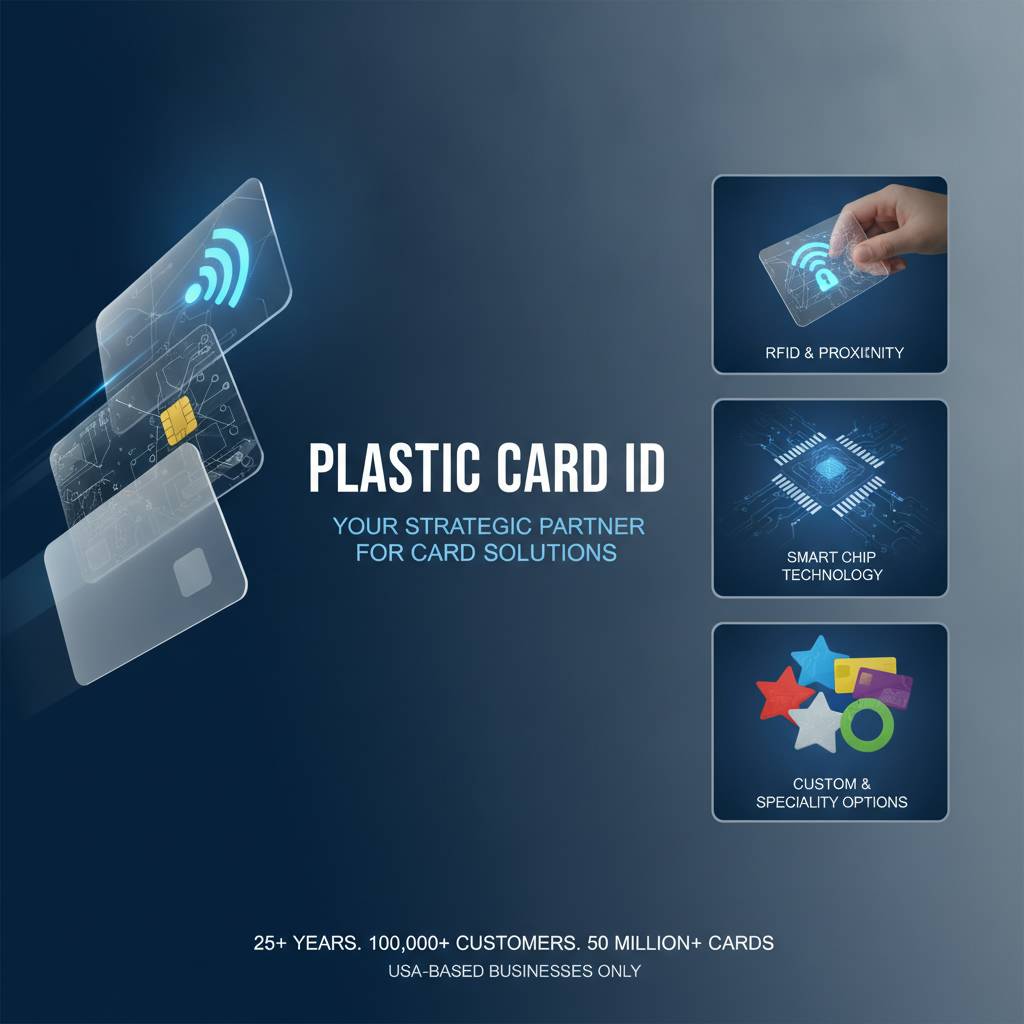 Not every card program runs on simple PVC. Hospitals, universities, corporate campuses, hotels, and casinos often require cards that do more - cards that communicate with readers, carry encrypted data, or control physical access. These are the programs where turnaround planning becomes especially important, because the production chain is longer and the margin for error is smaller.
Proximity cards, RFID smart cards, and MIFARE DESFire contactless cards all require manufacturing steps beyond what a standard blank card entails. The good news is that Plastic Card ID has deep experience with these card types, and the team knows how to guide buyers through the specification process so orders don't stall at the data-verification stage.
RFID and Contactless Cards in Access Control Programs
Proximity cards - 125kHz clamshell-style or standard credit-card-format - are the backbone of building access systems used in offices, warehouses, and institutional facilities across the country. They require no battery, no contact with a reader, and offer reliable performance over years of daily use. Their production process includes embedding and verifying the antenna and chip layer, which adds to lead time relative to a blank card.
For new installations or system expansions, buyers should plan for a 5-10 business day window on proximity card orders, though larger or more complex orders may require additional time. Submitting complete system specifications - reader compatibility, frequency requirements, encoding format - at the time of order is the best way to prevent delays.
Hotel Key Cards and Casino Player Cards
Hotel key cards sit at the intersection of visual design, encoding precision, and volume logistics. A hotel chain may issue thousands of key cards daily across multiple properties, which means stock management and reliable turnaround are operational necessities rather than conveniences. CPE supplies hotel-compatible key cards in magnetic stripe and RFID formats, with options for custom branding on the card face.
Casino player cards have their own requirements: tiered program structures, encoded member data, and often a premium visual finish that reflects the property's brand. These are high-touch programs where card quality is part of the guest experience, and the production process reflects that. Casino and hospitality programs benefit most from establishing a standing order cadence rather than reactive one-off purchasing.
Metal Cards, Die-Cut Shapes, and Luxury Options
At the premium end of the spectrum, Plastic Card ID offers luxury metal cards in stainless steel, brass, and gold finishes, as well as custom die-cut plastic cards in non-standard shapes. These are the longest lead-time options in the catalog - typically 10-21 business days depending on complexity and quantity - but they serve programs where the card itself is a statement piece.
A metal membership card communicates exclusivity in a way no paper certificate can. A die-cut card in a custom shape - a key, a logo silhouette, a branded form factor - creates a tactile, memorable impression that recipients keep. For these orders, planning ahead is not optional. Luxury card programs reward buyers who build lead time into their launch calendars.
Planning Your Order: Buyer Tips for Faster Fulfillment
Experience across 100,000 customers and 50 million cards reveals consistent patterns. The buyers who get their cards fastest aren't always the ones with the simplest orders - they're the ones who prepare the most thoroughly before they place the order. A few strategic habits can shave days off almost any fulfillment timeline.
Think of this section as the practical counterpart to everything discussed above. The variables that drive turnaround time are mostly knowable in advance - and knowable variables are manageable ones. Here's how to work with the system rather than against it.
Checklist: What to Have Ready Before You Order
- Card type and format confirmed - blank PVC, magnetic stripe, RFID, smart chip, specialty
- Exact quantity needed - including buffer stock for replacements and future issuance
- Encoding specifications - HiCo or LoCo for mag stripe, frequency and format for RFID/proximity, sector data for smart chip cards
- Shipping address and timeline - especially for multi-location programs or event deadlines
- Printer compatibility confirmed - if ordering blank cards for in-house printing, verify your printer accepts CR80 30-mil stock
- Budget range in mind - bulk cards range widely, from a few cents per card for blank PVC to $10-$30 per card for metal or smart chip options
The Buffer Stock Strategy
One of the most effective ways to insulate your program from turnaround anxiety is to maintain a buffer supply of your most-used card type. Rather than ordering reactively when stock runs low, establish a reorder point - say, when your supply drops below a 30-day usage level - and submit your next order before you hit that threshold. The result is a program that never runs dry.
This approach works especially well for blank PVC card programs where usage is predictable. Organizations issuing 200-500 cards per month can calculate their consumption with reasonable accuracy and time orders to arrive before the gap. Buffer stock is cheap insurance against program interruption.
Working With a Strategic Partner, Not Just a Vendor
There is a meaningful difference between a supplier that fulfills orders and a partner that helps you run a successful program. CPE operates as the latter. The team understands card programs across industries - retail, healthcare, hospitality, education, government, and more - and can advise on card selection, quantity optimization, and timing in ways that a generic fulfillment operation simply cannot.
That expertise shows up most clearly when something unexpected happens: a launch date moves, a quantity estimate proves too low, or a new use case emerges mid-program. Having a knowledgeable partner who knows your account history and your program's requirements means faster resolution and fewer disruptions. Call 800.835.7919 to connect with a specialist who can advise on your specific program needs.
Industries That Rely on Fast Bulk Card Turnaround
Across industries, the businesses that depend most heavily on reliable card program logistics tend to share a common trait: cards aren't a peripheral item for them - they're operational infrastructure. A hotel without key cards cannot check guests in. A healthcare facility without access badges creates security vulnerabilities. A retailer without gift cards leaves sales on the table during peak seasons.
Understanding which industries have the tightest turnaround requirements - and why - helps illustrate just how much is at stake when a card order gets delayed. These are real operational dependencies, not preferences.
Retail and Gift Card Programs
Retailers who have made the switch from paper gift certificates to plastic gift cards report sales increases of 35-50%. That's not a marginal improvement - it's a structural shift in how customers engage with the program. Plastic gift cards get reloaded, shared, and kept in wallets far more consistently than paper equivalents. They extend the customer relationship far beyond a single transaction.
For seasonal retail programs - holiday gifting, back-to-school, summer promotions - timing is everything. A gift card program that isn't stocked heading into a peak season is a missed revenue window. Retailers who plan their bulk orders 4-6 weeks ahead of season launch consistently outperform those who scramble at the last minute.
Corporate and Institutional ID Programs
Corporate campuses, hospitals, universities, and government agencies issue hundreds to thousands of employee and visitor ID cards annually. For these organizations, blank PVC cards stocked in-house and printed on-demand represent the most efficient model - combining the fast restocking of a simple product with the full personalization flexibility of in-house card printing systems.
Onboarding cycles, contractor rotations, and event access needs often create unpredictable surges in card demand. Organizations that maintain robust blank card inventory absorb those surges without disruption. In large institutions, card program downtime isn't just inconvenient - it's a security liability.
Loyalty and Membership Programs Across Sectors
From fitness studios to professional associations to regional retailers, loyalty and membership card programs depend on consistent card availability to enroll new members without delay. A prospective member who can't receive their card at point of enrollment is more likely to disengage before the relationship is established. Plastic loyalty cards kept in wallets dramatically outperform paper punch cards in both retention and repeat engagement.
These programs also benefit from tiered card designs - standard, silver, gold, VIP - which require multiple card types to be in stock simultaneously. Planning bulk orders for each tier in proportion to enrollment projections, with buffer stock factored in, keeps enrollment running smoothly regardless of demand fluctuations.
Your Next Bulk Order Starts with the Right Conversation - Plastic Card ID
Turnaround times are manageable when you understand what drives them and when you're working with a team that has the experience and infrastructure to deliver. Plastic Card ID has spent more than 25 years building exactly that kind of operation - and the results speak for themselves in the form of 100,000 satisfied customers and 50 million cards shipped to businesses across the United States.
Whether your program is 50 cards a month or 50,000 per production run, the principles are the same: know your card type, prepare your specifications, plan your timeline, and work with a partner who treats your program like it matters - because here, it does. From blank CR80 PVC cards to MIFARE DESFire smart chip cards, from standard white stock to luxury metal, every card type in the catalog ships from a team that knows what a successful card program requires.
Don't leave your card program timeline to chance. Reach out to Plastic Card ID today and speak with a specialist who can help you plan your bulk order, confirm your specifications, and get your cards moving on the fastest possible timeline. Call 800.835.7919 - your program, your pace, your partner.
Previous Page