Blank Clear Plastic Cards Uses: Creative Practical Ideas
Table of Contents []
- What Plastic Card ID Knows About Blank Clear Plastic Cards That Most Buyers Miss
- The Anatomy of a Blank Clear Plastic Card
- Primary Blank Clear Plastic Cards Uses Across Industries
- Access Control and Identity Management Applications
- Printing on Blank Clear Plastic Cards: What You Need to Know
- Buying Blank Clear Plastic Cards: Practical Guidance for Smart Buyers
- Partner With Plastic Card ID for Your Blank Clear Plastic Card Program
What Plastic Card ID Knows About Blank Clear Plastic Cards That Most Buyers Miss
Clear plastic cards occupy a strange, underappreciated corner of the card world. Most buyers stumble onto them while searching for something else entirely - a gift card, maybe, or an ID badge - and then stop cold when they realize what a transparent or frosted card can actually do for a brand. The visual impact is immediate and surprisingly difficult to articulate until you're holding one.
At Plastic Card ID, over 25 years of supplying plastic cards to American businesses has produced one consistent observation: the organizations that discover blank clear plastic cards rarely go back to opaque white stock for the applications where transparency genuinely shines. There is a tactile confidence that comes with handing someone a card they can literally see through, and that confidence translates directly into how your program is perceived.
This page is about understanding blank clear plastic cards uses in full - the practical, the creative, and the surprisingly strategic. Whether you run a boutique hotel, a gym membership program, a trade show credential operation, or a corporate access control system, there is almost certainly a use case here that you have not fully considered yet.
| Card Type | Transparency Level | Common Uses | Printer Compatibility |
|---|---|---|---|
| Blank Clear PVC | Fully Transparent | VIP cards, gift cards, ID overlays | Most direct-to-card printers |
| Frosted/Translucent PVC | Semi-Transparent | Membership, loyalty, access | Most direct-to-card printers |
| Clear w/ Mag Stripe | Transparent w/ stripe | Hotel keys, loyalty, events | Mag-stripe capable printers |
| Clear RFID/Proximity | Transparent | Access control, contactless ID | RFID encoding required |
The Anatomy of a Blank Clear Plastic Card
CR80 Standard and Why It Still Matters
Every blank clear plastic card sold by Plastic Card ID adheres to the CR80 standard - 3.375 inches by 2.125 inches, 30 mil thick, ISO 7810 compliant. That is the same footprint as a standard credit card, which means it slides into any wallet slot, badge holder, lanyard sleeve, or card carrier without issue. Standardization is not boring; it is the reason your card program operates without friction from day one.
The 30-mil thickness is another deliberate choice. Thinner cards flex and feel cheap in hand. Thicker novelty cards refuse to fit into card readers and badge holders. At 30 mil, a clear PVC card achieves the right balance of rigidity and printability, surviving daily use across environments that would destroy paper alternatives within a week.
Clear vs. Frosted: Understanding the Difference
Full transparency and frosted translucency are not interchangeable aesthetics - they produce meaningfully different design outcomes. A fully clear card lets printed colors float against whatever background is behind it, creating a distinctive layered visual effect. A frosted card diffuses light slightly, giving printed elements a softer, almost etched appearance that many premium brands prefer.
Neither option is universally superior. The right choice depends entirely on the design intent. Bold logos and vibrant color fields tend to perform better on frosted cards, where the slight opacity provides contrast. Fine-line artwork and photography-style images, on the other hand, can take on an almost holographic quality when printed on fully transparent stock.
Material Composition and Durability
These are PVC cards - polyvinyl chloride - the same durable material that has defined the card industry for decades. PVC resists everyday moisture, minor impacts, and the friction of being pulled from a wallet repeatedly. Unlike paper-based alternatives, a clear plastic card does not soften at the edges, fade from handling, or collapse when exposed to normal humidity conditions.
Durability is a feature, not a marketing claim. When a gym member, hotel guest, or event attendee holds onto a card for months or years, that card is still representing your brand every time it surfaces. A card that looks beaten up at the six-month mark is a silent brand liability. A card that looks crisp at month eighteen is a silent brand asset.
Primary Blank Clear Plastic Cards Uses Across Industries
Gift Cards and Retail Programs
Retailers who have made the shift from paper gift certificates to plastic gift cards - including clear variants - consistently report sales increases in the 35-50% range. Clear gift cards carry a premium visual signal that paper simply cannot replicate. When a customer presents a clear plastic gift card at checkout, the transaction feels different, more intentional, and that perception extends to the brand itself.
For smaller retailers and boutiques, blank clear plastic cards offer a compelling entry point. Print a small run in-house using a desktop card printer, encode them through your point-of-sale system, and launch a gift card program without committing to a large-scale preprinted order. The flexibility is real and the per-card cost over time comes in favorably compared to outsourcing every print run.
Loyalty and Membership Cards
Loyalty cards that live in wallets outperform punch cards that live in junk drawers. This is not a philosophical position - it is observable behavior. A clear plastic loyalty card from a coffee shop, spa, or fitness studio occupies wallet real estate alongside payment cards, which means it surfaces at the moment of spending decisions. Paper punch cards get crammed into pockets and forgotten entirely.
Membership programs built on plastic cards signal permanence and legitimacy in ways that digital-only alternatives still struggle to match. There is a segment of every membership base that genuinely values a physical card as proof of belonging. Clear plastic stock amplifies that effect - the card is visibly different, worth noticing, worth keeping.
Hotel Key Cards and Hospitality
Hotels have used plastic key cards for decades, but clear variants are increasingly popular in boutique and upscale properties where the card itself is part of the guest experience. A clear magnetic stripe card or clear RFID card printed with a hotel's logo and room number information makes a more memorable first impression than a generic white card with a logo stamped on it.
For properties that manage their own printing in-house - a growing segment of independent hotels and resorts - blank clear magnetic stripe cards are the essential starting stock. Print and encode at check-in, customize by floor or suite category, and track card lifecycle without depending on an outside fulfillment vendor every time inventory gets low.
Event Credentials and Access Passes
Trade shows, corporate events, concerts, and conferences all benefit from credential cards that look professional without requiring a six-week lead time. Blank clear plastic cards can be printed and encoded on-site using portable card printers, allowing event organizers to generate credentials in real time as attendees arrive and registration data is confirmed.
The visual appeal of a clear credential is also a deterrent to counterfeiting. It is harder to replicate convincingly than a white card because the transparency itself becomes part of the authentication visual. Event security improves when credentials are visually distinctive, and clear plastic achieves that without requiring expensive holographic overlaminates on every single card.
- On-site credential printing reduces pre-event logistics complexity significantly
- Clear cards stand out visually in badge holders and lanyards, making staff identification faster
- Reusable blank stock reduces waste between events when cards are not encoded with personal data
- Compatible with standard lanyard slots and badge holders without modification
- Available with magnetic stripes for access-controlled event zones and restricted areas
Access Control and Identity Management Applications
Proximity and RFID Clear Cards
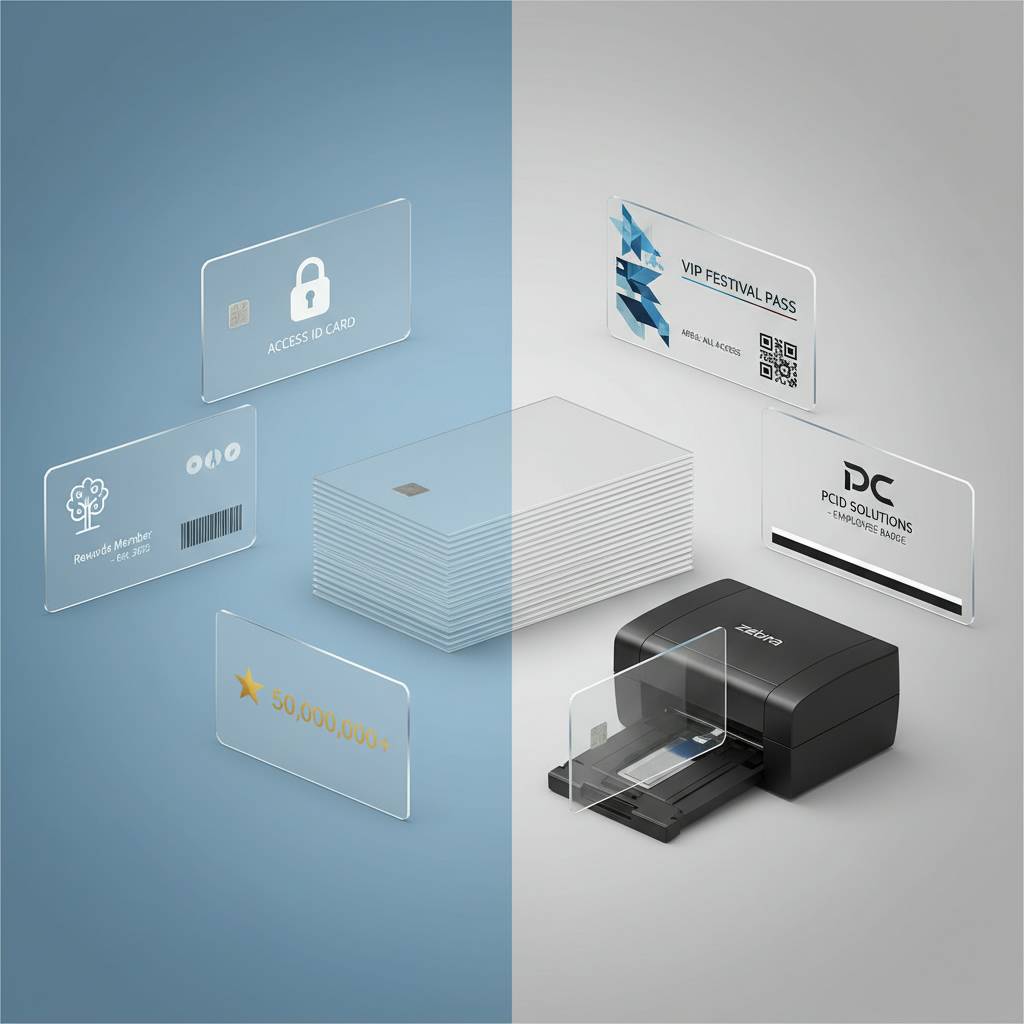
Access control is one of the fastest-growing application areas for clear plastic cards. Organizations that want their access credentials to look distinctive - rather than interchangeable with generic white badges - are turning to clear RFID and proximity card stock that can be printed with employee photos, department information, and branding while retaining full contactless functionality.
Clear RFID cards are available in multiple frequencies and technology standards, including MIFARE DESFire for high-security environments. The contactless antenna is embedded within the card body and remains fully functional regardless of what is printed on the card surface. From the outside, the card looks striking. From the system's perspective, it performs identically to any other credential on the network.
Employee ID Badges
Employee identification programs benefit enormously from in-house card production. With blank clear plastic cards and a dedicated card printer, HR and facilities teams can produce new employee badges on day one of employment, replace lost cards within hours rather than days, and update credentials when employees change roles or departments without waiting on a vendor queue.
The per-card cost advantage of in-house printing compounds over time. A mid-sized organization turning over several dozen employees per year will spend substantially less on badge production when operating from blank card stock than when ordering custom preprinted cards for every new hire. CPE helps organizations calculate that break-even point before they commit to a printer and card stock investment.
Visitor Management and Temporary Access
Visitor badge programs often get the leftover attention in security planning, but a poorly managed visitor credential system creates real gaps. Blank clear plastic cards can be issued as temporary access tokens, printed with visitor name, date, authorized areas, and expiration information at the front desk, and collected at departure for reuse in non-encoded programs or disposal in encoded ones.
The visual clarity of a transparent card makes visitor credentials easy to identify at a glance from across a room. Security staff can immediately distinguish a clear visitor card from an opaque employee badge without approaching to read it. That ambient awareness is a genuine, low-cost security enhancement that requires no technology upgrade at all.
| Organization Type | Primary Use Case | Volume Range |
|---|---|---|
| Boutique Retail | Gift cards, loyalty | 50-500/month |
| Corporate Office | Employee ID, access control | 100-2,000/year |
| Hotel/Hospitality | Key cards, guest credentials | 500-10,000/month |
| Event Management | Attendee passes, VIP credentials | 200-50,000/event |
| Healthcare/Clinic | Patient ID, staff badges | 100-1,000/year |
Printing on Blank Clear Plastic Cards: What You Need to Know
Printer Compatibility and Ribbon Selection
Not every card printer handles clear stock identically. The transparency of the card means that any imperfection in ink coverage is visible in a way that opaque white stock would conceal. Choosing the right printer ribbons - particularly those formulated for vibrant color output and strong adhesion to PVC surfaces - is essential for achieving professional results on clear cards.
Plastic Card ID carries full printer lines from Evolis, Zebra, and Fargo, along with the corresponding ribbons, cleaning kits, and maintenance supplies for each platform. Pairing the right consumables with the right card stock is not optional if you want consistent quality. The team at CPE can walk you through compatibility before you invest in hardware or supplies.
Call us at 800.835.7919 to discuss which printer and ribbon combination works best for your clear card program.
Design Considerations for Transparent Stock
Designing for clear plastic is genuinely different from designing for opaque white. Colors behave differently because there is no white background layer to reflect light back through the ink. Dark colors tend to perform well; light pastels can appear washed out or nearly invisible against certain backgrounds when the card is held up to light.
White ink printing on clear PVC is a specialized technique that some printers support - it creates opaque white elements that make lighter design components visible regardless of background. If your design relies on white space as a design element, you need a printer that supports white-ink output or you need to rethink the design's relationship with transparency entirely.
Encoding Options for Functional Cards
Blank clear plastic cards become functional credentials the moment they are encoded. Magnetic stripe encoding, RFID programming, and smart chip personalization can all be performed on clear card stock, provided the card was manufactured with the appropriate technology embedded. A blank card is not a limitation - it is a canvas waiting for both design and data.
For organizations running their own encoding in-house, the workflow is straightforward: load cards, run print and encoding jobs simultaneously on a printer equipped for combined output, and distribute. For organizations needing high-volume batch encoding, CPE can discuss the options that scale to tens of thousands of cards with consistent fidelity.
Buying Blank Clear Plastic Cards: Practical Guidance for Smart Buyers
Volume Tiers and Cost Planning
Clear plastic cards typically carry a slight premium over standard white PVC cards at the low end of volume, but that gap narrows quickly as order quantities increase. Buyers ordering 500 cards or fewer will notice the difference; buyers ordering 5,000 or more will find that clear stock is a very manageable cost relative to the visual and functional return it delivers.
Planning your card program around realistic volume projections matters more than most buyers realize at the outset. Overbuying clear stock with specialty encoding requirements (RFID, for example) and then having programs change can create inventory headaches. Plastic Card ID works with clients at every scale - from 50 cards a month to mass production in the tens of thousands - and can help you think through volume planning before you commit.
Frequently Asked Questions From First-Time Buyers
- Can I print on clear cards with my existing card printer? Most direct-to-card printers handle clear PVC without modification, but verify ribbon compatibility first.
- Are blank clear cards the same thickness as standard white cards? Yes, CR80 clear cards are 30 mil, matching standard card dimensions exactly.
- Can clear cards include magnetic stripes? Absolutely. Clear magnetic stripe cards are available in both HiCo and LoCo configurations.
- Do RFID and proximity cards come in clear versions? Yes. Clear RFID cards function identically to opaque versions - the antenna is embedded in the card body.
- What is the minimum order quantity? Plastic Card ID serves programs of every size, including small initial orders for organizations launching new card programs.
- Is frosted the same as clear? No. Frosted cards are translucent but not transparent. Both have distinct visual and design applications.
Building a Long-Term Card Program With a Strategic Partner
The difference between a vendor and a strategic partner shows up most clearly when something unexpected happens - a printer needs service mid-program, a new application requires a different card technology, or a program scales faster than anticipated. Plastic Card ID has been that partner for over 100,000 customers across America, and the programs that perform best over time are the ones built on reliable supply chains and consistent product quality from day one.
Longevity in this industry is earned, not claimed. Twenty-five years and over 50 million cards supplied means CPE has encountered virtually every card program scenario that exists, from boutique single-location loyalty programs to enterprise-scale access control deployments. That depth of experience is available to you as a buyer from the very first conversation.
Partner With Plastic Card ID for Your Blank Clear Plastic Card Program
Whether you are launching a new program, upgrading an existing one, or simply trying to understand what blank clear plastic cards uses look like for your specific application, the conversation starts with a call. Plastic Card ID carries the inventory, the equipment, the supplies, and most importantly, the experience to make your card program successful from day one through year ten and beyond.
Call Plastic Card ID today at 800.835.7919 and speak directly with a card program specialist who understands your industry, your volume, and your goals. No guesswork, no generic advice - just practical guidance from a team that has helped over 100,000 American businesses build card programs that work.
Previous Page