Shipping Blank Plastic Cards: What to Expect
Table of Contents []
- Shipping Blank Plastic Cards: What Plastic Card ID Wants You to Know Before Your Order Arrives
- How Blank Plastic Cards Are Packaged for Shipment
- Transit Times and What Affects Delivery
- Receiving Your Order: Inspection Steps That Matter
- Blank Card Buying Tips for First-Time and Returning Customers
- Value-Added Services That Pair With Your Blank Card Order
- Frequently Asked Questions About Shipping Blank Plastic Cards
- Ready to Order? Plastic Card ID Is Your Long-Term Blank Card Partner
Shipping Blank Plastic Cards: What Plastic Card ID Wants You to Know Before Your Order Arrives
You placed your order. Now what? Whether this is your first bulk card purchase or your hundredth, understanding exactly what happens between checkout and delivery can save you time, prevent surprises, and help your card program launch without a hitch. Shipping blank plastic cards is not complicated - but it does have its own rhythms, considerations, and best practices that seasoned buyers know by heart.
This guide walks you through every stage: how cards are packaged, what transit looks like, how to inspect your shipment, and how to get the most out of your blank PVC cards the moment they hit your desk. Plastic Card ID has been doing this for over 25 years and more than 50 million cards - there is real experience behind every box that ships out the door.
| Card Type | Thickness | Common Application | Encoder Required? |
|---|---|---|---|
| Blank CR80 PVC | 30 mil | ID badges, loyalty cards, event passes | No |
| HiCo Magnetic Stripe | 30 mil | Hotel keys, gift cards, access control | Yes |
| LoCo Magnetic Stripe | 30 mil | Membership cards, lower-security access | Yes |
| RFID / Proximity | 30-34 mil | Contactless building access, smart systems | Yes |
| Clear / Frosted PVC | 30 mil | Premium branding, VIP cards, specialty use | No |
| Smart Chip (Contact) | 30 mil | Secure ID, campus cards, enterprise access | Yes |
How Blank Plastic Cards Are Packaged for Shipment
There is a reason bulk cards arrive looking pristine - the packaging process is deliberate. Blank PVC cards are stacked and banded in groups of 100, then placed in sturdy cardboard boxes designed to prevent warping, scratching, or static buildup during transit. Proper packaging is not incidental - it is the first line of quality assurance.
When you order quantities in the hundreds or thousands, the boxes are sealed, labeled with card type and quantity, and often shrink-wrapped for additional protection. This matters especially for cards with magnetic stripes or embedded chips, where even minor surface damage can cause read errors down the line.
Standard Banding and Stacking Methods
Most blank CR80 cards ship in packs of 100. Each pack is tightly banded with a paper or poly band that keeps the stack flat and aligned. Flat stacking prevents the subtle warping that can jam card printers - something that inexperienced suppliers sometimes overlook but that Plastic Card ID never does.
For larger orders of 500, 1,000, or 5,000 cards, multiple banded packs are grouped into a single shipping box. You will typically find a packing slip inside confirming card type, quantity, and any special specifications ordered. Count against that slip immediately upon receipt - it makes discrepancy resolution much simpler.
Special Handling for Technology Cards
Cards containing embedded technology - RFID chips, proximity antenna inlays, or smart contact chips - require an extra layer of care during packaging. These cards are often shipped with antistatic packaging materials to protect the embedded electronics from electrostatic discharge, which can silently degrade chip performance before the card ever gets printed or used.
If you have ordered MIFARE DESFire cards, standard proximity 125kHz access cards, or any contactless smart card variant, inspect the packaging on arrival. Any signs of compression damage or moisture intrusion should be documented and reported before the cards are loaded into a printer or programmer.
Packaging for Magnetic Stripe Cards
HiCo and LoCo magnetic stripe cards ship with the stripe face protected. HiCo cards - with their higher magnetic coercivity of around 2750 Oe - are more resistant to accidental demagnetization in transit than LoCo cards at 300 Oe. However, both card types should be kept away from strong magnetic fields during storage, including near speakers, motors, or office equipment.
A practical habit: store magnetic stripe cards flat in their original banded packaging inside a drawer or cabinet, away from electronics. This keeps the stripe conditioned and ready for clean encoding whenever your card printer's encoder gets to work.
Transit Times and What Affects Delivery
Blank plastic cards ship quickly by nature - there is no custom print production window holding things up. In-stock blank cards often ship same day or next business day depending on order cutoff times and your chosen shipping method. That speed advantage is one of the core reasons businesses keep a standing inventory of blanks rather than waiting on full custom print runs every cycle.
Delivery timelines range from 1-2 business days for expedited shipping to 5-7 business days for standard ground across the continental United States. Alaska, Hawaii, and U.S. territories may see slightly extended windows. Always factor in your own internal lead time - the days between card arrival and when you actually need them printed and in employees' or customers' hands.
Ground vs. Expedited Shipping for Card Orders
For recurring monthly orders - say, 200-500 cards per cycle - ground shipping usually makes the most economic sense. The cost savings over time are real, and as long as you maintain a small buffer stock of blank cards, ground delivery timelines rarely cause operational disruption.
Expedited shipping becomes valuable when a new employee start date is Monday, an event kicks off in three days, or a hotel just onboarded a new property and needs key cards loaded by the weekend. Knowing when to pay for speed is a sign of a mature card program manager. CPE makes it easy to choose your preferred shipping method at checkout so you always have the option.
Tracking Your Shipment
Every order ships with a tracking number. Bookmark it. Plastic cards are small and relatively light, which means they occasionally get shuffled in carrier facilities - a tracking number ensures you know exactly where your shipment is at every step. If your tracking shows a delivery exception, contact the carrier promptly and loop in Plastic Card ID if the issue persists.
For large institutional orders - universities ordering 2,000 student ID blanks, casinos restocking player card inventory, or corporate campuses running an access card refresh - freight shipments may apply. In those cases, you will receive freight carrier tracking and a delivery window. Have a receiving dock or loading area ready and confirm someone is on-site during the delivery window to sign for the shipment.
Contact for Shipping Questions
Questions about your order status, shipping options, or delivery timelines are best handled directly and quickly. Reach Plastic Card ID at 800.835.7919 - the team is equipped to pull up order details and coordinate with carriers on your behalf. A fast answer is always better than a delayed one when your card program depends on a timely delivery.
Do not wait until a shipment is three days overdue to make the call. If your tracking has not updated in 48 hours or shows an unexpected exception, that is the right moment to reach out and get clarity before the situation cascades.
| Shipping Method | Estimated Transit Time | Best For |
|---|---|---|
| Standard Ground | 5-7 Business Days | Recurring restocks, non-urgent orders |
| 2-Day Shipping | 2 Business Days | Near-term needs with some flexibility |
| Overnight / Next Day | 1 Business Day | Urgent program launches, last-minute events |
| Freight (Large Orders) | Varies by location | Institutional bulk orders, palletized shipments |
Receiving Your Order: Inspection Steps That Matter
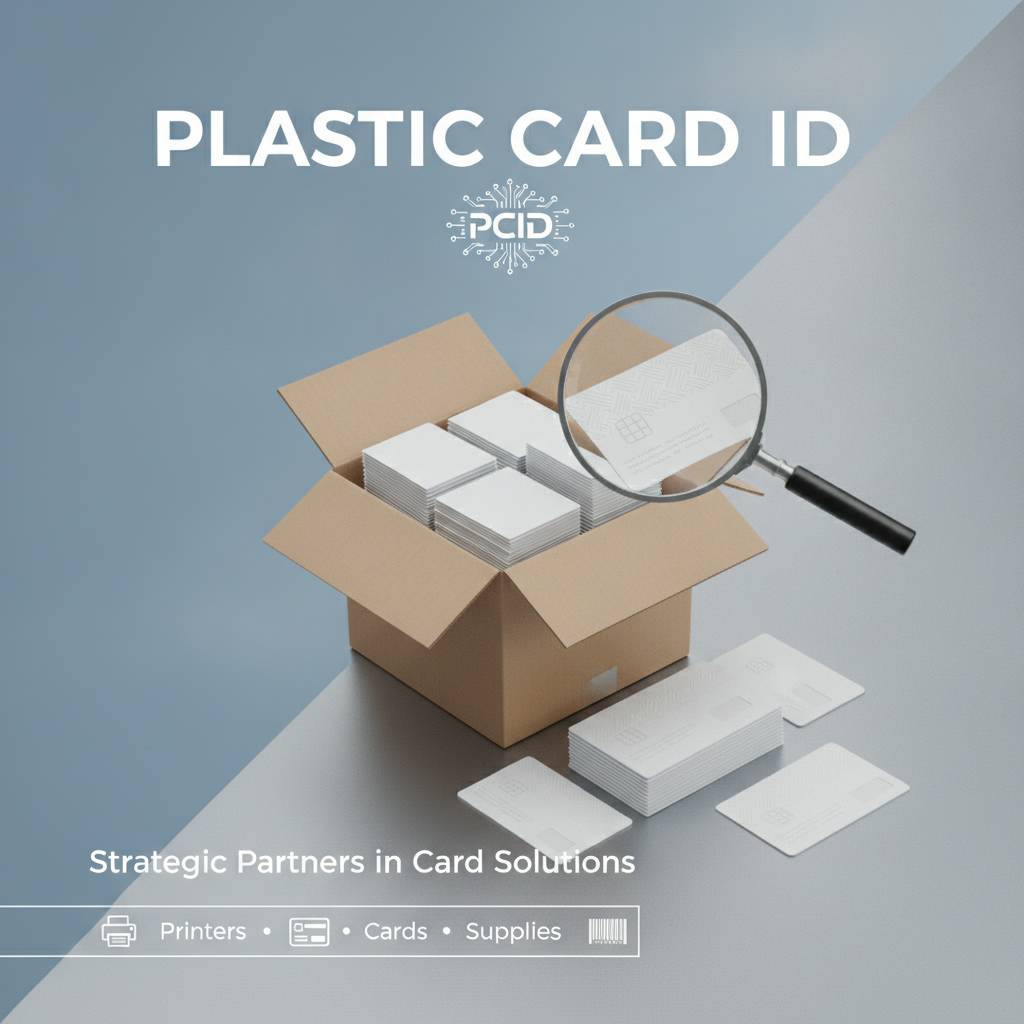 The moment your blank card shipment arrives is not the moment to toss the box in a closet and move on. A quick but deliberate receiving inspection protects you against issues that are far easier to resolve on day one than on day thirty. Smart receiving habits are the mark of a professional card program.
This does not have to be a lengthy process. Most inspections take under ten minutes for a typical order. But skipping them entirely means any discrepancy - short count, wrong card type, packaging damage - becomes harder to address and resolve quickly.
Counting and Verifying Card Quantities
Pull the packing slip and count your banded packs. Each pack should contain 100 cards unless noted otherwise. For an order of 500 cards, you should have five banded stacks. For 1,000, ten stacks - and so on. Verify quantity before breaking any seal or band. Documentation of an intact, short-shipped pack is unambiguous; documentation of a partially used pack is not.
If you ordered multiple card types - for example, a mix of blank white PVC and HiCo magnetic stripe cards - make sure each card type is correctly identified by its labeling. A magnetic stripe card loaded into the wrong printer configuration will not encode correctly, and troubleshooting that scenario wastes time that a simple receiving check would have prevented.
Checking Card Surfaces and Integrity
Fan through a sample stack and look at both faces of the cards. Blank PVC cards should be uniformly smooth, free of scratches, surface abrasions, or contaminants. Even minor surface defects can cause ribbon transfer issues during printing, resulting in spotty prints or streaking. A clean card surface is the foundation of a clean printed card.
For clear or frosted specialty cards, inspect for any cloudiness or surface inconsistency that falls outside normal product appearance. For technology cards, ensure no physical deformation of the card body - warped cards will jam printer card feeders and can damage rollers over time.
Storing Cards After Receipt
How you store blank cards between receipt and use matters more than most people realize. PVC cards perform best when stored at moderate room temperature - roughly 65-75 degrees Fahrenheit - away from direct sunlight and humidity. Extreme cold can make cards brittle; excessive heat can cause warping. Never store cards directly on a concrete floor in a warehouse or basement where temperature and humidity fluctuate.
Keep cards in their original banded packs until needed. This maintains flatness and protects surfaces. If you are running a high-volume card issuance operation, designate a specific storage location that is climate-stable and away from heavy foot traffic, machinery vibration, or electromagnetic sources.
Blank Card Buying Tips for First-Time and Returning Customers
Whether you are new to running an in-house card program or returning after a gap, a few purchasing principles make the process smoother, more cost-effective, and less prone to logistical headaches. The blank card market rewards those who think ahead rather than those who react to shortages.
Buying in larger quantities reduces per-card cost meaningfully. A case of 500 blank CR80 cards costs significantly less per card than ordering 100 at a time. When you know your monthly consumption, it often pays to order a 2-3 month supply at once - especially for a stable program running employee badges or loyalty cards at a consistent clip.
Matching Card Type to Your Printer
Not all blank cards work in all printers. Before ordering, confirm your printer's card thickness tolerance - most accept 30 mil standard CR80 cards, but some models have tighter or broader tolerances. Using cards outside the specified range increases jam risk and can void printer warranties. Always cross-reference your printer's manual or specifications before placing a card order.
For programs using Evolis, Zebra, or Fargo card printers - all carried by Plastic Card ID - compatibility is straightforward when you order through the same supplier. This alignment avoids the guesswork of sourcing cards from one vendor and a printer from another, only to discover a mismatch mid-run.
Understanding HiCo vs. LoCo for Your Application
The HiCo versus LoCo decision matters practically. High coercivity magnetic stripe cards at 2750 Oe hold their encoded data more reliably over time and are better suited for cards that will be swiped frequently or stored near moderate magnetic fields - hotel key programs, gift card systems, transit passes. LoCo cards at 300 Oe are suitable for shorter-term or lower-frequency applications.
- HiCo is preferred for: hotel key cards, gift cards, loyalty programs with daily swipe use, access control in commercial environments
- LoCo is preferred for: short-term event credentials, low-frequency membership programs, applications where card life expectancy is limited
- When in doubt, HiCo is the more future-proof choice and the slight cost difference rarely justifies choosing LoCo for permanent programs
- Always verify with your card reader or encoder manufacturer which coercivity they are optimized to read
- Mixing HiCo and LoCo cards in the same batch is possible but requires careful labeling to avoid operational confusion
Estimating Your Order Quantity Accurately
One of the most common first-time buyer errors is underordering. Card programs almost always grow. A retail chain that launches a gift card program at three locations tends to expand. A gym that starts with 200 member cards often reaches 1,000 within a year. Order with your six-month trajectory in mind, not just today's headcount.
A practical calculation: take your current active card count, add projected new issuances over the next quarter, and add 10-15% buffer for damaged cards, test prints, and unexpected demand spikes. That buffer stock has saved more card programs from last-minute scrambles than any other single practice. CPE supports orders from 50 cards all the way into the tens of thousands, so scaling up is always an option when your program grows.
Value-Added Services That Pair With Your Blank Card Order
A blank card is the starting point, not the finish line. The real value of a card program comes from what is printed, encoded, and done with that card after it arrives. Plastic Card ID operates as a true one-stop resource - meaning the cards, the printers to print them, and the consumables to run those printers all come from one place.
This matters for logistical simplicity. When your ribbon, cleaning kit, and card stock all ship together, you are not coordinating three separate vendors, three separate delivery windows, and three separate customer service contacts. A unified supply chain for your card program is an operational advantage that compounds over time.
Printer Ribbons and Cleaning Kits
Every card printer requires compatible ribbons to function, and every ribbon type is specific to a printer model and card application. Color ribbons (YMCKO) for full-color ID printing, monochrome ribbons for single-color badge printing, and specialty ribbons for holographic overlaminates all serve distinct purposes. Ordering the wrong ribbon for your printer wastes money and delays production - CPE carries ribbons matched precisely to the printer models in its lineup.
Cleaning kits are non-negotiable for print quality and printer longevity. Debris, dust, and card residue accumulate on rollers and print heads, degrading output over time. A regular cleaning cycle - typically every 250-500 cards depending on environment - keeps prints sharp and printers running without service calls. Clean printers print better cards. It is that simple.
Card Carriers, Sleeves, and Mailing Services
Once cards are printed, they need to reach their recipients professionally. Card carriers - folded mailers designed to hold a credit card-sized card - present a membership card, loyalty card, or gift card with the kind of intentionality that customers notice. A card arriving in a quality carrier communicates more about your brand than the card alone ever could.
For organizations issuing cards by mail, affixing and mailing services remove the internal labor burden entirely. Cards are printed, affixed to their carriers, and mailed directly to recipients. For health systems sending patient ID cards, retailers deploying loyalty card campaigns, or associations distributing membership credentials to hundreds of members, outsourcing the fulfillment step saves significant time and reduces errors.
Phone Support for Supply Planning
If you are building a card program from scratch - or retooling one that has outgrown its original setup - a quick call is often the fastest path to getting everything right. Reach Plastic Card ID at 800.835.7919 to talk through your volume requirements, card type options, and compatible printer and ribbon recommendations. The team has helped organizations of every size structure card supply chains that run without friction.
There is no substitute for direct conversation when the variables are specific - a school district configuring student IDs for 4,000 students, a casino refreshing player card stock in three coercivity tiers, a hotel group standardizing key card procurement across twelve properties. These are the conversations Plastic Card ID handles every day.
Frequently Asked Questions About Shipping Blank Plastic Cards
After 25 years and over 100,000 customers, certain questions come up reliably. The answers below address the most common uncertainties buyers encounter when shipping blank plastic cards for the first time or returning to expand a program.
Can I Mix Card Types in a Single Order?
Yes. Orders can include multiple card types - for example, a base quantity of white blank PVC for standard employee badges alongside a smaller quantity of HiCo magnetic stripe blanks for access-controlled areas. Each card type will be separately banded and labeled in the shipment, making receiving and storage organization straightforward.
The only consideration is minimum order thresholds per card type, which vary. Confirming quantities per card type before placing the order ensures you meet any applicable minimums without inflating your inventory unnecessarily.
What If My Cards Arrive Damaged?
Document everything. Photograph the outer box, the inner packaging, and the specific damaged cards before using or discarding anything. Submit that documentation with your damage claim. Photographic evidence is the single most effective tool for resolving shipping damage disputes quickly.
- Note whether the outer box shows signs of impact, compression, or moisture
- Identify how many cards within which banded pack are affected
- Do not attempt to print on damaged cards - this can damage your printer as well
- Contact Plastic Card ID promptly with your order number and documentation to initiate a resolution
How Far in Advance Should I Order?
For standard blank PVC cards with ground shipping, ordering one to two weeks before you need the cards gives comfortable buffer. For technology cards - RFID, smart chip, or specialty formats - consider extending that buffer to two to three weeks, particularly for large quantities where the order may involve fulfillment from a specific production run.
For event-driven programs - a conference credential refresh, a seasonal retail gift card campaign - always order earlier than instinct suggests. Last-minute rush shipping costs real money, and supply chains occasionally encounter carrier delays outside anyone's control. The best card program managers build ordering lead time into their event planning calendars months in advance.
Ready to Order? Plastic Card ID Is Your Long-Term Blank Card Partner
 Shipping blank plastic cards is a process that rewards preparation, good supplier relationships, and knowing what to expect at every stage. When the cards arrive flat, clean, and in the right quantity - ready for your printer - your card program runs the way it is supposed to. That outcome does not happen by accident.
With over 25 years of experience, more than 50 million cards shipped, and a catalog that covers everything from plain white CR80 stock to MIFARE DESFire smart cards, Plastic Card ID is built to support card programs of every scale and complexity across the United States. From your first 50 cards to your fifty-thousandth, the commitment to quality and service stays the same.
Call Plastic Card ID today at 800.835.7919 and let a knowledgeable team member help you build the right card order - right quantity, right card type, right shipping timeline - so your program launches and runs without interruption.
Previous Page