Blank Plastic Cards for Magnetic Stripe Encoding
Table of Contents []
- Blank Plastic Cards for Magnetic Stripe Encoding - Plastic Card ID
- What Makes Magnetic Stripe Cards the Backbone of Modern Card Programs
- The Business Case for Blank Mag Stripe Cards Over Alternatives
- Card Printer Integration: Making Blank Mag Stripe Cards Work In-House
- Specialty Magnetic Stripe Cards for Advanced Applications
- Buyer's Guide: What to Know Before You Order Blank Mag Stripe Cards
- Why Plastic Card ID Is the Right Strategic Partner for Your Card Program
Blank Plastic Cards for Magnetic Stripe Encoding - Plastic Card ID
There is a moment every business reaches - when the paper card, the punch card, the photocopied badge just stops cutting it. Maybe a customer lost it. Maybe it smudged. Maybe your front desk staff is spending more time apologizing for your credentials than celebrating them. Blank plastic cards with magnetic stripes solve that problem completely, and they do it at a scale and cost that surprises most buyers the first time they see a quote.
Plastic Card ID has spent more than 25 years supplying blank and custom plastic cards to businesses all across the United States. With over 100,000 customers served and more than 50 million cards shipped, the team at CPE understands one thing deeply: the card in your customer's wallet is doing work around the clock, even when your doors are closed.
| Card Type | Magnetic Stripe Option | Common Use Case | Encoding Method |
|---|---|---|---|
| Blank White PVC CR80 | HiCo or LoCo | Loyalty, ID, Access | In-house printer |
| Blank Colored PVC | HiCo | Membership, Gift | In-house or vendor |
| Frosted/Clear PVC | HiCo | Premium Branding | In-house printer |
| Pre-Printed Custom Card | HiCo or LoCo | Gift, Loyalty, Hotel Key | At point of issuance |
| Casino Player Card | HiCo | Player Tracking | Dedicated encoder |
What Makes Magnetic Stripe Cards the Backbone of Modern Card Programs
Magnetic stripe technology has been around for decades, and it has earned every year of that track record. The stripe on the back of a card is not decoration - it is a data highway that connects your system to every transaction, every check-in, every loyalty redemption, and every access event that card is involved in. Businesses across retail, hospitality, healthcare, education, and entertainment rely on it daily.
The two dominant formats are HiCo (High Coercivity) and LoCo (Low Coercivity). Choosing between them is not complicated when you understand what each is built for. HiCo stripes resist accidental erasure far better, making them the preferred choice for cards that will live in wallets near phones, keys, and other magnets. LoCo cards are appropriate for shorter-term or controlled-environment applications where durability demands are lower.
HiCo vs. LoCo: Choosing the Right Stripe for Your Program
HiCo magnetic stripe cards operate at 2750 oersteds of coercivity - a technical way of saying they require a significantly stronger magnetic field to encode and erase. That resistance to accidental demagnetization is what makes HiCo the right call for most business programs. Loyalty cards, membership cards, employee ID cards, and gift cards should almost always use HiCo stripes.
LoCo cards operate at 300 oersteds and encode with a weaker field. They are a cost-effective option for short-duration programs, event applications, or systems where the encoding hardware available only supports LoCo writing. Hotel key cards are a classic LoCo use case because the card is only needed for the duration of a stay and then recycled or reprogrammed. Your application determines your stripe - and CPE can help you choose correctly before you order a single card.
The CR80 Standard and Why It Matters
Every blank plastic card in Plastic Card ID's core catalog is built to the CR80 ISO 7810 standard - 3.375 inches wide by 2.125 inches tall, 30 mil thick. That is the same size and thickness as a driver's license or standard credit card. Standardization matters enormously when you are buying cards at volume, because it guarantees compatibility with every card printer, card holder, lanyard slot, and wallet slot your cardholders will encounter.
Deviation from CR80 is possible - custom die-cut shapes and specialty sizes are available for brands that want to stand out - but for operational programs involving encoding, badging, or access control, the CR80 format is almost universally the correct choice. It feeds cleanly through every encoder, every printer, every laminator. It is the professional standard for a reason, and 50 million cards sold gives CPE some authority when making that recommendation.
Tracks, Encoding, and What Your System Actually Reads
A standard magnetic stripe card carries up to three data tracks. Track 1 holds alphanumeric data - names, account numbers, and descriptive fields. Track 2 is numeric only and is the track most widely used for loyalty programs, access control, and gift card systems. Track 3 is used in some specialized financial and transit applications. Most business card programs live entirely on Track 2, and the encoding is done at the point of card issuance using a printer with a built-in encoder module.
This is where the value of buying blank cards with pre-applied magnetic stripes becomes obvious. You receive blank CR80 cards with HiCo or LoCo stripes already applied during manufacturing - precise, uniform, and ready to encode on demand. Your in-house card printer does the encoding at the moment of issuance, meaning each card can carry a unique number, a unique loyalty account, or a unique access credential without any batch pre-encoding fees or lead time delays.
The Business Case for Blank Mag Stripe Cards Over Alternatives
Why buy blank cards and encode in-house rather than ordering pre-encoded cards from a service bureau? The short answer is control. In-house encoding gives you immediate issuance capability - a new employee gets a badge today, not in two weeks. A new loyalty customer gets a card at checkout, not mailed to them three days later. That immediacy has measurable retention value that pre-printed batch programs simply cannot replicate.
The economics are equally compelling. Blank CR80 cards with magnetic stripes are priced to favor volume buyers, but even at modest quantities the per-card cost is low enough that a program issuing 500-1000 cards per month can see costs that pencil out convincingly against any paper-based alternative. Retailers who have made the switch from paper punch cards to plastic loyalty cards with mag stripes typically report meaningful increases in repeat visit frequency and average transaction value.
Loyalty Programs That Actually Drive Return Visits
Paper punch cards go through the wash. They get dog-eared, lost, or deliberately over-stamped. A plastic loyalty card with a magnetic stripe is a completely different instrument. It lives in the wallet, it scans consistently, it connects to your database, and it enables personalization that paper simply cannot support. Retailers who switch to plastic loyalty cards see sales increases of 35-50% compared to programs running on paper.
That number is not hypothetical. It reflects the behavioral reality that a durable card in a wallet prompts visits, while a crumpled paper card in a junk drawer does not. When you add magnetic stripe encoding, you unlock the ability to track spending, issue tier upgrades, apply targeted offers, and measure program ROI with actual data. The blank HiCo card is the foundation of a program that could, over time, become one of your most powerful customer retention tools.
Employee Badges, Access Control, and ID Cards
The same blank PVC card with a magnetic stripe that serves as a loyalty card can be transformed into an employee ID badge, an access control credential, or a time-and-attendance token simply by changing what gets printed and encoded onto it. Organizational identity starts with the card in the employee's hand, and that card needs to be durable, professional, and functional from day one.
For access control applications, HiCo magnetic stripe cards work in tandem with magnetic stripe readers installed at doors, turnstiles, or secure areas. Each card carries a unique encoded number that your access control software associates with a specific employee's permissions. Adding or revoking access is a software action. Replacing a lost card takes minutes with an in-house printer loaded with blank mag stripe cards. The agility that brings to facilities management is substantial.
To discuss your specific access or identity program needs, contact CPE directly at 800.835.7919. A knowledgeable team member will walk through card specifications, encoding requirements, and volume pricing without the runaround.
Gift Cards and the Magnetic Stripe Advantage
Gift card programs powered by magnetic stripe technology are one of the highest-ROI card programs any retail business can run. The card carries a unique account number encoded on the stripe; your point-of-sale system handles activation, loading, and redemption. A well-run gift card program generates float, drives new customer acquisition, and produces breakage revenue - all from a card that costs cents to produce.
Blank PVC cards with HiCo stripes are the starting point for any in-house gift card program. The card is printed with your brand, encoded with a unique number, and activated at the register when the customer purchases it. No third-party processing required for the card itself - your system does the work. Plastic Card ID supplies the cards; your program does the rest.
Card Printer Integration: Making Blank Mag Stripe Cards Work In-House
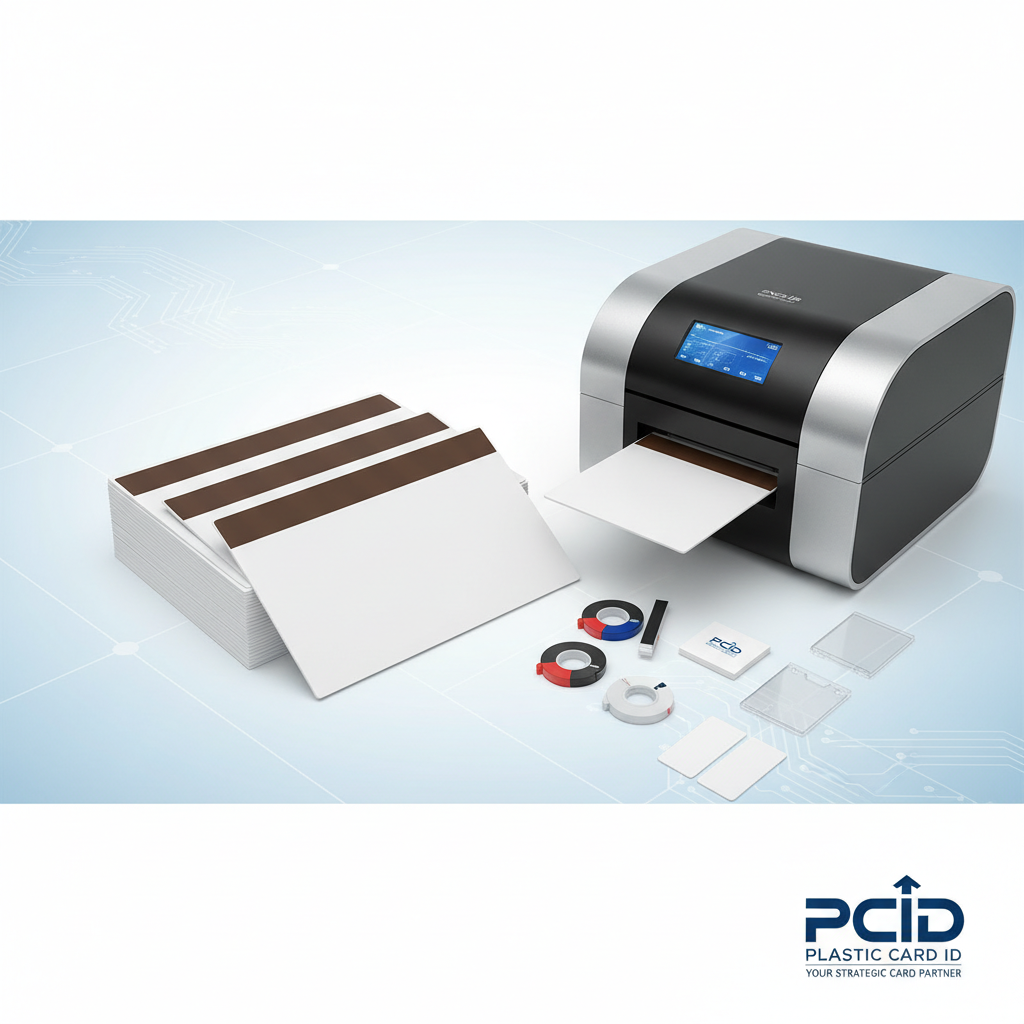 A blank magnetic stripe card is only as useful as the printer and encoder sitting on your desk. Plastic Card ID carries a full lineup of card printers from three of the most trusted names in the industry: Evolis, Zebra, and Fargo. Each brand covers a range of throughput capacities, feature sets, and price points, making it possible to match the right printer to the right program without overspending or underequipping.
The combination of blank HiCo cards, a capable printer, and encoding software is what transforms a card program from a concept into a daily operational reality. Buying these components from a single supplier like CPE means compatibility is handled, support is unified, and reorders are simple. You are not cobbling together components from three different vendors and hoping they play nicely together.
Evolis Printers for Small to Mid-Volume Programs
Evolis card printers occupy a sweet spot for programs issuing anywhere from 50 to several thousand cards per month. They are compact, reliable, and designed for environments where card printing is a regular but not industrial-scale task - HR departments, front desks, membership offices, and retail locations. Evolis printers with magnetic stripe encoding modules accept blank HiCo and LoCo cards directly, printing and encoding in a single pass.
The Evolis range includes single-sided and dual-sided printing options, retransfer models for edge-to-edge print quality, and lamination capabilities for cards that need an extra layer of durability. Ribbon and cleaning kit compatibility with Plastic Card ID's supply catalog makes ongoing maintenance straightforward and cost-predictable.
Zebra and Fargo for Mid-to-High Volume Needs
When card issuance volume climbs into the thousands per week, Zebra and Fargo printers bring the throughput and reliability those programs demand. Zebra's ZC and ZXP series handle encoding, lamination, and high-speed printing in configurations designed for continuous-duty environments. Fargo's HDP series uses high-definition retransfer printing that produces photographic-quality output on CR80 cards. Both brands are fully compatible with standard blank mag stripe cards supplied by Plastic Card ID.
For organizations running casino player card programs, hotel key card issuance, or large-scale employee credentialing, these printers represent a serious infrastructure investment that pays back quickly when card quality, throughput, and reliability are factored together. CPE can recommend the right model based on your monthly volume and encoding requirements.
Specialty Magnetic Stripe Cards for Advanced Applications
Not every card program runs on standard white PVC. Plastic Card ID's catalog extends well beyond the basics, covering specialty substrates and configurations that serve industries and applications with specific functional or aesthetic requirements. Clear plastic cards, frosted cards, colored stock, and even luxury metal cards are all available with magnetic stripe options where technically applicable.
These specialty products serve a purpose beyond novelty. A frosted card with a HiCo stripe makes a premium membership card that communicates exclusivity and brand quality. A clear card with a stripe creates visual intrigue that standard white cards simply cannot produce. The card itself becomes part of the brand experience, not just a functional token. That distinction matters enormously in competitive markets where every customer touchpoint is a branding opportunity.
Clear and Frosted PVC Cards with Magnetic Stripes
Clear and frosted PVC cards are manufactured to the same CR80 standard as white stock but allow printed designs to interact with the card's transparency in visually striking ways. When paired with a HiCo magnetic stripe, they function identically to standard cards in any compatible reader or encoder. Clear cards are particularly popular in premium loyalty programs and VIP membership applications where the physical card is meant to feel like a reward in itself.
Printing on clear cards requires attention to ink opacity and design contrast, which is where working with an experienced supplier like CPE pays dividends. The team can provide guidance on what prints well on clear stock and what substrate will best serve the intended use case before you commit to a production run.
Casino Player Cards and Hotel Key Cards
Casino player cards are among the most data-intensive magnetic stripe card applications in existence. They track game session data, player tier status, reward accumulation, and compliance records - all through encoding on a HiCo stripe that must be reliably read through thousands of swipe cycles. Durability, encoding consistency, and print quality are non-negotiable in casino environments, and Plastic Card ID supplies cards built to meet those demands.
Hotel key cards operate on a different model - typically LoCo stripes that are wiped and re-encoded for each guest stay. The emphasis here is on encoding reliability and card uniformity across high-volume issuance. A hotel issuing hundreds of key cards per day needs a supplier that delivers consistent quality at scale, without per-card variation that causes reader failures or guest complaints.
Colored Stock and Custom Die-Cut Magnetic Stripe Cards
Colored PVC stock - available in a range of base colors - allows organizations to implement color-coded card programs without relying entirely on printed color. A yellow base card for one department, a blue base for another, with HiCo stripes applied during manufacturing and printed details added in-house. Color-coded magnetic stripe card systems are widely used in healthcare, education, and multi-site retail environments where fast visual identification matters alongside electronic function.
Custom die-cut shapes - cards manufactured in non-standard dimensions or with custom contours - are available for brands that need a truly distinctive physical identity. These are specialty production items with longer lead times and minimum order requirements, but for the right application they create an impression that no standard CR80 card can match. Contact CPE to discuss feasibility and pricing for custom form factor cards with magnetic stripe options.
Buyer's Guide: What to Know Before You Order Blank Mag Stripe Cards
Buying blank magnetic stripe cards is straightforward once you understand the key variables. Getting those variables right before you place an order saves time, money, and the frustration of cards that do not perform as expected in your specific application. Here is a practical breakdown of the decisions every buyer needs to make before selecting a card specification.
- HiCo vs. LoCo stripe: Choose HiCo for permanent programs, loyalty cards, ID badges, and gift cards. Choose LoCo only when your encoding hardware requires it or the application is short-term.
- Track configuration: Most programs use Track 2 only. Confirm with your software vendor which track or tracks your system reads and writes before specifying a card.
- Quantity and volume: Plastic Card ID scales from small runs to mass production in the tens of thousands. Per-card pricing improves significantly at higher quantities - request a volume pricing breakdown before finalizing your budget.
- Substrate choice: Standard white PVC, colored stock, clear, or frosted - each has different printing characteristics. Select your substrate based on the final card design and your printer's capabilities.
- Printer compatibility: Confirm that your existing printer supports encoding the stripe type you are ordering. If you are purchasing a printer through CPE simultaneously, compatibility is guaranteed.
- Additional features: Consider whether signature panels, sequential numbering, barcodes, or dual-technology options (mag stripe plus RFID) serve your program better than a stripe-only card.
Frequently Asked Questions About Blank Magnetic Stripe Cards
Buyers new to blank mag stripe cards often have the same core questions. Can these cards be encoded with any card printer? Yes - as long as the printer includes a magnetic stripe encoding module compatible with the stripe coercivity you ordered. Can the stripe be erased and re-encoded? HiCo stripes can be re-encoded with appropriate hardware, but standard card printers typically write once at the point of issuance. For re-encoding applications, confirm your hardware supports it.
Do blank cards come pre-encoded? No - blank cards are supplied with an unencoded stripe. Encoding happens through your printer or a standalone encoder at the moment of card issuance. This is the correct workflow for programs that need unique data on each card. Pre-encoded cards are available for programs that require factory encoding, but most business applications benefit more from in-house issuance flexibility. Call CPE at 800.835.7919 with specific technical questions about your program requirements.
Value-Added Supplies That Complete Your Card Program
Plastic Card ID is a true one-stop shop for card programs, and that extends well beyond the cards themselves. Printer ribbons for Evolis, Zebra, and Fargo printers are stocked and available for reorder. Cleaning kits keep your printer running at peak performance and prevent encoding errors caused by dust and debris accumulation on the card path. Card carriers and sleeves protect cards during mailing and distribution.
Card affixing and mailing services round out the offering for organizations that need to distribute cards by mail rather than in-person issuance. Having a single supplier handle cards, printer supplies, and mailing logistics reduces procurement complexity dramatically and ensures that the people ordering your cards understand exactly how they will be used. That context produces better recommendations and fewer costly mistakes.
Why Plastic Card ID Is the Right Strategic Partner for Your Card Program
Twenty-five years in business does not happen by accident. It happens because customers come back, and they come back because the cards perform, the service is knowledgeable, and the pricing stays competitive at every volume level. Plastic Card ID has built something that most card suppliers never achieve: genuine long-term partnerships with businesses that return order after order because the relationship delivers real value.
Programs that start at 50 cards a month and grow to 5,000 cards a month do so with CPE scaling alongside them. The catalog, the expertise, and the operational support are all structured to serve that growth without requiring customers to migrate to a different supplier at each new stage. That continuity has real value - institutional knowledge of your program, your history, and your preferences does not have to be rebuilt from scratch every time you need cards.
Serving USA Businesses Across Every Vertical
The Plastic Card ID customer base spans virtually every industry that issues cards to people - retail loyalty programs, corporate identity and access control, healthcare and clinic ID programs, hospitality and hotel operations, education institutions, casinos, fitness clubs, faith organizations, government agencies, and event venues. Every one of these verticals has nuances that affect card specification, and the team at CPE has worked with enough programs across all of them to provide counsel that goes beyond a product catalog listing.
USA-based businesses are the exclusive focus. Plastic Card ID does not supply financial credit or debit cards and does not process payments of any kind. The focus is entirely on the cards themselves - and on the programs those cards power. That focused expertise shows in every conversation and every recommendation the team makes.
Getting Started With Your Magnetic Stripe Card Order
Starting a new card program or upgrading an existing one begins with a conversation. What is the application? What volume do you anticipate monthly? Do you have existing printing hardware, or are you building your infrastructure from scratch? Answering those three questions correctly shapes everything else about a card program - the stripe type, the substrate, the printer, the ribbon, and the reorder cadence.
Plastic Card ID makes that conversation easy and productive. There is no pressure, no overselling, and no one-size-fits-all answer pushed at every caller. The goal is to help you build a card program that works for your specific business, at your specific scale, with the right components matched to your real requirements.
Ready to get your magnetic stripe card program started? Contact Plastic Card ID today at 800.835.7919 and speak with a card program specialist who will help you select the right blank mag stripe cards, the right printer, and the right supplies to build something your customers and employees will carry with pride.
Previous Page