Blank Plastic Cards for Barcode Scanning Applications
Table of Contents []
- Blank Plastic Cards for Barcode Scanning - Plastic Card ID
- Why Barcode Scanning Demands a High-Quality Plastic Card
- Types of Blank Cards That Support Barcode Scanning Programs
- Matching Blank Cards to Your Barcode Scanner Technology
- Card Printers for Barcode Programs - Complete In-House Control
- Industries That Rely on Blank Plastic Cards for Barcode Scanning
- Getting Started with Plastic Card ID - Your Blank Card Partner
Blank Plastic Cards for Barcode Scanning - Plastic Card ID
Barcodes run the world. Walk into any distribution center, hospital, university, or retail backroom and you will find barcode-driven systems moving product, tracking people, and managing access - quietly, reliably, without complaint. What those systems need, fundamentally, is a card that can carry a barcode cleanly and be read without hesitation. That is exactly what blank plastic cards for barcode scanning are built to do.
Plastic Card ID has been supplying these cards to businesses across the United States for over 25 years. With more than 50 million cards delivered and 100,000 customers served, the insight runs deep. The right blank card is not just a substrate - it is the foundation of a functional, professional card program that scales with your organization.
| Card Type | Barcode Compatibility | Common Use Case | Surface Finish |
|---|---|---|---|
| Blank White PVC CR80 | 1D, 2D, QR | Employee ID, Loyalty, Membership | Gloss or Matte |
| Blank Magnetic Stripe (HiCo) | 1D, 2D, QR Mag Stripe | Access Control, Time Tracking | Gloss |
| Blank Proximity / RFID Card | 1D, 2D, QR Contactless | Secure Access, Smart Buildings | Gloss |
| Blank Clear / Frosted PVC | 1D, 2D (dark ink required) | Premium Membership, VIP Cards | Clear or Frosted |
| Blank Colored PVC Stock | 1D, 2D (contrast matters) | Event Credentials, Club Cards | Gloss |
Why Barcode Scanning Demands a High-Quality Plastic Card
Paper barcodes crack, smear, and delaminate. Fold a paper loyalty card twice and the barcode scanner hesitates, beeps twice, and the line behind the customer grows. Plastic does not fold. It does not warp in a wallet. The smooth, uniform surface of a CR80 PVC card gives a barcode scanner the consistent substrate it needs to read confidently every single time.
The physics of scanning favor plastic. A barcode scanner reads contrast - light against dark. Any surface distortion, moisture damage, or toner smearing breaks that contrast and introduces read errors. Blank PVC cards offer a dimensionally stable, ISO 7810-compliant surface that holds print precisely and resists the daily abuse of being handled, swiped, and shoved back into a pocket.
The CR80 Standard and Why It Matters
CR80 is the internationally recognized card size - 3.375 inches by 2.125 inches, 30 mil thick. Every wallet slot, card holder, and badge reel is built around it. When you print a barcode on a CR80 card, you know it will fit where it needs to go and scan where it needs to scan. Consistency is not a luxury in card programs; it is the baseline requirement.
Plastic Card ID stocks CR80 blank cards in the quantities your program actually needs, from small batches of 50 cards to production runs in the tens of thousands. Whether you are running an in-house printing setup or sourcing pre-encoded cards, the CR80 foundation ensures that your scanners, printers, and card holders all play nicely together.
Print Resolution and Barcode Legibility
Not all blank cards print the same way. Lower-quality cards introduce surface texture variation or inconsistent coating that causes ink or ribbon transfer to be uneven - and uneven printing means unreliable barcodes. A card that fails to scan is a card that costs you money. Every failed scan at a point-of-sale, access point, or check-in station is a friction event that frustrates users and erodes confidence in the program.
The blank PVC cards available through CPE are manufactured to tight specifications that ensure consistent print adhesion across the entire card surface. When your card printer lays down a barcode, it needs to land cleanly and stay put. That is exactly what happens with quality-controlled blank stock.
Gloss vs. Matte Finish for Barcode Applications
Gloss-finish cards give barcodes sharp visual contrast and produce crisp edges that scanners love. Matte-finish cards reduce glare in bright environments - a useful property when cards are being scanned under fluorescent warehouse lighting or outdoor event canopies. Choosing the right finish is a practical decision, not an aesthetic one.
Plastic Card ID carries both gloss and matte blank PVC options, allowing organizations to match the card finish to the scanning environment. If you are unsure which finish suits your setup, the team at Plastic Card ID can walk you through the decision based on your specific scanner hardware and use case.
Types of Blank Cards That Support Barcode Scanning Programs
The catalog is broader than most buyers expect. Blank plastic cards for barcode scanning are not a single SKU - they are a family of products, each with different built-in capabilities that complement the barcode on the surface. Understanding the options means you can build a smarter card program from the start.
Combining barcode functionality with magnetic stripe, RFID, or smart chip technology is one of the most powerful moves an organization can make. A single card can carry a printed barcode for quick visual scanning and a magnetic stripe for system authentication - serving two functions without increasing the card count your staff needs to manage.
Blank White PVC Cards - The Reliable Workhorse
Standard blank white CR80 cards are the most common choice for barcode scanning programs. They accept dye-sublimation printing beautifully, are compatible with virtually every card printer on the market, and offer the highest-contrast surface for black barcode printing. These are the cards that loyalty programs, employee ID systems, library networks, and event organizers reach for first.
For organizations running Evolis, Zebra, or Fargo card printers - all available through CPE - blank white PVC cards are the default consumable that keeps operations running. Stocking them in quantity reduces per-card cost and ensures your program never stalls waiting on replenishment.
Magnetic Stripe Cards with Barcode Capability
HiCo (High Coercivity) magnetic stripe cards are the gold standard for card programs that need both data encoding and barcode scanning in a single credential. HiCo cards resist magnetic field interference more effectively than LoCo cards, making them ideal for hotel key-style access systems, time and attendance tracking, and retail loyalty programs where cards endure frequent swiping.
LoCo magnetic stripe cards serve well in lower-intensity environments where magnetic interference is less of a concern. Both HiCo and LoCo cards are available blank, ready to accept your barcode print job and your magnetic encoding in one production run. This dual-function capability is a major efficiency gain for programs that previously issued separate credentials for different access points.
- HiCo cards: 2750 Oe coercivity, excellent for high-use environments
- LoCo cards: 300 Oe coercivity, suitable for low-interference locations
- Both accept 1D (Code 39, Code 128, ITF) and 2D (QR, PDF417, Data Matrix) barcodes
- Available in single-stripe, triple-stripe, and signature panel configurations
- Compatible with all major card printer brands including Evolis, Zebra, and Fargo
RFID and Proximity Cards with Printed Barcodes
RFID and proximity cards are increasingly common in access control, time tracking, and smart building applications. These cards carry an embedded chip or antenna that communicates wirelessly with a reader - but there is nothing stopping you from also printing a barcode on the surface. Many organizations do exactly that: contactless authentication for the reader, printed barcode for visual scanning or secondary verification.
MIFARE DESFire technology, available through Plastic Card ID, represents the sophisticated end of the contactless card spectrum - offering encrypted, multi-application capability that high-security environments require. When combined with a printed barcode, these cards become remarkably versatile credentials that can serve multiple departments and scanning systems simultaneously.
Matching Blank Cards to Your Barcode Scanner Technology
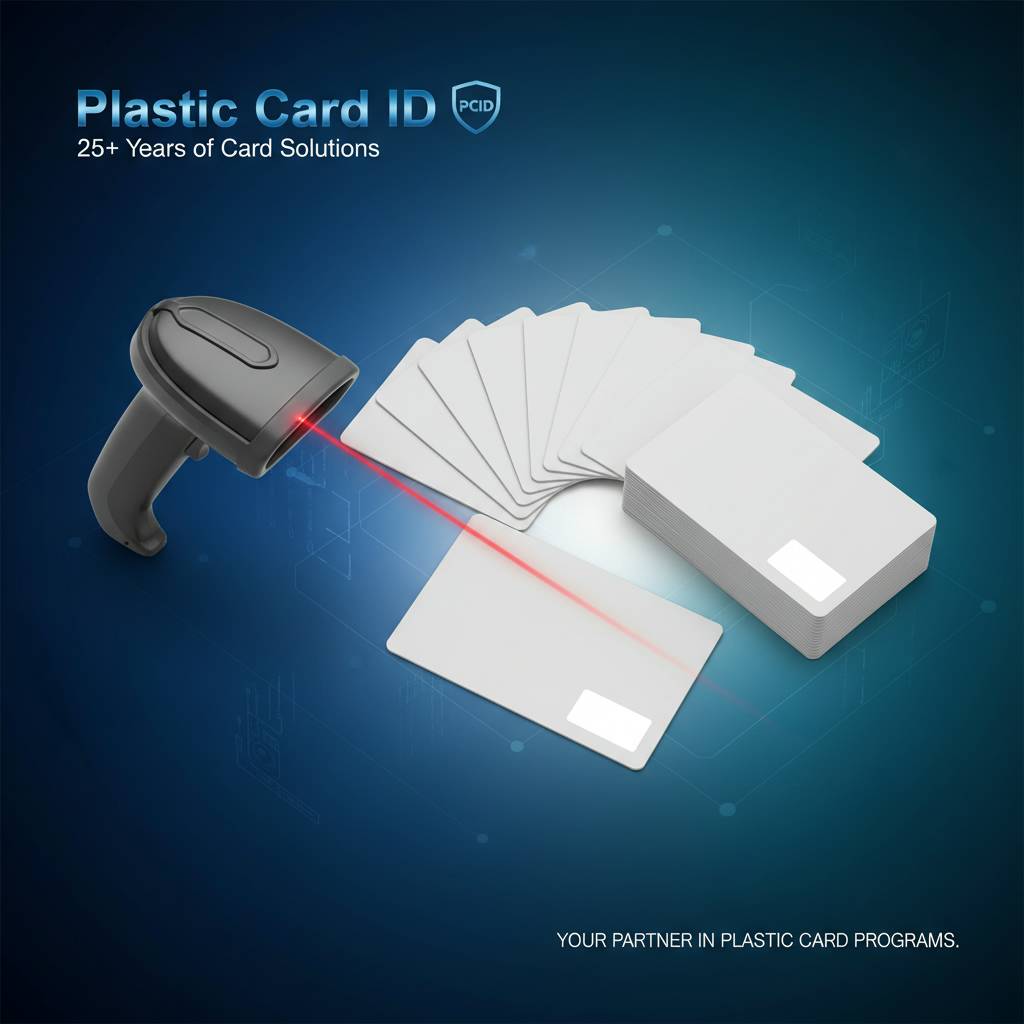 The scanner drives the card selection more than most buyers realize. A 1D laser scanner reading Code 39 has different requirements than a 2D imager reading QR codes. Getting the pairing right means fewer read errors, faster transactions, and a card program that actually performs in the field rather than just looking good on paper.
Understanding your scanner hardware before ordering cards is not optional - it is the starting point. Plastic Card ID has worked with organizations running everything from single-station desktop scanners to networked handheld systems covering multi-building campuses, and the card recommendations shift based on that context.
1D Barcode Scanning - Linear Codes on Plastic
Code 39, Code 128, and Interleaved 2 of 5 (ITF) are the most common 1D barcode symbologies printed on plastic cards. These linear barcodes require clean, high-contrast printing on a flat, stable surface - requirements that blank PVC cards meet naturally. The key variable is print resolution: a card printer producing 300 DPI output is sufficient for most 1D barcodes at standard card-length sizes.
For tight bar spacing or small card real estate, 600 DPI printing becomes important. Several card printers in the Evolis, Zebra, and Fargo ranges support 600 DPI printing, and CPE carries compatible blank cards that accept high-resolution output without surface artifacts that would compromise scan accuracy.
2D and QR Code Scanning on Plastic Cards
QR codes, PDF417, and Data Matrix codes encode more data in a smaller footprint - making them popular for applications where a card needs to carry URLs, encrypted credential strings, or multi-field data without relying on a backend database lookup. Printing 2D codes on plastic cards requires slightly higher attention to print resolution and color contrast, but the result is a card that is self-sufficient in offline scanning scenarios.
Blank white PVC cards remain the top choice for 2D barcode applications because of their high-contrast base. For applications where colored stock is preferred for visual differentiation between card types, Plastic Card ID can advise on which color backgrounds maintain sufficient contrast for reliable 2D scanning.
- QR codes: ideal for URLs, app-based check-ins, and customer engagement campaigns
- PDF417: used in government ID, shipping, and event ticketing applications
- Data Matrix: compact, error-correcting, used in healthcare and asset tracking
- All require minimum 300 DPI print output; 600 DPI preferred for dense codes
Contacting Plastic Card ID About Scanner Compatibility
If you are unsure whether your existing scanner infrastructure is compatible with the card type you are considering, the team at Plastic Card ID is ready to help you work through the technical details. Call 800.835.7919 to speak with a product specialist who can match card specifications to your scanning environment. This is not a sales call - it is a technical consultation that saves programs from expensive re-ordering later.
With over 25 years of experience matching card products to real-world scanning applications, CPE has seen virtually every configuration and can draw on that depth to steer you toward the right blank card for your specific system. That kind of guidance is what separates a strategic partner from a simple card vendor.
Card Printers for Barcode Programs - Complete In-House Control
Buying blank cards is only half the equation if you are running an in-house card program. The card printer is the production engine that transforms a blank PVC card into a functional, scannable credential. Plastic Card ID carries a full lineup of card printers from Evolis, Zebra, and Fargo - three of the most trusted names in the card printing industry.
In-house printing puts you in control of timing, design, and data. You print what you need, when you need it. No waiting on print runs from external vendors, no minimum order constraints beyond your blank card stock, and no lead time surprises when a new employee starts Monday morning or an event opens Friday afternoon.
Evolis Card Printers
Evolis printers are known for their compact footprint, intuitive operation, and excellent output quality for barcode printing applications. The Evolis Primacy and Zenius models are popular in small to mid-size organizations where a single-operator setup handles card production efficiently. Print speeds range from 150 to 225 cards per hour depending on model and configuration, making them practical for moderate-volume programs.
Evolis printers work seamlessly with standard blank CR80 PVC cards and are compatible with HiCo and LoCo magnetic stripe card stock, RFID cards, and specialty substrates. Ribbons, cleaning kits, and blank card stock for all Evolis models are available through Plastic Card ID, keeping your supply chain consolidated and your reorder process simple.
Zebra and Fargo Card Printers
Zebra card printers - particularly the ZC series - are workhorses in high-volume environments. School districts, hospitals, and corporate campuses running card programs in the thousands per month rely on Zebra for throughput and reliability. The ZC300 and ZC500 models offer single and dual-sided printing with lamination options that add durability to barcode cards used in demanding physical environments.
Fargo card printers, including the HDP5000, use High Definition Printing technology that transfers ink to a film before applying it to the card surface - producing exceptionally sharp barcode edges that scan consistently. For programs where barcode scan failure is simply not acceptable, Fargo HDP printers are the professional-grade solution. CPE carries compatible supplies for the full Fargo lineup.
Supplies and Consumables - Everything Under One Roof
A card printer without the right ribbon is a very expensive paperweight. Plastic Card ID stocks printer ribbons for all Evolis, Zebra, and Fargo models, along with cleaning kits, card carriers, and protective sleeves. Ordering blank cards and consumables from a single source means one invoice, one shipping event, and one vendor relationship to manage.
Card affixing and mailing services round out the value-added offering - particularly useful for organizations that issue barcode loyalty or membership cards to customers by mail. Rather than managing a fulfillment operation in-house, CPE can handle the physical card preparation and distribution, letting your team focus on the program itself rather than the logistics.
Industries That Rely on Blank Plastic Cards for Barcode Scanning
The diversity of applications for barcode-enabled plastic cards is genuinely broad. It spans industries that seem to have little in common - and yet every single one shares the same core need: a reliable, durable card that carries identifying information and can be read quickly and accurately in the field.
What follows is not an exhaustive list. It is a representation of the organizations that Plastic Card ID serves daily - the kind of programs that have discovered, often through painful experience with paper alternatives, that plastic is the only material serious card programs should consider.
Retail Loyalty and Gift Card Programs
Retailers switching from paper punch cards or paper gift certificates to plastic barcode loyalty cards consistently report sales increases in the 35-50% range. The physical permanence of a plastic card keeps the brand in the customer's wallet and, by extension, top of mind. A scanned barcode at the point of sale takes milliseconds; the loyalty credit appears instantly; the customer feels rewarded and returns.
Gift cards on plastic substrates carry perceived value that paper simply cannot match. When a customer hands someone a plastic gift card with a barcode on the back, it feels like a gift. When they hand over a paper certificate, it feels like a coupon. That distinction drives purchase behavior in measurable ways, and Plastic Card ID has helped thousands of retailers make the switch.
Healthcare, Education, and Access Control
Hospitals issue barcode patient ID cards that tie into electronic health record systems. Universities issue barcode student IDs that open dormitory doors, authorize meal plan purchases, and check out library books. Corporate campuses issue barcode employee badges that log time and attendance while controlling access to restricted zones. In every case, the plastic card is the physical interface between a person and a system.
These environments are demanding. Cards are swiped, scanned, dropped, and carried through weather. The durability of a 30 mil PVC CR80 card is not incidental - it is why plastic replaced paper in these applications decades ago and never looked back. CPE supplies blank card stock to organizations across all of these verticals, from small clinics to large university systems.
- Hospitals and clinics: patient ID, visitor passes, staff credentials
- Universities and K-12: student and staff ID, library cards, meal plan cards
- Corporate campuses: employee ID, time and attendance, access control
- Government and municipal: employee credentials, event access, program enrollment
- Events and conferences: attendee badges, session tracking, VIP access
Casino, Hospitality, and Membership Programs
Casino player cards are a masterclass in barcode card program sophistication. A single card tracks play activity across dozens of machines, ties into loyalty reward systems, and serves as a physical representation of the player's relationship with the property. These cards take serious abuse - they are carried daily, scanned constantly, and must perform flawlessly every time.
Plastic Card ID supplies casino player cards, hotel key cards, and club membership cards for hospitality programs across the United States. Specialty options including clear plastic cards, custom die-cut shapes, and luxury metal cards in stainless steel, brass, and gold are available for programs where the card itself is part of the brand experience.
Getting Started with Plastic Card ID - Your Blank Card Partner
Starting a card program - or improving one that is already running - begins with a conversation about what you actually need. Volume, card type, printing setup, encoding requirements, and scanning environment all factor into the recommendation. Plastic Card ID has the depth of experience to guide that conversation and the inventory to fulfill whatever the program demands.
From 50 blank cards for a small gym's member check-in system to tens of thousands of blank cards for a retail chain rolling out a national loyalty program, CPE scales with you. The relationship does not end at the first order - it grows as your program grows, with a team that understands your setup and can anticipate your needs before you articulate them.
Ordering Options and Volume Pricing
Blank plastic cards for barcode scanning are available in standard pack sizes and bulk quantities, with pricing that reflects volume commitments. Programs ordering regularly benefit from account pricing that brings the per-card cost down significantly over time - one of the core financial advantages of running an in-house card program rather than outsourcing production.
Consistent card quality at a reliable price point is the foundation of a sustainable card program. Plastic Card ID works with organizations to establish ordering cadences that prevent stock-outs without requiring excessive on-hand inventory. Reach out to discuss what order frequency and volume make sense for your specific program scale and storage capacity.
Technical Support and Card Program Consultation
Buying cards is easy. Building a card program that actually works - that integrates with your point-of-sale, your access control system, or your event management platform - takes more than a product catalog. Plastic Card ID functions as a strategic partner, not just a supplier, which means the team is available to troubleshoot, advise, and help you optimize your card program over time.
Call 800.835.7919 to connect with the CPE team about technical questions, volume pricing, printer recommendations, or any aspect of your barcode card program. Whether you are just exploring the idea of switching from paper to plastic or you are managing an established program that needs a more reliable supply chain, Plastic Card ID is ready to help.
Card Mailing and Fulfillment Services
For organizations that issue barcode cards to customers or members remotely, Plastic Card ID offers card affixing and mailing services that eliminate the need for an in-house fulfillment operation. Cards arrive ready to mail, with protective carriers and sleeves that ensure the card reaches its recipient in perfect condition and ready to scan immediately.
This service is particularly valuable for loyalty program rollouts, membership renewal campaigns, and any initiative where large volumes of barcode cards need to reach recipients in different locations without delay. Offloading fulfillment logistics to a proven partner frees your team to focus on the program itself - the marketing, the engagement, and the results that make the card program worth running in the first place.
Ready to upgrade your barcode card program? Connect with the Plastic Card ID team today and discover what 25 years of card program expertise can do for your organization.
Call Plastic Card ID now at 800.835.7919 - your blank plastic cards for barcode scanning are ready to ship.
Previous Page