Blank PVC Cards Explained: Everything You Need to Know
Table of Contents []
- Blank PVC Cards Explained: Everything You Need to Know From Plastic Card ID
- Why Organizations Choose Blank PVC Cards Over Pre-Printed Alternatives
- The Full Spectrum of Blank PVC Card Options
- Matching Blank PVC Cards to the Right Card Printer
- Specialty and Advanced Blank Card Options
- Buying Blank PVC Cards: A Practical Buyer's Guide
- Ready to Start Your Card Program? Contact Plastic Card ID Today
Blank PVC Cards Explained: Everything You Need to Know From Plastic Card ID
Walk into any organization running a serious card program and you will likely find the same humble workhorse sitting in a printer tray - the blank PVC card. It looks almost unremarkable at first. A smooth, white, credit-card-sized rectangle. But what happens next is where the story gets interesting.
Blank PVC cards are, in fact, the foundation of nearly every in-house card issuance program in the United States. Employee badges, gym membership cards, event credentials, hotel key cards, loyalty rewards cards - they all start from the same place. Understanding what blank PVC cards actually are, and how to choose the right ones, can save organizations real money while dramatically improving their card program outcomes.
What Makes a Card "Blank PVC"?
The term sounds simple, but there is more packed into it than people expect. PVC stands for polyvinyl chloride - a thermoplastic polymer that is rigid, smooth, and receptive to both inkjet and dye-sublimation printing. It resists moisture, bending, and everyday wear far better than paper or cardstock alternatives.
A blank card in this context means the card has no pre-printed artwork, encoding, or personalization applied to it yet. It arrives ready for your printer, your design, your data. That is precisely the appeal. You control every element of the finished card.
Most blank PVC cards conform to the ISO 7810 ID-1 standard - commonly called CR80 - which specifies the familiar dimensions of 3.375 x 2.125 inches at 30 mil thickness. This is the same size as a standard credit card, meaning it fits into every wallet, badge holder, and card reader built for that form factor worldwide.
The CR80 Standard and Why It Matters
ISO 7810 is not a suggestion. It is a global specification that ensures interoperability across card printers, readers, and holders. When you purchase CR80-compliant blank PVC cards, you are guaranteed that every card will feed cleanly through your printer, seat correctly in a badge reel, and function reliably in access control hardware.
Non-standard cards - slightly thicker, slightly off in dimension - cause misfeeds, jams, and encoder errors. Choosing certified CR80 cards eliminates an entire category of preventable operational problems. This is one of those details that seems minor until it is causing headaches at 7 AM before a major event.
30 Mil vs. Other Thicknesses
The standard thickness for a CR80 card is 30 mil (0.030 inches). This is the baseline - the universally accepted thickness for card printers from Evolis, Zebra, Fargo, and all major manufacturers. It provides the right balance of rigidity and flexibility for everyday use.
Some applications call for variations. A 10 mil card, for instance, is thin and flexible - useful for situations where cards need to be inserted into folded mailers or affixed to documents. Thicker cards at 40 mil or higher are sometimes used for high-end VIP credentials or specialty applications. But for the vast majority of programs, 30 mil is the definitive starting point and the one CPE stocks most extensively.
| Card Type | Thickness | Common Uses | Printer Compatible |
|---|---|---|---|
| Standard CR80 PVC | 30 mil | ID badges, loyalty, membership | Yes - all major brands |
| Thin Flex PVC | 10 mil | Mailers, affix-to-document | Limited - check model |
| Thick Premium PVC | 40 mil | VIP credentials, specialty | Select printers only |
| Clear/Frosted PVC | 30 mil | Overlay cards, premium branding | Yes - all major brands |
| Colored Stock PVC | 30 mil | Visual segmentation, departments | Yes - all major brands |
Why Organizations Choose Blank PVC Cards Over Pre-Printed Alternatives
Here is the economic reality that many businesses discover only after they have already spent money the other way: ordering pre-printed cards from an outside printer every time you need a new employee badge or updated membership card is expensive and slow. Blank PVC cards, paired with an in-house card printer, fundamentally change that equation.
The upfront investment in a quality card printer pays for itself remarkably quickly in most programs. Once that printer is on your desk, every card you print costs a fraction of what you would pay for an outsourced print run - and you can print one card or a thousand with equal ease, on demand, whenever you need it.
Total Control Over Design and Data
When you print in-house on blank PVC cards, you dictate every design decision. Logo placement, color scheme, text fields, photo placement, barcode positioning - none of it requires approval from an outside vendor or a minimum order quantity to justify a design change. That level of agility is genuinely powerful for organizations that update their branding or card designs periodically.
Data personalization is equally seamless. Variable data printing allows each card to carry a unique name, employee number, photo, or encoded data - all from a single print run. Blank cards make this possible in ways that pre-printed stock simply cannot accommodate.
Cost Efficiency at Scale - And at Small Volumes
This is a point worth dwelling on. Blank PVC cards are cost-effective whether you are issuing 50 cards a month or 50,000. Small organizations benefit because they pay only for what they print, with no minimums and no wasted inventory. Larger operations benefit from per-card costs that decrease meaningfully as volume increases.
Retailers who have made the switch from paper gift certificates to printed plastic gift cards have seen sales increases in the range of 35-50% on gift card revenue alone. The card format signals value, stays in wallets longer, and gets redeemed (and topped up) more frequently than paper equivalents. That is not a subtle difference - it is a business case in a rectangle.
Blank Cards as Inventory Flexibility
There is an underappreciated operational advantage to stocking blank PVC cards: they are universal. A box of blank CR80 cards can become an employee badge today, a visitor credential tomorrow, or a loyalty card next week - depending entirely on what you print and encode onto it. Your inventory does not lock you into a single card purpose.
Organizations running multiple card programs - say, a hotel managing both employee ID cards and guest key cards - can simplify procurement by stocking a single base card type and differentiating at the print stage. CPE helps clients think through exactly these kinds of streamlining opportunities when designing their card programs.
The Full Spectrum of Blank PVC Card Options
Not all blank cards are created equal, and the range of options available reflects the genuine diversity of card program needs. Understanding the landscape before you order saves frustration and ensures your cards perform as expected in the systems you are running them through.
From magnetic stripes to RFID chips to colored stock to crystal-clear overlays, the "blank" in blank PVC cards refers only to the printing surface - not to the embedded technology or material variation that might be built into the card itself.
Magnetic Stripe Cards: HiCo and LoCo
A magnetic stripe card is a blank PVC card with a stripe of ferromagnetic material - brown or black - bonded across the back. Data encoded onto that stripe can be read by swipe readers in access control systems, point-of-sale terminals, timekeeping systems, and more. The choice between HiCo and LoCo encoding strength matters more than most buyers initially realize.
HiCo (high coercivity) stripes require more energy to encode but hold their data far more reliably in everyday environments. They resist accidental erasure from proximity to other magnetic sources - purses, phones, metal fixtures. LoCo (low coercivity) stripes are easier to encode and appropriate for shorter-term use cases like hotel key cards, where the card will be deactivated and reused anyway.
RFID, Proximity, and Smart Chip Cards
The contactless card category has expanded dramatically. Proximity cards (125 kHz) remain a stalwart in legacy access control systems, and CPE stocks a broad selection to support existing installations. RFID smart cards operating at 13.56 MHz - including MIFARE DESFire variants - support encrypted, multi-application environments where security is non-negotiable.
Casino player tracking, healthcare facility access, university campus card programs, corporate headquarters entry systems - these are all environments where smart chip technology earns its higher per-card cost. The data capacity, encryption capability, and read range of a quality RFID card simply cannot be replicated by a magnetic stripe or barcode alone.
Clear, Frosted, and Colored Stock Cards
Standard white PVC is the baseline, but the material variations available open up genuine creative and functional possibilities. Clear PVC cards - fully transparent - allow designs to incorporate the see-through surface as a design element. Frosted cards offer a matte diffusion that works beautifully with minimalist premium branding.
Colored stock cards (pre-colored PVC in red, blue, gold, green, and other options) are useful for organizations that want instant visual differentiation between card categories - different departments, access levels, or membership tiers - without printing a color background on every card. It is an elegant, low-cost way to add meaning to card design at a glance.
Matching Blank PVC Cards to the Right Card Printer
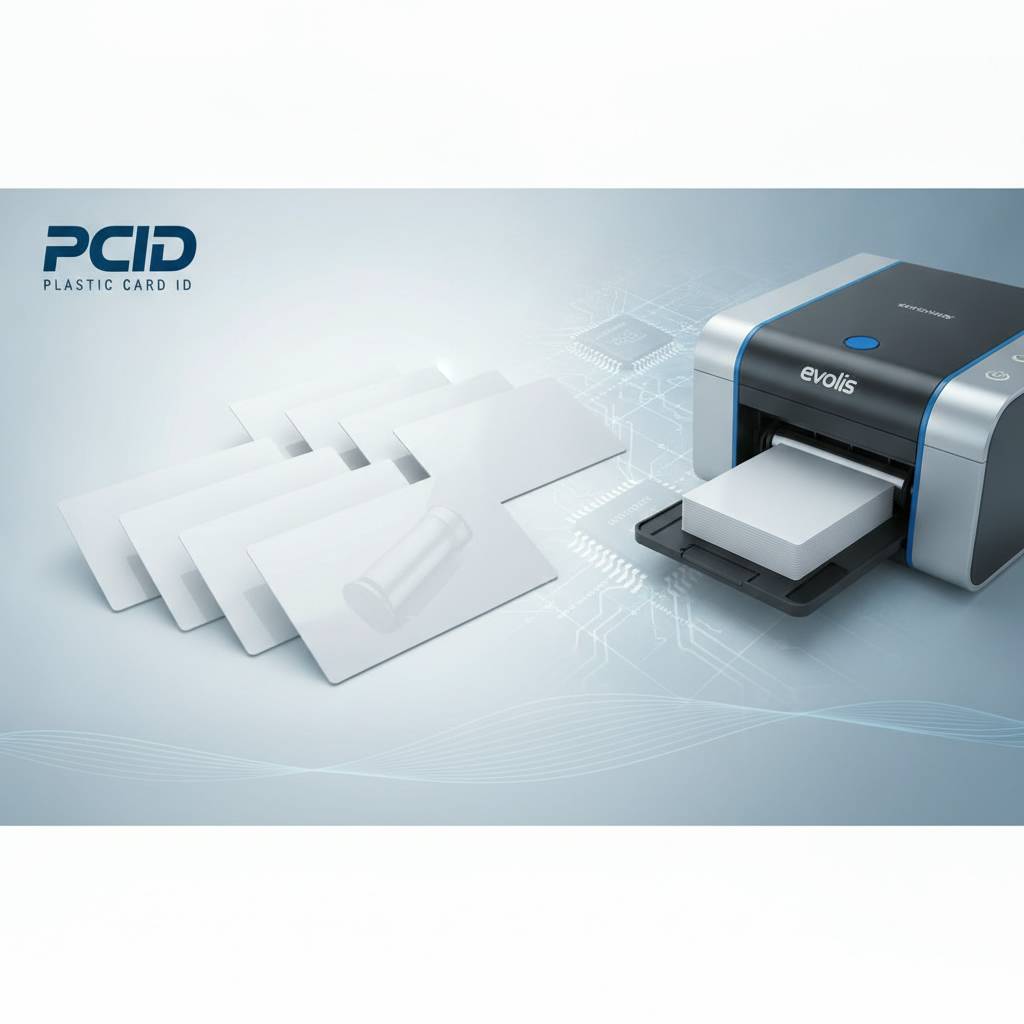 Blank PVC cards and card printers are inseparable partners, and compatibility matters. Not every printer handles every card type, and selecting the wrong combination creates problems ranging from print quality issues to encoder failures. This is an area where working with a knowledgeable supplier pays dividends immediately.
CPE carries a full lineup of card printers from Evolis, Zebra, and Fargo - three of the most trusted names in the industry - along with the ribbons, cleaning kits, and card supplies that keep those printers operating at their best. The relationship between card and printer is not incidental; it is central to the quality of every card your program produces.
Evolis, Zebra, and Fargo: Choosing the Right Brand
Evolis printers are widely respected for their sleek design, ease of use, and strong performance in low-to-mid volume environments. They are a favorite in corporate offices, schools, and membership organizations that need reliable daily printing without a complex setup. Evolis printers paired with quality blank PVC cards produce consistently sharp, professional results.
Zebra printers, particularly the ZXP series, are workhorses built for durability and high throughput. Organizations running hundreds or thousands of cards per week gravitate toward Zebra for its robust construction and long ribbon life. Fargo printers, now a part of HID Global, are a preferred choice in security-conscious environments - hospitals, government facilities, corporate campuses - where dual-sided printing and advanced encoding are standard requirements.
Printer Ribbons and the Impact on Print Quality
Here is something buyers often underestimate: the ribbon matters as much as the card. A quality blank PVC card run through a printer with a worn or incompatible ribbon will produce faded colors, incomplete encoding, and cards that look unprofessional regardless of the design file. Ribbon replacement on schedule is not optional maintenance - it is core to consistent output.
CPE stocks OEM-compatible and genuine ribbons for all major printer brands, ensuring that clients never find themselves hunting for compatible supplies at a critical moment. Call 800.835.7919 to confirm ribbon compatibility for your specific printer model before you run out mid-batch.
Cleaning Kits and Printer Longevity
Dust, PVC debris, and ribbon residue accumulate inside card printers over time. Without regular cleaning, printhead wear accelerates, card jams increase, and print quality degrades gradually - often so slowly that users do not notice until the deterioration is significant. Cleaning kits are inexpensive insurance against premature printhead replacement.
Most manufacturers recommend a cleaning cycle every 500-1000 cards, or whenever a new ribbon is installed. CPE includes cleaning kits and accessories in its full supply catalog because protecting your printer investment is every bit as important as choosing the right card stock.
Specialty and Advanced Blank Card Options
Beyond the standard CR80 white PVC, there is a world of specialty card formats serving specific industries and high-touch applications. Knowing these options exist - and knowing when to deploy them - separates a basic card program from one that genuinely impresses its audience.
These are not novelty options. Each specialty format solves a real problem or creates a measurable impression that standard cards simply cannot match.
Metal Cards: Stainless Steel, Brass, and Gold
Luxury metal cards occupy a unique position in the card hierarchy. Stainless steel, brass, and gold-finished metal cards carry a tactile weight and permanence that communicates premium status the moment they are handed over. Private clubs, financial advisory firms, luxury hospitality brands, and high-end retail operations use metal cards as deliberate brand statements.
The reaction a metal card generates is immediate and visceral. Recipients do not discard them. They show them to people. A metal card becomes a conversation piece that keeps your brand circulating in exactly the circles where it matters most. CPE offers these through its specialty catalog for organizations ready to invest in that level of impression.
Casino Player Cards and Hotel Key Cards
Casino environments have particular requirements around card durability, encoding reliability, and player tracking system compatibility. Player cards cycle through readers hundreds of times and must maintain consistent swipe performance throughout their usable life. The cards CPE supplies for casino applications are selected with exactly that durability standard in mind.
Hotel key cards are a LoCo magnetic stripe staple - encoded with temporary access credentials at check-in, deactivated at checkout, and wiped clean for the next guest. The cycle is fast, the volume is high, and the margin for encoding error is zero. Selecting reliable card stock for hotel key applications directly affects guest experience at the most friction-prone touchpoint of a stay.
Custom Die-Cut Shapes and Card Affixing Services
Not every card needs to be a rectangle. Custom die-cut cards in unusual shapes - rounded key fobs, uniquely dimensioned loyalty cards, or branded shapes that match a logo's silhouette - create tactile differentiation that standard formats cannot achieve. These are typically used in marketing and brand activation contexts where standing out is the entire point.
Card affixing and mailing services round out the specialty offering. For organizations that need cards mailed to members, employees, or customers - already attached to a carrier document, sealed, and addressed - CPE handles the logistics end-to-end. That kind of turnkey capability transforms a card supplier into a genuine operational partner.
Buying Blank PVC Cards: A Practical Buyer's Guide
Choosing blank PVC cards should be straightforward, and it is once you know what to look for. The questions below reflect the decisions that actually determine whether your card program runs smoothly from day one.
Key Questions to Ask Before You Order
- What card printer do you own or plan to purchase? Confirm card compatibility before buying in bulk.
- Do you need magnetic stripe encoding? If yes, determine HiCo or LoCo based on your reader infrastructure.
- What is your monthly card volume? This affects whether a desktop printer or a high-volume unit is the right investment.
- Do you need contactless technology? Proximity, RFID, or smart chip cards require compatible readers already installed or planned.
- Are you printing in-house or outsourcing? Blank cards are for in-house programs; custom-printed cards are for outsourced fulfillment.
- What is your card lifecycle? High-turnover programs (events, hotels) differ from long-term programs (employee IDs, membership) in durability requirements.
Ordering Volumes and What to Expect on Pricing
Blank PVC card pricing follows a volume curve - the more you order, the lower the per-card cost. Entry-level quantities for small programs can start as low as a few cents per card for standard white CR80 stock. Specialty cards - magnetic stripe, RFID, clear, colored - carry higher per-card costs reflecting the embedded technology or material premium.
For most small businesses and organizations, a starter order of 500-1000 cards gives enough inventory to run a program for months without reordering constantly, while keeping unit costs reasonable. Larger operations running 5,000-50,000 cards per month will see per-card economics that make in-house programs highly compelling from a pure cost perspective.
Working With CPE to Build Your Program
One of the genuine differentiators in working with CPE is the consultative approach to program building. This is not a click-and-ship operation. It is a supplier that has helped over 100,000 customers across the United States set up, scale, and optimize card programs of every description - and that experience translates into concrete guidance for new clients navigating decisions for the first time.
Whether you are starting from scratch with your first 50 employee badges or scaling a loyalty program to tens of thousands of members, the right conversation with the right supplier saves time, money, and the frustration of avoidable mistakes. Reach out by calling 800.835.7919 and describe your program goals - the rest is a conversation, not a hard sell.
Ready to Start Your Card Program? Contact Plastic Card ID Today
The blank PVC card is deceptively simple - a smooth white rectangle that becomes whatever your program needs it to be. Employee credential. Loyalty card. Access token. Membership credential. Event badge. The possibilities are bounded only by what you print and encode onto it, and the program you build around it.
Plastic Card ID has spent over 25 years building exactly these kinds of programs alongside businesses and organizations across the United States. More than 50 million cards shipped. More than 100,000 customers served. A catalog that covers every card type, every major printer brand, and every supply category your program requires.
Call Plastic Card ID at 800.835.7919 today and let's build something that works - from the first blank card to the thousandth, and every one after that.
Previous Page