Blank White PVC Cards vs Printed Cards: Key Differences
Table of Contents []
- Blank White PVC Cards vs Printed Cards: Which Choice Actually Wins for Your Business? - Plastic Card ID
- What Makes a Blank White PVC Card So Versatile
- Where Pre-Printed Custom Cards Make More Sense
- The True Cost Comparison Over Time
- Card Programs That Run on Blank PVC Stock
- Choosing the Right Blank Card Specification for Your Program
- Frequently Asked Questions: Blank PVC Cards vs Printed Cards
- Your Card Program Starts Here - Plastic Card ID
Blank White PVC Cards vs Printed Cards: Which Choice Actually Wins for Your Business? - Plastic Card ID
Here is a question that trips up more organizations than you might expect: should you order blank white PVC cards or fully printed cards? It sounds simple. It is not. The answer depends on your volume, your timeline, your design flexibility needs, and how your card program is likely to evolve over the next year or two. Get it wrong and you are either paying too much per card or scrambling when your design changes mid-program.
At Plastic Card ID, this is a conversation we have had with tens of thousands of businesses across the United States. After supplying more than 50 million cards to over 100,000 customers, we have developed a clear picture of who benefits from blank stock, who benefits from pre-printed cards, and who benefits from a hybrid approach. This page lays it all out.
| Feature | Blank White PVC Cards | Pre-Printed Custom Cards |
|---|---|---|
| Design Flexibility | Full control, print in-house anytime | Fixed design, ordered in batches |
| Per-Card Cost at Scale | Lower over time with card printer | Competitive at high batch volumes |
| Personalization | Individual names, photos, barcodes | Generic batch printing only |
| Turnaround Speed | Instant on-demand printing | Production and shipping time required |
| Upfront Investment | Card printer required | No printer needed |
| Best For | ID cards, memberships, access, loyalty | Gift cards, event cards, marketing runs |
What Makes a Blank White PVC Card So Versatile
A blank white CR80 PVC card - 30 mil thick, conforming to ISO 7810 standards - is one of the most adaptable tools in any card program. It is the same dimensions as a standard credit card, fits every wallet, and accepts printing from virtually every card printer on the market. The blank card is not a lesser product; it is a canvas.
What happens to that card depends entirely on what you encode or print onto it. Today it is an employee ID badge. Tomorrow, the same card stock becomes a gym membership card or a hotel key card. That flexibility is genuinely powerful for organizations that run multiple card programs or expect their needs to shift over time.
CR80 Standard and Why It Matters
The CR80 format - 3.375 inches by 2.125 inches - is the global standard for plastic cards. Every card printer, every card sleeve, every cardholder accessory is designed around this size. Buying non-standard sizes creates friction throughout your entire program. Stick with CR80 and everything works seamlessly together.
At 30 mil thickness, standard PVC cards are rigid enough to feel substantial in hand without being fragile. Thinner cards (20 mil) exist for specific applications, but for employee IDs, membership cards, and access credentials, 30 mil is the professional standard that cardholders expect.
The Range of Card Formats Available Blank
Blank does not mean plain. CPE carries blank PVC cards with magnetic stripes - both HiCo and LoCo configurations - RFID chips, proximity chips, smart card contacts, and specialty surfaces including clear, frosted, and pre-colored stock. The blank card category is far broader than most buyers initially realize.
A blank HiCo magnetic stripe card, for example, is ready to be encoded with loyalty account data the moment you print it. A blank MIFARE DESFire smart card can be issued as a contactless access credential with no additional components required. The encoding capability is built into the card before you ever print a single pixel.
Printed vs Unprinted Surface Quality
High-quality blank white PVC cards have a smooth, consistent surface that holds ink uniformly from edge to edge. Card quality at the blank stage directly determines print quality at the output stage. Low-grade blank cards have surface inconsistencies that cause banding, streaking, or color variation when printed - problems that reflect on your brand regardless of how good your design is.
When you source blank cards from Plastic Card ID, you are getting cards manufactured to tight tolerances. The consistency across a case of 500 cards is something that budget suppliers simply cannot match, and that consistency matters when you are printing 200 employee badges and need them all to look identical.
Where Pre-Printed Custom Cards Make More Sense
Pre-printed cards have a clear and defensible place in the market. If your design is locked, your volume is high, and you do not need individual personalization, ordering printed cards in bulk can be the right call. Retailers launching gift card programs at scale, for instance, often benefit from professional offset or digital printing at quantities that make per-card costs very attractive.
The retail gift card example is worth studying. Retailers who switch from paper gift certificates to plastic gift cards routinely see sales increases of 35-50%. That result is not about printing method - it is about the physical permanence and perceived value of plastic. Whether you achieve that with in-house printing or batch-ordered pre-printed cards, the card itself is driving the lift.
Situations Where Pre-Printed Cards Win
High-volume marketing runs, event giveaways, and generic gift cards with no individual data encoding are natural fits for pre-printed production. If you are ordering 50,000 identical loyalty cards with your brand and a barcode that gets scanned generically, pre-printed cards at volume pricing can be very cost-effective. The key word is identical - no personalization, no variable data.
Hotel chains launching a new key card program at a flagship property may order thousands of pre-printed key cards with the property branding already on the surface. The access encoding happens at check-in via the property management system, not at a card printer. In that model, pre-printed blank-backed cards serve perfectly.
The Personalization Ceiling of Pre-Printed Cards
Here is where pre-printed cards hit a hard wall. The moment you need a name on the card, a photo on the badge, a unique barcode tied to an individual member account, or a card number sequence, pre-printed production cannot help you. Individual personalization requires an in-house card printer and a supply of blank PVC cards.
Employee ID programs almost universally require individual personalization. So do student ID programs, healthcare worker badges, government access credentials, and loyalty programs that assign unique account numbers to members. For these use cases, blank white PVC cards paired with a card printer are not optional - they are the only workable solution.
Design Lock-In Risk
Ordering 5,000 pre-printed cards is a commitment. If your logo changes, your brand colors refresh, or your program structure shifts before those cards are depleted, you are left with obsolete inventory. Design lock-in is a real cost that rarely appears in initial budget calculations.
Organizations that operate in-house card printing programs with blank stock face zero design lock-in risk. Update your template file today, print new cards tomorrow. The agility this provides is especially valuable for growing businesses, franchises launching new locations, and membership organizations running seasonal promotions.
| Use Case | Recommended Approach | Reason |
|---|---|---|
| Employee ID Badges | Blank PVC In-House Printer | Individual names and photos required |
| Retail Gift Cards | Either approach viable | Depends on volume and personalization needs |
| Loyalty Membership Cards | Blank PVC Magnetic Stripe | Unique account encoding per member |
| Event Credentials | Pre-Printed or In-House | Depends on attendee data requirements |
The True Cost Comparison Over Time
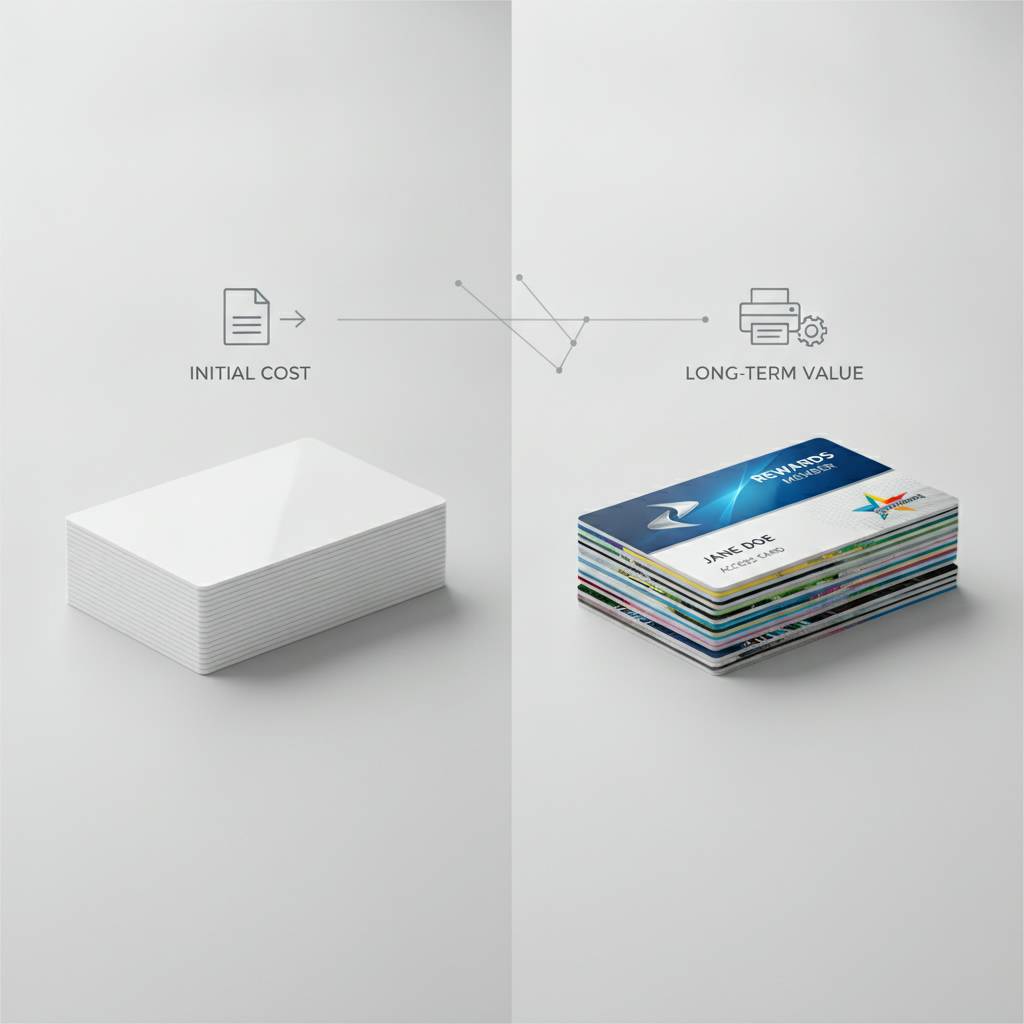 Cost comparisons between blank PVC cards and pre-printed cards often mislead buyers who only look at the per-card price in isolation. The total cost of card ownership includes printer investment, ribbon and supply costs, labor, and inventory flexibility value. When you model it correctly over 12-24 months, the picture changes significantly for moderate to high-volume programs.
A quality card printer from Evolis, Zebra, or Fargo - the brands CPE stocks and supports - typically falls in a price range of $500-$2,500 depending on features and throughput. That is a one-time capital expenditure. Blank PVC cards in quantity run significantly less per card than pre-printed alternatives, and the cumulative savings compound quickly once the printer cost is amortized.
Volume Break Points to Know
For organizations printing fewer than 50 cards per month with no personalization requirements, pre-printed batch orders can be cost-competitive depending on minimum order quantities. Below a certain volume, the printer investment does not pay back fast enough. However, most business card programs cross that threshold faster than expected as they grow.
At 200 or more cards per month, the economics of in-house printing with blank stock almost always favor the card printer model. The per-card cost of blank stock plus ribbon supplies drops well below equivalent pre-printed pricing at this volume, often dramatically so over an annual horizon.
Hidden Costs in Pre-Printed Card Programs
- Minimum order quantities that force you to order more than you need
- Shipping and handling charges on every reorder
- Rush fees when you run low unexpectedly
- Obsolescence cost when designs change before inventory depletes
- Lost time coordinating with external vendors on every card update
- Storage costs for bulk card inventory waiting to be used
These costs are real but rarely quantified upfront. When a membership organization changes its logo and has 2,000 pre-printed cards sitting in a storage closet, that is money gone with no recovery. In-house blank card programs eliminate most of these hidden costs entirely.
Ribbon and Supply Economics
Card printer ribbons are a recurring cost in any in-house program. A full-color YMCK ribbon from a quality brand prints approximately 200-500 cards depending on the printer model and yield specifications. Plastic Card ID supplies ribbons for all major card printer brands, and buying ribbons through the same supplier as your blank cards simplifies procurement considerably.
When you factor ribbon cost into total cost per card, the math still typically favors in-house production at medium to high volumes. And critically, your cost per card stays predictable and within your control rather than subject to vendor pricing changes on pre-printed orders.
Card Programs That Run on Blank PVC Stock
The range of programs successfully built on blank white PVC cards is broader than most people picture. From a small business issuing 50 staff IDs to a regional healthcare network badging several thousand employees, blank card programs scale smoothly in both directions. The infrastructure - cards, printer, ribbons, software - is the same regardless of scale; only the throughput changes.
Consider a regional fitness chain with 15 locations. Each location has a card printer and a supply of blank magnetic stripe PVC cards. New members are enrolled and issued cards instantly at the front desk. Design updates roll out via template changes pushed to all locations simultaneously. No vendor coordination, no wait time, no minimum orders. That is operational efficiency that compounds daily.
Identity and Access Control Programs
Employee ID badges and facility access cards represent the most common use case for blank white PVC card programs. These programs share a universal requirement: every card must be unique, carrying the employee's name, photo, department, and often an encoded access level. Pre-printed cards cannot serve this need, full stop.
Proximity cards and smart chip cards from CPE's catalog begin as blank stock before personalization. The access technology is embedded in the card substrate. Your printer adds the visual identity layer - name, photo, title, barcode - to produce a finished credential that works in both your access control reader and at a visual inspection point.
Loyalty and Membership Card Programs
Loyalty cards that live in wallets dramatically outperform paper punch cards. A plastic card, by its physical nature, signals that the program is permanent and worth joining. A card in a wallet is a brand impression every time the wallet opens. Paper punch cards end up crumpled at the bottom of a bag and forgotten.
Magnetic stripe blank cards are the workhorses of loyalty programs. Encode the member account number onto the stripe, print the member name and your brand on the face, and you have a complete loyalty credential produced in seconds per card. When members replace lost cards, reissuance takes minutes rather than days of waiting for a new shipment.
Event Credentials and Temporary Access Cards
Trade shows, conferences, corporate events, and sporting venues use blank PVC card stock to produce credentials on-site or in advance of events. The advantage of blank stock here is producing exactly the quantity needed - no over-ordering, no waste, and individual attendee names can be printed directly onto each card.
For multi-day events with tiered access levels, different card designs can be produced from the same blank stock simply by switching the template. VIP access, general admission, staff, and vendor credentials can all originate from the same case of blank white CR80 cards, differentiated entirely by design and encoding.
Choosing the Right Blank Card Specification for Your Program
Not all blank PVC cards are alike, and selecting the right specification for your application prevents frustrating compatibility and performance issues down the line. The surface coating, core material, and any embedded technology must all match your printer model and encoding equipment. Plastic Card ID helps customers match card specifications to their specific printer and program requirements - it is part of the service.
The core decision tree starts with whether you need a plain blank, a magnetic stripe card, a proximity card, or a smart chip card. Layer onto that whether you need single-sided or dual-sided printing capability, any special finishes, and whether the cards will be used in access control readers. Those answers narrow the field quickly.
Magnetic Stripe Card Specifications: HiCo vs LoCo
HiCo (High Coercivity) magnetic stripe cards are more resistant to accidental erasure from everyday magnetic fields - other cards, purse clasps, magnetic closures on bags. HiCo is the professional standard for employee IDs, loyalty programs, and hotel key cards. LoCo cards encode more easily and suit applications where data is temporary or frequently rewritten, such as short-term event credentials.
Unless you have a specific reason to choose LoCo, HiCo is the safer default for most business card programs. The cards cost marginally more but the durability advantage in daily-use programs is significant. CPE stocks both configurations in quantity.
RFID and Smart Card Options on Blank Stock
Blank RFID and smart chip cards bring contactless convenience to access control, cashless payment within closed systems, and secure identity applications. MIFARE DESFire cards, in particular, offer strong encryption suitable for corporate security environments. Contactless technology in a standard CR80 format means no change to your printer setup or cardholder workflow.
Casino player cards, healthcare worker credentials, university IDs, and building access programs all leverage smart chip technology on blank card substrates. The visual design is applied via card printer; the secure functionality lives in the chip. These two layers are entirely independent, which gives program administrators tremendous flexibility.
Specialty Blank Card Options: Clear, Frosted, and Color Stock
Beyond standard white PVC, Plastic Card ID carries blank clear plastic cards, frosted cards, and pre-colored PVC stock. Clear and frosted cards create striking visual effects when printed because light interacts with the card substrate itself. A loyalty card printed on frosted stock looks and feels premium in a way that white-stock cards simply cannot replicate.
Pre-colored stock - available in a range of solid colors - allows programs to use color as a visual differentiator without printing a full-bleed color background on every card. A security access program might issue red cards to temporary visitors and blue cards to full employees, with the color distinction visible at a glance from across a lobby. Call 800.835.7919 to discuss specialty card options and find the right fit for your program.
Frequently Asked Questions: Blank PVC Cards vs Printed Cards
After years of supporting card programs of every size, Plastic Card ID hears the same questions repeatedly. The answers below represent practical guidance drawn from real program experience - not marketing language, but operational reality.
Can I mix blank and pre-printed cards in the same program?
Yes, and many programs do exactly this. A common model is ordering pre-printed card shells with your brand design already applied - full-color front surface, logo, color blocks - and then overprinting variable data (names, photos, barcodes) in-house with your card printer. This hybrid approach combines the print quality of commercial production with the personalization of in-house printing.
The limitation is that your card printer must be capable of overprinting on a pre-printed surface without color mixing issues. Retransfer printers handle this better than direct-to-card models. CPE can help you evaluate whether your current printer is suited to a hybrid workflow.
What is the minimum order for blank white PVC cards?
Blank PVC cards are available in quantities starting at 100 cards, with pricing that improves substantially at 500, 1,000, and 5,000 card quantities. There is no reason to over-order blank stock just to hit a price break if your storage or cash flow does not support it. The pricing at 500 cards is already very competitive for most business applications.
For programs running 50 cards a month, a quarterly order of 150-200 blank cards keeps inventory lean without frequent reordering. For larger programs, annual volume pricing discussions are available - a conversation worth having with the Plastic Card ID team to understand what cost structure makes sense for your specific volume.
Do card printers from different brands use the same blank cards?
CR80 PVC cards at 30 mil thickness are compatible with virtually all card printers from Evolis, Zebra, Fargo, and other major brands. However, some specialty cards - particularly RFID, smart chip, and certain magnetic stripe configurations - have compatibility nuances with specific printer encoder models. Always verify encoder compatibility before ordering specialty blank card stock in quantity.
When you purchase your card printer and blank card supply through Plastic Card ID, compatibility verification is straightforward because we know both product lines. Sourcing cards from a different supplier than your printer creates a compatibility gap that can be difficult to diagnose after the fact.
Your Card Program Starts Here - Plastic Card ID
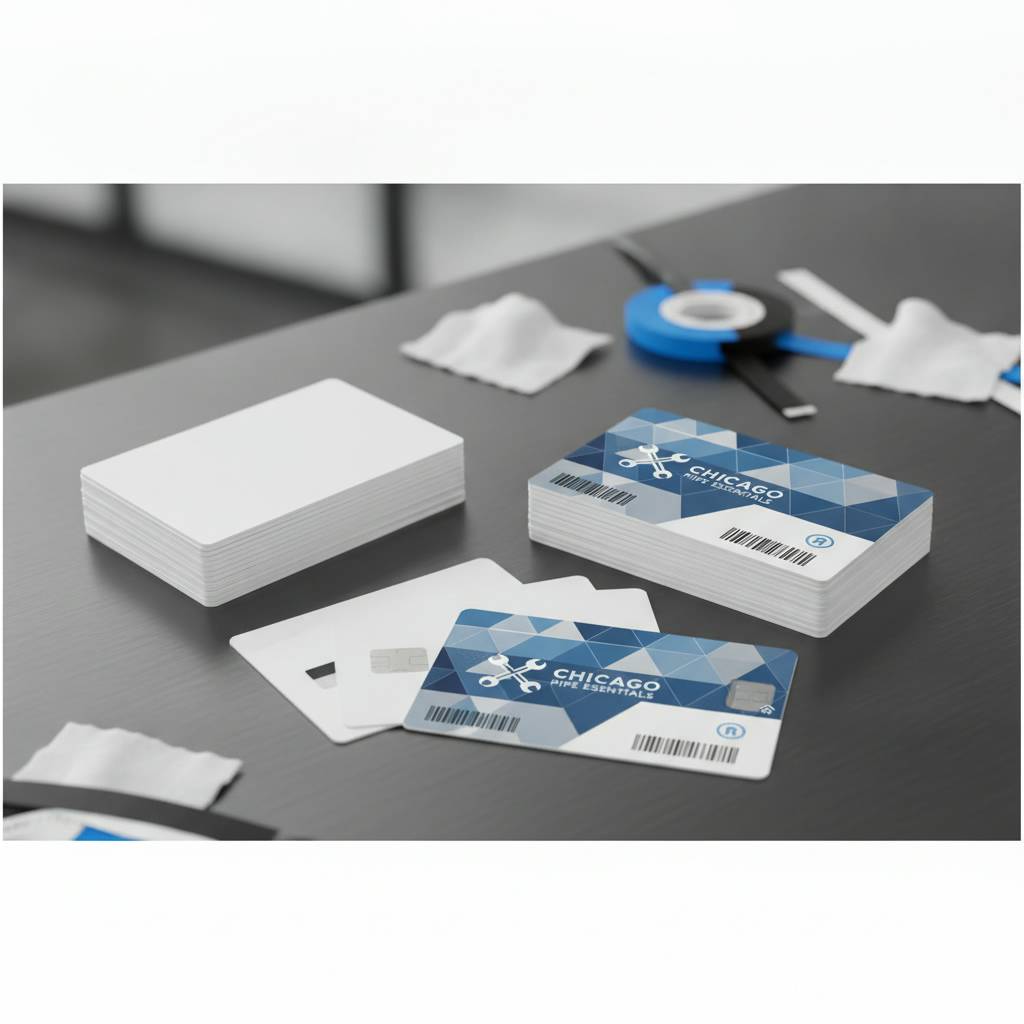 Whether your organization is launching its first employee ID program, scaling a loyalty card initiative across multiple locations, or upgrading from paper credentials to professional plastic, Plastic Card ID has the card stock, printers, supplies, and program knowledge to make it work. We are not just a card supplier - we are the team that helps you run a successful card program.
From blank white CR80 PVC cards to magnetic stripe stock, RFID cards, smart chip credentials, and specialty finishes, everything your program needs is available through a single trusted source. Over 100,000 customers and more than 50 million cards later, we know what works and what does not - and we share that knowledge with every customer we serve.
Ready to talk through your card program needs? Contact Plastic Card ID today at 800.835.7919 and let us help you choose the right card solution for your program, your volume, and your budget.
Previous Page