Access Control Levels with Plastic Cards
Table of Contents []
- Access Control Levels with Plastic Cards: What Plastic Card ID Knows That Your Current System Doesn't
- Understanding Access Control Tiers: Why One Card Type Never Fits All
- Smart Chip Cards and High-Security Access: MIFARE Technology Explained
- Proximity vs. Smart Card: A Practical Buyer's Decision Guide
- Building a Multi-Tier Access Card Program: From Design to Deployment
- Specialty Access Cards: Clear, Custom, and High-End Options
- Frequently Asked Questions: Access Control Levels with Plastic Cards
- Partner with Plastic Card ID for Access Control Card Solutions That Actually Work
Access Control Levels with Plastic Cards: What Plastic Card ID Knows That Your Current System Doesn't
Most organizations discover the gaps in their access control strategy the hard way - a contractor walks into a server room, a part-time employee badges into a restricted storage area, or a visitor wanders past a lobby checkpoint unchallenged. The problem isn't always the hardware. Often, it's the card. Specifically, it's using the wrong card for the wrong access tier.
Access control levels with plastic cards is a nuanced topic, and it deserves a thorough breakdown. The card stock, encoding technology, and card type you choose determines not just who gets through a door - but how reliably, how securely, and how scalably your entire system runs over time. CPE has spent over 25 years helping businesses across the United States get this right, and the insights here reflect that deep operational experience.
| Card Type | Technology | Best For | Security Level |
|---|---|---|---|
| Proximity Card | 125kHz RFID | General office access | Standard |
| MIFARE Classic | 13.56MHz smart chip | Multi-zone facilities | Moderate-High |
| MIFARE DESFire | 13.56MHz encrypted chip | High-security environments | Very High |
| HiCo Magnetic Stripe | High-coercivity magnetic | Hotel keys, controlled entry | Moderate |
| Blank PVC Card | Print-on-demand | In-house ID and badging | Visual/Basic |
Understanding Access Control Tiers: Why One Card Type Never Fits All
Security isn't a single dial you turn up or down - it's a layered architecture, and plastic cards sit at the physical intersection of identity and permission. An organization with three floors, a data center, and a loading dock doesn't need one card type. It needs a tiered card strategy where the technology embedded in each card matches the sensitivity of what it unlocks.
Proximity cards, magnetic stripe cards, and smart chip cards each occupy a different rung on this ladder. Choosing the right rung means fewer breaches, a smoother user experience, and a card system that grows with your organization rather than fighting against it. The following sections break down each level in practical, operational terms.
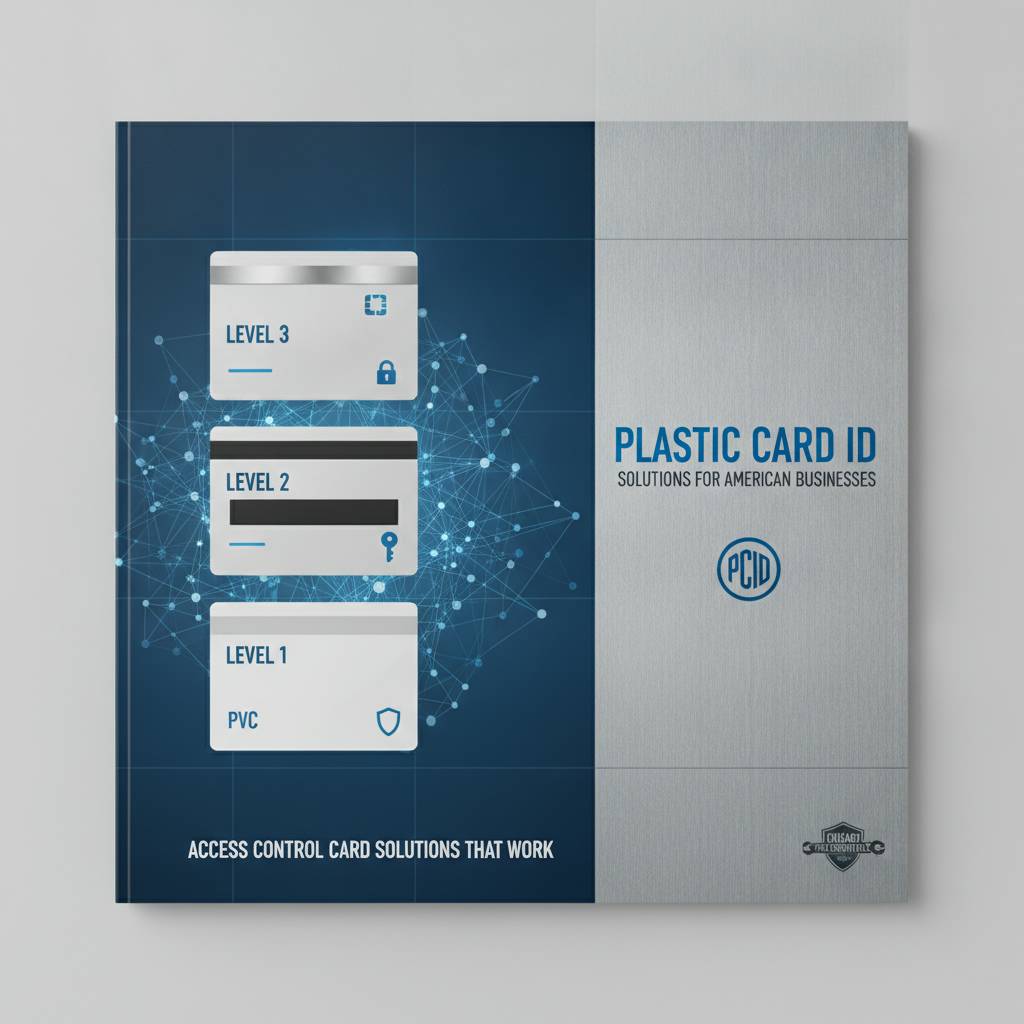
Level One: Visual ID and Basic Access
At the most fundamental tier, a plastic card functions primarily as a visual credential. A printed employee badge with a photo, name, and department - produced on a CR80 blank PVC card using an in-house printer - tells security at a glance whether someone belongs in a space. This level requires no electronic reader, no encoding, and no infrastructure beyond the card printer itself.
Blank CR80 cards at 30 mil thickness are the ISO 7810 standard for a reason: they're durable, printable, and wallet-compatible. Organizations running small-to-mid-scale operations - community centers, schools, retail backrooms, small corporate offices - often find this tier entirely sufficient for day-to-day access management. The cost per card is low, and the total control over design means badges can include barcodes for timekeeping or color-coded zones.
Level Two: Magnetic Stripe Encoding for Controlled Entry
A step above visual identification, magnetic stripe cards introduce machine-readable data. HiCo (High Coercivity) magnetic stripe cards are far more resistant to demagnetization than LoCo cards, making them the preferred choice for access applications where cards will be used repeatedly over months or years. Hotel key cards are a classic example, but the same technology scales to any controlled-entry scenario.
HiCo magnetic stripe cards encode data reliably across thousands of swipes without significant degradation. Paired with a compatible card reader and access control software, this tier allows you to assign specific permissions to each card's encoded data - meaning two cards that look identical can open completely different sets of doors. It's a meaningful jump in access granularity without a dramatic increase in per-card cost.
LoCo cards, by contrast, use lower magnetic field strength and are generally suited to short-term use cases like event credentials or single-season gym memberships where card longevity is less critical. Knowing which coercivity level fits your application prevents data-loss headaches down the line.
Level Three: RFID Proximity Cards for Hands-Free Verification
Proximity cards operating at 125kHz are the workhorse of mid-level physical access control in North American facilities. A card holder simply waves or taps the card near a reader, and the embedded antenna transmits a unique identifier - no contact required. This hands-free experience improves throughput at high-traffic access points like building entrances and parking garages.
The limitation worth noting: standard 125kHz proximity technology transmits a fixed ID without encryption. This is adequate for many applications, but in environments where card cloning is a realistic threat, organizations should evaluate upgrading to a higher-frequency smart card solution. For many mid-sized businesses, though, proximity cards strike the right balance of convenience, cost, and control.
Smart Chip Cards and High-Security Access: MIFARE Technology Explained
When access control conversations reach the phrase "high security," smart chip cards enter the picture. These contactless cards operate at 13.56MHz and carry an embedded microchip capable of storing and processing data - a fundamental difference from the passive identifier broadcast by a basic proximity card. The chip doesn't just say "here I am"; it can engage in a cryptographic handshake with the reader before granting access.
MIFARE DESFire cards represent the current gold standard in contactless smart card security for physical access applications. Used in government facilities, financial institutions, data centers, and any environment where unauthorized access carries serious consequences, DESFire cards offer AES encryption, mutual authentication, and multiple application support on a single card. This means one card can handle building access, elevator permissions, cafeteria payments, and parking - all encoded and segmented securely.
MIFARE Classic vs. MIFARE DESFire: Choosing the Right Chip
MIFARE Classic cards, operating on a proprietary encryption scheme, were the industry standard for years and remain widely deployed. However, known vulnerabilities in the Classic's encryption have led security professionals to prefer DESFire in new deployments where the threat model justifies the upgrade. For organizations with existing MIFARE Classic infrastructure, the decision to migrate involves weighing reader compatibility, card replacement costs, and actual security risk.
MIFARE DESFire EV2 and EV3 variants offer backward compatibility benefits and enhanced transaction speeds, making them a forward-looking investment for organizations planning access control infrastructure for the next decade. CPE supplies both card families, allowing clients to source from a single, reliable partner regardless of which technology their system requires.
Multi-Application Smart Cards: One Card, Multiple Access Levels
One of the most compelling advantages of smart chip technology is the ability to segment a single card into multiple distinct applications. A hospital employee might carry one card that handles building access at one security level, pharmacy access at a higher level, and restricted research areas at the highest level - all governed by different encryption keys and readable only by appropriately configured readers.
This multi-application architecture eliminates card proliferation - the frustrating situation where an employee carries a different card for every system. Consolidation onto a single smart card reduces administrative overhead, simplifies issuance, and creates a cleaner audit trail. It also means that when an employee leaves, a single card deactivation cuts off all access simultaneously.
Casino Player Cards and Specialty High-Use Smart Cards
Some industries place extraordinary demands on smart cards in terms of transaction volume, durability, and data integrity. Casino player cards are issued to loyalty program members and must survive thousands of reader interactions while maintaining accurate encoding and clean printability for player information. These cards often combine magnetic stripe encoding with smart chip technology to interface with different systems throughout a gaming floor.
The physical card itself must be robust. Standard CR80 PVC at 30 mil handles this well, but laminate overlaminates and specialty coatings further extend card life in high-use environments. CPE supplies cards engineered for exactly these demands, along with the ribbons and printers needed to produce them in-house or at volume.
Proximity vs. Smart Card: A Practical Buyer's Decision Guide
 The decision between proximity and smart card technology isn't purely technical - it's operational and financial. Proximity cards are less expensive per unit and require simpler reader infrastructure. Smart cards cost more upfront but deliver capabilities that proximity cards fundamentally cannot replicate. The right choice depends on the specific access control levels your organization needs to enforce and the sophistication of your threat environment.
Here's a practical framework for evaluating which technology belongs at each access point in your facility:
Key Questions Before Selecting Your Card Technology
- How many distinct access zones does your facility have? More zones with different permission sets favor smart card segmentation over proximity's single-ID broadcast.
- What is the consequence of unauthorized entry? Higher-stakes areas justify the added cost of encrypted smart card authentication.
- Do you need card cloning protection? Proximity cards are more vulnerable; DESFire smart cards offer robust anti-cloning measures.
- Will the card serve multiple functions? Multi-application smart cards eliminate the need for separate credentials for different systems.
- What is your monthly card volume? From 50 cards a month to tens of thousands, the economics of in-house printing vs. pre-encoded ordering shift accordingly.
- What readers are already installed? Backward compatibility matters - new cards must work with existing infrastructure or a reader upgrade must be budgeted.
The Role of Blank PVC Cards in Scalable Access Programs
Not every access control program needs sophisticated encoding from day one. Many organizations begin with blank CR80 PVC cards printed in-house - adding barcodes, photos, and color-coded zones that security staff can visually verify. This approach gives total design control, extremely low per-card costs, and the flexibility to iterate card design without ordering minimums from an outside printer.
The blank card is deceptively powerful. With the right card printer - Evolis, Zebra, or Fargo models carried by CPE - a blank CR80 becomes a photo ID badge, a barcoded visitor pass, a color-zoned contractor credential, or an event-day access card. As the access program matures and electronic verification becomes necessary, the same card stock can be sourced with magnetic stripes or chip options already embedded, ready for encoding.
Card Printers That Support Multi-Level Access Programs
The card printer selection is inseparable from the access card strategy. Single-sided monochrome printers handle basic photo ID and barcode printing at the lowest cost per card. Dual-sided color printers enable richer designs with front-face photos and back-face data fields. Printers with built-in encoding modules handle magnetic stripe and smart chip writing in a single pass.
Evolis, Zebra, and Fargo each bring distinct strengths. Evolis printers excel in compact, high-quality output ideal for mid-volume programs. Zebra's ZXP and ZC series offer speed and durability for high-volume operations. Fargo's HDP series uses retransfer printing for superior image quality over uneven card surfaces, including smart cards with embedded chips that create a slight surface relief. Choosing the right printer is part of choosing the right access card solution, and CPE guides clients through both decisions.
| Printer Type | Best Card Volume | Encoding Capability | Ideal Program Type |
|---|---|---|---|
| Monochrome Direct-to-Card | 50-500/month | None or mag stripe | Basic ID badging |
| Color Direct-to-Card | 100-2,000/month | Mag stripe optional | Photo ID, employee badges |
| HDP Retransfer | 500-10,000/month | Mag stripe and smart chip | Multi-level access, smart cards |
Building a Multi-Tier Access Card Program: From Design to Deployment
A well-executed multi-tier access program doesn't happen by accident. It begins with a clear map of your physical spaces, a defined classification of access levels, and a card technology assignment for each level. The output is a card matrix: which card type, what encoding, which printer ribbon, and what card carrier or sleeve is appropriate for each role within the organization.
Organizations that skip this planning phase typically end up with a patchwork of incompatible cards, readers that can't talk to each other, and security gaps that only become visible after an incident. A structured approach - even for a 50-person organization - saves significant time, cost, and risk over the life of the program.
Structuring Access Levels Across Card Types
A practical multi-tier structure might look like this: general employees carry a color-printed CR80 photo badge with a proximity chip for building entry; managers carry the same card design with a MIFARE Classic chip that also opens restricted department areas; IT and executive staff carry MIFARE DESFire cards with multiple application segments covering server room access, executive floors, and secure document areas.
Visitors receive a blank card printed on-demand with the date and a barcode that grants lobby-only access for a defined time window. Contractors receive a color-coded card with a different stripe color or design element that immediately signals their limited access tier to security personnel doing visual checks. Each layer is distinct, legible, and enforceable.
Card Carriers, Sleeves, and Accessories That Support Access Programs
An access card that is physically damaged, demagnetized, or lost creates an immediate security and operational problem. Card carriers and sleeves protect the card surface from scratching and the magnetic stripe from interference. Lanyards and badge reels keep cards visible and accessible, supporting the visual verification layer of any tiered access system.
CPE supplies a full range of card accessories - sleeves, rigid carriers, lanyards, badge holders, and card reels - meaning the entire physical access card ecosystem is available from a single source. This one-stop-shop model eliminates the sourcing headache of managing multiple vendors for cards, printers, ribbons, and accessories. Everything works together because it's specified together.
When to Call Plastic Card ID: Contact Information for Program Planning
Whether you're designing a new access card program from the ground up or identifying gaps in an existing tiered system, speaking with someone who has guided hundreds of similar projects is invaluable. CPE handles programs ranging from 50 cards per month all the way to mass production in the tens of thousands, and the guidance is calibrated to the actual scale and needs of your organization.
Reach the team directly at 800.835.7919 to discuss card technology selection, printer recommendations, encoding options, and volume pricing. Conversations are practical, not high-pressure - the goal is to match you with exactly what your access control program requires, nothing more and nothing less.
Specialty Access Cards: Clear, Custom, and High-End Options
Standard white PVC CR80 cards serve the vast majority of access control applications beautifully. But certain environments - luxury hotels, executive offices, high-end membership clubs, or brand-conscious corporate campuses - benefit from cards that carry visual weight commensurate with the brand. Specialty card options bring that dimension without sacrificing functional encoding capability.
Clear plastic cards create a striking visual effect when printed with a design that lets the card's transparency interact with the printed elements. Frosted cards offer a more subtle premium aesthetic. Custom die-cut shapes break from the standard CR80 format for brand differentiation. And for the highest-end tier, metal cards in stainless steel, brass, or gold deliver a tactile and visual authority that plastic simply cannot replicate.
Clear and Frosted Cards for Access Applications
Clear and frosted PVC cards accept printing, magnetic stripe encoding, and in some configurations smart chip embedding, making them functionally equivalent to standard white cards. The difference is purely aesthetic - and in environments where that aesthetic communicates brand value or exclusivity, the difference matters considerably. A clear access card for a boutique hotel's VIP floor reads completely differently than a white stock card, even if the embedded technology is identical.
Frosted cards offer a middle ground: not fully transparent, but with a soft, diffuse quality that elevates the perceived card value. Both formats are available through CPE in CR80 dimensions compatible with standard card printers and readers.
Metal Cards as Premium Access Credentials
Metal cards - available in stainless steel, brass, and gold finishes - represent the highest tier of physical card prestige. These are not standard encoding substrates; they are prestige objects that happen to carry access functionality. Executive membership clubs, high-security VIP programs, and luxury hospitality brands use metal cards to signal permanent, elevated status to holders and observers alike.
A metal card that grants access to an executive floor communicates something about the cardholder's standing within the organization in a way that no paper or standard plastic card can. The weight, the finish, and the permanence of metal create a credential that people don't lose, don't abuse, and don't lend - behavioral benefits that quietly reinforce security compliance.
Custom Die-Cut Shapes and Branded Access Cards
Standard CR80 dimensions are the norm, but organizations with strong brand identities sometimes benefit from cards that break the rectangle. Custom die-cut shapes - within the constraints of standard reader slot dimensions for encoded cards - allow for rounded corners, notched edges, or entirely non-standard outlines for cards intended primarily for visual verification or event access.
Branded access cards that incorporate a company's logo, color scheme, and visual identity into the card design do more than just look good. They function as a deterrent to counterfeiting, since a highly specific branded design is far harder to replicate convincingly than a generic white card with printed text. CPE advises on both the design parameters and the encoding compatibility of any specialty card format before production begins.
Frequently Asked Questions: Access Control Levels with Plastic Cards
The following questions reflect the most common points of confusion and decision-making friction that organizations encounter when building or upgrading a tiered plastic card access control system. Answers are drawn from decades of hands-on program experience.
Can I use the same card for multiple access zones?
Yes - but the card technology must support it. A basic proximity card broadcasts a single identifier and relies on the access control software to determine what that identifier can open. A MIFARE DESFire smart card, by contrast, can carry multiple encrypted application segments on a single chip, with different segments governing different access zones independently. For organizations with complex, multi-zone needs, smart cards are the right tool.
Magnetic stripe cards can encode multiple tracks of data, and different readers can be configured to respond to different data fields - enabling a degree of multi-zone logic. However, this approach is less flexible and less secure than smart chip-based segmentation and is generally suited to simpler tiered environments.
What is the difference between HiCo and LoCo magnetic stripe cards for access control?
HiCo (High Coercivity) cards encode data using a stronger magnetic field, making them significantly more resistant to accidental demagnetization. For access control applications where cards are used daily over months or years, HiCo is the correct choice. LoCo (Low Coercivity) cards are appropriate for short-term, single-use, or low-frequency applications where card longevity is not a priority.
Using LoCo cards in a long-term access program is a common mistake that leads to read errors, frustrated cardholders, and administrative overhead from frequent card replacements. CPE helps clients specify the correct coercivity level during the initial card selection process to avoid this entirely preventable problem.
How does card volume affect my technology and printer choices?
At lower volumes - say, 50-200 cards per month - the economics favor in-house printing with a desktop card printer and blank card stock. The per-card cost is slightly higher than bulk ordering, but the design flexibility and speed of issuance more than compensate. At higher volumes, bulk pre-encoded card ordering, higher-throughput printers, and tiered pricing structures shift the economics favorably toward larger upfront orders.
- 50-200 cards/month: Desktop printer, blank PVC stock, on-demand printing
- 200-1,000 cards/month: Mid-volume color printer, bulk blank card purchasing, optional in-house encoding
- 1,000-10,000 cards/month: High-throughput retransfer printer, pre-encoded bulk card orders, dedicated ribbon supply management
- Occasional large runs: Custom print-and-encode orders fulfilled by CPE with card affixing and mailing services for direct distribution
Partner with Plastic Card ID for Access Control Card Solutions That Actually Work
 Twenty-five years. Over 100,000 customers. More than 50 million cards delivered across the United States. Plastic Card ID isn't a transactional card supplier - it's a strategic partner that has guided organizations of every size through the complexities of building access card programs that perform reliably, scale gracefully, and represent their brands with integrity.
Whether your access control program is a straightforward employee badge system or a multi-tier smart card deployment covering dozens of zones across multiple facilities, the depth of product knowledge and program experience at CPE means you're not figuring this out alone. From blank PVC CR80 cards to MIFARE DESFire smart cards, from Evolis desktop printers to Fargo HDP retransfer systems, from card sleeves to full card affixing and mailing services - everything you need is available from one trusted source.
Don't let a mismatched card technology create security gaps in your access control program. Call 800.835.7919 today and speak directly with the team at Plastic Card ID. The right card for the right access level is a single conversation away.
Previous Page