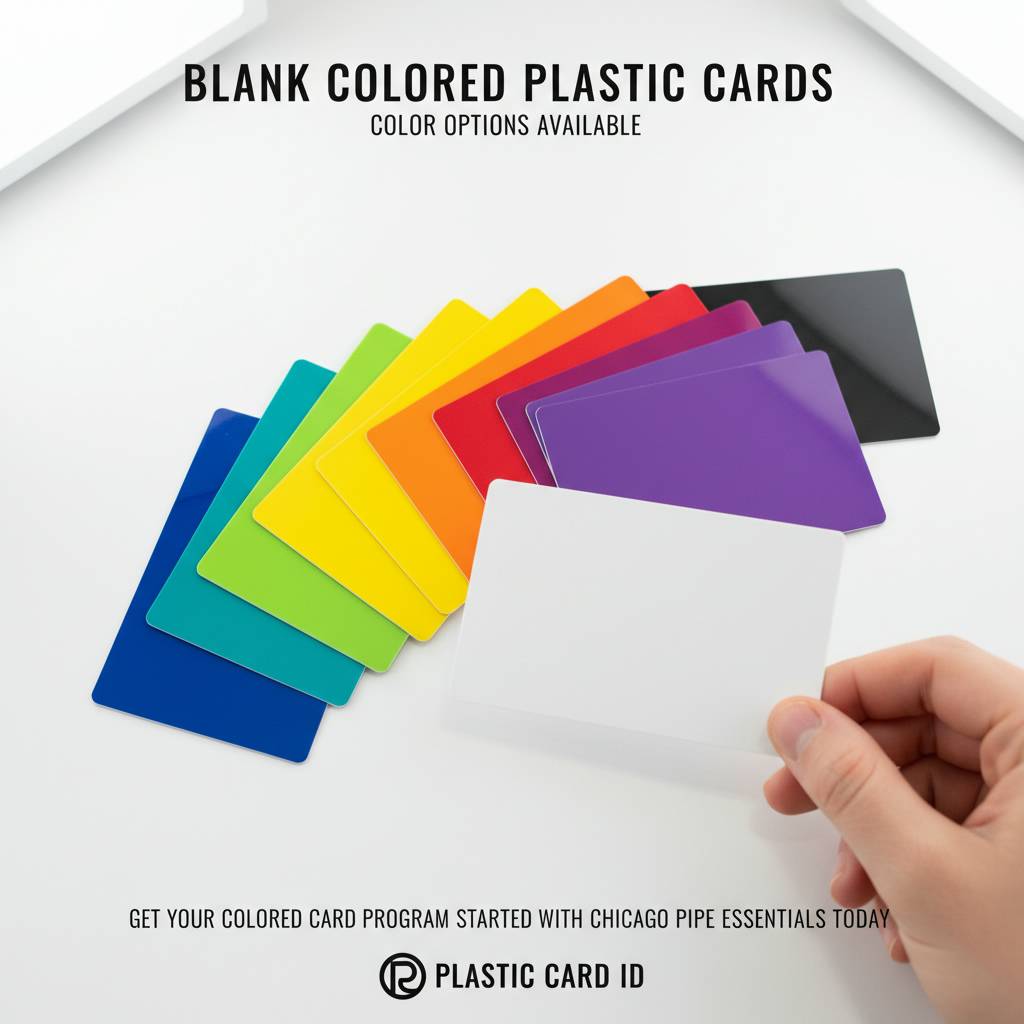
Blank Colored Plastic Cards: Color Options Available
Table of Contents []
- Blank Colored Plastic Cards: Color Options That Work as Hard as You Do - Plastic Card ID
- Why Color Selection Is a Strategic Business Decision
- The CR80 Standard and Why It Matters for Colored Cards
- Best Use Cases for Blank Colored Plastic Cards
- Buyer's Guide: Choosing the Right Colored Card Stock
- Supporting Products That Complete Your Colored Card Program
- Frequently Asked Questions About Colored Blank Plastic Cards
- Get Your Colored Card Program Started with Plastic Card ID Today
Blank Colored Plastic Cards: Color Options That Work as Hard as You Do - Plastic Card ID
Walk into any well-run membership club, loyalty program, or corporate office and you will notice something almost immediately - the cards people carry say something before a single word is read. Color does that. The right card color signals brand identity, category, tier, and purpose in a single glance. At Plastic Card ID, we have spent over 25 years watching color choices transform ordinary card programs into powerful business tools, and we want to help you make the same leap.
Blank colored plastic cards are not a niche product for niche buyers. They are the operational foundation for in-house card programs across retail, hospitality, healthcare, education, manufacturing, and beyond. When you control the card stock color, you control the visual language of your entire program without relying on a third party to print every single batch.
| Card Color | Common Use Cases | Available Options |
|---|---|---|
| White (Standard) | Employee ID, Loyalty, Membership | Plain, HiCo Mag, LoCo Mag, RFID |
| Black | VIP Membership, Premium Loyalty | Plain, Magnetic Stripe |
| Red | Event Credentials, Access Tiers | Plain, Mag Stripe |
| Blue | Employee Badges, ID Programs | Plain, HiCo Mag |
| Clear / Frosted | Specialty, Luxury, Gift Cards | Plain, Mag Stripe |
| Gold / Silver | VIP Tier, Rewards Programs | Plain, Magnetic Stripe |
Why Color Selection Is a Strategic Business Decision
Most buyers come to CPE thinking about quantity and price. Smart buyers - the ones running programs that actually stick - ask about color first. Color is your first line of brand communication. A black card feels premium. A red card feels urgent and energetic. A blue card reads as trustworthy and institutional. These are not opinions; they are patterns confirmed across millions of card programs over decades.
Choosing the right blank card color means your print staff or card printer can personalize each card on-site without having to pre-sort, re-order by tier, or manage complex inventory across multiple printed designs. You print what you need, when you need it, on the color stock that already communicates the right category before a single ink drop touches it.
Color as a Tier Differentiator
Tiered loyalty and membership programs are among the most effective uses of colored card stock. Gold and silver cards naturally communicate elevated status without requiring a cardholder to read fine print. Black cards consistently signal VIP or premium access in nearly every industry context. When you assign colors to tiers, your cardholders know exactly where they stand.
This matters operationally, too. Staff at a point-of-sale terminal, front desk, or access checkpoint can visually identify card tier instantly - no scanning required for a preliminary assessment. The color does the work before the technology does. That kind of layered redundancy makes programs run faster and with fewer errors in busy environments.
In-House Printing Flexibility with Colored Stock
Running an in-house card program with a desktop card printer from Evolis, Zebra, or Fargo? The printer does not care about the card's base color. What it prints on top of that base color is entirely yours to design. A yellow base card with black text and a logo printed on top creates a visual combination no white card can replicate. It is an effect that looks expensive but is achievable at every order volume.
When your organization needs to issue cards in a hurry - for a new employee, a visiting contractor, a member who lost their card - having the right colored stock already in your printer means you are never waiting on a new shipment. That operational speed is one of the most underrated advantages of keeping colored blank card stock on hand.
What Color Options Are Actually Available
The range surprises most first-time buyers. Beyond white, Plastic Card ID stocks colored PVC cards in black, red, blue, green, yellow, orange, silver, gold, and more depending on current inventory and order volume. Specialty finishes including clear, frosted, and translucent options round out a catalog that gives buyers genuine design flexibility at every budget level.
Some colors are available in standard CR80 30 mil thickness (the same size and thickness as a standard credit card), while specialty colors or finishes may have minimum order quantities that differ slightly from the core catalog. It is always worth calling the team directly to confirm current stock and discuss your specific needs before placing a large order.
The CR80 Standard and Why It Matters for Colored Cards
Every blank colored card in CPE's catalog is built to the CR80 ISO 7810 standard - 3.375 inches by 2.125 inches, 30 mil thick. That is not a marketing claim; it is the global specification that makes your cards compatible with every card printer, card carrier, badge holder, wallet slot, and card reader on the market. Standardization is what makes a blank card program scalable.
When you move from a paper-based credential or loyalty system to plastic CR80 cards, the upgrade is not just aesthetic. The cards fit existing infrastructure, swipe in existing readers, and print on existing hardware. There is no retooling of your environment - just an immediate, visible, tangible improvement in how your program presents itself to the people it serves.
Durability Across Color Options
A common question from new buyers is whether colored cards are as durable as standard white stock. The answer is yes - and here is why it matters. PVC plastic cards do not fade, bend, or degrade the way paper credentials do, regardless of base color. A red card issued today will still be a clean, firm, professional-looking red card six months from now if handled normally.
This durability is not just about aesthetics. It is about the card's functional lifespan as a swipeable, scannable, usable credential. A warped or faded card does not scan reliably. A cracked paper punch card stops being useful after a few uses. Plastic card stock - in any color - eliminates those failure modes entirely and reduces replacement costs over the life of your program.
Magnetic Stripe Options on Colored Card Stock
Need a loyalty card, gift card, or access credential that also carries encoded data? Magnetic stripe technology is available on most colored card stock options. Both High Coercivity (HiCo) and Low Coercivity (LoCo) magnetic stripe options can be combined with colored PVC stock to give you a card that communicates visually and functions technologically at the same time.
HiCo stripes are recommended for cards that will be swiped frequently or stored near magnets - think employee access badges, retail loyalty cards, and hotel key-style applications. LoCo stripes work well for shorter-term or lower-swipe applications. Getting the coercivity right for your use case extends the functional life of every card in your program and reduces re-issuance headaches.
RFID and Smart Chip on Colored Cards
Contactless access is increasingly standard in commercial and institutional environments. RFID proximity cards and smart chip cards - including advanced options like MIFARE DESFire - are available in select colored card formats. These cards allow contactless reading at access control points, time-and-attendance terminals, and other smart infrastructure without requiring a physical swipe.
For organizations with access control systems already in place, dropping in a colored RFID card means the new credential integrates with existing readers while also introducing visual tier or role differentiation into your badge program. Blue for general employees, red for restricted zones, black for executive access - the color coding works alongside the technology, not instead of it.
Best Use Cases for Blank Colored Plastic Cards
 Color is not decoration. It is a functional element in card program design, and the use cases below illustrate why the most successful programs almost always make deliberate color choices. Whether you issue 50 cards a month or 50,000, the logic is the same: let color do the heavy lifting before your team even looks at a name or number.
The diversity of applications across industries is one reason Plastic Card ID has served over 100,000 customers. Card programs look different in a hotel chain, a fitness club, a regional retailer, and a university - but the underlying logic of using color strategically is identical across all of them.
Loyalty and Gift Card Programs
Retailers who upgrade from paper punch cards or paper gift certificates to plastic card stock see measurable lifts. Gift card sales increases of 35 to 50 percent are documented in retail environments making that transition. Plastic cards live in wallets; paper certificates live in junk drawers. That difference in physical presence drives real revenue, and the color of the card is part of what makes it wallet-worthy.
For loyalty programs, colored cards signal permanence and intentionality. A customer holding a gold loyalty card feels differently about your brand than one holding a white card with a barcode sticker applied in-store. The former feels like a reward. The latter feels like an afterthought. Color is cheap. The perception gap it creates is not.
Employee ID and Access Badges
Human resources and facilities teams love colored stock for one practical reason: role differentiation at a glance. Full-time employees get blue. Contractors get red. Visitors get green. The facility manager does not need to read small print to know who belongs where. This kind of visual access management is simple, fast, and effective in environments from manufacturing floors to corporate headquarters.
When paired with a magnetic stripe or RFID chip, colored ID cards become true multi-function credentials - carrying access permissions electronically while communicating role and clearance level visually. That combination is hard to replicate with any other credential format, and it is available in-house with the right card stock and a compatible desktop card printer.
Event Credentials and Membership Cards
Events that need to control access to multiple zones - general admission, backstage, VIP, staff - benefit enormously from color-coded credentials. Colored wristbands are standard, but colored plastic cards carry far more information, scan reliably, and project a professional image that wristbands never can. An event that cards its attendees with printed plastic credentials signals organizational competence before the first speaker takes the stage.
Membership organizations - gyms, clubs, associations, professional societies - use colored cards to visually reinforce membership status. A member who receives a sleek black card in the mail when they reach platinum status feels the upgrade before they even use the card. That tactile and visual experience is a retention mechanism disguised as stationery.
Buyer's Guide: Choosing the Right Colored Card Stock
- Define your use case first. Is this a loyalty card, an ID badge, an event credential, or a membership card? Use case determines color logic, encoding needs, and durability requirements.
- Match color to existing brand guidelines. Your card should feel like an extension of your brand, not a departure from it. Pull Pantone or hex codes before selecting stock colors.
- Consider your print hardware. Some colored stocks show printed colors differently than white stock. Test a sample batch on your actual printer before committing to large quantities.
- Plan for encoding needs early. If you need magnetic stripe, RFID, or smart chip capabilities on a colored card, confirm availability for that specific color before ordering.
- Order appropriate quantities for your program size. Plastic Card ID supports programs from 50 cards a month to tens of thousands. Match your order cadence to your actual issuance rate to avoid obsolete stock.
- Think about how color communicates tier. If your program has multiple membership or access levels, map a color to each level before you order anything. Changing mid-program creates confusion.
Minimum Orders and Volume Pricing
One of the most frequent buyer questions is about minimum order quantities for non-white colored stock. The short answer is that minimums exist but are reasonable for most business programs. Higher order volumes bring lower per-card costs, which is why organizations with high monthly issuance rates almost always see a strong return on stocking colored card inventory versus ordering white cards and managing complex print designs to differentiate tiers.
For smaller programs just getting started, it is worth discussing your projected growth with the CPE team before placing your first order. Getting the color and encoding spec right on the first order - even at a small quantity - is far less expensive than re-tooling a program after the first thousand cards have been issued. Call 800.835.7919 and let the team help you plan that first order correctly.
Specialty Finishes Beyond Solid Color
Solid colored PVC stock is the foundation, but it is not the ceiling. Clear and frosted card options create a completely different visual impact that standard opaque colors cannot replicate. A frosted white card with dark printing has a premium tactile quality. A fully clear card with printed design elements lets background colors show through in layered, sophisticated ways. These specialty finishes are particularly effective for luxury retail, high-end hospitality, and premium membership programs.
Gold and silver metallic finishes occupy a different aesthetic space than standard solid colors. They communicate premium positioning without requiring a word to be printed. Metal cards in stainless steel, brass, or gold are also available for organizations that want the absolute pinnacle of credential quality - the kind of card no one throws away and everyone notices. These are not novelties; they are legitimate business tools for programs where first impressions carry significant commercial weight.
Supporting Products That Complete Your Colored Card Program
A colored card is the centerpiece of your program, but it does not operate alone. The full ecosystem of supporting products - printers, ribbons, cleaning kits, card carriers, sleeves, and mailing services - determines how well your program actually runs day to day. Plastic Card ID stocks the complete lineup because experience over 50 million cards sold teaches you quickly that card stock without the right supporting infrastructure creates frustrating problems downstream.
The best card programs are ones where every element has been considered together, not assembled piecemeal from multiple vendors with incompatible specifications. That is the operational advantage of working with a true one-stop shop rather than buying card stock from one vendor, ribbons from another, and printers from a third.
Card Printers Compatible with Colored Stock
Evolis, Zebra, and Fargo card printers are the three major platforms that CPE supports, and all three handle colored PVC card stock without issue. The key variable is ribbon selection - printing on a black card base requires a different ribbon configuration than printing on white stock, and getting that configuration right makes a visible difference in print quality. Using manufacturer-recommended ribbons and following standard cleaning schedules keeps your printer producing consistent results on any base color.
Cleaning kits are not optional accessories - they are maintenance essentials. Print heads degrade faster on dirty rollers, and card stock debris from any color of card will accumulate over time. A regular cleaning cycle, properly documented, extends the life of a card printer by years and protects print quality across every card color in your inventory.
Card Carriers, Sleeves, and Mailing Services
When your card program involves mailing credentials to members, employees, or customers, the presentation matters almost as much as the card itself. A card carrier - the folded paper carrier that presents the card when it arrives by mail - frames the entire experience of receiving a new credential. A well-designed carrier with a gold or black card inside converts a logistical transaction into a brand moment.
Card affixing and mailing services are available for organizations that want to outsource the fulfillment side of card program operations. Rather than managing a mailing operation in-house, you can supply the design and the list and have the complete credential package handled by a fulfillment operation that has processed millions of card mailings across every type of program imaginable.
Frequently Asked Questions About Colored Blank Plastic Cards
After serving over 100,000 customers and shipping more than 50 million cards, the team at Plastic Card ID has heard nearly every question a buyer can ask. The most common ones about colored card stock cluster around the same core concerns: compatibility, durability, printing behavior, and ordering logistics. Here are the answers that tend to resolve those concerns fastest.
Buyers who ask detailed questions before ordering are the ones who run the smoothest programs. There is no such thing as a too-specific question when you are investing in a card program that your members, employees, or customers will interact with every single day.
Will My Card Printer Work with Colored Stock?
Yes - with the right ribbon. Desktop card printers from Evolis, Zebra, and Fargo are all designed to print on standard CR80 30 mil PVC stock regardless of base color. What changes is how your printed design interacts with the base color. Light inks on dark cards require resin-based ribbons for best opacity. Dark inks on light colored cards behave much like standard white card printing. Testing a small quantity before a full production run is always the right call when introducing a new base color to your program.
The CPE team can walk you through ribbon selection for your specific printer model and color combination before you invest in a full order. That guidance costs nothing and saves real money in wasted stock and failed print runs. It is the kind of practical expertise that comes from decades of real program support, not just product sales.
What Is the Shelf Life of Colored Card Stock?
Properly stored PVC card stock - kept away from direct sunlight, extreme heat, and humidity - has a shelf life measured in years, not months. Most organizations stock six to twelve months of card inventory without any quality degradation, provided storage conditions are reasonable. This makes bulk purchasing at volume pricing genuinely practical for programs with predictable issuance rates.
Color stability is not a concern for standard PVC card stock under normal storage conditions. The pigmentation used in colored PVC cards is integral to the material, not a surface coating, so it does not flake, fade, or transfer during normal handling and storage. What you order is what you get, consistently, across the full inventory cycle.
Can I Mix Colors in a Single Order?
Mixed color orders are absolutely possible and frequently requested by organizations managing multiple program tiers, departments, or credential categories simultaneously. Ordering multiple colors in a single transaction simplifies logistics, reduces shipping overhead, and lets you build a complete colored credential system in one move. Minimum quantities apply per color, but the team can work with buyers to find the right combination for their specific program size.
Organizations that are just beginning to explore color differentiation sometimes start with two colors - a primary and a secondary - and expand from there as the program matures. That staged approach keeps initial investment manageable while still delivering the core operational benefits of visual credential differentiation from day one.
Get Your Colored Card Program Started with Plastic Card ID Today
 Color changes everything about how a card program performs - in the hands of your customers, on the desks of your staff, and in the wallets of your members. The right colored blank plastic card does not just look better; it works smarter. It communicates before anyone reads it, differentiates before anyone scans it, and lasts long enough to justify every dollar spent on it.
From standard colored PVC stock to magnetic stripe, RFID, smart chip, clear, frosted, gold, and specialty formats, Plastic Card ID carries the full range of blank colored plastic card options for every type of USA-based business program. Whether your program is growing from its first hundred cards or scaling into mass production, there is a color option, an encoding option, and a supporting product lineup ready to make it work.
Call Plastic Card ID now at 800.835.7919 and speak with a card program specialist who has helped thousands of organizations choose the right colored card stock for their exact needs. Your program deserves cards that make the right impression every single time - start building that program today.
Previous Page