Blank Plastic Cards vs Paper Cards: Durability Comparison
Table of Contents []
- Blank Plastic Cards vs Paper Cards: Why the Material You Choose Changes Everything - Plastic Card ID
- The Physical Reality: What Happens to These Cards in the Real World
- How Blank PVC Cards Give Businesses Total Design Control
- The Business Case: Real Numbers Behind Plastic Card Programs
- Specialty Plastic Cards: When Standard White Is Not Enough
- Buyer's Guide: Choosing the Right Blank Plastic Card for Your Use Case
- Why Plastic Card ID Is the Strategic Partner Your Card Program Deserves
Blank Plastic Cards vs Paper Cards: Why the Material You Choose Changes Everything - Plastic Card ID
Walk into almost any business that runs a card program - loyalty rewards, employee badges, event credentials, membership access - and you will find a decision that was made early and rarely revisited: plastic or paper? It sounds simple. It is not. The material behind a card shapes how customers perceive your brand, how long that card survives in a wallet, and whether your program actually delivers measurable returns.
At Plastic Card ID, that question has been answered more than 50 million times. Over 25 years supplying blank and custom plastic cards to businesses across the United States, the pattern is clear: plastic outperforms paper in nearly every real-world metric that matters. Durability, perceived value, wallet retention, reuse potential - the comparison is not even close once you look at the numbers.
This page digs into what separates a blank PVC card from a paper alternative at a structural, behavioral, and financial level. Whether you are running 50 cards a month or scaling into mass production, understanding this comparison will change how you design your program.
| Feature | Blank Plastic (PVC CR80) | Paper Cards |
|---|---|---|
| Durability | Years of daily use | Weeks to months |
| Wallet Retention | High - standard wallet size | Low - folds, tears, lost |
| Brand Perception | Professional, permanent | Temporary, disposable |
| Encoding Support | Magnetic stripe, RFID, chip | None |
| Reusability | Yes | No |
| Program Scalability | Excellent | Limited |
The Physical Reality: What Happens to These Cards in the Real World
Paper cards were never designed for daily friction. A punch card tucked into a back pocket, exposed to moisture, folded under keys, or pulled in and out of a tight wallet slot degrades fast. The average paper loyalty card is damaged or discarded within 90 days. That means your program investment walks out the door - literally - every three months.
Blank PVC plastic cards manufactured to the CR80 standard (30 mil thickness, ISO 7810 compliant) are built for a different kind of life. The same card that gets tapped against a reader Monday morning can still be scanning cleanly two years later. That is not an accident of materials - it is the point of the specification.
CR80 Standards and What They Mean for Your Program
The CR80 format is the same size as a standard credit card: 3.375 inches by 2.125 inches, 30 mil thick. Every card printer on the market - from Evolis to Zebra to Fargo - is built around this standard. That universality matters enormously when you are building or scaling a card program.
Paper alternatives exist in dozens of non-standard sizes, which creates friction at every touchpoint. A card that does not fit a wallet slot does not stay in a wallet. CR80 plastic fits precisely, and that geometry is a silent but powerful retention tool for any loyalty or membership program.
Moisture, Wear, and Structural Integrity
Paper absorbs moisture. Even laminated paper cards delaminate at edges over time when exposed to sweat, rain, spilled coffee, or humidity inside a vehicle. The printed surface cracks, the structural integrity fails, and the card stops functioning as an ambassador for your brand.
PVC plastic is fundamentally resistant to moisture infiltration. The printed layer is protected by the card body itself, and properly printed plastic cards resist fading, scuffing, and edge deterioration far beyond what any paper-based substrate can offer. For access cards, ID badges, and loyalty cards that need to work reliably every single time, that material difference is non-negotiable.
The Cost of Replacement - A Number Most Programs Ignore
Here is a figure most organizations skip when comparing paper to plastic: replacement frequency. Paper cards may cost less per unit, but if they need replacing every 60-90 days versus every 2-3 years, the total program cost of paper is dramatically higher. Factor in the staff time to process replacements, the customer friction of carrying a damaged card, and the brand damage of a tatty-looking credential, and the math shifts decisively.
Programs that have switched from paper punch cards to blank plastic loyalty cards report not only cost efficiencies over 24-month periods, but measurably stronger customer retention. The card itself becomes a small but real touchpoint in the customer relationship - and a plastic card signals that your program is worth holding onto.
How Blank PVC Cards Give Businesses Total Design Control
There is a concept in card program management that does not get discussed enough: the advantage of the blank slate. A blank CR80 PVC card is not a finished product - it is a platform. What gets printed or encoded onto it determines everything: whether it becomes an employee badge, an event wristband replacement, an access token, a gift card, or a loyalty credential. That flexibility is something no pre-printed paper alternative can match.
Organizations that maintain an inventory of blank plastic cards and print in-house - using a desktop card printer loaded with the right ribbons - can issue credentials on demand. New employee started today? Badge printed in minutes. Event guest needs a replacement credential? Done in seconds. That agility collapses the gap between need and fulfillment in ways that ordering pre-printed paper supplies simply cannot.
In-House Printing vs Pre-Printed Options
Many businesses start their card programs by ordering fully pre-printed cards in bulk. That works fine at scale and when design is stable. But for organizations whose needs shift - new staff, changing member tiers, updated access levels - in-house printing on blank PVC stock is operationally superior. You control the output, the timing, and the data.
Card printers from manufacturers like Evolis, Zebra, and Fargo pair directly with blank PVC cards and produce professional-grade results in a desktop footprint. Combined with the right ribbon, a single-sided or dual-sided card print takes seconds. The per-card cost over time drops significantly when you remove the external print vendor from the workflow.
Design Freedom That Paper Programs Cannot Access
A blank plastic card accepts full-color printing, UV overlaminates, variable data like names and ID numbers, barcodes, and encoding - all in a single pass through a capable printer. Paper cards are typically limited to a single design, static content, and no encoding capability whatsoever. That gap in functionality is enormous once you examine real program requirements.
Want different card tiers for your loyalty program - standard, silver, and gold? Print them on demand from blank PVC stock in matching formats. Want employee badges with individual photos and access levels? Blank CR80 plastic plus a card printer makes that a five-minute task per card. The design ceiling for plastic is vastly higher than for any paper equivalent.
Encoding Capabilities That Open New Program Dimensions
Blank PVC cards are available with pre-installed features - magnetic stripes (HiCo and LoCo), proximity chips, RFID antennas, smart chip modules - that paper cards simply cannot carry. These embedded technologies transform a card from a visual credential into a functional access, payment tracking, or identity verification tool.
HiCo magnetic stripe cards (encoded at 4000 Oe) are used in high-wear environments where reliability under repeated swipes matters. LoCo cards serve lower-frequency applications. RFID-enabled blank cards support contactless access and attendance tracking systems. Smart chip cards, including those running MIFARE DESFire technology, serve secure applications in hospitality, casinos, and enterprise environments. None of these capabilities exist in any paper card format.
| Card Type | Best Applications |
|---|---|
| Plain White CR80 | Employee badges, membership cards, event credentials |
| HiCo Magnetic Stripe | Gift cards, loyalty programs, hotel keys |
| Proximity / RFID | Access control, attendance, contactless identity |
| Smart Chip (MIFARE) | Secure enterprise access, casino player cards |
| Clear / Frosted PVC | Premium loyalty, VIP membership, specialty branding |
The Business Case: Real Numbers Behind Plastic Card Programs
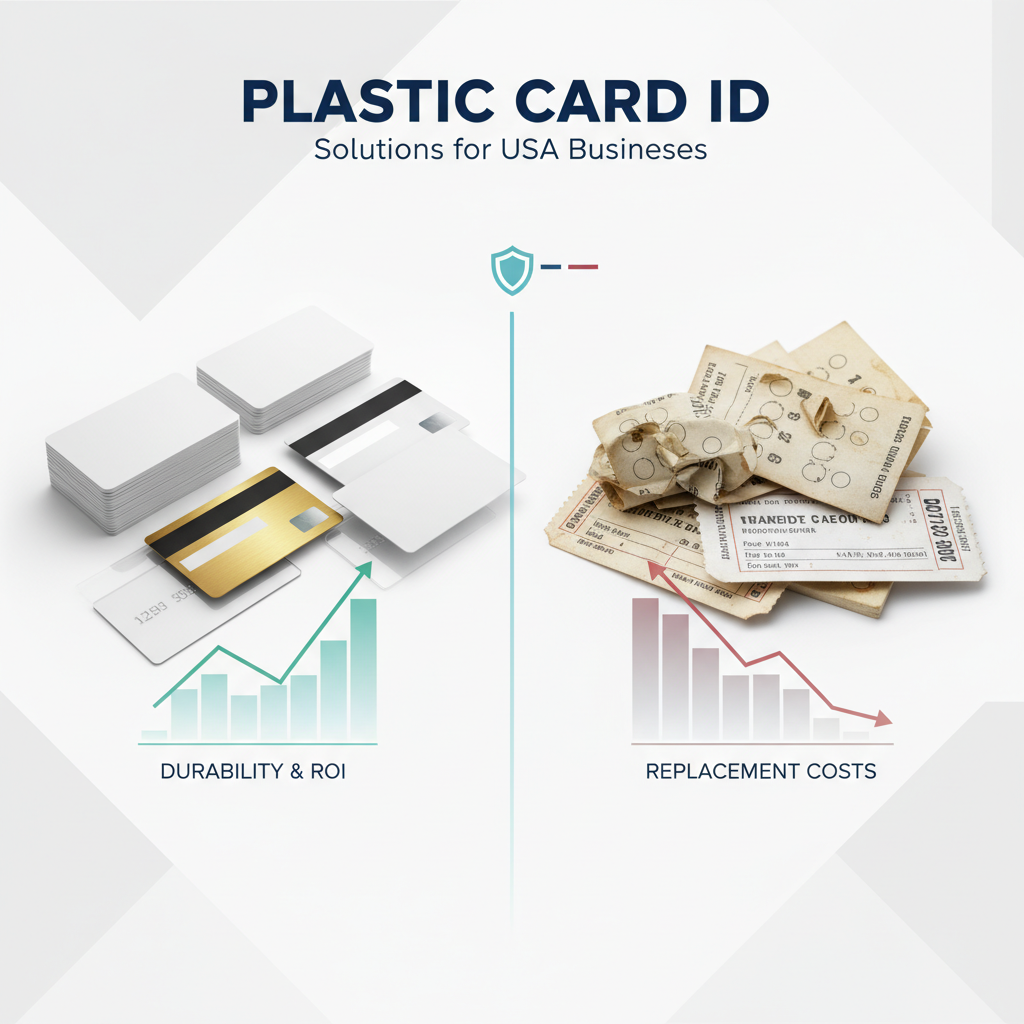 Talking about durability is one thing. Talking about revenue impact is another. Retailers who have transitioned from paper gift certificates to plastic gift cards have documented sales increases of 35-50% in gift card program revenue - not because the dollar amounts changed, but because plastic cards are kept, reloaded, shared, and repurchased in ways that paper certificates never are.
That number is significant. A 35% lift in gift card revenue without changing the underlying product or price point is purely a function of the medium. The card itself drives the outcome. For businesses on the fence about the switch, that data point alone tends to close the argument.
Loyalty Programs: Wallet Presence Drives Redemption
A paper punch card sits loose in a pocket, gets forgotten in a drawer, or disintegrates in a wash cycle. A plastic loyalty card lives in a wallet alongside debit and credit cards, visible and accessible every time the wallet opens. That physical presence is a passive but powerful marketing tool. The card reminds the customer of your business multiple times per week without any additional marketing spend.
Studies of retail loyalty programs consistently show that plastic card holders redeem at higher rates and return more frequently than paper card holders. The durability of the medium directly correlates with the durability of the customer relationship. CPE has served over 100,000 U.S. businesses on exactly this foundation.
Membership and ID Cards: Signaling Legitimacy
When your organization issues a plastic membership card, it sends a clear signal: this membership is real, it has structure, and it is worth protecting. Paper membership documents read as temporary even when they are not. A laminated card in a plastic sleeve communicates permanence in a way that no paper format replicates.
For nonprofit organizations, gyms, clubs, professional associations, and healthcare providers issuing ID credentials, the professional appearance of a plastic card directly influences how members and patients perceive the organization's competence and stability. That perception effect carries real value - often more than any printed marketing material can generate.
Contact CPE to Talk Through Your Program ROI
Whether you are running a small local loyalty program or scaling a national membership initiative, the financial case for switching to blank plastic cards is well-supported. The team at Plastic Card ID can walk you through per-card costs, printer economics, and program design considerations that help you model the return before you commit to a purchase.
Reach out directly at 800.835.7919 to speak with a card program specialist who has worked through these decisions with thousands of U.S. businesses. The conversation is free; the clarity it provides is genuinely useful.
Specialty Plastic Cards: When Standard White Is Not Enough
The blank white CR80 is the workhorse - versatile, cost-effective, and universally supported. But it is not the only card in the catalog. Some programs demand a visual or functional upgrade that standard white PVC cannot deliver. That is where specialty card formats step in and where card programs can genuinely differentiate themselves.
Clear and frosted PVC cards create a premium aesthetic that positions a loyalty or membership program in a visually distinct tier. Custom die-cut shapes - non-rectangular cards in branded outlines - serve event marketing, promotional, and collectible applications. And at the absolute top of the perceived-value spectrum, luxury metal cards in stainless steel, brass, and gold carry a material weight that communicates exclusivity in a way no paper or standard plastic card can approximate.
Clear and Frosted Cards for Premium Programs
Clear plastic cards are transparent, allowing printed graphics and colors to read against whatever background they are held against. Frosted cards produce a matte, semi-opaque finish that photographs beautifully and feels premium in the hand. Both formats print cleanly on compatible card printers and are available in blank stock for in-house programs.
Spas, boutique hotels, high-end retail memberships, and VIP club programs have embraced clear and frosted formats precisely because the card itself communicates value before a single logo or word is printed on it. The medium carries the message.
Metal Cards for the Highest-Tier Programs
Stainless steel, brass, and gold metal cards are not mass-market products - they are statements. Issued to top-tier loyalty members, executive account holders, or premium event guests, a metal card creates a physical reaction that paper and standard plastic cannot generate. People pick them up differently. They notice the weight, the finish, the precision of the edges.
For businesses whose brand equity depends on conveying exclusivity and quality, metal cards are the logical ceiling of the card program spectrum. They are also extraordinarily durable - they do not crack, fade, or degrade under the conditions that destroy lesser materials over time.
Hotel Keys, Casino Cards, and Specialty Access Applications
Hotel key cards and casino player cards are highly specialized applications that require not just durable plastic stock but precise encoding to interact with proprietary reader systems. RFID hotel key cards must meet the electromagnetic specifications of the lock system installed in the property. Casino player cards must integrate with floor management software and survive continuous daily handling.
The catalog at Plastic Card ID includes RFID smart cards with contactless technology - including MIFARE DESFire formats - specifically suited to these demanding environments. These are not generic cards; they are sourced and specified to perform in the exact use cases they serve.
Buyer's Guide: Choosing the Right Blank Plastic Card for Your Use Case
Choosing the right blank card stock is not complicated once you understand the variables. The wrong choice costs money not through the per-card price but through program failures - cards that do not encode properly, readers that do not recognize the right chip frequency, or printers that jam on incompatible stock thickness. Getting this right upfront saves real operational pain.
The following framework covers the key decision points most U.S. businesses face when setting up or expanding a card program. It is not exhaustive - every program has nuances - but it covers the majority of real-world use cases confidently.
Key Questions to Answer Before Ordering
- Will the card need to be encoded? If yes, determine whether magnetic stripe, proximity, RFID, or smart chip technology is required by your reader hardware.
- What printer will you use? Confirm the printer accepts CR80 30 mil stock and the card type you intend to order - some printers handle chip cards differently than plain stock.
- How many cards do you need monthly? Volume determines whether bulk blank stock or smaller repeat orders make more economic sense.
- Will cards be printed in-house or externally? In-house printing requires a compatible desktop printer and ribbon supply; external printing shifts that responsibility to the vendor.
- What visual or material finish do you need? Standard white, colored, clear, frosted, or specialty material - each serves different brand positioning goals.
- Are replacement cards likely to be frequent? High-turnover programs (events, short-term memberships) may favor lower-cost blank stock; long-term programs can justify specialty formats.
What CPE Carries in the Card Catalog
The full lineup covers: plain white CR80 PVC cards in bulk quantities, magnetic stripe cards in both HiCo (4000 Oe) and LoCo (300 Oe) variants, proximity access cards at 125kHz, RFID smart cards at 13.56MHz including MIFARE formats, clear PVC, frosted PVC, colored card stock in multiple base colors, and custom die-cut formats.
Card printers from Evolis, Zebra, and Fargo are stocked alongside matching ribbons, cleaning kits, card carrier envelopes, and card sleeves. For programs that need cards mailed to members or cardholders, card affixing and mailing services are available - making Plastic Card ID a genuine single-source solution.
Pricing Expectations and Volume Economics
Blank PVC card pricing scales favorably with volume. Small starter orders of a few hundred cards are readily available, typically in the range of a few cents per card at volume. Specialty cards - magnetic stripe, RFID, smart chip, metal - carry higher per-unit costs reflecting the embedded technology. Card printers range from entry-level desktop models at around $300-$600 to high-throughput professional units at $1,500-$4,000 or more depending on capability.
The total program cost calculation should account for: card stock, printer amortization, ribbon and supply cost per card, and any mailing or fulfillment costs. Across all those inputs, plastic card programs consistently show lower 24-month total cost of ownership than paper-based alternatives once replacement frequency is properly factored in.
Why Plastic Card ID Is the Strategic Partner Your Card Program Deserves
There is a meaningful difference between a supplier who ships cards and a partner who understands card programs. Over more than 25 years and more than 100,000 U.S. business relationships, Plastic Card ID has built its operation around the latter model. The catalog is deep, the experience is genuine, and the support is direct - no call center scripts, no overseas routing.
Whether you are running 50 cards a month for a local gym membership program or managing tens of thousands of cards for a regional retail chain, the team at CPE has seen the use case, worked through the specification questions, and helped comparable organizations build card programs that perform. That accumulated expertise is a real differentiator that no commodity card supplier can replicate.
A Full-Service Program from Cards to Delivery
The catalog does not stop at card stock. Printer ribbons in YMCKO, monochrome, and specialty configurations keep in-house printers running cleanly. Cleaning kits protect printer heads and card transport mechanisms from particulate buildup - extending printer life and print quality simultaneously. Card carrier envelopes and sleeves present finished cards professionally for mailing or in-person issuance.
Card affixing and mailing services handle the fulfillment side of card programs entirely - useful for organizations without the in-house staff or equipment to manage volume card distribution. From blank stock to issued credential, Plastic Card ID can cover the entire chain.
Built for U.S. Businesses Across Every Industry
The customer base spans an enormous range: retail chains running gift and loyalty programs, healthcare organizations issuing patient and staff ID cards, universities managing student and access credentials, hotels encoding key cards, casinos managing player tracking systems, fitness clubs running membership programs, associations issuing professional credentials, and event organizers building attendee badge systems.
Every one of those industries depends on cards that work reliably, look professional, and last. Paper alternatives have been tried and abandoned across all of them. The migration to plastic is not a trend - it is a settled conclusion drawn from real operational experience across hundreds of thousands of programs.
Speak Directly With a Card Program Specialist
The best way to navigate blank card selection, printer compatibility, encoding specifications, and volume pricing is to speak with someone who has worked through those questions before. The team at Plastic Card ID is accessible, knowledgeable, and focused on helping you get the program right - not just fulfilling a transaction.
When the decision you make today will drive your card program for the next several years, talking it through with an experienced partner is worth the five-minute phone call. Call 800.835.7919 and get the answers your program needs from people who have delivered over 50 million cards across every major industry in the United States.
Ready to build a card program that outperforms paper in every measurable way? Plastic Card ID has the cards, the printers, the supplies, and the expertise to make it happen - call 800.835.7919 today.
Previous Page