Adding Logos and Photos to Blank Plastic Cards
Table of Contents []
- Turn Blank Plastic Cards Into Branded Powerhouses With Plastic Card ID
- The Technical Side of Adding Logos and Photos to Plastic Cards
- Building a Card Program Around Branded Plastic Cards
- Choosing the Right Card Printer for Photo and Logo Output
- Specialty Card Options for Advanced Branding Needs
- Frequently Asked Questions: Logos, Photos, and Blank Plastic Cards
- Partner With Plastic Card ID for Every Card Your Program Needs
Turn Blank Plastic Cards Into Branded Powerhouses With Plastic Card ID
There is something quietly powerful about a plastic card handed over a counter - the weight of it, the snap of color, the clarity of a well-placed logo. Blank CR80 plastic cards are not raw materials waiting for purpose; they are canvases waiting for identity. When your business adds a logo, a photograph, a color palette, or even a custom die-cut shape, something shifts. A generic card becomes a credential, a marketing tool, a membership badge, a proof of belonging.
Whether you are running a gym with 200 members, a hotel chain issuing key cards at scale, or a school district that needs photo ID badges for every staff member, the journey begins with the same foundation: a high-quality blank plastic card and the right approach to customizing it. CPE has spent over 25 years helping organizations across the United States answer exactly that challenge - and the results speak for themselves, including measurable sales lifts for retailers and recognition boosts for loyalty programs of every size.
This guide digs into the practical realities of adding logos and photos to blank plastic cards: what methods exist, which card types support which customization options, and how to choose a path that fits your volume, budget, and brand standards.
What Blank Cards Actually Offer - And Why That Matters
A blank CR80 card (30 mil thick, conforming to ISO 7810 standards) gives your organization something invaluable: total design control at a lower per-card cost over time. You are not locked into a vendor's design cycle or minimum order commitments for pre-printed stock. When your logo updates or your branding refreshes, you adapt immediately with your in-house printer rather than waiting for a new production run.
Blank cards are also extraordinarily versatile. The same white PVC card becomes an employee ID badge when paired with a photo and a barcode, transforms into a loyalty card when printed with your rewards program artwork, or functions as an event credential when encoded with access data. That single SKU, stocked in quantity, supports multiple programs simultaneously - a genuine operational advantage for larger organizations managing several card programs at once.
The practical upshot is that blank cards pair beautifully with on-site card printers from brands like Evolis, Zebra, and Fargo - printers that CPE supplies alongside its card catalog. Print what you need, when you need it, and add logos and photos in-house with full quality control.
Types of Blank Cards That Support Logo and Photo Printing
Not every blank card is identical in its printing potential. Standard white PVC cards accept dye-sublimation printing exceptionally well, producing sharp logos and vibrant photographic images with smooth gradations and accurate color reproduction. These are the workhorses of most ID, membership, and loyalty programs, and they represent the bulk of what CPE ships to its 100,000 customers across the United States.
Beyond standard white, there are specialty blank options worth knowing about. Clear and frosted plastic cards create a striking visual effect - logos and photos printed on clear stock seem to float, catching light in ways that standard cards never achieve. Colored stock cards (blue, red, green, and more) offer a pre-built visual identity that reduces ink coverage requirements while still accepting full-color logo and photo overlays. Each of these substrates interacts differently with printing technology, so matching card type to printer capability is an important early decision.
Understanding the Difference Between Pre-Printed and In-House Printed Cards
There are two broad paths to getting logos and photos onto plastic cards: ordering custom-printed cards from a professional card production facility, or printing them in-house using a dedicated card printer. Each has genuine advantages, and the right answer depends on your volume, timeline requirements, and how frequently your card design changes.
Professional pre-printing delivers offset or digital print quality that is extremely difficult to match with desktop card printers - useful when brand precision is paramount and the design is unlikely to change. In-house printing, by contrast, gives you the ability to personalize every single card differently, adding unique photos, names, barcodes, or magnetic stripe data in a single pass. For ID badges and photo ID cards specifically, in-house printing is not just convenient - it is often the only practical option.
The Technical Side of Adding Logos and Photos to Plastic Cards
Understanding how logos and photos actually end up on a plastic card surface clarifies many decisions that would otherwise feel arbitrary. The dominant technology for full-color card printing is dye-sublimation, used by Evolis, Zebra, and Fargo card printers - the three primary printer brands that CPE carries. In dye-sublimation, heat-sensitive dye is transferred from a ribbon onto the card surface in ultra-fine gradations, producing photo-realistic images with continuous tones rather than the dot patterns associated with standard inkjet or laser printing.
This matters enormously when adding photographs to cards. A staff photo on an employee badge, a member portrait on a club card, or a headshot on a casino player card - all of these demand the smooth tonal range that dye-sublimation delivers. Logos printed this way also benefit: gradients, drop shadows, and detailed brand marks reproduce accurately rather than breaking down into visible artifacts.
Printer Ribbons and Their Role in Logo Quality
The ribbon is the unsung variable in card print quality. YMCKO ribbons - Yellow, Magenta, Cyan, black resin, and Overlay - are the standard choice for full-color printing with a protective overlay coating. The overlay panel is particularly important for card longevity: it seals the printed image, protecting logos and photos from fading, scratching, and UV degradation over the card's operational life.
For cards where only the back needs color or where security features like black text and barcodes are the priority, half-panel ribbons (YMCKO-K or similar configurations) reduce per-card ribbon cost without sacrificing quality on the panels that matter. CPE stocks a full range of compatible ribbons for Evolis, Zebra, and Fargo printers - a logistical convenience that keeps your card program running without sourcing delays from multiple vendors.
Resolution, File Formats, and Logo Preparation
Before any logo or photo reaches a blank card, it passes through design software and then a printer driver. Resolution is the first technical checkpoint. For card printing at CR80 size (3.375 x 2.125 inches), logos and photos should be prepared at a minimum of 300 DPI - and 600 DPI is preferable for fine detail in brand marks, small text, or facial photographs used for identification purposes.
File formats carry meaningful implications. Vector files (AI, EPS, SVG) for logos scale without quality loss and are ideal for any logo application. Raster photos (JPG, PNG, TIFF) need to be high-resolution originals - a low-resolution web image scaled up for card printing produces blurry, unprofessional results. Preparing artwork correctly before you print is the single highest-return investment you can make in card quality.
Encoding Features That Work Alongside Logo Printing
Adding a logo or photo does not preclude adding functional data encoding to the same card. Magnetic stripe cards - available in both HiCo (high coercivity, more durable) and LoCo (low coercivity) configurations from CPE - can be simultaneously encoded and printed in a single pass by capable card printers. The magnetic stripe runs on the back while your logo, member photo, and card number appear on the front.
Similarly, RFID and proximity cards can be printed with full-color logos and photos using appropriate card printers equipped with RFID encoding modules. Smart chip cards, including those using MIFARE DESFire contactless technology, support printed overlays as well - meaning your access card or casino player card carries both functional chip data and your branded visual identity without compromise. This combination of form and function is where plastic cards genuinely outperform every paper alternative.
| Card Type | Full-Color Logo Printing | Photo ID Printing | Encoding Option |
|---|---|---|---|
| Standard White PVC | Excellent | Excellent | Magnetic Stripe, RFID |
| Clear / Frosted PVC | Very Good | Good | Magnetic Stripe |
| Colored Stock PVC | Good | Moderate | Magnetic Stripe |
| RFID / Proximity Cards | Excellent | Excellent | Contactless RFID |
| Smart Chip Cards | Excellent | Excellent | Contact / Contactless Chip |
| Metal Cards | Laser Engraved | Limited | None Standard |
Building a Card Program Around Branded Plastic Cards
Starting a card program feels daunting until you break it into its component decisions. Volume is the first. Organizations printing 50-200 cards per month operate in a completely different mode than those pushing out 5,000-20,000 cards across a multi-location enterprise. Both are valid, and CPE has built its catalog and support model specifically to serve both - which explains why its customer base spans everything from single-location fitness studios to national retail chains.
The second decision is design ownership. Do you want your staff to print and personalize cards on-demand using an in-house printer? Or does the program call for a fixed design where every card looks identical, produced in a batch? The answer shapes which card types you purchase, which printer (if any) you need, and how you structure your ongoing supply relationship. There is no universally correct answer - only the answer that fits your operational reality.
Employee ID and Photo Badge Programs
Employee ID card programs are among the most common deployments of blank plastic cards with added photos and logos. A typical setup involves a card printer, a supply of blank white PVC cards, a YMCKO ribbon, and card design software - all of which CPE can supply. The HR or security administrator photographs each employee, enters their name and department, and the printer produces a finished, laminated-quality card in under a minute per card.
What separates a professional employee badge from a printed paper card is not just appearance - it is durability and function. A plastic employee ID card survives years of daily use, clipping to a lanyard, sliding through a reader, and riding around in a wallet without degrading. Add a magnetic stripe or proximity chip and the same card that displays the employee's photo also grants or restricts building access. The logo visible on the front is not decorative; it is an assertion of organizational identity.
Call 800.835.7919 to discuss setting up an employee ID card program - whether you need 50 cards or 5,000, the team at CPE will help match you to the right card stock, printer, and ribbon combination from the first conversation.
Loyalty and Membership Card Programs With Brand Photography
Retailers who switch from paper punch cards to plastic loyalty cards with their logo and brand photography consistently report significant program engagement increases. The data behind this is not subtle - retailers making the switch from paper to plastic gift and loyalty cards have seen sales increases of 35-50%. The physical card in a customer's wallet is a persistent brand impression. It prompts return visits and communicates program seriousness in a way that a paper card simply cannot sustain.
Membership cards for gyms, clubs, associations, and professional organizations benefit similarly. A card bearing the organization's logo, the member's name, and potentially a membership tier indicator tells the member something important: this organization takes its program seriously, and by extension, the membership has real value. That psychological signal drives retention in ways that are difficult to quantify but easy to observe in renewal rates and referral behavior.
Event and Access Credentials
Event credentials have evolved significantly. Where laminated paper badges once sufficed, many conferences, trade shows, entertainment venues, and corporate events now issue plastic cards - complete with event logos, sponsor branding, attendee photos, and barcode or magnetic stripe access data. The card does double duty as both identification and an access control token, reducing fraud and streamlining gate management.
For recurring events - annual conferences, seasonal festivals, multi-day conventions - the investment in card stock and a printer pays back quickly across multiple event cycles. CPE works with event organizers at all scales, from intimate 100-person corporate gatherings to large-scale productions requiring thousands of branded credentials on tight timelines.
Choosing the Right Card Printer for Photo and Logo Output
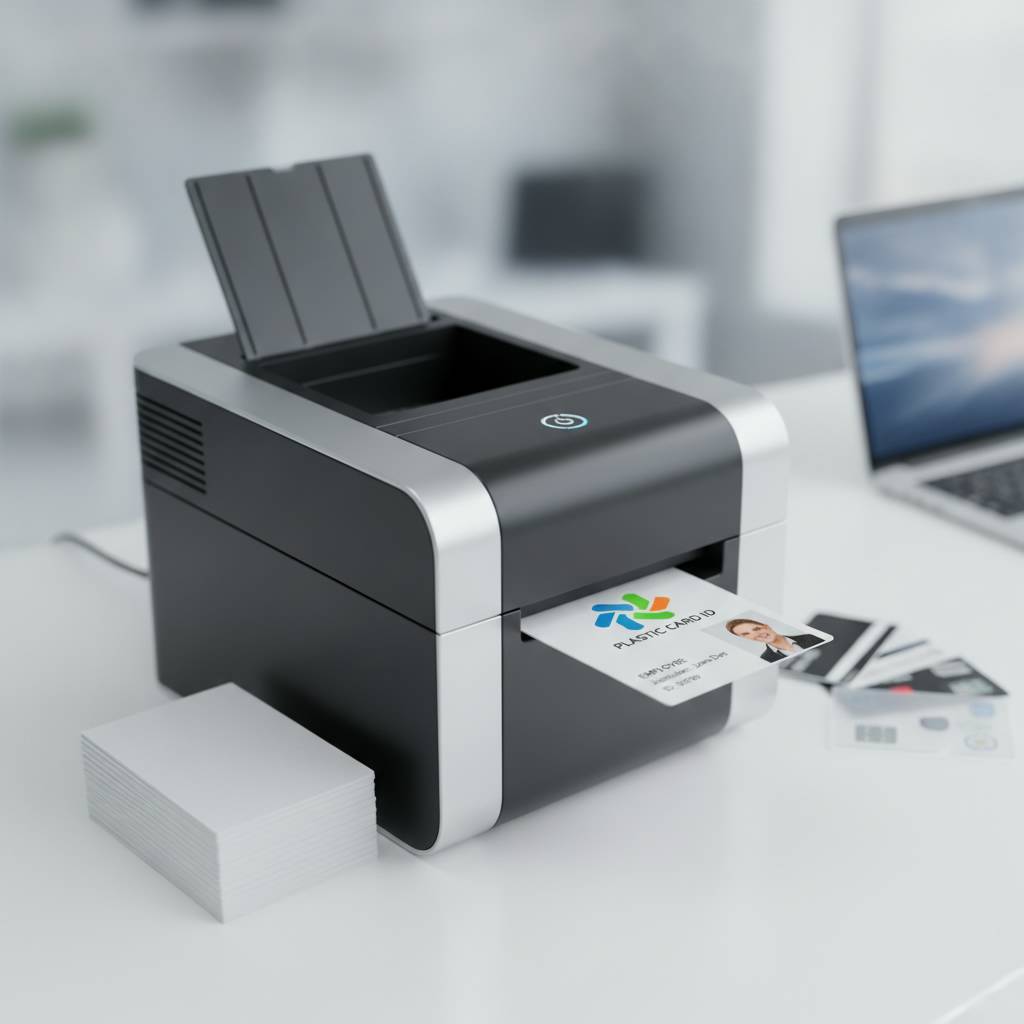 The printer is the production engine of your card program. Choose well and it will serve you reliably for years; choose poorly and you will fight quality problems and supply chain headaches from the start. The three manufacturer families that CPE carries - Evolis, Zebra, and Fargo - each have distinct strengths worth understanding before you commit to a platform.
Entry-level single-sided printers from these brands typically handle volumes up to 500 cards per day with excellent logo and photo quality. Step up to dual-sided models and you gain the ability to print front and back in a single pass - critical for cards that display a logo and member photo on the front while placing barcodes, terms, or magnetic stripe data indicators on the reverse. High-volume retransfer printers, like Fargo's HDP series, print onto a transfer film first and then laminate it to the card, producing edge-to-edge color with extraordinary durability.
Evolis Printers for Logo and Photo Card Applications
Evolis printers are widely regarded for their combination of compact footprint and reliable print quality. The Primacy 2 and Avansia lines handle full-color YMCKO printing with consistent results, making them popular choices for membership programs, employee ID systems, and loyalty card production. The card hopper and output tray configurations are thoughtfully designed for uninterrupted batch printing - a detail that matters when you are running a large event credential job under time pressure.
Evolis printers pair particularly well with standard white PVC blank cards, though they also perform admirably on frosted and clear substrates when print settings are properly calibrated. CPE stocks Evolis-compatible ribbons and cleaning kits, ensuring that your supply chain for the printer and the cards runs through a single, reliable source.
Zebra Printers for High-Volume Branded Card Production
Zebra's card printer lineup - including the ZC series - occupies a strong position in mid-to-high volume applications where throughput and total cost of ownership both matter. Zebra printers are known for their network connectivity options and software compatibility, making them straightforward to integrate into existing IT infrastructure for enterprise employee badge programs or multi-location retail loyalty card issuance.
The ZC300 and ZC500 models handle full-color photo printing alongside magnetic stripe encoding in a single pass - a significant operational efficiency when personalized cards need to go out at scale. For organizations managing card programs across multiple departments or locations, Zebra's centralized management capabilities add meaningful administrative value beyond print quality alone.
Fargo Printers for Premium and High-Security Card Output
Fargo printers anchor the premium end of the card printing market, particularly for applications where card security and print permanence are top priorities. Fargo's HDP retransfer technology prints the image onto a clear transfer film before bonding it to the card surface - the result is edge-to-edge printing without the white border typical of direct-to-card printers, and a surface hardness that resists scratching far better than standard dye-sublimation output.
For government-adjacent ID programs, high-security access cards, and casino player cards where card integrity directly supports fraud prevention, Fargo HDP printers are often the professional standard of choice. CPE carries Fargo printers and compatible supplies, and the team can walk you through the selection process to match printer capability to your specific program requirements.
Specialty Card Options for Advanced Branding Needs
Standard white PVC cards with a dye-sublimation logo and photo cover the majority of card program needs - but there is a tier above standard that some organizations find genuinely worth the investment. When the card itself is a brand statement, specialty options open up creative and functional possibilities that standard stock cannot match.
Clear plastic cards with printed logos create a visual impression that is difficult to overstate in person. The transparency of the card body, combined with the opacity of the printed logo and any solid color blocks, produces a layered effect that looks designed and intentional. Frosted variants soften this to a matte sophistication. For premium retail gift card programs, VIP membership tiers, or executive badge programs, these materials signal premium status before the cardholder reads a single word.
Metal Cards for Luxury and Executive Applications
Stainless steel, brass, and gold metal cards represent the absolute top tier of card program materials. These cards are not printed in the traditional sense - logos and design elements are laser-engraved or etched into the metal surface, producing an indelible, tactile impression that no dye-sublimation output can replicate. The weight of a metal card in hand communicates value instantly and unmistakably.
Metal cards are used for ultra-premium loyalty programs, executive membership clubs, VIP access credentials, and high-end hospitality applications. They last essentially indefinitely under normal use conditions. If your program's goal is to make card recipients feel that holding the card is itself an experience, metal cards deliver that outcome with no ambiguity.
Custom Die-Cut Shapes and Casino Player Cards
Standard CR80 format covers most needs, but custom die-cut shapes - cards trimmed to match a product silhouette, a brand mascot, or a unique geometric identity - create memorability that standard rectangles simply cannot. Die-cut cards require custom production runs and have minimum order considerations, but for product launches, trade show promotions, or high-stakes loyalty programs, the differentiation is significant.
Casino player cards represent a specialized application where photo printing, logo placement, and functional encoding (magnetic stripe or RFID chip) must all coexist on a card that also withstands the physical demands of heavy daily use. CPE supplies casino player card solutions across this full spectrum, from the card stock through the encoding specification and beyond.
Frequently Asked Questions: Logos, Photos, and Blank Plastic Cards
After 25 years and more than 50 million cards shipped to organizations across the United States, certain questions surface reliably. These are the ones worth answering directly, without the runaround.
What File Types Should I Use for My Logo?
Vector files - AI, EPS, or SVG - are the ideal format for logos on plastic cards. Unlike raster images, vector files are resolution-independent, meaning your logo will print sharply at any size without pixelation or edge roughness. If you only have a raster logo (JPG or PNG), ensure it is at least 300 DPI at the actual print size before using it in card design software.
For photographs intended for ID card use, high-resolution JPG files captured in good lighting conditions produce the best results. A minimum of 300 DPI at card size is the standard, but photos captured by modern smartphones in good lighting generally meet this threshold without additional processing.
How Many Cards Should I Order to Start?
This depends almost entirely on your program type and printing setup. Organizations using in-house printers generally order blank cards in quantities of 500-5,000 at a time, balancing per-card cost savings from larger quantities against storage and cash flow considerations. Programs that pre-print full batches with a fixed design often order 1,000-10,000 cards per run, depending on monthly distribution volume.
- Small programs (under 200 members or employees): start with 500-1,000 blank cards and a desktop card printer
- Mid-size programs (200-1,000 cards/month): 2,500-5,000 card stock quantities, mid-range card printer
- High-volume programs (1,000 cards/month): 10,000 card quantities, high-throughput printer with encoding capability
- Variable personalization programs (every card unique): in-house printing is essential regardless of total volume
- Fixed-design batch programs: professional pre-printing may offer cost advantages at volumes above 5,000 cards
Can I Add Both a Photo and a Magnetic Stripe to the Same Card?
Yes - and this combination is extremely common. Employee ID badges, loyalty cards with member tracking, hotel key cards, and casino player cards all routinely combine full-color photo printing on the front with magnetic stripe data encoding on the back. The key is choosing a card printer that includes a magnetic stripe encoding module, which many mid-range and above card printers from Evolis, Zebra, and Fargo support natively.
HiCo magnetic stripes are recommended for cards that will be used in readers frequently or stored near other magnetic sources - their higher coercivity means they retain encoded data more reliably under real-world conditions. LoCo stripes are appropriate for lower-use applications like hotel key cards where periodic re-encoding is standard practice anyway. CPE supplies both HiCo and LoCo magnetic stripe cards in standard blank format, ready for in-house printing and encoding.
Partner With Plastic Card ID for Every Card Your Program Needs
There is a meaningful difference between buying cards from a catalog and working with a partner who understands how card programs actually function in the field. Plastic Card ID has built that partnership with more than 100,000 customers across the United States over 25 years - organizations ranging from single-location retail shops to multi-state enterprises, from small nonprofits issuing membership cards to large hospitality groups managing hotel key card programs at scale.
The catalog covers every card type discussed in this guide: standard white PVC blank cards, colored stock, clear and frosted options, HiCo and LoCo magnetic stripe cards, RFID and proximity cards, smart chip cards, and luxury metal options in stainless steel, brass, and gold. Card printers from Evolis, Zebra, and Fargo ship alongside compatible ribbons and cleaning kits. Card carriers, sleeves, and card affixing and mailing services round out a genuinely comprehensive one-stop supply model - because a program interrupted by a missing supply is a program that loses momentum at the worst possible moment.
Value-Added Services That Keep Your Program Running
Beyond the cards and printers themselves, CPE supports programs with the supplies and services that make daily operations smooth. Printer ribbons in every configuration - YMCKO, monochrome, half-panel - ship quickly to keep production lines moving. Cleaning kits extend printer life and protect print head quality, which directly protects the crispness of your logos and photos over time. Card carriers and protective sleeves give finished cards a professional presentation that reinforces brand quality at the moment of delivery.
For organizations that need finished cards mailed directly to cardholders - loyalty program members, remote employees, or membership renewal recipients - CPE offers card affixing and mailing services that remove the logistics burden entirely. Your card program runs smoother when a single partner handles everything from the blank card to the cardholder's mailbox.
Getting Started Is Straightforward
Starting a new card program, upgrading an existing one, or simply sourcing the blank cards your in-house printer needs - none of these require complex procurement processes or long lead times. CPE is structured to serve organizations at every stage of that journey, with knowledgeable staff who understand card technology, printing specifications, and program logistics from genuine experience.
Reach out to the team at 800.835.7919 with your program details - card type, approximate volume, encoding requirements, and any questions about logos and photo printing - and expect a direct, useful conversation rather than a sales script. The goal from the first call is finding the right solution for your specific program, not selling you equipment or stock you do not need.
Your brand deserves to live on a card that people hold onto. Call Plastic Card ID at 800.835.7919 and start building the card program your organization has been ready for.
Previous Page