Things to Know Before Buying Blank Plastic Cards
Table of Contents []
- What Smart Buyers Know Before Ordering Blank Plastic Cards from Plastic Card ID
- Magnetic Stripe Cards: HiCo vs. LoCo and Why It Actually Matters
- RFID and Smart Card Technology: What You Need to Confirm Before Ordering
- Card Printers: Why Your Blank Card Order and Your Printer Must Match
- Specialty Cards: Clear, Colored, Metal, and Custom Die-Cut Options
- Buyer Tips: What to Confirm Before You Place Your Blank Card Order
- Partner with Plastic Card ID for Your Blank Plastic Card Program
What Smart Buyers Know Before Ordering Blank Plastic Cards from Plastic Card ID
Most people assume buying blank plastic cards is straightforward - pick a quantity, pay, done. But experienced card program managers know there are real decisions hiding underneath that simple surface. Card thickness, magnetic stripe coercivity, encoding compatibility, even the finish on the card face - each one can make or break how well your program actually performs in the field.
Whether you are launching a brand-new loyalty program, upgrading a clunky paper punch card system, or scaling a high-volume employee badge operation, what you know before you buy determines whether your investment pays off. This guide covers everything worth knowing - from card specs to printer compatibility - so your first order (or your fiftieth) lands exactly right.
The Difference Between "Blank" and Ready-to-Print
A blank CR80 PVC card is not an empty placeholder. It is a precisely manufactured product conforming to ISO 7810 standards - 3.375 x 2.125 inches, 30 mil thick - designed to pass through professional card printers, encode onto magnetic stripes, or function as a proximity token straight out of the box. The "blank" refers to the print surface, not the functionality.
That distinction matters enormously when you are ordering. A blank card might already carry a HiCo magnetic stripe, an embedded RFID chip, or a smart card contact pad - all before a single design gets printed onto it. Choosing the wrong base card for your printer or encoder wastes money and time on reprints and replacements.
CR80 Is the Standard - But Not the Only Option
CR80 is the card size everyone recognizes because it matches a standard credit card. It fits wallets, badge holders, card sleeves, and virtually every desktop card printer on the market. For most businesses, CR80 at 30 mil thickness is the right call - durable enough for daily handling, thin enough to stack and store efficiently.
That said, CPE carries specialty formats too. Need a custom die-cut shape for a memorable promotional card? A clear or frosted card for a premium membership look? A thicker card stock for a luxury feel? These are real options, and knowing they exist before you lock in your order could change your entire approach to card design and distribution.
How Quantity Tiers Affect Your Per-Card Cost
Blank plastic cards are priced on volume. A small order of 50-100 cards will cost more per card than a run of 5,000 - that is standard across the industry. But the break-even math is worth running carefully. Organizations that print cards in-house consistently see lower per-card costs over time than those relying on fully pre-printed cards from external vendors.
The sweet spot for most small-to-medium programs is ordering blank cards in quantities that match 3-6 months of anticipated usage. Over-ordering ties up budget; under-ordering means repeat shipping costs eat into savings. CPE works with clients running programs of 50 cards a month all the way up to tens of thousands - the pricing structure scales accordingly.
| Card Type | Common Use Cases | Key Spec to Confirm |
|---|---|---|
| Blank PVC CR80 | Employee ID, event badge, membership | 30 mil thickness, gloss or matte finish |
| HiCo Magnetic Stripe | Gift cards, loyalty cards, hotel keys | 2750 Oe coercivity, track configuration |
| LoCo Magnetic Stripe | Short-term access, event passes | 300 Oe coercivity, lower data retention |
| RFID / Proximity | Access control, contactless loyalty | Frequency (125kHz or 13.56MHz), protocol |
| Smart Chip (Contact) | Secure ID, stored value programs | Chip type, contact pad configuration |
| Clear / Frosted PVC | Premium membership, VIP programs | Printability, ink adhesion compatibility |
Magnetic Stripe Cards: HiCo vs. LoCo and Why It Actually Matters
Here is where a lot of first-time buyers stumble. Magnetic stripe cards come in two coercivity ratings - High Coercivity (HiCo) and Low Coercivity (LoCo) - and choosing the wrong one for your application can mean data loss, reader errors, or cards that demagnetize in someone's back pocket sitting next to their phone.
HiCo cards hold data more reliably under real-world conditions and are the standard choice for most business card programs. LoCo cards are less expensive and sufficient for short-term or low-wear applications. Understanding the difference before your first order saves you from an expensive mistake that only shows up weeks into your program.
HiCo Magnetic Stripe: The Workhorse for Serious Programs
High Coercivity magnetic stripe cards operate at 2750 Oersteds, meaning they resist demagnetization far better than their LoCo counterparts. Gift card programs, hotel key systems, loyalty cards, and employee access badges are all strong candidates for HiCo cards. A card that lives in a wallet next to other cards, keys, and phones needs HiCo durability to stay reliably readable over months of daily use.
The black stripe you see on most business cards is typically HiCo. The brown stripe indicates LoCo. It sounds like a small detail - it is not. Retailers who have switched from paper gift certificates to HiCo magnetic stripe plastic cards have documented sales increases of 35-50%, in large part because the card simply works every time, scan after scan, month after month.
LoCo Magnetic Stripe: When It Makes Sense
LoCo cards at 300 Oe are perfectly appropriate for certain applications - short-term event credentials, temporary visitor passes, or single-use discount cards distributed at trade shows. The lower coercivity means data is easier and cheaper to encode, which can matter at high volumes for limited-use scenarios.
The risk with LoCo in long-term applications is real. A card stored near a magnetic clasp or another card's stripe can lose data. For anything your customers or employees will carry and use repeatedly, LoCo is a gamble. CPE can help you match the right coercivity to the right application before you commit to a quantity.
Track Configuration: Tracks 1, 2, and 3
Magnetic stripes can hold data on up to three tracks. Track 1 holds alphanumeric data (names, account numbers). Track 2 is the most commonly used track for machine-readable numeric data. Track 3 is less standard. Most business applications write to Track 1 and 2; your point-of-sale or access control system should dictate which tracks you need encoded.
Ordering blank magnetic stripe cards without confirming track compatibility with your reader hardware is one of the more common - and preventable - mistakes in card program setup. Confirming your track configuration upfront with CPE takes minutes and prevents costly misprints and re-orders. Reach out to Plastic Card ID at 800.835.7919 to verify compatibility before placing your order.
RFID and Smart Card Technology: What You Need to Confirm Before Ordering
Contactless cards are no longer a niche technology. Access control systems in office buildings, hotels, universities, and healthcare facilities increasingly rely on RFID and proximity cards that communicate with readers without physical contact. If your building's access control infrastructure is already installed, your card order must match it precisely - frequency, protocol, chip type, and all.
The category is broader than most buyers initially realize. There is a meaningful difference between a 125kHz proximity card (the older, simpler standard) and a 13.56MHz MIFARE DESFire card with encrypted memory sectors. Buying the wrong frequency means your cards simply will not work with your readers - and there is no workaround short of replacing the cards or the readers.
125kHz Proximity Cards: The Legacy Standard
Proximity cards operating at 125kHz are the access control workhorses of the last two decades. They are read-only, carrying a fixed ID number that your access control system either recognizes or does not. They are robust, inexpensive, and compatible with a vast installed base of readers. If your facility runs an older HID-compatible system, 125kHz is almost certainly your card format.
One important note for new buyers: proximity cards can look identical to regular blank PVC cards. The antenna and chip are embedded invisibly inside the card body. Always confirm the chip type and facility code requirements with your access control system vendor before ordering. CPE stocks a range of proximity cards and can advise on compatibility.
13.56MHz Smart Cards and MIFARE Technology
Modern access control, casino player card systems, and high-security ID programs frequently use 13.56MHz contactless smart cards. Within this frequency, there are multiple protocols - MIFARE Classic, MIFARE DESFire, MIFARE Ultralight, ISO 15693, and others. Each has different security capabilities and memory configurations. MIFARE DESFire cards offer hardware encryption and sector-level access control that older proximity formats simply cannot match.
For organizations running casino player loyalty programs, hospital staff credentials, or university campus cards, DESFire is often the right choice. The upfront card cost is higher than basic proximity cards, but the security and flexibility of the platform justify the investment at scale. Knowing this before you specify your card type saves considerable back-and-forth during procurement.
Contact Smart Chip Cards: When the Chip Needs to Be Touched
Not all smart cards are contactless. Contact chip cards require physical insertion into a reader, with the gold contact pad on the card face making direct connection with the reader's pins. These are used in applications requiring high-security data read/write capabilities - secure employee credentials, stored value programs, and certain government or institutional ID systems.
The chip type, memory size, and contact pad configuration must all match your card management system. Ordering contact chip cards without this information is like ordering a key before you know which lock it needs to open. CPE carries multiple contact chip card configurations and can match you to the right spec for your system.
Card Printers: Why Your Blank Card Order and Your Printer Must Match
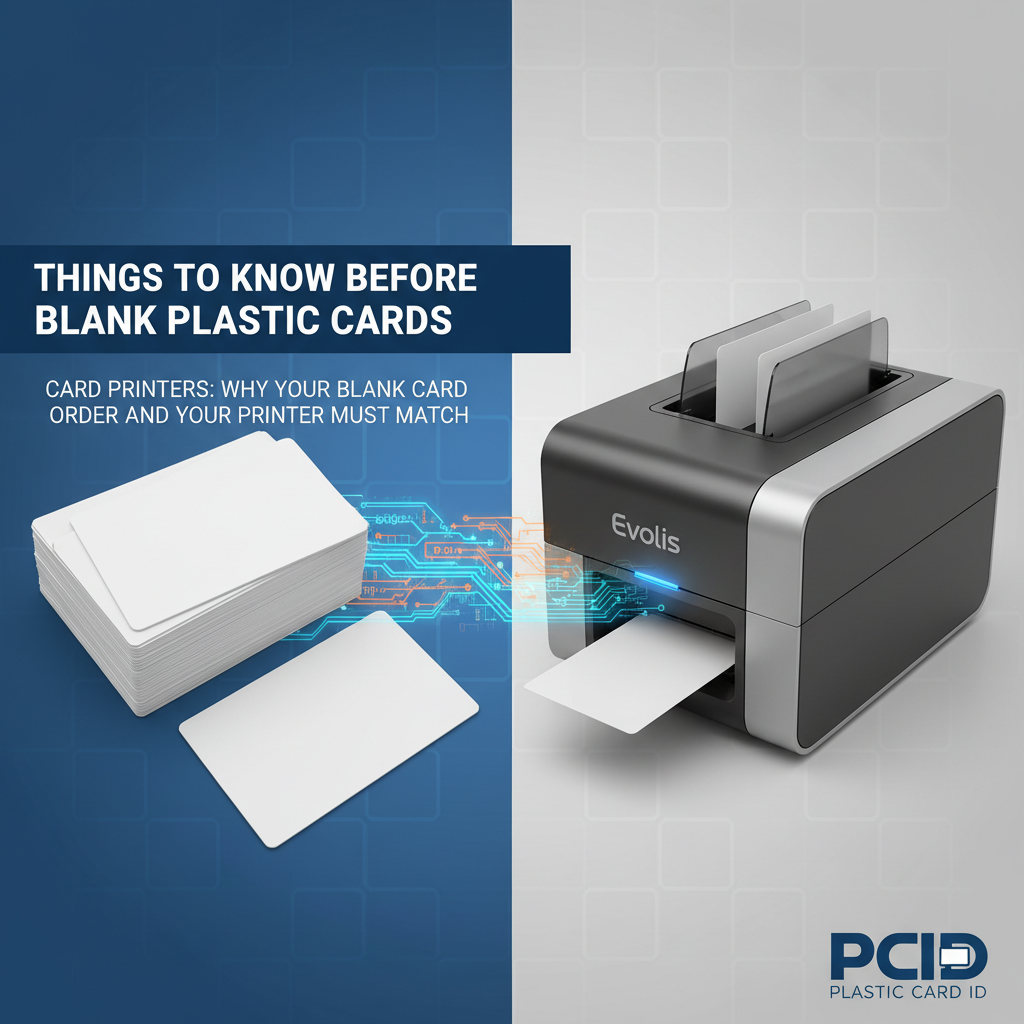 A blank plastic card and a card printer are not two separate decisions - they are one decision made together. The card stock you order must be compatible with your printer's specifications. Feed rollers, ribbon types, temperature profiles, and card thickness tolerances all vary between printer models. A card that works beautifully in one printer might jam, print unevenly, or damage ribbons in another.
Plastic Card ID supplies card printers from three of the industry's leading manufacturers - Evolis, Zebra, and Fargo - along with the ribbons, cleaning kits, and supplies needed to keep those printers running well. Buying your cards and your printer from the same source eliminates the compatibility guesswork entirely.
Evolis Printers: Compact Power for Mid-Volume Programs
Evolis printers are a popular choice for organizations printing 100-1,000 cards per month. Models like the Primacy and Zenius series are compact, reliable, and designed for ease of use without sacrificing output quality. They pair well with standard 30 mil PVC cards and produce clean, professional results with both YMCKO and monochrome ribbons.
Evolis printers support single and dual-sided printing, encoding options for magnetic stripe and smart card, and lamination modules for extended card durability. If your program is growing and you need a printer that can grow with it, Evolis is worth a serious look. CPE can advise on which Evolis model fits your volume and feature requirements.
Zebra and Fargo Printers for Higher Volume Demands
Zebra's ZC series and Fargo's HDP series are the go-to choices for organizations printing at higher volumes or requiring higher-security output. Fargo's HDP (High Definition Printing) technology prints onto a film that is then transferred to the card surface - producing sharper images and better edge-to-edge coverage than direct-to-card methods.
High-volume programs printing thousands of cards per month benefit from the throughput and reliability that Zebra and Fargo printers deliver. These printers also support inline encoding - printing and encoding a magnetic stripe or smart chip in a single pass - which is a significant efficiency gain at scale. Confirming ribbon compatibility and card spec before ordering is essential, and Plastic Card ID makes that process straightforward. Call 800.835.7919 to discuss your printer and card requirements together.
Ribbons, Cleaning Kits, and Supplies: Don't Overlook Them
Printer ribbons are consumables, and running out mid-job is a disruptive (and expensive) event for any card program. YMCKO ribbons for full-color printing, KO ribbons for monochrome with overlay, and specialized ribbons for lamination or encoding - each serves a different purpose and must match your specific printer model exactly.
Cleaning kits are not optional maintenance. Card printer manufacturers require regular cleaning cycles to maintain warranty coverage and ensure consistent print quality. Dust, debris, and residue from card surfaces accumulate inside the printer and degrade output over time. Ordering cleaning kits alongside your card stock is a small habit that prevents large repair bills.
Specialty Cards: Clear, Colored, Metal, and Custom Die-Cut Options
Not every program calls for a standard white CR80 card. Specialty card formats exist for good reason - premium membership programs, luxury hospitality brands, high-end retail gift card programs, and organizations that want their cards to make a tangible impression the moment they are handed over. The card itself is often the first physical touchpoint between your brand and your customer, and specialty formats make that moment count.
Plastic Card ID carries an impressive range of specialty options beyond the standard white PVC blank. Knowing what is available before you finalize your program design opens creative and strategic possibilities that a basic card catalog listing would not suggest.
Clear and Frosted Plastic Cards
Clear PVC cards have a striking visual effect - printing floats on a transparent surface, creating a modern, high-end look that white cards cannot replicate. Frosted cards offer a softer, matte-clear appearance that works beautifully for membership programs, VIP access cards, and premium loyalty programs where brand differentiation matters.
The key technical consideration with clear and frosted cards is ink adhesion. Not all card printers and ribbon combinations produce optimal results on clear stock. CPE can confirm compatibility with your printer model before you order specialty card stock, preventing the frustrating experience of discovering adhesion issues after the fact.
Colored Stock, Custom Die-Cut, and Metal Cards
Pre-colored card stock - black, gold, red, blue - eliminates the need to print a solid color background on every card, saving ribbon usage and print time. Custom die-cut shapes take physical differentiation a step further, creating cards in non-standard shapes for promotional campaigns, event credentials, or collector programs where novelty drives engagement.
At the premium end, Plastic Card ID offers metal cards in stainless steel, brass, and gold finishes. These are not gimmicks. A metal card communicates exclusivity and permanence in a way that even the finest printed PVC card cannot match. For high-net-worth client programs, executive membership tiers, or luxury retail gift card programs, metal cards are a genuine strategic differentiator worth the investment.
Casino Player Cards and Hotel Key Cards
Specialized applications like casino player loyalty programs and hotel room key systems have specific technical requirements that go beyond standard card specs. Casino player cards often combine magnetic stripe encoding with RFID for dual-read capability across different system touchpoints on the floor. Hotel key cards are typically LoCo or HiCo magnetic stripe, encoded at check-in, with a lifespan measured in days to weeks rather than months.
Both applications require cards that perform consistently under real-world conditions - handled frequently, swiped through readers dozens of times, carried in wallets alongside other cards. CPE has deep experience supplying both card types to hospitality and gaming clients across the United States, and can spec the right card for your system's requirements before your order is placed.
Buyer Tips: What to Confirm Before You Place Your Blank Card Order
Even experienced card program managers benefit from a pre-order checklist. The details that seem minor in the ordering process have a way of mattering enormously when cards are in the hands of employees or customers. A few minutes of verification before you order saves hours of troubleshooting after delivery.
The list below reflects the most common points of confusion that CPE encounters when helping new and returning clients place orders. Run through it before you finalize any blank card purchase.
Your Pre-Order Checklist for Blank Plastic Cards
- Card size and thickness: Confirm CR80 (standard) or specialty size; confirm 30 mil for most printers.
- Magnetic stripe requirement: Determine if you need a stripe, and whether HiCo or LoCo fits your application.
- Track configuration: Know which tracks your point-of-sale or access control system uses (1, 2, or 3).
- RFID or smart chip spec: Confirm frequency (125kHz or 13.56MHz), protocol (MIFARE variant), and chip type if applicable.
- Printer compatibility: Verify that your card stock is rated for your printer model and ribbon type.
- Finish preference: Gloss, matte, clear, frosted - each affects print quality and user perception differently.
- Quantity and reorder schedule: Match your order quantity to 3-6 months of anticipated usage to balance cost and storage.
- Accessories needed: Ribbons, cleaning kits, card carriers, sleeves, and affixing or mailing services should be ordered alongside your cards.
Ready to get your card program right from the start? Connect with Plastic Card ID before you order.
Card Carriers, Sleeves, and Mailing Services
A printed card without a delivery plan is only half the job done. Card carriers - the folded paper or card stock inserts that hold a plastic card for mailing - add professionalism to your distribution process and protect the card surface during transit. Sleeves provide ongoing protection for cards that will be stored or handled repeatedly before use.
Plastic Card ID offers card affixing and mailing services as part of its one-stop-shop value proposition. Rather than managing a separate fulfillment vendor, clients can have their printed cards attached to carriers and mailed directly to cardholders. Consolidating card production and distribution into a single vendor relationship simplifies logistics and reduces total program management time significantly.
Loyalty and Membership Cards: Why Plastic Outperforms Paper Every Time
The data on this is not ambiguous. Loyalty cards that live in wallets outperform paper punch cards on every meaningful metric - redemption rates, customer retention, average transaction value, and program longevity. A plastic card signals that your program is real, permanent, and worth participating in. Paper communicates temporary; plastic communicates committed.
Membership and ID cards carry an additional layer of legitimacy that paper simply cannot replicate. A plastic membership card with an ID number, cardholder name, and organizational branding looks and feels like something worth keeping. An employee badge in plastic signals professional infrastructure. These are not cosmetic distinctions - they drive measurable behavioral outcomes for the organizations that make the switch.
Partner with Plastic Card ID for Your Blank Plastic Card Program
There is a real difference between buying cards from a catalog and building a card program with a partner who has supplied over 50 million cards to more than 100,000 customers across the United States. CPE brings 25 years of accumulated knowledge to every client conversation - not to upsell, but to make sure the cards you order actually do what your program needs them to do.
From basic blank CR80 PVC cards to MIFARE DESFire smart cards, from entry-level Evolis desktop printers to high-volume Fargo HDP systems, from standard white stock to luxury metal cards - the full catalog is here, supported by people who know it inside and out. Your card program deserves a supplier who treats it like the serious business investment it is.
Serving Businesses of Every Size Across the USA
Whether your program runs 50 cards a month or tens of thousands, CPE has the inventory depth and operational capacity to support it. Small organizations appreciate the accessibility and personalized guidance. Large-volume clients appreciate the consistency, competitive pricing at scale, and the reliability of a supplier that has never failed to fulfill an order in over two decades of operation.
Every state, every industry, every card application - Plastic Card ID operates strictly within the United States, serving domestic businesses and organizations with the speed and reliability that US-based operations demand. No financial credit or debit cards, no payment processing - just the complete card supply ecosystem your program needs, delivered reliably, priced competitively, and backed by genuine expertise.
Get in Touch Before Your Next Order
The best time to talk to CPE is before you place your order - not after. A five-minute conversation can confirm card specs, resolve printer compatibility questions, and ensure your quantity matches your actual program needs. The cost of getting it right upfront is zero. The cost of getting it wrong shows up in reprints, replacements, and frustrated end users.
Call 800.835.7919 to speak directly with a card program specialist. No automated menus, no offshore call centers - just straightforward, knowledgeable guidance from a team that has been doing this longer than most card programs have existed.
Contact Plastic Card ID today at 800.835.7919 - and order blank plastic cards with confidence, clarity, and the right specs the first time.
Previous Page