Glossy vs Matte Finish Blank Plastic Cards Compared
Table of Contents []
- Glossy vs Matte Finish Blank Plastic Cards: Which Surface Is Right for Your Program? Plastic Card ID
- Understanding the Core Difference Between Glossy and Matte Plastic Cards
- Print Performance and Compatibility With Card Printers
- Application Guide: Matching Finish to Card Program Type
- Durability, Handling, and Long-Term Card Performance
- Specialty Card Options and Finish Variations
- Buyer Tips: Making the Right Decision for Your Card Program
- Partner With Plastic Card ID for Your Blank Plastic Card Program
Glossy vs Matte Finish Blank Plastic Cards: Which Surface Is Right for Your Program? Plastic Card ID
Walk into any office, hotel, or retail store and you'll interact with a plastic card within minutes. But here's what most people never think about - the surface finish on that card changes everything. Whether it catches light like a mirror or absorbs it like brushed steel tells a story before the card is even read, swiped, or tapped. At Plastic Card ID, we've spent over 25 years watching businesses make this decision, and we can tell you: it matters more than most buyers expect.
This page breaks down the real differences between glossy and matte finish blank plastic cards - not just the aesthetics, but the practical performance, print compatibility, durability, and program fit that should drive your final decision. If you're running employee badges, loyalty cards, membership programs, or event credentials, this guide is for you.
| Feature | Glossy Finish | Matte Finish |
|---|---|---|
| Light Reflection | High shine, mirror-like | Diffused, non-reflective |
| Fingerprint Visibility | Very visible | Minimal to none |
| Color Vibrancy | Excellent, vivid | Softer, subdued |
| Scratch Resistance | Moderate | Generally higher |
| Writing Surface | Poor | Excellent |
| Best Use Cases | Gift cards, loyalty, retail | ID badges, access, membership |
| Printer Compatibility | Standard dye-sub, retransfer | Dye-sub, direct-to-card |
Understanding the Core Difference Between Glossy and Matte Plastic Cards
Both glossy and matte blank plastic cards start from the same standard CR80 format - 3.375 x 2.125 inches, 30 mil thick, and fully compliant with ISO 7810. The distinction lives entirely in the surface coating applied during manufacturing. Glossy cards feature a smooth, polished surface that maximizes light reflection, giving printed colors an almost luminous depth. Matte cards, by contrast, are treated to scatter incoming light, producing a clean, even appearance that communicates a different kind of professionalism.
Neither finish is inherently superior. That's the honest answer. What separates the right choice from the wrong one is understanding what your card program demands - the environment where cards are used, how they're printed, how they're handled, and the impression you want to leave. These aren't minor stylistic preferences. They're operational decisions with measurable consequences.
How Each Surface Finish Is Achieved
Glossy cards are typically produced using a high-polish laminate or a PVC compound processed under high pressure to create that signature sheen. The result is a surface that feels almost slick to the touch, with a reflective quality you notice immediately. This isn't accidental - it's engineered specifically to enhance printed graphics.
Matte finishes are achieved through a different lamination process or by introducing micro-texture into the surface layer. This controlled roughness breaks up light reflection, creating that soft, professional look. The textured surface also dramatically reduces the appearance of fingerprints and smudges, which is a practical benefit that organizations with high card turnover truly appreciate.
Visual Identity and First Impressions
A glossy card walks into a room and announces itself. Retail brands, gift card programs, and loyalty rewards cards frequently choose glossy because the surface amplifies color saturation, making logos pop and brand colors look exactly as intended - maybe even better. When a customer pulls a glossy gift card out of their wallet, the visual impact is immediate and intentional.
A matte card communicates something quieter but no less powerful. Corporate membership cards, employee ID badges, and access credentials in matte finish project seriousness and permanence. They feel authoritative. Many premium brands actually choose matte specifically because it signals understated quality - the visual equivalent of not needing to shout. The finish you choose communicates your brand values before anyone reads a single word on the card.
Tactile Experience and Perceived Card Value
There's genuine psychology behind how a card feels in the hand. Glossy cards feel smooth, almost frictionless, and this tactile quality reinforces a sense of polish - appropriate for consumer-facing retail contexts. The surface is satisfying to handle in the brief moment of a transaction.
Matte cards introduce a slight texture that many people associate with premium quality. Think about high-end business cards or luxury packaging - that soft-touch, non-reflective surface reads as upscale and deliberate. For employee IDs worn daily or membership cards that live long-term in a wallet, a matte finish can actually increase the perceived value of the card program itself.
Print Performance and Compatibility With Card Printers
Here's where the conversation gets technical - and genuinely important for anyone running an in-house card printing operation. CPE works closely with Evolis, Zebra, and Fargo card printers, and across all three platforms, surface finish directly affects print quality, ink adhesion, and overall output results. Choosing the wrong card stock for your printer setup wastes time, ribbons, and money.
The good news is that both glossy and matte cards are compatible with the most common card printer technologies - dye-sublimation (dye-sub) and retransfer printing. But they don't behave identically in these environments, and understanding the differences upfront prevents frustrating trial-and-error later.
Dye-Sublimation Printing on Glossy Cards
Dye-sublimation printers - the standard in most mid-volume in-house card programs - transfer color from a ribbon onto the card surface using heat. On a glossy card, this process yields vivid, photographic-quality output with exceptional color depth. The smooth surface allows the dye to transfer evenly, producing sharp edges and accurate color reproduction. Full-color photo IDs, retail gift cards with gradient artwork, and branded loyalty cards all benefit enormously from this combination.
The trade-off with glossy dye-sub output is that fingerprints and handling marks appear readily. For high-touch consumer cards that get used daily - think coffee shop loyalty cards or gym membership cards - this can become a visible wear issue over time. A topcoat overlay panel, which many ribbon configurations include, helps protect the print and adds a layer of durability.
How Matte Surfaces Interact With Printer Technology
On matte cards, dye-sublimation printing still performs well, though the output tone is noticeably different. Colors appear slightly softer and less saturated compared to identical artwork printed on a glossy card. This isn't necessarily a problem - for many professional applications, that subdued quality is precisely the aesthetic goal. Corporate ID badges with consistent, professional-grade color reproduction look excellent on matte stock.
Retransfer printing, used in higher-end printers like certain Fargo HDP models, prints to a clear film that is then laminated onto the card surface. This process works exceptionally well on matte cards because the retransfer film essentially creates its own surface layer, delivering consistent results regardless of the underlying card texture. For organizations that demand edge-to-edge printing and high image quality, retransfer on matte stock is a powerful combination.
Ribbon Selection and Surface Finish Considerations
Your ribbon choice should always be matched to your card surface. YMCKO ribbons - featuring yellow, magenta, cyan, black, and an overlay panel - work well on both glossy and matte surfaces. However, the overlay panel on a glossy card creates an additional sheen layer, while on a matte card it may slightly alter the finish character. Always run test prints when changing card stock specifications.
Call 800.835.7919 if you're uncertain which ribbon configuration pairs best with your chosen card finish and your specific printer model. Our team has matched thousands of card programs with the right supplies configuration, and we can prevent common pitfalls before they become production problems.
Application Guide: Matching Finish to Card Program Type
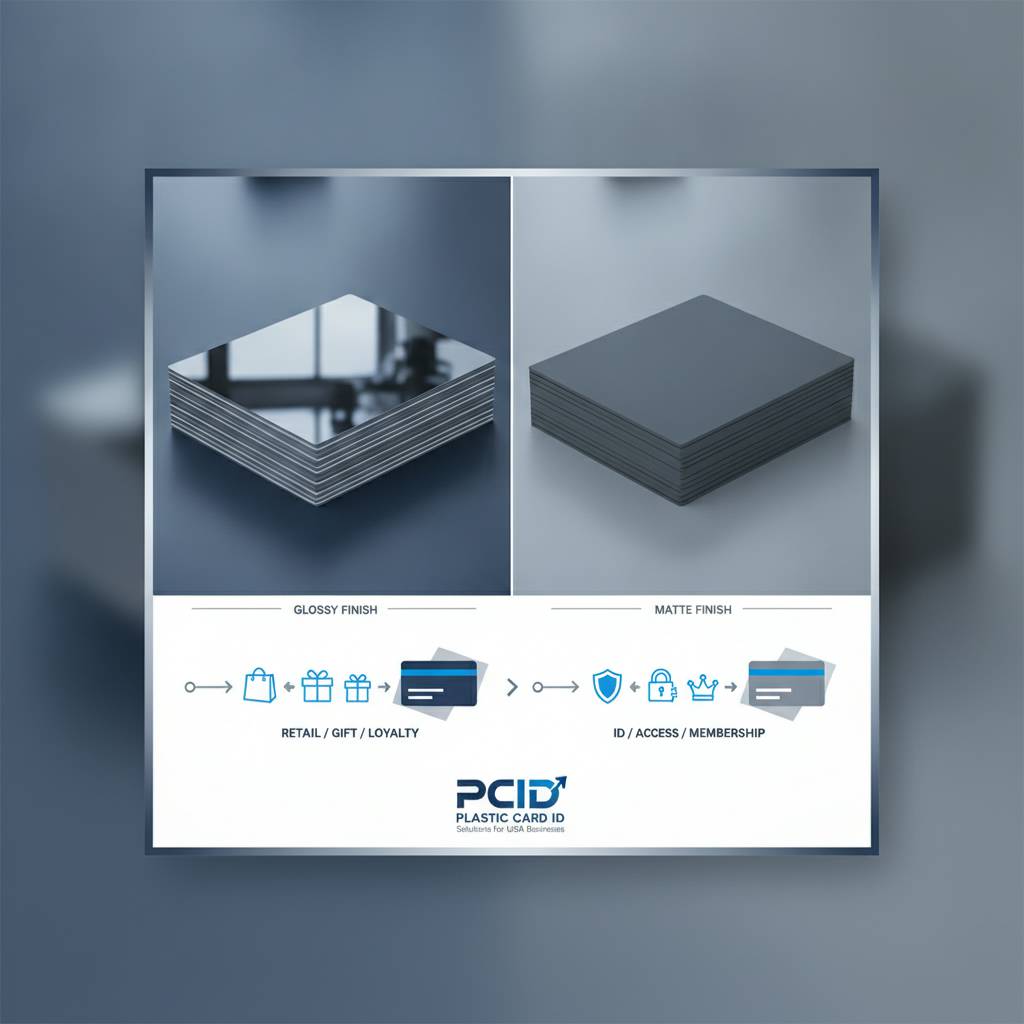 The most common mistake buyers make is selecting a surface finish based purely on visual preference without considering how the card will actually be used. A stunning glossy loyalty card that shows every fingerprint after three days in someone's wallet is a less effective loyalty card. Function must inform aesthetics, not the other way around.
Let's break this down by program type - because the right answer genuinely varies depending on what your cards need to accomplish in the real world.
Gift Cards and Retail Loyalty Programs
Glossy finish dominates in retail gift card and loyalty card applications, and for good reason. The retail environment rewards visual impact. When a customer pulls a glossy gift card from a display rack, the sheen catches attention. When they hand it to a cashier, it projects perceived value. Retailers who have switched from paper punch cards or paper gift certificates to glossy plastic cards have seen gift card sales increase dramatically - in some documented cases, 35-50% higher revenue compared to paper alternatives.
Loyalty cards that live in wallets outperform paper punch cards consistently, and a glossy card is more likely to stay in the wallet simply because it looks and feels like something worth keeping. Physical presence in a customer's wallet drives repeat visits and purchase behavior in ways that digital-only programs still struggle to replicate fully.
Employee ID Badges and Access Control Cards
For employee identification and access control programs, matte finish is frequently the smarter operational choice. These cards are handled daily, clipped to lanyards, inserted into badge holders, and swiped repeatedly through card readers. A matte surface resists visible wear patterns better than glossy, maintains its professional appearance longer, and avoids the reflective glare that can actually make laminated photo IDs harder to read under fluorescent lighting.
Organizations using RFID or proximity cards for access control - a growing segment of CPE's business - often prefer matte finishes because the card's function is primarily practical rather than decorative. The surface finish becomes a backdrop for essential information rather than a design centerpiece, and matte delivers that clean, readable backdrop effectively.
Membership Cards and Professional Credentials
- Professional associations often favor matte membership cards for their authoritative, serious visual character.
- Healthcare organizations issuing staff credentials benefit from matte's durability and reduced glare in clinical lighting environments.
- Fitness clubs and gyms may prefer glossy cards that visually align with lifestyle brand aesthetics.
- Hotel key card programs often use glossy stock when the card doubles as a marketing piece showcasing the property's branding.
- Event credentials and VIP passes can go either direction depending on the event's brand positioning - a luxury gala warrants matte, a product launch event might call for glossy impact.
- Casino player cards frequently use glossy to complement the high-energy visual environment of gaming floors.
The point is that no universal answer exists - but understanding where your cards will live and how they'll be used narrows the choice quickly. Plastic Card ID helps clients think through these considerations every single day, and the consultation doesn't cost anything extra.
Durability, Handling, and Long-Term Card Performance
Both glossy and matte cards are built on the same CR80 PVC substrate - 30 mil thick, rigid, and engineered for daily use. The surface finish doesn't change the card's structural integrity. What it does affect is how wear manifests visually over time, which becomes a practical concern in high-volume programs where cards need to look professional for months or years.
Durability isn't just about how long the card lasts - it's about how long the card looks good. A card that technically functions for two years but looks scratched and worn after six months reflects poorly on the organization that issued it. Surface finish is a meaningful variable in that calculation.
Scratch Resistance and Surface Wear
Matte cards generally show fewer visible scratches over time. The micro-textured surface naturally disguises minor abrasion in a way that a high-gloss surface cannot. Scratches on a glossy card catch light and become immediately visible. This doesn't mean glossy cards scratch more easily on a material level - it means the visual evidence of normal wear appears more prominently on a reflective surface.
For cards that will be stored in wallets alongside keys, coins, and other cards - the standard fate of most loyalty and membership cards - matte finish holds its visual integrity longer. For cards kept in protective sleeves or card holders, the difference is less pronounced. Card carriers and protective sleeves, both available through CPE, extend the useful life of either surface finish significantly.
Magnetic Stripe and Chip Compatibility
Here's a reassuring fact: surface finish has no impact whatsoever on the performance of magnetic stripes, smart chips, or RFID antenna systems embedded in the card. Whether you choose HiCo or LoCo magnetic stripe, MIFARE DESFire smart chips, or standard proximity technology, those functional layers operate completely independently of whether the face of the card is glossy or matte.
Both surface finishes are available across Plastic Card ID's full catalog of functional cards - including magnetic stripe cards in both coercivity levels, RFID and proximity access cards, and smart chip options. The finish is a surface-layer specification; the embedded technology is a separate card architecture decision. You don't have to sacrifice one to get the other.
Storage, Stacking, and Production Handling
In production environments where cards are printed in batches and stacked before distribution, glossy cards require slightly more care. The smooth surface can cause cards to slide when stacked, and under certain temperature and pressure conditions, glossy surfaces can temporarily stick together. This is rarely a serious operational issue, but it's worth noting for high-volume in-house programs.
Matte cards stack cleanly and handle easily in production workflows. If your team is processing large volumes - running hundreds or thousands of cards per month through your printer - the matte surface's handling characteristics offer a modest but real operational advantage. It's one of those small details that becomes visible only at scale but matters once it does.
Specialty Card Options and Finish Variations
The glossy vs matte conversation doesn't end with standard white PVC. Plastic Card ID's catalog includes specialty card options where surface finish intersects with unique substrate choices in ways that create genuinely distinctive card products. For organizations that want their card program to stand apart, these options are worth understanding.
Clear and frosted plastic cards occupy their own aesthetic space - frosted cards are essentially a form of matte applied to a translucent substrate, creating an elegant, premium look that neither standard glossy nor standard matte can replicate. Luxury metal cards in stainless steel, brass, and gold bring a different finish conversation entirely, where the metallic sheen itself becomes the design element.
Clear and Frosted Card Finishes
Clear plastic cards with a glossy finish allow full transparency, which brands use creatively to let a card holder or backing art show through the card itself. Frosted clear cards diffuse the transparency into an elegant semi-opaque effect that photographs beautifully and handles fingerprints better than fully transparent glossy surfaces. Both variations are available in CR80 standard dimensions.
For membership programs, VIP credential systems, or brand identity initiatives where differentiation matters, clear and frosted cards provide a visual lever that standard white stock simply cannot offer. These cards generate genuine attention and are frequently retained by recipients long after their practical use expires - which is exactly the kind of brand impression sophisticated programs aim to create.
Colored Stock Cards and Finish Interactions
Colored stock cards - available in a range of pre-colored PVC options - interact with surface finish in interesting ways. A glossy finish on a deep blue or red card stock creates a jewel-like intensity that standard white glossy doesn't replicate. Matte finish on colored stock produces a sophisticated, fashion-forward result that many membership organizations find aligns perfectly with their brand identity.
When printing on colored stock, keep in mind that the base card color will interact with printed inks. Light colors and white elements require planning, as PVC card printers don't print true white. Working with CPE's team when selecting colored stock helps avoid print output surprises and ensures your finished cards match expectations. Call 800.835.7919 to discuss colored stock options and how finish affects final print results on non-white substrates.
Custom Die-Cut Shapes and Specialty Formats
Custom die-cut cards - available in shapes beyond standard CR80 rectangles - can be produced in both glossy and matte finishes. Keychain-size cards, unusual geometric shapes, and cards with punched holes for lanyards all benefit from the same finish considerations as standard cards. The shape gets attention; the finish determines the tactile and visual character of that attention.
For event credentials, promotional giveaways, and novelty loyalty programs, die-cut cards in the right finish create a memorable physical object that recipients actively want to keep. This isn't just aesthetics for its own sake - it's a direct investment in card retention and program engagement, both of which drive measurable business outcomes.
Buyer Tips: Making the Right Decision for Your Card Program
After 25 years and more than 50 million cards supplied to businesses across the United States, Plastic Card ID has seen every kind of card program decision play out. Some buyers overthink the finish decision; others under-think it entirely. Here's the practical framework that helps most programs land on the right choice quickly and confidently.
Start with the card's primary environment. Ask yourself: Where does this card live most of the time? In a wallet, in a badge holder, on a lanyard, or in a reader? Each environment weights the decision differently. Then consider the print output you need and verify your printer's compatibility with the surface you're considering. Finally, think about the impression the card should create - and let that guide the aesthetic choice within the functional parameters you've already established.
Questions to Ask Before Ordering Blank Card Stock
- Will the card be used primarily in a consumer-facing retail context or an internal operational context?
- Does your card printer perform better on glossy or matte stock, based on your ribbon configuration?
- Will the card need to be written on by hand at any point during its lifecycle?
- How long do you expect the card to remain in active use - weeks, months, or years?
- Does the card carry embedded technology (magnetic stripe, chip, RFID) that needs to be factored into the card spec?
- What volume are you printing - 50 cards a month or thousands - and how does that affect your handling workflow?
These aren't complicated questions, but answering them honestly will often resolve the glossy vs matte decision without requiring a single test print. And when the answers leave you uncertain, CPE's team is prepared to help you work through it efficiently.
Ordering Quantities and Cost Considerations
Blank card stock is priced by volume, and Plastic Card ID serves programs across a wide range of scale - from small organizations ordering as few as 50 cards a month to enterprises running mass production in the tens of thousands. The per-card cost at volume is meaningfully lower, making it financially sensible for growing programs to plan ahead and order for projected card issuance rather than reactive immediate need.
The choice between glossy and matte does not significantly affect card pricing - both finishes are available at comparable price points across standard and specialty card categories. Your budget is better invested in getting the specification right than in trying to optimize cost between finish types, which will rarely produce meaningful savings differences at normal program scales.
Sampling and Testing Before Full Program Commitment
Before committing to a large card order, especially when launching a new program or transitioning from one card type to another, testing samples on your actual printer setup is a genuinely worthwhile step. Print behavior can vary between printer models and ribbon configurations, and a test run protects you from discovering an incompatibility after your order has been produced.
Plastic Card ID supplies card programs of every scale and works with buyers to ensure the card stock specification matches both the intended printer platform and the program's visual requirements. Getting the specification right before the first order saves time, money, and frustration - and it's the kind of upstream support that distinguishes a strategic card supply partner from a simple order-and-ship vendor.
Partner With Plastic Card ID for Your Blank Plastic Card Program
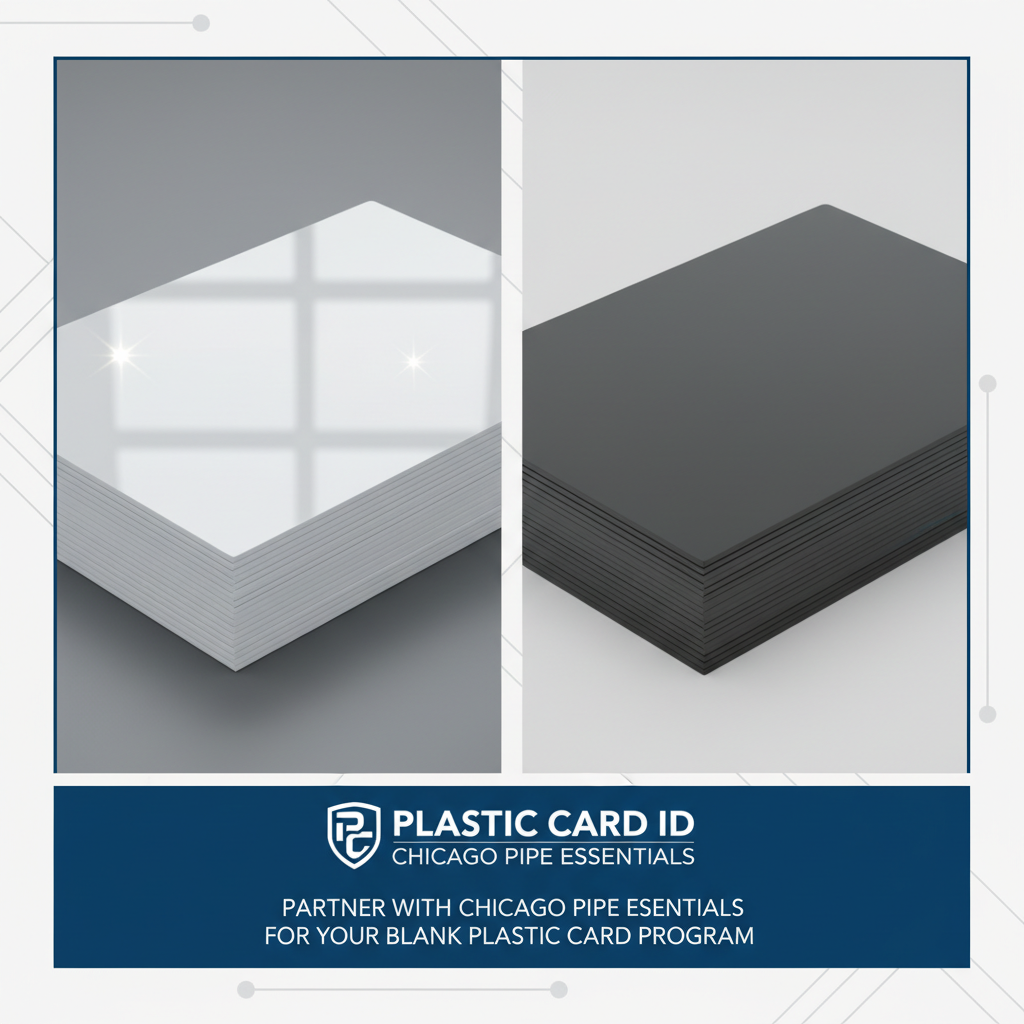 Whether you've landed firmly on glossy, decided on matte, or still have questions that need working through, Plastic Card ID is the partner that has supported card programs like yours for over 25 years. More than 100,000 customers across the United States have trusted CPE with their card supply needs - from the first blank card order to full-scale program support including printers, ribbons, cleaning kits, card carriers, and mailing services.
The decision between glossy and matte is just one dimension of building a card program that works. The right cards, paired with the right printer and the right supplies, running a program tailored to your actual organizational needs - that's what produces the results that matter. Physical plastic cards drive real business outcomes, and every specification decision, including surface finish, contributes to those outcomes in ways that are more significant than they first appear.
Ready to find the right blank plastic cards for your program? Contact Plastic Card ID today at 800.835.7919 - our team is ready to help you make the right call, the first time.
Previous Page