Blank Plastic Cards for Time and Attendance Systems
Table of Contents []
- Blank Plastic Cards for Time and Attendance Systems - Plastic Card ID
- Why Plastic Cards Outperform Every Other Time and Attendance Solution
- Magnetic Stripe Cards - The Workhorse of Time and Attendance
- Proximity and RFID Cards for Contactless Time and Attendance
- Building a Complete In-House Card Program for Workforce Tracking
- Frequently Asked Questions About Blank Plastic Cards for Time and Attendance
- Partner with Plastic Card ID for Your Time and Attendance Card Program
Blank Plastic Cards for Time and Attendance Systems - Plastic Card ID
Time is money. That phrase gets thrown around a lot, but in workforce management, it is absolutely literal. When your time and attendance system relies on flimsy paper cards, handwritten logs, or inconsistent badge stock, you are not just dealing with inconvenience - you are hemorrhaging accuracy, accountability, and ultimately, payroll dollars. Blank plastic cards designed specifically for time and attendance systems change that equation entirely.
Plastic Card ID has supplied blank and custom plastic cards to businesses across the United States for over 25 years, moving more than 50 million cards to over 100,000 customers. That depth of experience means when a manufacturing plant, hospital network, or retail chain calls looking for the right card stock for their workforce tracking system, the answer is never a guess. It is a recommendation built on decades of real-world application.
| Card Type | Common Use in T&A Systems | Key Feature |
|---|---|---|
| Blank CR80 PVC Cards | Employee ID and manual swipe systems | ISO 7810 standard, 30 mil thickness |
| HiCo Magnetic Stripe Cards | Clock-in terminals, access-linked attendance | High coercivity, durable encoding |
| LoCo Magnetic Stripe Cards | Short-term or seasonal employee tracking | Lower coercivity, cost-effective |
| Proximity (Prox) Cards | Contactless clock-in, secure door access | 125kHz RFID technology |
| Smart Chip Cards | Multi-function T&A with access control | Onboard chip storage, MIFARE compatible |
Why Plastic Cards Outperform Every Other Time and Attendance Solution
Paper timesheets have a long history of being wrong. They get lost, altered, smudged, or simply forgotten on kitchen counters. Even basic digital punch-in systems without a physical credential attached invite buddy punching - the practice of one employee clocking in for another. A physical plastic card tied to a specific individual closes that loophole fast.
Plastic cards bring a level of physical accountability that software alone cannot replicate. When an employee must present a card to clock in, the system logs who is physically present. That single change - from honor-system timekeeping to credential-verified attendance - has saved organizations significant sums in payroll fraud alone. The card itself becomes a tool of operational integrity.
Beyond fraud prevention, plastic cards are simply built for daily use. A CR80 card at 30 mil thickness survives wallets, lanyards, badge clips, and years of repeated swipes without degrading. Paper cannot say the same after a week in a back pocket. Durability is not a luxury in time and attendance - it is a functional requirement.
The CR80 Standard and Why It Matters
Every blank PVC card in the Plastic Card ID catalog is built to the CR80 ISO 7810 standard - the same size as a standard credit card at 3.375 x 2.125 inches, 30 mil thick. This is not arbitrary. That dimension is what every card reader, printer, and badge holder on the market is designed around. Compatibility is built in from the start.
CR80 is the universal language of plastic cards. Whether your time and attendance terminals are from a national brand or a niche vendor, they read CR80. Your badge printers accept CR80. Your card holders and lanyards are sized for CR80. Buying outside this standard introduces compatibility headaches that no operations manager wants.
Durability That Survives the Workday
Factory floors, construction sites, retail backrooms, hospital corridors - these environments are not gentle. Cards get dropped, sat on, exposed to moisture, and jammed into readers by people who are clearly not in a delicate mood at 5:45 a.m. Blank PVC cards at 30 mil handle all of it without flinching.
That durability translates directly to cost savings. When cards last for years rather than weeks, your per-use cost drops dramatically. A card that lasts three years instead of three months costs a fraction per swipe. At volume, those numbers add up to a meaningful budget difference over the life of your card program.
Printing In-House vs. Pre-Printed Cards
Blank cards give organizations total control over what gets printed and when. Need to onboard 40 new hires next Monday? Print them Monday morning - no waiting on a print vendor, no minimum order delays. For HR departments and facilities managers who value agility, in-house printing paired with blank card stock is the most responsive setup available.
Pre-printed cards have their place, but for time and attendance programs that experience regular turnover or growth, blank stock wins on flexibility. Pair blank CR80 cards with a desktop card printer from Evolis, Zebra, or Fargo, and you have a complete badging operation that lives entirely within your building.
Magnetic Stripe Cards - The Workhorse of Time and Attendance
Magnetic stripe technology is decades old, and that longevity is a feature, not a flaw. Time and attendance terminals that read magnetic stripes are everywhere - in warehouses, schools, healthcare facilities, and corporate offices. The infrastructure already exists. Magnetic stripe cards plug directly into that infrastructure without a single hardware upgrade.
Two coercivity options matter here. High coercivity, or HiCo, cards are encoded with stronger magnetic fields that resist accidental erasure from everyday magnetic exposure. Low coercivity, or LoCo, cards work well in lower-traffic or shorter-duration programs. Knowing which to use is the kind of guidance CPE provides every customer before they place an order.
HiCo Cards for Permanent or High-Use Programs
HiCo magnetic stripe cards are the right choice when cards will be swiped dozens of times per week, carried alongside other magnetic items, or expected to last through multiple years of use. The stronger encoding holds up where LoCo would degrade. For manufacturing plants, large retail teams, or any organization with shift-based attendance tracking, HiCo is the smart default.
These cards arrive blank and ready for encoding with your existing time and attendance software. The magnetic stripe occupies the standard Track 1, Track 2, and Track 3 positions on the card back - fully compatible with virtually every attendance terminal on the market. No exotic configuration required.
LoCo Cards for Seasonal or Temporary Workforce Programs
When your workforce swells seasonally - think warehouses before the holidays, landscaping companies in summer, tax firms in spring - LoCo cards offer a cost-effective solution for tracking temporary staff. They do the job for shorter durations without the premium price of HiCo stock.
LoCo cards are also common in environments where the time and attendance terminal and card never leave the premises, reducing the chance of exposure to strong external magnetic fields. For controlled, short-term deployments, LoCo delivers solid performance at lower cost. Call 800.835.7919 to discuss which coercivity level fits your program's timeline and budget.
Encoding Blank Magnetic Stripe Cards In-House
Many card printers from Evolis, Zebra, and Fargo include built-in magnetic stripe encoding modules. This means your blank HiCo or LoCo cards can be printed and encoded in a single pass. Employee photo, name, department, and a unique employee ID on the magnetic stripe - all done at the same desktop machine in under a minute per card.
This single-step workflow is exactly why organizations with active hiring programs choose in-house card production. The ability to issue a fully encoded, printed card on the same day as onboarding is an operational advantage that pre-print vendors simply cannot match on short notice.
Proximity and RFID Cards for Contactless Time and Attendance
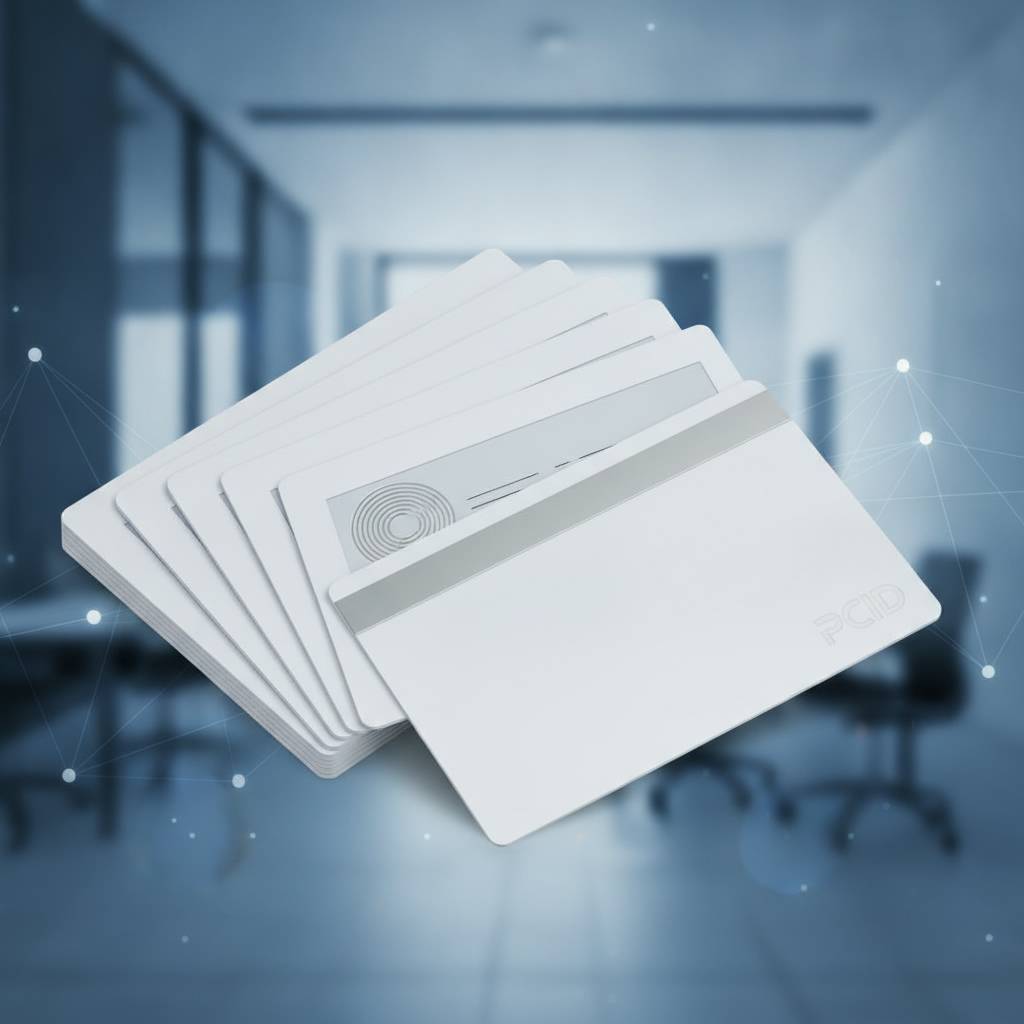 Contactless card technology has transformed how organizations handle both time tracking and access control simultaneously. A single proximity card can clock an employee in at a terminal and grant them access through a secured door - one credential, two functions, zero contact required. For facilities where hygiene, speed, or security are priorities, this is significant.
Proximity cards operate at 125kHz and are readable without physical insertion into a terminal. Employees tap or wave their card near a reader, and the system logs the event. No swipe, no insert, no fumbling at 6 a.m. in a winter coat with gloves on. The workflow is faster and the reader hardware experiences less mechanical wear.
How Proximity Cards Work in T&A Environments
A proximity card contains an embedded antenna and a small chip that communicates with compatible readers. When the card enters the reader's electromagnetic field, it transmits a unique identifier that the system uses to log the clock-in event. The whole transaction takes under a second. Speed and reliability at clock-in directly reduce line congestion during shift changes - a real operational pain point for facilities with dozens or hundreds of employees clocking in within a five-minute window.
Because proximity cards have no exposed components - no stripe to scratch, no chip contact to wear - they tend to outlast magnetic stripe cards in demanding physical environments. For organizations in construction, manufacturing, or food processing, that added durability justifies the slightly higher per-card cost.
RFID Smart Cards with Advanced Encoding
For organizations that need more than a simple identifier - think multi-location access, department-specific permissions, or integration with payroll platforms - RFID smart cards offer onboard chip storage that goes far beyond a magnetic stripe. MIFARE DESFire-compatible cards in the Plastic Card ID catalog support advanced, encrypted data storage for high-security environments.
Smart cards are the foundation of integrated workforce management systems where time tracking, access control, and identity verification operate from a single credential. Hotels, hospitals, universities, and large corporate campuses increasingly rely on this architecture because it consolidates multiple systems into one card and one reader infrastructure.
Choosing Between Proximity and Smart Cards
- Choose proximity cards when your system only needs a unique employee identifier read at a terminal - simple, fast, and cost-effective for standard clock-in workflows.
- Choose RFID smart cards when your credential needs to carry data, support multiple applications, or operate in a high-security environment requiring encrypted communication.
- Consider your reader infrastructure first - proximity readers and smart card readers are not interchangeable without hardware upgrades.
- For multi-site organizations, smart cards allow one credential to work across facilities with different permission levels assigned to the same card.
- Ask CPE about compatibility with your existing access control or time and attendance platform before selecting card technology.
Building a Complete In-House Card Program for Workforce Tracking
A successful time and attendance card program is more than just a stack of blank cards. It is a system - and every component of that system needs to work together. Card stock, printer, ribbon, software, and encoding module all need to be aligned before the first badge rolls off the printer. Plastic Card ID supplies every component of that system, which is what makes the one-stop-shop model genuinely valuable rather than a marketing slogan.
Organizations that source all their card program components from a single trusted supplier eliminate compatibility guesswork. The blank cards are matched to the printer specifications. The ribbons are correct for the card surface. The cleaning kits maintain the printer's performance over time. Nothing is mismatched, and when something needs troubleshooting, one call reaches someone who knows the whole system.
Card Printers That Pair with Blank T&A Card Stock
Evolis, Zebra, and Fargo card printers cover the full range of time and attendance program sizes. A small business badging 20-50 employees per year needs a different machine than a hospital system onboarding hundreds of new staff quarterly. CPE helps match printer capability to program volume so organizations are not overpaying for capacity they will never use - or underpowering a system that will constantly bottleneck.
Desktop card printers from these brands are specifically designed for blank CR80 PVC stock. Single-sided or dual-sided printing, with optional magnetic stripe encoding or smart chip contact station modules, are available across the product lines. The right printer is the one that matches your volume, your card type, and your encoding needs - not simply the most expensive model on the shelf.
Ribbons, Cleaning Kits, and Accessories
A card printer without the right ribbon is like a printer without ink - obvious but surprisingly often overlooked when budgeting a new card program. Plastic Card ID stocks ribbons for every printer brand in their catalog, including YMCKO full-color ribbons for photo ID badges and monochrome ribbons for high-volume text-only applications. Matching the ribbon to the card surface and printer model is essential for print quality and printer longevity.
Cleaning kits deserve a specific mention because neglected printers produce degraded print quality long before they fail outright. Regular cleaning cycles keep rollers and print heads performing at specification. Card sleeves and badge holders protect finished cards from daily wear. Card carriers streamline distribution during new employee onboarding. All of these accessories are available through CPE.
Card Affixing and Mailing Services for Distributed Workforces
Not every organization has a central HR office where employees pick up their badges in person. Distributed workforces - remote workers who need to check in at regional facilities, seasonal staff who receive credentials before their start date - benefit from card affixing and mailing services. Plastic Card ID handles this end of the process too, sending finished cards directly to employees or locations.
This service is particularly useful for organizations that print centrally but distribute across multiple states. Mailing finished credentials directly to employees removes a logistical bottleneck from HR and facilities teams that are already managing onboarding alongside a hundred other responsibilities. Call 800.835.7919 to learn how card mailing services integrate into your existing badging workflow.
Frequently Asked Questions About Blank Plastic Cards for Time and Attendance
Customers considering a transition to plastic card-based time and attendance tracking often have similar questions. The following covers the most common considerations so you can move forward with confidence rather than uncertainty.
What Quantity Should I Order?
Order quantities at Plastic Card ID scale from small runs suitable for a 50-person office all the way up to tens of thousands of cards for enterprise deployments. The per-card cost decreases as quantity increases, so organizations with predictable annual card needs often benefit from ordering a full-year supply at once rather than reordering in small batches.
For most time and attendance programs, a practical starting point is calculating your current employee headcount, adding a 15-20% buffer for turnover and reprints, and ordering accordingly. CPE can help you model the cost difference between small recurring orders and larger annual purchases so the decision is based on real numbers.
Are These Cards Compatible with My Existing System?
CR80 cards are the universal standard, and the overwhelming majority of time and attendance terminals and readers on the market are built around this form factor. Magnetic stripe cards work with any magnetic stripe reader operating on standard track configurations. Proximity and RFID cards require a compatible reader - but if your system is already contactless-capable, the cards will integrate without issue.
If you are unsure about compatibility, provide CPE with your terminal brand and model number. In most cases, the answer is immediate. Compatibility confirmation before you order is a service that comes standard - because the last thing anyone needs is a box of cards that does not work with their hardware.
What Is the Difference Between Blank and Pre-Printed Cards for T&A?
Blank cards give you complete control: print employee photos, names, departments, and barcodes whenever you need them, in whatever quantity you need, on your schedule. Pre-printed cards with a generic design can reduce per-card cost at very high volumes but sacrifice that flexibility. For most time and attendance programs with any degree of workforce change, blank cards paired with an in-house printer are the more practical and cost-efficient long-term choice.
Pre-printed cards make more sense for organizations with a stable, large workforce and a design that will not change for multiple years. If that describes your situation, CPE can discuss custom-printed options as well. The goal is always to match the supply model to your actual operational reality, not to sell you something that creates friction instead of solving it.
Ready to get the right blank plastic cards for your time and attendance system? The team at Plastic Card ID is standing by.
Partner with Plastic Card ID for Your Time and Attendance Card Program
Twenty-five years of experience. More than 50 million cards shipped. Over 100,000 customers across every industry in the United States. These numbers represent something more meaningful than scale - they represent a depth of knowledge that shows up in every conversation, every recommendation, and every order that leaves the warehouse. Plastic Card ID is not just a card supplier; it is a strategic partner that understands what your card program actually needs to succeed.
Whether you are launching a brand-new time and attendance card program, replacing an aging system, or scaling an existing program to meet workforce growth, the catalog, expertise, and support infrastructure at Plastic Card ID is built to handle it. Blank CR80 PVC cards, HiCo and LoCo magnetic stripe options, proximity and RFID smart cards, card printers, ribbons, cleaning kits, accessories, and mailing services - everything your program needs lives under one roof.
Do not leave workforce tracking accuracy to chance, paper, or an underpowered card system. Call Plastic Card ID today at 800.835.7919 and speak with a specialist who will match the right blank plastic cards and card program components to your time and attendance system - no guesswork, no compatibility surprises, just a program that works from day one.
Previous Page