Plastic Card Dimensions and Sizing Guide: Full Overview
Table of Contents []
- The Complete Plastic Card Dimensions and Sizing Guide from Plastic Card ID
- Why CR80 Is the Undisputed Standard
- CR79 and Hotel Key Card Sizing
- Mini Cards, Keychain Tags, and Specialty Sizes
- Magnetic Stripe Cards - Sizing and Track Placement
- Choosing the Right Card Size for Your Program
- Frequently Asked Questions About Plastic Card Sizing
- Partner With Plastic Card ID for Every Card Size and Format You Need
The Complete Plastic Card Dimensions and Sizing Guide from Plastic Card ID
Walk into any wallet in America and pull out a card. Any card. Odds are near certain it fits a very specific set of measurements - and that is no accident. Standardized plastic card dimensions exist because they have to. A card that does not fit a reader, a wallet slot, or a badge holder is a card that fails at its job. Understanding sizing before you order is the difference between a card program that works seamlessly and one that creates friction at every touchpoint.
At Plastic Card ID, we have spent over 25 years supplying plastic cards to businesses, nonprofits, event organizers, and institutions across the United States. More than 100,000 customers. More than 50 million cards shipped. The questions we hear most often from first-time buyers? They are almost always about size. Getting the dimensions right from the start saves money, time, and a lot of frustration. This guide exists to answer every sizing question you might have - and a few you have not thought of yet.
| Card Format | Dimensions (inches) | Dimensions (mm) | Thickness (mil) | Common Uses |
|---|---|---|---|---|
| CR80 (Standard) | 3.375 x 2.125 | 85.6 x 54.0 | 30 mil | ID, loyalty, membership, gift |
| CR79 | 3.303 x 2.051 | 83.9 x 52.1 | 30 mil | Hotel key cards, access control |
| CR80 Thick | 3.375 x 2.125 | 85.6 x 54.0 | 40 mil | Premium feel, VIP, luxury programs |
| CR50 (Mini) | 2.625 x 1.625 | 66.7 x 41.3 | 30 mil | Keychain tags, mini loyalty cards |
| CR100 (Jumbo) | 3.88 x 2.63 | 98.5 x 66.8 | 30 mil | Event passes, oversized VIP cards |
Why CR80 Is the Undisputed Standard
When people say "credit card size," they mean CR80. The CR80 is the ISO 7810 ID-1 standard, measuring exactly 3.375 inches wide by 2.125 inches tall at 30 mil thickness. Every card printer on the market - Evolis, Zebra, Fargo - is engineered with CR80 in mind as the default format. Every wallet slot, every card sleeve, every badge holder is built around it. If you are starting a card program and you are not sure what size to order, CR80 is the answer.
The number "30 mil" refers to the card's thickness: 30 thousandths of an inch. This is the standard that gives plastic cards their characteristic rigidity - substantial without being unwieldy. It is the same thickness as a credit card, a driver's license, a hotel key. That familiarity is itself a form of credibility. When your employee receives a CR80 ID badge or a customer receives a CR80 loyalty card, it registers immediately as legitimate, professional, and durable.
The ISO 7810 Standard Explained
ISO 7810 is the international standard that governs the physical characteristics of identification cards. The ID-1 format within that standard is what we know as CR80. The specification is precise - not approximate. 85.6mm x 54mm x 0.76mm, with tolerances tight enough that a card produced anywhere in the world to this standard will fit any compliant reader or holder.
This matters enormously for businesses. Purchasing CR80 cards means your investment is compatible with virtually every card-related infrastructure already in place. Badge holders purchased last year, readers installed a decade ago, printers acquired recently - all built around the same spec. Plastic Card ID stocks CR80 blanks in white PVC, clear, frosted, and colored stock precisely because the format is universal.
Thickness Options Within CR80
Standard CR80 cards come in 30 mil thickness, but that is not the only option available. Some programs call for a 40 mil card - notably thicker, with a weight and rigidity that communicates premium quality the moment someone holds it. VIP membership programs, executive ID cards, and high-end gift card programs often benefit from the 40 mil option.
There are also specialty CR80 offerings in ultra-thin formats for specific lamination or overlay applications. Understanding which thickness your card printer supports is critical before ordering. Most desktop card printers handle 30 mil with ease; some accommodate 40 mil. Always confirm with your printer specifications or with CPE before placing a bulk order in a non-standard thickness.
Blank CR80 Cards and Your Printer
Blank CR80 PVC cards are the backbone of in-house card production. When you print your own cards using a desktop card printer, you load blank CR80 stock and let your design software do the rest. The per-card cost of blank stock is substantially lower than pre-printed cards from a third-party, and you retain total control over design, personalization, and timing.
Contact Plastic Card ID at 800.835.7919 to discuss which blank card stock is compatible with your existing printer. Whether you are running an Evolis Primacy, a Zebra ZC300, or a Fargo HDP5000, the right blank card substrate matters for print quality and card longevity.
CR79 and Hotel Key Card Sizing
The CR79 format is the overlooked sibling of the CR80. Nearly identical in appearance, the CR79 measures 3.303 inches by 2.051 inches - just slightly smaller than the standard. That small difference is intentional. CR79 cards are specifically designed to be laminated, with the smaller base card accepting an overlay that brings it up to CR80 dimensions. This is the standard format for hotel key cards and many access control applications.
If you are deploying a hotel key card program or a similar proximity-based access system, the CR79 is likely the format your lock hardware expects. Substituting a standard CR80 card into a system designed for laminated CR79 cards can cause jamming, reader errors, or card damage. This is the kind of detail that Plastic Card ID helps clients navigate before it becomes a problem on opening day.
RFID and Proximity Cards in CR79
Most hotel key cards and building access cards use RFID or proximity technology embedded within the card body. These inlays - thin antennas and chips sandwiched between PVC layers - do not change the external dimensions but they do affect which manufacturing process is required. CR79 proximity cards from Plastic Card ID include 125kHz standard proximity formats as well as higher-frequency 13.56MHz smart card options.
MIFARE DESFire cards represent the premium tier of access control technology, offering encrypted, sector-based data storage that is significantly more secure than legacy proximity formats. These cards are used in corporate campuses, government facilities, and casino environments where security requirements are uncompromising.
Smart Chip Cards and Physical Dimensions
Smart chip cards - the kind with a visible gold contact pad on the face - conform to CR80 dimensions. The chip module is embedded flush with the card surface per ISO standards. From a sizing standpoint, smart chip cards behave identically to any other CR80 card in terms of wallet fit, badge holder compatibility, and printer handling.
What changes with smart chip cards is the printing process. Contact chip cards require a printer with a smart card encoding station. CPE carries the full range of card printers capable of both printing and encoding smart chip cards in a single pass, which dramatically simplifies card issuance workflows for healthcare, government, and corporate ID programs.
Comparing CR79 vs CR80 for Access Programs
- CR79: Slightly smaller base; designed for lamination; standard for hotel key and access control systems
- CR80: Full standard size; used unlaminated in most desktop printer workflows
- Thickness: Both typically 30 mil before any lamination overlay
- Reader compatibility: Verify your hardware specification before choosing between the two formats
- Cost: CR79 laminated cards may carry slightly higher production cost due to overlay process
Mini Cards, Keychain Tags, and Specialty Sizes
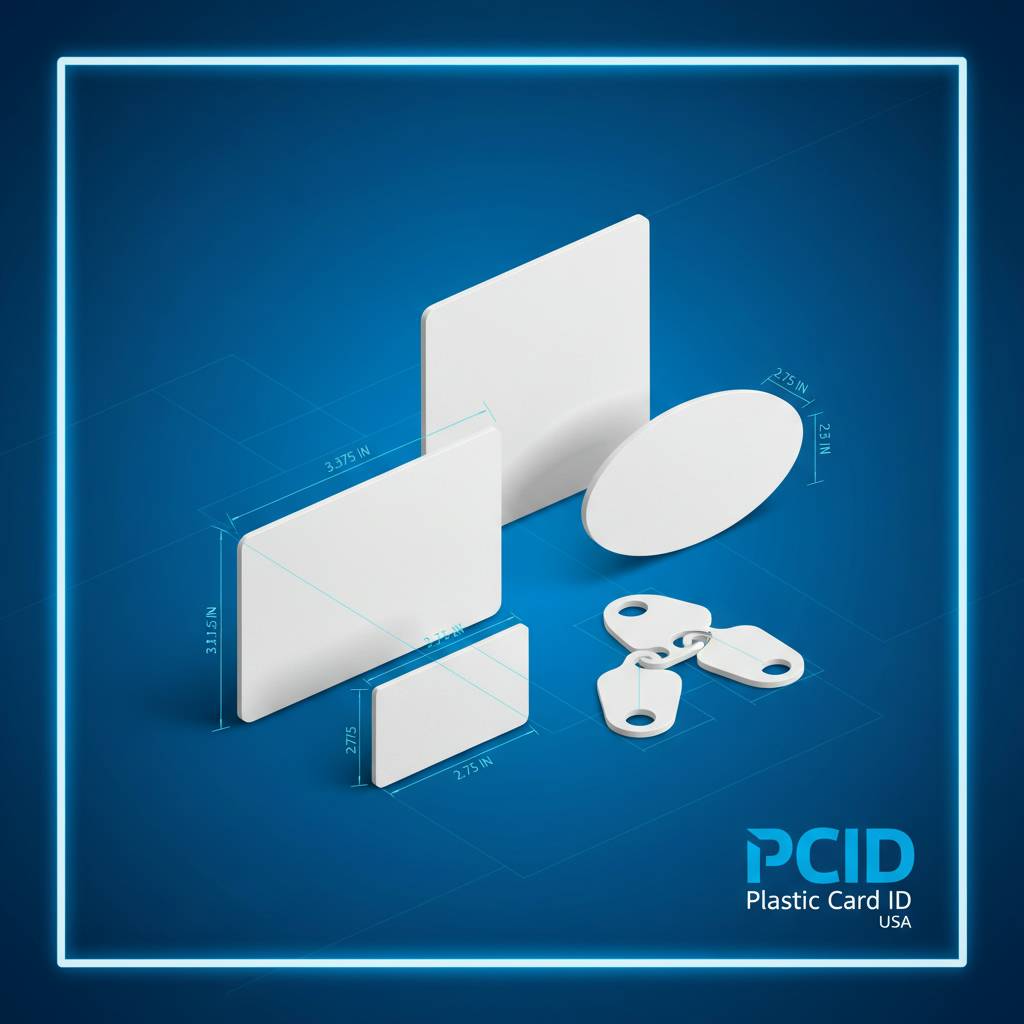 Not every card program fits neatly into a wallet. Keychain loyalty tags, mini membership cards, and compact event credentials serve users who want convenience without the bulk of a full-size card. The CR50 format at 2.625 x 1.625 inches is the most common compact card size, roughly half the footprint of a standard card and designed specifically for keychain attachment or slim cardholders.
Retailers running loyalty programs have found real traction with keychain-format cards precisely because they remove friction. When a customer does not have their wallet, they still have their keys. That simple insight drives measurable improvement in loyalty program participation rates. Plastic Card ID supplies CR50 mini cards in blank PVC as well as with magnetic stripe encoding for programs that require swipe functionality.
Jumbo and Oversized Card Formats
On the opposite end of the spectrum, some programs intentionally want a card that stands out. The CR100 jumbo format at 3.88 x 2.63 inches provides noticeably more surface area - useful for event VIP passes that need to display substantial information, or promotional cards designed to be kept on a desk rather than a wallet.
Oversized cards are attention-getting by nature. They do not disappear into a wallet, which means they stay visible and keep your brand in front of the cardholder. For high-value promotions, limited-run event credentials, or premium membership tiers, the jumbo format makes a visual statement that a standard card simply cannot.
Custom Die-Cut Card Shapes
When standard rectangles are not the right answer, custom die-cut plastic cards open up a world of possibilities. Cards shaped like a product, a logo, or a distinctive geometric form make an immediate impression. Die-cut cards are particularly effective for tradeshow giveaways, seasonal promotions, and brand-forward loyalty programs where differentiation matters.
There are practical considerations with custom shapes - specifically around how they are stored and handled. Cards that do not conform to CR80 dimensions will not fit standard badge holders or card sleeves. For programs where functional use in card readers is required, custom shapes need to maintain minimum dimension requirements around the read zone. CPE can guide clients through what is feasible and what is not before artwork is committed.
| Format | Best For | Reader Compatible? |
|---|---|---|
| CR50 Mini / Keychain | Loyalty tags, key fobs | Mag stripe versions: yes |
| CR100 Jumbo | VIP passes, event credentials | Not for standard readers |
| Custom Die-Cut | Promotions, branded giveaways | Depends on shape/read zone |
| Metal Cards (Stainless/Brass/Gold) | Luxury membership, VIP tiers | CR80 dimensions; varies by type |
Magnetic Stripe Cards - Sizing and Track Placement
Magnetic stripe cards follow CR80 dimensions with one addition: a stripe of magnetic oxide material bonded to the card back. The stripe's position is also standardized - ISO 7811 governs exactly where the stripe sits, how wide it is, and how far from the card edge. This standardization is what makes a magnetic stripe card usable across thousands of different reader types from point-of-sale terminals to access control panels.
The stripe runs along the top edge of the card back (when the card is held horizontally in landscape orientation). There are three data tracks - Track 1, Track 2, and Track 3 - each occupying a defined position within the stripe. Most retail and loyalty applications use Track 2. Hotel key systems typically use Track 3. Casino player tracking systems often encode across multiple tracks.
HiCo vs LoCo Magnetic Stripe
Magnetic stripe cards come in two coercivity ratings: HiCo (high coercivity) and LoCo (low coercivity). HiCo cards resist demagnetization and are appropriate for long-life card programs - employee ID cards, durable membership cards, frequent-use loyalty cards. LoCo cards are easier to encode and re-encode, making them practical for short-term applications like hotel room keys where cards are reused and reprogrammed frequently.
The physical dimensions of HiCo and LoCo cards are identical - both CR80 standard. The difference is entirely in the magnetic layer properties. HiCo stripes are typically dark brown or black; LoCo stripes are typically light brown. Most quality card printers can encode both, but the encoder must be set to the correct coercivity level. Ordering the wrong type for your reader is a common and easily avoided mistake - one that CPE helps customers sidestep every day.
Signature Panels and Overlay Options
Magnetic stripe cards for certain applications include a signature panel - a white patch on the card back that accepts ballpoint pen ink and resists most erasure attempts. The panel's placement is also standardized, situated below the magnetic stripe on the card back. Signature panels do not change card dimensions but they do affect the available print area on the card reverse.
Clear overlaminates add durability without changing card dimensions, protecting printed surfaces from abrasion, UV fading, and casual tampering. For programs where cards will be handled frequently - daily badge swipes, retail checkout, casino floor use - an overlaminate can meaningfully extend card lifespan. Plastic Card ID supplies overlay options compatible with all major card printer platforms. Call 800.835.7919 for details on overlay materials and their applications.
Encoding Standards for Loyalty and Membership Programs
A blank magnetic stripe card becomes a loyalty card the moment it is encoded with a unique identifier. That identifier - typically a numeric string on Track 2 - is what your point-of-sale or loyalty management system reads. The size of the card does not change; what changes is the invisible data written into the stripe.
For loyalty programs, encoding is often done at the time of card printing using a desktop card printer with built-in magnetic stripe encoder. Batch encoding at order time is also available through Plastic Card ID for clients who need cards to arrive ready to issue without an in-house printing step. This is particularly useful for small businesses and franchises that do not have their own card printing infrastructure.
Choosing the Right Card Size for Your Program
The right card size is the one that works - in your readers, in your holders, in your customers' wallets, and within your budget. Most programs benefit from starting with CR80 standard sizing and evaluating specialty formats only when a specific operational need justifies the deviation. This approach keeps costs predictable and infrastructure compatibility high.
That said, program goals matter. A luxury spa's VIP membership program has different sizing logic than a school district's ID card program or a regional retailer's gift card initiative. Plastic Card ID has worked with clients across all of these sectors and more. The institutional knowledge built over 25 years of card program support means practical, experienced guidance rather than generic recommendations.
Buyer's Checklist: Before You Order
- Confirm the card size your card reader or lock hardware is designed to accept
- Verify your card printer's accepted card thickness range (30 mil vs 40 mil)
- Determine whether magnetic stripe, RFID, or smart chip encoding is required
- Assess whether cards will be carried in wallets (CR80 preferred) or on keychains (CR50 mini)
- Decide between blank in-house printing vs pre-printed cards from a fulfillment partner
- Consider whether card carriers, sleeves, or mailing services are needed alongside the cards
Card Holders and Accessories Matched to Size
A card's dimensions only matter if the accessories around it are sized to match. Badge holders, retractable reels, card sleeves, and card carriers are all engineered around CR80 dimensions as the default. When a card program steps outside CR80, the accessory supply chain narrows considerably. This is a real operational cost that is easy to overlook during the planning phase.
Plastic Card ID stocks card holders, sleeves, lanyards, and card carriers alongside its card inventory, making it possible to source both in a single order. For programs that include card mailing - new member welcome packets, replacement card mailings, seasonal reloads - the card affixing and mailing service handles fulfillment so clients do not have to staff an internal operation.
Card Programs at Any Scale
Volume shapes strategy. A business ordering 50 cards per month has different needs than one ordering 50,000. Both are well-served by CPE, but the approach differs. Small programs benefit most from in-house printing with blank card stock - the per-card cost is lower over time, and design changes can be made on the fly. Large-volume programs often benefit from pre-printed cards, batch encoding, and fulfillment services that eliminate internal labor.
The card dimensions remain constant across all scales - CR80 is CR80 whether you order 100 or 100,000. What changes is the economics and the workflow. That scalability is one of the reasons Plastic Card ID has retained loyal clients who started as small operators and grew into large-scale card programs over years or even decades of partnership.
Frequently Asked Questions About Plastic Card Sizing
Some questions come up over and over when clients are planning a new card program or expanding an existing one. The answers to these questions save real money and prevent real headaches. Here are the most common sizing questions answered directly.
What is the difference between a credit card and a standard business plastic card? Physically - nothing. Both are CR80, 30 mil, ISO 7810 compliant. The difference is entirely in the data encoded onto the card and the financial infrastructure behind it. Plastic Card ID supplies the physical cards; the functionality is determined by what is printed or encoded on them.
Does Card Thickness Affect Print Quality?
Yes, in meaningful ways. A 30 mil card feeds through most desktop card printers with zero issues. A 40 mil card may require manual feed settings or may not be supported at all by entry-level printers. Before upgrading to premium thick-stock cards, always verify that your printer manufacturer supports the heavier gauge. Running unsupported card stock through a printer is the leading cause of preventable print head damage.
For programs that want the feel of a heavier card without requiring a new printer, dual-card lamination or overlay techniques can add perceived weight and durability without exceeding printer specifications. This is a nuanced area where Plastic Card ID brings genuine expertise - call 800.835.7919 with your printer model and card goals and get a direct answer.
Are Clear and Frosted Cards the Same Size as Standard PVC?
Yes. Clear and frosted plastic cards from Plastic Card ID conform to CR80 standard dimensions. The transparency of the card substrate does not affect thickness, width, or height. What changes is the visual presentation - clear cards create a distinctive look, particularly when printed with designs that leverage the transparency as a design element.
Frosted cards offer a soft, premium tactile quality that is particularly well-received in spa, salon, and wellness program applications. Both clear and frosted stock are available in blank form for in-house printing and as custom pre-printed options for programs with defined artwork. Compatibility with standard badge holders and wallet slots is unchanged from standard white PVC.
What About Metal Cards - Do They Fit Standard Wallets?
Metal cards - stainless steel, brass, and gold options available through Plastic Card ID - are manufactured to CR80 dimensions and fit standard wallets and cardholders. What they do not do is flex the way PVC cards do. For programs where the card will pass through a card reader's feed mechanism, it is essential to confirm that the reader supports metal card stock, as some automated feeders are calibrated only for PVC.
The primary use case for metal cards is prestige membership and VIP program tiers where the physical weight and material signal exceptional status. A metal card makes an unmistakable impression the first time a cardholder handles it - that moment of surprise and delight is engineered into the product. These are not everyday transaction cards; they are relationship-building instruments at the top of a program's tier structure.
Ready to order the right card size for your program? Reach out to Plastic Card ID today at 800.835.7919 and talk to a card specialist who has seen it all.
Partner With Plastic Card ID for Every Card Size and Format You Need
 Twenty-five years is a long time to spend learning the card industry, and Plastic Card ID has used every one of those years to build something genuinely useful for American businesses: a one-stop resource that covers blank card stock, custom-printed cards, card printers and ribbons, encoding services, accessories, and fulfillment under one roof. When you know what you need, we make it easy to get it. When you are not sure, we help you figure it out.
From the CR80 standard to CR79 hotel keys, from CR50 keychain tags to luxury metal cards, from 30 mil standard stock to 40 mil premium thickness - the full spectrum of plastic card dimensions is represented in Plastic Card ID's catalog. Over 100,000 customers have found what they needed here. More than 50 million cards have shipped from our inventory to businesses and organizations across the United States. That track record speaks directly to what matters: reliability, expertise, and a genuine commitment to client success.
Call Plastic Card ID at 800.835.7919 today. Whether you need 50 cards or 50,000, the right size, the right format, and the right price are waiting for you.
Previous Page