Blank Plastic Card Materials Compared: Find Your Best Option
Table of Contents []
- Blank Plastic Card Materials Compared - Plastic Card ID Breaks It Down
- Standard White PVC - The Workhorse of Every Card Program
- Magnetic Stripe Cards - HiCo vs. LoCo Explained
- Clear and Frosted PVC Cards - Premium Materials for Premium Impressions
- RFID, Proximity, and Smart Chip Cards - Contactless Card Materials
- Colored Core Cards and Metal Cards - When Material Is the Message
- Why Plastic Card ID Is the Right Partner for Your Blank Card Program
Blank Plastic Card Materials Compared - Plastic Card ID Breaks It Down
Walk into any business that runs a card program and you will find a surprisingly wide range of materials being used - sometimes chosen wisely, sometimes just by accident. Standard PVC, composite stock, clear frosted, colored cores, even metal. Each material behaves differently under a printer, encodes differently onto a reader, and lands differently in a customer's hand. Knowing the distinctions is not just academic. It is the difference between a card program that runs smoothly and one that costs you money in reprints, reader errors, and poor first impressions.
At Plastic Card ID, more than 25 years of supplying blank plastic cards to businesses across the United States has produced something worth more than any product catalog: pattern recognition. When you have shipped over 50 million cards to more than 100,000 customers, you start to see exactly which material choices succeed and which ones quietly cause problems. This page is built on that knowledge.
| Material Type | Thickness | Best Use Cases | Printer Compatibility | Durability |
|---|---|---|---|---|
| Standard White PVC (CR80) | 30 mil | ID cards, loyalty, membership | Universal | High |
| Composite PVC/PET | 30 mil | High-use cards, retransfer printing | Retransfer printers preferred | Very High |
| Clear / Frosted PVC | 30 mil | Premium membership, VIP cards | Compatible with most | High |
| Colored Core PVC | 30 mil | Branding, tiered programs | Universal | High |
| Metal (Stainless, Brass, Gold) | Varies | Luxury membership, VIP, executive | Requires custom production | Exceptional |
| Magnetic Stripe (HiCo/LoCo) | 30 mil | Gift cards, hotel keys, access | Requires mag stripe encoder | High |
Standard White PVC - The Workhorse of Every Card Program
There is a reason that the CR80 white PVC card - 30 mil thick, conforming to ISO 7810 standards - dominates the blank card market. It is reliable, universally compatible with direct-to-card printers from Evolis, Zebra, and Fargo, and delivers consistent print quality run after run. When organizations want total design control at the lowest per-card cost over time, this is almost always the starting point.
A standard blank white PVC card is genuinely versatile. The same card stock becomes an employee badge on Monday and a gym membership card on Friday. It accepts dye-sublimation printing cleanly, holds laminate overlaminates without peeling, and encodes to magnetic stripes when specified. The material is also stable under typical workplace and retail conditions - not warping, not cracking, not fading under normal use.
CR80 Dimensions and ISO Compliance
The CR80 format - 3.375 inches by 2.125 inches, 30 mil in thickness - is the global standard for plastic ID cards. Every card slot, badge holder, card sleeve, and card reader in professional use is designed around these dimensions. Choosing standard-format cards means your program integrates with existing infrastructure without friction.
ISO 7810 compliance is not a marketing term; it is a technical specification covering flatness tolerance, dimensional accuracy, and material behavior during encoding and printing. Plastic Card ID supplies cards that meet this standard, which matters most when you are feeding cards through automated printers at volume or running them through RFID encoding stations where small dimensional variances can cause read errors.
What Makes a Good Blank PVC Card
Not all white PVC cards are the same. Surface texture, core composition, and laminate layer quality all influence how well a card accepts ink, how sharp the final printed image looks, and how long that image holds up under everyday handling. Cheaper stock often yields images that fade prematurely, scratch with light contact, or show visible banding after printing.
Cards supplied by CPE are formulated for direct-to-card and retransfer printing processes. The surface is consistent across the card face, the tolerance for printer feeding is tight, and the laminate layer responds predictably to heat during dye-sublimation printing. These are not small details when you are printing employee ID cards or customer-facing loyalty cards that reflect your brand.
Volume Flexibility - From 50 Cards to 50,000
One underappreciated advantage of blank PVC card stock is the flexibility it gives organizations on print volume. You do not need to commit to large print runs. A business printing 50-100 cards per month with an in-house printer gets the same CR80 card that a large employer printing 10,000 employee badges per quarter relies on. The blank card is the constant; the print volume is your variable.
For contact us about current pricing on bulk orders, reach Plastic Card ID at 800.835.7919. Volume pricing tiers make larger programs significantly more cost-efficient, and the team can help you determine the right reorder schedule to avoid stock-outs without over-purchasing.
Magnetic Stripe Cards - HiCo vs. LoCo Explained
Adding a magnetic stripe to a blank PVC card transforms it from a visual credential into a functional data-carrying device. That stripe - the dark brown or black band running across the card's back - stores information in magnetically encoded particles. But here is where it gets nuanced: not all magnetic stripes are equal, and choosing the wrong coercivity level for your application is a genuine operational hazard.
HiCo (high coercivity) and LoCo (low coercivity) stripes store the same type of data but at different magnetic field strengths. HiCo stripes require a stronger field to encode and are significantly harder to accidentally erase - ideal for hotel key cards, access control cards, and any card that will live near other magnetic sources. LoCo stripes encode and re-encode more easily, making them suitable for gift cards and temporary credentials where frequent re-encoding is expected.
HiCo Cards - Where Reliability Is Non-Negotiable
HiCo cards encode at 2750 Oersteds. That higher field strength means the data is resistant to interference from everyday magnetic sources - phone cases, bag clasps, other cards in a wallet. For hotel key programs, employee access cards, and any application where a dead card means a disruption, HiCo is the appropriate choice. The reliability difference in real-world conditions is dramatic enough that most professional installers will specify HiCo by default.
Standard HiCo blank cards from CPE include a three-track stripe, which allows for versatile data storage across different tracks. Track 1 stores alphanumeric data, Track 2 is the standard for access and payment-adjacent applications, and Track 3 supports additional read/write functions. Your encoder determines what goes on each track; the card itself simply needs to be compatible with your encoder's coercivity rating.
LoCo Cards - Smart Choice for Gift and Loyalty Programs
LoCo cards operate at 300 Oersteds. They are easier and faster to encode and re-encode, which makes them the efficient choice when cards cycle through different values or credentials frequently. Gift card programs, event access cards, and some loyalty card systems that re-encode points balances at each transaction are natural fits. LoCo cards cost slightly less than HiCo and remain the standard for retail gift card issuance in the United States.
The practical concern with LoCo is placement. These cards should not be stored directly against strong magnets or placed in wallets alongside cards that have strong magnetic closures. That is not a flaw; it is simply a material characteristic to communicate to cardholders when running a gift or loyalty program at the retail level.
Choosing Between HiCo and LoCo - A Decision Framework
- Choose HiCo when card longevity and resistance to accidental erasure are critical - hotel keys, employee access, membership cards used daily over months or years.
- Choose LoCo when cards are issued at the point of sale, may be re-encoded, and are used in lower-magnetic-interference environments - retail gift cards, event credentials.
- Verify your card printer or encoder's coercivity rating before ordering. Most Zebra, Evolis, and Fargo encoders specify which coercivity they support.
- For programs with mixed use cases, standardize on HiCo to avoid reader compatibility issues across different card batches.
- Contact Plastic Card ID at 800.835.7919 if you are unsure which coercivity is right for your existing card reader infrastructure.
Clear and Frosted PVC Cards - Premium Materials for Premium Impressions
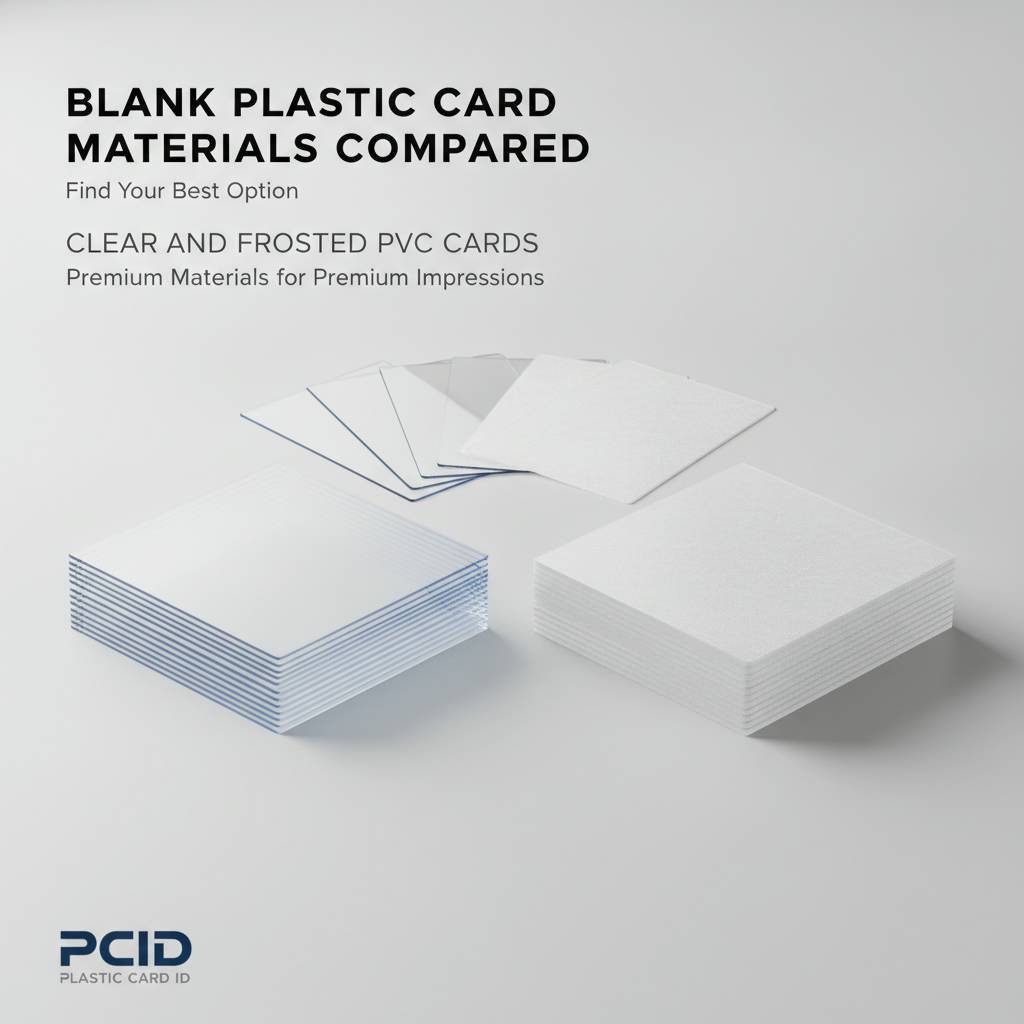 There is a particular moment when a customer receives a card made from clear or frosted PVC stock - a pause, a look, sometimes a comment. Transparent and semi-transparent card stock carries an immediate perception of quality that white PVC simply cannot replicate. That perception is not accidental; it is the material doing work for your brand.
Clear PVC cards are fully transparent, allowing any printed graphics or background images to play against the card's see-through core. Frosted PVC diffuses light softly across the surface, creating a matte-elegant appearance that sits between opaque and transparent. Both materials accept dye-sublimation printing, though color reproduction behaves differently compared to white PVC - and that difference requires thoughtful design adjustment.
Applications Where Clear and Frosted Cards Shine
VIP membership programs, luxury hotel guest cards, high-end retail loyalty programs, and executive access credentials are the natural territory for clear and frosted PVC. The material signals that this card is not just functional - it represents membership in something worth noticing. Brands that have elevated their loyalty programs from standard white PVC to clear or frosted stock frequently report increased cardholder pride of ownership and higher carry rates.
Event organizations use clear cards for premium attendee badges where the visual design benefits from the transparent background. Spas, private clubs, and boutique fitness studios use frosted PVC to match a premium brand aesthetic that plain white stock would undermine. The material choice becomes part of the brand communication.
Printing Considerations for Clear and Frosted Stock
Printing on clear or frosted cards requires understanding that the ink sits differently on the transparent or semi-transparent substrate. Colors that look bold on white PVC may appear lighter or more muted against a clear background unless the design accounts for this. Adding a white underprint layer is a technique some in-house programs use to achieve opaque backgrounds on specific design elements while retaining the clear card edge aesthetic.
Most Evolis, Zebra, and Fargo direct-to-card printers handle clear and frosted PVC without modification. Retransfer printers, which print to a film first and then fuse it to the card, can produce particularly sharp results on clear stock. CPE can advise on which printer and ribbon combination delivers the best results for your specific clear card design requirements.
Pairing Clear Cards with the Right Accessories
Clear and frosted cards make a stronger impression when paired with accessories that match their quality level. Matte or textured card carriers, premium card sleeves, and professional card mailers all contribute to the overall recipient experience. A luxury card arriving in a plain envelope in a loose poly bag undercuts the material investment. The unboxing or delivery experience is part of what the premium card stock is trying to accomplish.
Plastic Card ID supplies card carriers, sleeves, and card affixing and mailing services that complement premium card programs. When the card material, the carrier, and the delivery method all align, the entire program communicates quality at every touchpoint.
| Feature | Clear PVC | Frosted PVC |
|---|---|---|
| Transparency Level | Fully transparent | Semi-transparent, diffused |
| Print Color Appearance | Lighter, requires design adjustment | Muted, soft tones work well |
| Ideal Aesthetic | Modern, minimalist, bold | Elegant, soft, upscale |
| Best Programs | VIP, event, luxury retail | Spa, club, boutique loyalty |
RFID, Proximity, and Smart Chip Cards - Contactless Card Materials
At some point in the discussion of blank plastic card materials, the conversation has to move past what the card looks like and into what it does. RFID cards, proximity access cards, and smart chip cards are not defined primarily by their surface material - they are defined by the antenna and chip embedded within the card core. The blank plastic shell is the housing; the embedded technology is the capability.
Contactless cards are used across access control, casino player tracking, hotel room entry, corporate security, transit systems, and increasingly in retail loyalty programs that want tap-based interaction. The material construction must accommodate the embedded components without compromising card flexibility, flatness, or printability - all of which Plastic Card ID verifies across its contactless card catalog.
Proximity Cards and 125 kHz Technology
Proximity cards operate at 125 kHz and represent the most widely deployed access control card format in the United States. They work at short range - typically 1-4 inches from a reader - and are ideal for door access, time-and-attendance systems, and basic credential applications. The cards are durable, inexpensive relative to smart cards, and compatible with a massive installed base of readers from HID, Kantech, and other major access control vendors.
Proximity cards remain the sensible choice when upgrading from older key-based or PIN-based access without the need for advanced cryptographic security. For organizations that simply need reliable tap-to-enter door access for employees or members, prox cards deliver that without complexity or high per-card cost.
MIFARE and DESFire Smart Cards - Advanced Security Applications
MIFARE DESFire cards operate at 13.56 MHz and represent a significant step up in security capability. They use hardware-based cryptography, support multiple application sectors on a single card, and communicate with readers using encrypted data exchange. For casino player programs, healthcare facilities, university campuses, and corporate environments handling sensitive data, DESFire is the professional standard.
The card construction must precisely embed and protect the antenna coil and chip without introducing stress fractures during normal use. Cards that crack near the chip or lose antenna continuity are a common failure mode in lower-quality smart card stock. CPE sources RFID and smart cards built to withstand the flex and handling cycles of daily active use programs.
Casino Player Cards and Hotel Key Cards
Casino player tracking cards are among the most performance-intensive card applications in the industry. They pass through readers hundreds of times per session, absorb handling from staff and players, and need to retain both their magnetic stripe data and their visual printed appearance over months of active use. Material quality in casino card programs is not optional - it is a direct operational cost factor. Card failures mean floor disruptions, player frustration, and reissuance costs.
Hotel key cards share similar performance demands. They are handed to guests who will insert and remove them from door readers multiple times per day, carry them in pockets with coins and other cards, and sometimes return them bent or scuffed. HiCo magnetic stripe stock with surface protection handles this well. Contactless hotel key options using MIFARE technology are gaining ground in newer properties. Plastic Card ID supplies both formats and can help properties determine which technology matches their door lock infrastructure.
Colored Core Cards and Metal Cards - When Material Is the Message
Some card programs need more than functional performance - they need the card material itself to communicate something. Colored core PVC cards and metal cards serve this role. They are not materials you choose because they print better or encode more reliably. You choose them because the card's appearance and feel in a customer's hand carries direct brand and status value.
Colored core cards - available in a range of stock colors including black, gold, red, and others - show that core color on the card edge. When a card is viewed from the side, that color edge is visible, adding a design detail that standard white-core PVC cannot replicate. For tiered loyalty or membership programs where different card levels need visual distinction, colored cores are an elegant solution that works within standard CR80 dimensions.
Metal Cards - Stainless Steel, Brass, and Gold
Metal cards in stainless steel, brass, and gold finish are a category unto themselves. The weight and rigidity of a metal card in a recipient's hand creates an immediate and powerful impression of prestige and permanence that no plastic material can fully replicate. Private clubs, executive membership programs, high-net-worth client services, and VIP programs use metal cards when the card itself needs to be a statement of exclusivity.
Metal cards are produced through custom processes and are not in-house printed. They require advance planning, design coordination, and lead time. The per-card cost is substantially higher than PVC - but for the programs that use them, the cost is considered marketing investment, not supply cost. A metal card does not get thrown in a drawer. It gets kept, used, and shown to others.
Choosing the Right Tier of Card Material for Your Program
- Standard white PVC: Employee IDs, event badges, basic loyalty programs, school credentials, general membership. Best value, maximum compatibility.
- Colored core PVC: Tiered programs, brand-forward loyalty cards, programs where edge color adds visual differentiation between membership levels.
- Clear or frosted PVC: Premium retail loyalty, boutique memberships, VIP credentials, aesthetic-driven programs where design transparency matters.
- Metal cards: Executive programs, private clubs, luxury brand loyalty, any program where the card itself is meant to signal elite status.
- Composite PVC/PET: High-frequency-use cards, retransfer printing programs, any application demanding maximum durability over extended card life.
Matching Card Material to Program Scale and Budget
One of the practical challenges organizations face when planning a card program is matching material quality to program scale and budget without either overspending on material for a basic application or under-specifying for a premium one. The most common mistake is choosing on price alone without considering the total cost of the program over 12-24 months. A slightly higher per-card cost for composite or quality PVC stock often saves money on reprints, reader errors, and replacement cards.
The team at Plastic Card ID has spent over two decades helping organizations navigate exactly this kind of decision. Reach the team at 800.835.7919 to talk through your program's volume, use case, and budget. There is no single right answer - but there is almost always a material choice that is clearly more suited to your specific application than the alternatives.
Why Plastic Card ID Is the Right Partner for Your Blank Card Program
Material knowledge only matters when it is paired with reliable supply, genuine depth of catalog, and a team that understands how cards function inside real business programs. Plastic Card ID brings all three to every customer relationship - and has done so for more than 25 years across more than 100,000 customers nationwide. That experience is not a historical footnote. It shows up in every product recommendation, every bulk pricing conversation, and every order that ships accurately and on time.
The catalog at CPE runs from blank white PVC to RFID smart cards, from HiCo magnetic stripe stock to stainless steel metal cards, from standard CR80 format to custom die-cut shapes. Card printers from Evolis, Zebra, and Fargo are in-catalog alongside the ribbons, cleaning kits, card carriers, and sleeves that complete a functioning program. Everything a USA-based organization needs to run a professional card program - from first order to daily operations - is available from one source.
The Strategic Partner Difference
The distinction between a supplier and a strategic partner is real and it matters over time. A supplier fills orders. A strategic partner helps you understand which material is right for your application, flags a coercivity mismatch before it causes reader failures in the field, and advises on which printer ribbon combination produces the best output for your specific card stock. That kind of involvement saves organizations significant time and money across the life of a card program.
Plastic Card ID operates at that level of involvement by choice. The business was built on long-term relationships - customers who started with a small first order and have been reordering for years because the products perform and the service is consistent. Over 50 million cards shipped is not a number that happens without a repeating customer base that trusts the source.
Ready to Choose the Right Blank Card Material?
Every card program starts with a single decision: what material do you need? The answer depends on your application, your printer, your readers, your volume, and your brand standards. Getting that decision right from the start saves money, avoids operational problems, and produces a card that does exactly what you need it to do.
Call Plastic Card ID at 800.835.7919 today - talk to a team that has guided more than 100,000 businesses through exactly this decision and knows how to match the right blank plastic card material to your specific program needs.
Frequently Asked Questions About Blank Plastic Card Materials
What is the most versatile blank card material for an in-house card program? Standard white PVC CR80 30 mil cards are universally compatible with direct-to-card printers, accept dye-sublimation and thermal transfer printing, and support magnetic stripe encoding - making them the default choice for the widest range of applications at the lowest per-card cost.
Can I print on clear or frosted PVC cards with my existing printer? Most standard Evolis, Zebra, and Fargo card printers handle clear and frosted stock without modification. Color output will appear differently than on white PVC due to the transparent substrate, and design files may need adjustment to compensate. Consulting with CPE before ordering is the reliable way to confirm compatibility with your specific printer model.
What is the difference between composite PVC/PET and standard PVC? Composite cards blend PVC with PET (polyester) in the card core, increasing rigidity, durability, and resistance to cracking under frequent flex. They are preferred for retransfer printing applications and for cards that will undergo heavy daily handling over extended periods - such as casino player cards or high-volume employee access credentials.
Contact Plastic Card ID at 800.835.7919 to discuss your blank card material needs with a team that has matched the right card to the right program for over 100,000 customers across the United States.
Previous Page