Difference Between PVC and ABS Plastic Cards Explained
Table of Contents []
- PVC vs. ABS Plastic Cards: What Plastic Card ID Wants You to Know Before You Buy
- Understanding PVC Plastic Cards in Depth
- Understanding ABS Plastic Cards
- Side-by-Side: When to Choose PVC, When to Consider ABS
- Buyer Tips: Getting Your Card Program Right From the Start
- The Full Plastic Card ID Product Ecosystem
- Make the Right Choice with Plastic Card ID
PVC vs. ABS Plastic Cards: What Plastic Card ID Wants You to Know Before You Buy
Most buyers shopping for plastic cards assume all cards are created equal. They are not. The material your card is made from affects how it feels in a wallet, how it survives daily handling, how well it prints, and whether it will hold an encoded magnetic stripe for years or fail after a few swipes. Two materials dominate the market: PVC (polyvinyl chloride) and ABS (acrylonitrile butadiene styrene). Knowing the difference is not a technicality - it is a purchasing decision that shapes the success or failure of your entire card program.
This guide breaks down everything you need to know about PVC and ABS plastic cards - their properties, their performance differences, their ideal use cases, and where each one falls short. Whether you are running a loyalty program, issuing employee ID badges, managing hotel key access, or printing membership cards, choosing the right substrate matters more than most buyers realize until after they have already made a costly mistake.
Why Card Material Gets Overlooked - and Why That Is a Problem
Card programs tend to fail quietly. A loyalty card that cracks after two months in a wallet does not send a complaint email - it just gets thrown away, and that customer relationship weakens without anyone connecting the cause. Material quality is invisible until it becomes a visible failure, and by that point, your brand has already taken a hit that never makes it into a report.
The assumption that plastic is plastic is understandable but incorrect. PVC and ABS are chemically distinct polymers with meaningfully different mechanical and thermal properties. They process differently on printing equipment, they bond differently with lamination, and they interact differently with magnetic stripe encoding. Getting this wrong is not a minor inconvenience - it can mean reprinting thousands of cards or discovering your card printer is incompatible with your substrate mid-run.
The Short Answer: PVC Is the Industry Standard for a Reason
CR80 PVC cards - measuring 3.375 inches by 2.125 inches at 30 mil thickness - are the global ISO 7810 standard for a reason. They offer a balance of flexibility, durability, printability, and encoding compatibility that no other material consistently matches at scale. The vast majority of card printers on the market are calibrated for PVC substrates, meaning your Evolis, Zebra, or Fargo printer was almost certainly engineered with PVC in mind.
ABS cards exist in the market and serve specific roles, but treating them as a universal substitute for PVC creates real operational risks. Understanding where each material excels - and where it does not - is exactly the kind of knowledge that separates buyers who run smooth card programs from those who troubleshoot problems every quarter.
Who This Guide Is For
This resource is built for purchasing managers, operations leads, business owners, IT administrators, and marketing coordinators across the United States who are responsible for sourcing plastic cards at any volume - from 50 cards a month to tens of thousands per production run. If your organization issues ID cards, loyalty cards, membership cards, access credentials, hotel keys, event badges, or promotional cards, the PVC vs. ABS question is directly relevant to your operation.
CPE has spent over 25 years helping organizations across every sector make smarter card purchasing decisions, and the PVC vs. ABS question comes up more often than most buyers expect. This guide reflects real-world guidance shaped by millions of cards sold and thousands of customer programs built from the ground up.
| Property | PVC Cards | ABS Cards |
|---|---|---|
| Flexibility | High - bends without cracking | Lower - more rigid and brittle |
| Print Compatibility | Universal - works with all major printers | Limited - requires specific printer settings |
| Magnetic Stripe Encoding | Excellent retention over time | Acceptable but less consistent |
| Lamination Bonding | Strong - laminates bond reliably | Variable - adhesion can be inconsistent |
| Temperature Sensitivity | Performs well in typical environments | Better heat resistance in some grades |
| Cost | Competitive at scale | Often higher per-unit cost |
| Chip and RFID Integration | Industry standard substrate | Less common in chip card production |
Understanding PVC Plastic Cards in Depth
PVC is a synthetic thermoplastic polymer that has been the backbone of the card industry since credit cards, ID cards, and loyalty cards first moved to plastic. It is valued for its workability - it can be extruded into thin sheets, laminated in layers, printed on with dye-sublimation and direct-to-card thermal processes, and encoded with magnetic, RFID, and smart chip technology without losing structural integrity. No other substrate checks every one of those boxes as consistently and affordably as PVC.
What makes PVC particularly well-suited for card programs is its layered construction. A standard blank PVC card is not a single sheet of material - it is typically a laminated composite of multiple PVC layers bonded under heat and pressure. This construction gives the card its characteristic slight flex, which prevents cracking under the bending stress cards experience daily in wallets, pockets, and badge holders. That flexibility is not a weakness; it is an engineered feature.
Printability and Color Performance on PVC
Dye-sublimation printing on PVC produces vivid, photographic-quality output because the dye thermally diffuses into the card surface rather than sitting on top of it. This means colors are permanently embedded in the card material, not just applied as a surface coating that scratches and fades. Retailers who switch to plastic gift cards with dye-sublimation printing often see brand recognition improve significantly simply because the cards look and feel premium.
Direct-to-card thermal transfer printing also performs exceptionally well on PVC substrates. The surface accepts the ribbon transfer cleanly, producing sharp text, clean barcodes, and accurate color gradients. For organizations printing employee IDs, membership cards, or loyalty cards in-house with a desktop card printer, PVC cards are the only substrate type that will deliver consistent results across the card's entire lifespan.
Magnetic Stripe Performance on PVC Cards
HiCo (high coercivity) and LoCo (low coercivity) magnetic stripes adhere to PVC card surfaces with exceptional consistency. The stripe material bonds to the PVC substrate in a way that maintains reliable read performance through thousands of swipe cycles - which matters enormously for loyalty programs, hotel key cards, and access control systems where a failed read creates immediate operational friction.
LoCo stripes work well for short-duration applications like hotel room keys, where the card may be reprogrammed and retired within days. HiCo stripes are appropriate for long-term programs like employee ID cards, frequent-shopper cards, and library cards that need to survive years of active use. PVC handles both formats without compromise. CPE maintains inventory of both stripe types across its blank card catalog, giving buyers the flexibility to source exactly what their program requires.
RFID, Smart Chip, and Specialty PVC Card Options
PVC is the standard substrate for contactless RFID cards, proximity access cards, and smart chip cards - including advanced formats like MIFARE DESFire used in high-security casino player programs and enterprise access control systems. The laminated PVC construction accommodates embedded antenna coils and chip modules without compromising card rigidity or print quality. These are not niche products - they represent a growing share of card programs across hospitality, gaming, corporate security, and higher education.
Specialty PVC options extend the format further. Clear and frosted PVC cards allow for creative design effects that standard white cards cannot achieve. Custom die-cut shapes in PVC enable key tag formats, unusual geometries, and branded shapes that set a card program apart. Even luxury metal cards - stainless steel, brass, gold - are often paired with PVC card carrier formats for mailing and distribution, making PVC a foundational element of even the most premium card programs.
Understanding ABS Plastic Cards
ABS is a terpolymer - a material made from three monomers - that is widely used in manufacturing applications ranging from automotive components to consumer electronics housings. It is harder and more rigid than PVC at comparable thicknesses, and it offers better resistance to impact cracking under certain stress conditions. In card applications, ABS sometimes appears in specific markets and use cases, most notably in certain older-generation magnetic stripe cards and in some specialty security credential formats.
The rigidity of ABS can feel like a quality indicator to buyers who handle the cards - they are stiffer, which some associate with durability. But rigidity and durability are not the same thing in card applications. A card that does not flex will eventually crack under the repeated bending stress of wallet use, while a card engineered to flex slightly will absorb that same stress without damage. Understanding this distinction is critical before making an ABS purchase based on first impressions.
Where ABS Cards Have Been Used Historically
ABS cards have historically appeared in specific European and Asian markets where certain manufacturing processes favored the material. In the United States, they represent a small fraction of the overall card market and are not stocked by most mainstream card suppliers. Their presence tends to be concentrated in legacy systems that were originally built around ABS card specifications before PVC became the universal ISO standard.
Some embossing applications - where raised lettering is physically pressed into a card surface - have historically favored ABS because the material holds an embossed character shape with less spring-back than PVC. However, digital printing and encoding have largely displaced physical embossing in modern card programs, reducing one of ABS's few functional advantages to a legacy consideration rather than an active benefit.
Printer Compatibility Issues with ABS Cards
This is where the PVC vs. ABS question becomes operationally urgent. Card printers from Evolis, Zebra, and Fargo are calibrated for PVC card thickness and surface properties. Running ABS cards through a PVC-calibrated printer introduces risks: inconsistent ribbon transfer, color banding, improper card feeding due to thickness variations, and potential damage to the printer's card transport mechanism over time.
Printer ribbons are also formulated for PVC substrates. The dye-sublimation chemistry that produces sharp, embedded color output on PVC does not transfer identically to ABS surfaces, which have different surface energy characteristics. Buyers who discover mid-program that their cards and printer are mismatched often face ribbon waste, reprinting costs, and printer maintenance calls that add up quickly. Confirming substrate compatibility before purchasing is not optional - it is essential.
Lamination and Encoding Challenges with ABS
Lamination overlay panels - the clear protective layers applied by card printers to protect printed surfaces - bond to PVC reliably because both materials share compatible surface chemistry. On ABS surfaces, laminate adhesion can be inconsistent, creating the risk of delamination at card edges and corners. This compromises both the visual quality of the card and the durability of any printed information beneath the laminate layer.
Magnetic stripe encoding on ABS cards also introduces variability. While ABS can physically carry a magnetic stripe, the substrate's different thermal expansion properties mean that stripe performance under temperature cycling - common in outdoor or vehicle-stored card scenarios - is less predictable than on PVC. For any program where read reliability is mission-critical, this variability represents an unacceptable risk that PVC simply does not carry.
Side-by-Side: When to Choose PVC, When to Consider ABS
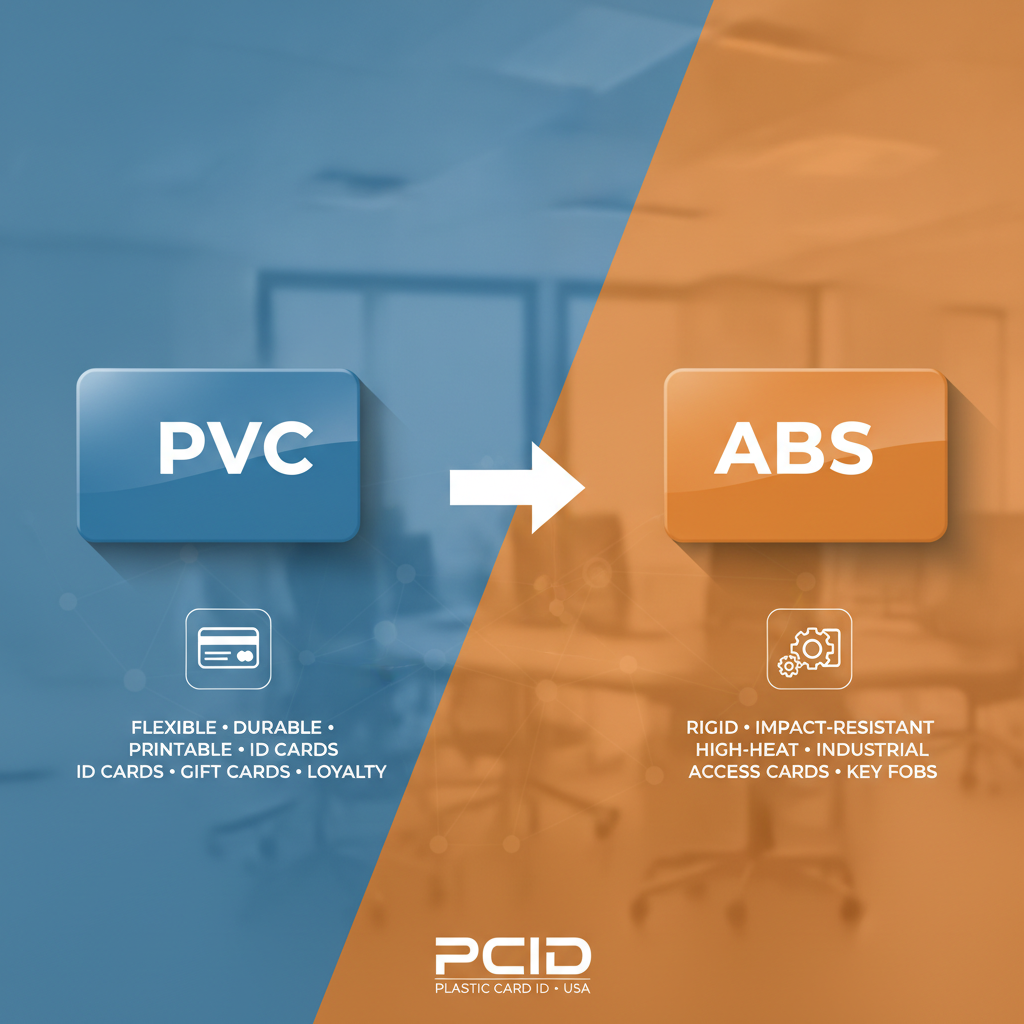 Framing this as a competition misses the point. The real answer is that PVC is the right choice for the overwhelming majority of card programs run by U.S. businesses and organizations today. ABS occupies a narrow legacy niche with limited active relevance to modern card programs. But understanding the specific scenarios where each material performs best - or fails - helps buyers make decisions confidently rather than by default.
The table earlier in this page gives a quick-reference comparison. What follows digs into the practical decision factors that actually drive purchasing outcomes for loyalty programs, access control systems, ID programs, hotel key card operations, and membership organizations.
Program Types Best Served by PVC Cards
- Employee ID and Badge Programs: Dye-sublimation printing on PVC produces photo-quality ID cards that hold up through years of daily badge-holder use without fading or cracking.
- Loyalty and Rewards Cards: PVC cards that live in wallets drive measurably better engagement than paper alternatives. Retailers see 35-50% sales increases when switching to plastic gift and loyalty cards.
- Membership Cards: The feel and permanence of a PVC membership card signals credibility and institutional seriousness that paper and ABS alternatives cannot match.
- Hotel Key Cards: LoCo magnetic stripe PVC cards are the industry standard for hotel room key programs, offering reliable encoding and rewriting through multiple guest cycles.
- Access Control Credentials: Proximity cards and RFID smart cards on PVC substrates integrate cleanly with major access control platforms without compatibility concerns.
- Casino Player Cards: High-use programs with intensive swipe cycles demand the stripe durability that HiCo PVC cards deliver consistently over long program lifespans.
- Event Credentials and Badges: Printed PVC cards for conferences, trade shows, and events present professionally and hold up through multi-day wear without deteriorating.
The Cost Argument: PVC Wins at Scale
Blank PVC CR80 cards are priced competitively precisely because volume demand keeps manufacturing costs efficient. The more cards you order, the lower the per-card cost drops - a compounding advantage for organizations running ongoing programs rather than one-time print runs. ABS cards, where available, tend to carry a higher per-unit cost with fewer suppliers competing on price, which means buyers often pay more for a material that delivers less compatibility and consistency.
Total program cost is not just the card cost. It includes ribbon waste from incompatible printing, printer maintenance from substrate-related feed issues, reprinting costs from failed encodes or poor laminate adhesion, and the operational disruption of cards that fail in the field before their expected lifespan. On every one of those dimensions, PVC's cost advantage compounds over time into a materially better financial outcome for the program operator.
When ABS Might Enter the Conversation
There are narrow scenarios where ABS card specifications appear - primarily when a buyer is replacing cards in a legacy system that was originally built around ABS substrates and whose card readers were calibrated to ABS card thickness tolerances. In those cases, the driver is backward compatibility with existing infrastructure, not a preference for ABS's material properties. Even in those scenarios, confirming reader compatibility with a PVC card sample first is always the smarter first step before assuming ABS is required.
Outside of legacy system constraints, there is no common modern U.S. card program use case where ABS cards outperform PVC cards on the dimensions that matter most to program operators: printability, encode reliability, laminate adhesion, cost at scale, and compatibility with the card printers that dominate the U.S. market. The conversation about ABS is largely historical - the decision for new and growing programs is straightforward.
Buyer Tips: Getting Your Card Program Right From the Start
Card program failures are almost always avoidable. They stem from mismatched substrates, incompatible printer and ribbon combinations, under-specified card quantities, or encoding choices made without understanding the downstream reader requirements. A few hours of informed planning at the front end of a card program saves weeks of troubleshooting and thousands of dollars in avoidable waste. These tips are distilled from decades of helping U.S. organizations set up and scale card programs of every type and size.
The single most important decision is substrate - and by now you know that means PVC for virtually every modern use case. But substrate choice intersects with a set of downstream decisions that collectively determine whether your program runs smoothly or generates ongoing friction. Here is a practical framework for getting those decisions right.
Know Your Encoding Requirements Before You Order
The card you choose must match the encoding technology your readers and systems use. Ordering the wrong stripe type or the wrong RFID frequency means your cards will not work with your infrastructure - a problem that does not surface until after delivery and can delay a program launch significantly. Confirm whether your system uses LoCo or HiCo magnetic stripes, 125 kHz proximity, 13.56 MHz MIFARE, or another contactless standard before placing your order.
For access control and smart card programs, the chip type and its programmed application must also align with your existing reader hardware and software. MIFARE DESFire cards, for example, require a compatible reader platform - they will not work with 125 kHz proximity readers even though both technologies are described as contactless. CPE's team is equipped to help buyers navigate these specifications and avoid costly compatibility mismatches before they happen.
Match Your Card Printer to Your Substrate and Volume
Not all card printers are created equal. A single-sided, direct-to-card printer designed for low-volume ID badge printing is not the right tool for a high-throughput loyalty card program. Matching printer capability to program volume and card type is as important as choosing the right card substrate, and the two decisions are deeply interconnected. Evolis, Zebra, and Fargo each offer printers calibrated for specific volume ranges and output types.
Printer ribbons must match the printer model and the card substrate. Using a ribbon formulated for a different printer model or a different substrate introduces output quality problems that are often misdiagnosed as printer malfunctions. Sourcing cards, printers, and ribbons from the same supplier - rather than mixing sources - eliminates a significant category of compatibility risk and simplifies troubleshooting when issues arise.
Contact Plastic Card ID at 800.835.7919 to Confirm Your Specifications
The fastest way to get your card program specification right is to speak directly with an expert who has seen the full range of program types and common failure modes. CPE has served over 100,000 customers across the United States and has helped organizations ranging from small retail boutiques to large enterprise access control operations select the right cards, encodings, printers, and accessories for their specific needs.
Whether you are starting a new program from scratch or troubleshooting an existing one, a conversation with Plastic Card ID at 800.835.7919 is the most efficient first step. There is no obligation, and the guidance you receive will be specific to your program's requirements - not generic advice that fits no one's situation precisely.
The Full Plastic Card ID Product Ecosystem
Understanding PVC vs. ABS is one piece of a larger picture. Running a successful card program means having access to the right cards, the right printers, the right supplies, and the right support - all from a supplier who understands how those elements work together. Plastic Card ID operates as a strategic partner in your card program, not just a box-shipping vendor, and that distinction shows up in the depth of the catalog and the quality of the guidance available to every customer.
The product range spans blank PVC cards in every common format, custom-printed cards for organizations that want professional design without in-house printing infrastructure, a full lineup of card printers from the three dominant brands in the U.S. market, and all the supporting supplies - ribbons, cleaning kits, card carriers, sleeves - that keep a card program running smoothly. Mailing and card affixing services round out a genuinely end-to-end capability that most buyers find eliminates the need for multiple vendors entirely.
Blank Cards and Custom Stock
Blank PVC CR80 cards are the workhorse of in-house card programs. They give organizations total design control, allowing a single card stock order to support multiple program types depending on what is printed or encoded onto the card. A blank card becomes an employee badge, a loyalty card, an event credential, or an access token - the substrate is the constant, and the program-specific information is variable. This flexibility is a major cost advantage for organizations managing multiple card programs simultaneously.
Colored PVC card stock, frosted cards, clear cards, and custom die-cut formats extend design possibilities for organizations that want their cards to stand out in a wallet. Magnetic stripe cards, RFID proximity cards, and smart chip cards are available as blank stock, allowing organizations with in-house encoding equipment to program cards to their own specifications rather than paying for pre-encoded product they could produce more cost-effectively themselves.
Card Printers: Evolis, Zebra, and Fargo
The three printer brands carried by Plastic Card ID represent the full spectrum of card printing capability available in the U.S. market. Evolis printers are known for compact, reliable single-card and batch printing at low to mid volumes - an excellent choice for front-desk ID issuance or small loyalty programs. Zebra printers offer rugged performance and high-volume throughput for organizations printing hundreds or thousands of cards per run. Fargo printers combine print quality with security features like holographic overlaminates, making them popular for government, healthcare, and enterprise ID programs.
Choosing the right printer is not about brand preference - it is about matching the printer's capabilities to the specific demands of your card program. Volume, card type, encoding requirements, and security feature needs all factor into the decision. CPE helps buyers navigate this selection with direct, practical guidance based on the actual card program requirements - not a sales pitch for the highest-margin model.
Supplies, Accessories, and Fulfillment Services
A card program is only as reliable as its supply chain. Running out of printer ribbon mid-run, using a cleaning kit that is incompatible with your printer model, or storing cards improperly and introducing static damage are all common operational failures that disrupt programs unnecessarily. Sourcing all supplies from the same supplier as your cards and printers eliminates compatibility uncertainty and simplifies reordering into a single vendor relationship.
Card carriers and sleeves protect cards in transit and in storage, extending usable card life and maintaining print quality from warehouse to wallet. Card affixing and mailing services allow organizations to outsource the physical fulfillment step entirely - cards arrive ready to distribute, dramatically reducing the internal labor cost of program management. For organizations scaling programs rapidly, these services represent a meaningful operational advantage that compounds as volume grows.
Ready to build or scale your card program with the right substrate, the right printer, and the right support behind you? Contact Plastic Card ID today and put 25 years of card program expertise to work for your organization.
Make the Right Choice with Plastic Card ID
The difference between PVC and ABS plastic cards is not an academic question - it is a practical one with real consequences for print quality, encode reliability, printer compatibility, program cost, and card longevity. PVC is the clear choice for modern U.S. card programs across virtually every application: loyalty, membership, ID, access control, hotel keys, casino player cards, event credentials, and beyond. ABS occupies a narrow legacy niche that has little bearing on the decisions facing most buyers today.
Plastic Card ID has spent over 25 years helping organizations across the United States make exactly these kinds of decisions - and make them well. With over 100,000 customers served, more than 50 million cards sold, and a catalog that spans every major card type, printer brand, and supporting supply category, CPE is positioned to be the last card supplier you will ever need to find. The knowledge, the inventory, and the commitment to long-term customer success are all here.
Call Plastic Card ID at 800.835.7919 today. Whether you are sourcing blank PVC cards for the first time, upgrading an existing program, or scaling to mass production volumes, the team at Plastic Card ID is ready to help you get it right - from the first card to the fifty-millionth.
Previous Page