Blank Plastic Cards for Library Cards
Table of Contents []
- Why Plastic Card ID Is the Trusted Source for Library Card Programs Across the USA
- The Full Range of Blank Plastic Cards Available for Library Use
- Choosing the Right Card Printer for Your Library's Blank Card Program
- Specialty Card Options That Expand What Your Library Can Offer
- How Library Card Programs Scale With Plastic Card ID as a Long-Term Partner
- Frequently Asked Questions About Blank Plastic Cards for Library Cards
Blank Plastic Cards for Library Cards: The Smart Choice for Modern Library Programs
| Card Type | Best For | Popular Feature |
|---|---|---|
| Blank CR80 PVC Cards | In-house printing programs | Full design control |
| Magnetic Stripe Cards | Borrowing and account lookup | HiCo or LoCo encoding |
| Barcode-Ready Blank Cards | Integrated catalog systems | Scanner-compatible surface |
| RFID / Proximity Cards | Contactless access and check-in | Tap-and-go convenience |
| Smart Chip Cards | High-security patron ID | Encrypted data storage |
Why Plastic Card ID Is the Trusted Source for Library Card Programs Across the USA
Libraries occupy a unique space in any community - they are simultaneously public infrastructure, cultural institutions, and daily-use service hubs. The humble library card is the key that unlocks all of it. But here is the thing: not all library cards are created equal, and the material they are made from matters more than most administrators initially realize. Blank plastic cards for library cards have become the industry standard precisely because they survive real-world use in ways that paper simply cannot.
Plastic Card ID has spent well over two decades supplying blank and custom plastic cards to institutions across the United States, serving more than 100,000 customers along the way. Library programs make up a significant and deeply valued portion of that client base. Whether a small-town branch needs 200 cards a quarter or a large municipal system processes thousands of new patrons each month, CPE builds programs that scale gracefully without sacrificing quality.
The numbers tell an honest story. More than 50 million cards sold. Libraries, schools, museums, government agencies, and membership organizations all relying on the same core philosophy: plastic outperforms paper every single time. A card that survives a wash cycle, a spilled coffee, or years of wallet friction is a card that stays in service and keeps your patrons connected to your collection.
The Real Cost of Paper Library Cards
Paper punch cards and printed cardstock library cards have one apparent advantage: they look cheap upfront. And they are cheap - until you calculate the replacement rate. Paper cards crack at fold points, fade under fluorescent lighting, and deteriorate rapidly in wallets, purses, and backpacks. The result is a cycle of constant reprinting, patron frustration, and administrative overhead that quietly drains library budgets.
When libraries make the switch to blank plastic CR80 cards and print in-house, the per-card cost drops significantly over time. A 30-mil PVC card at ISO 7810 standard is built to last years, not weeks. That durability translates into fewer replacement requests, less staff time spent on re-issuance, and patrons who actually keep and use their cards rather than losing them in the bottom of a bag.
What CR80 Blank Cards Deliver for Library Operations
The CR80 format is the same size as a standard credit card - 3.375 inches by 2.125 inches - meaning it fits comfortably in any wallet alongside everything else a patron carries. That wallet-presence is not trivial. A card that lives in a wallet is a card that gets used. Loyalty programs learned this lesson years ago, and libraries that adopt the same format see measurable improvements in patron engagement and return visit rates.
Blank CR80 cards give library administrators total creative flexibility. Print your logo, patron name, barcode, photo ID, and any relevant access information directly onto the card using your in-house card printer. You control the design entirely. Update the template seasonally, add new program branding, or issue specialty cards for kids, seniors, or digital-access tiers - all without waiting on a vendor or paying custom print minimums every time.
Speaking With Our Team About Your Library Program
Every library operates differently. Some issue cards at a single circulation desk; others manage multiple branches with centralized card production. The right card and printer combination depends entirely on your volume, your existing software integrations, and your budget. That is exactly why CPE functions as a strategic partner, not just a card supplier.
When you call 800.835.7919, you are not reaching a call center script. You are reaching a team with deep experience in library card programs, patron ID systems, barcode and magnetic stripe configurations, and in-house printing setups. The conversation is always about your program and what makes it run better.
The Full Range of Blank Plastic Cards Available for Library Use
Libraries do not all use the same technology, and Plastic Card ID does not offer a one-size-fits-all solution. The catalog spans the full spectrum of blank plastic card types, from simple white PVC stock all the way to RFID smart cards with contactless capability. Each card type serves a distinct purpose, and knowing which one fits your operation is the first step toward building a program that actually works.
What makes CPE genuinely different is the breadth of that catalog paired with real guidance about what belongs in it. Too many libraries have purchased card stock that is incompatible with their printers, or magnetic stripe cards with the wrong coercivity for their ILS software. Those are avoidable mistakes when you have an experienced team walking you through the decision.
Blank White PVC Cards: The Workhorse Option
Standard blank white CR80 PVC cards are the most popular choice for library programs operating their own card printers. Available in 30 mil thickness, these cards accept dye-sublimation and direct-to-card printing beautifully, producing sharp barcodes, legible text, and vibrant full-color graphics. They are the foundation of any effective in-house card program, and they are available in quantities from modest batches to bulk orders of tens of thousands.
The economics of blank white cards are compelling. A library printing 500 cards a month using a quality card printer and a steady supply of blank stock quickly achieves a cost-per-card that is a fraction of outsourced printing. Add in the speed advantage - printing cards on demand rather than waiting for shipments - and the operational case for in-house production becomes undeniable.
Magnetic Stripe Blank Cards for Integrated Library Systems
Many library management platforms - Polaris, Sierra, Koha, Destiny, and others - rely on magnetic stripe data for patron account lookup at self-checkout kiosks, circulation desks, and book drop stations. Blank magnetic stripe cards from CPE are available in both High Coercivity (HiCo) and Low Coercivity (LoCo) configurations. Most library applications call for HiCo at 2750 Oe, which resists accidental demagnetization far better than LoCo stock.
The magnetic stripe runs across the back of the card in the standard ISO position, compatible with all major card encoder hardware. Libraries can print patron information on the front while encoding account data on the stripe simultaneously using a dual-sided printer with an encoding module. It is a seamlessly efficient workflow once the setup is right.
RFID and Proximity Cards for Modern Library Access
Contactless is no longer a luxury feature - it is increasingly expected. RFID and proximity cards allow patrons to tap in at turnstiles, self-checkout terminals, computer lab stations, and study room access points without fumbling for a card to swipe. For high-volume urban libraries processing hundreds of patron interactions daily, the speed difference is significant.
Plastic Card ID carries proximity access cards and RFID smart cards including MIFARE DESFire options for libraries requiring encrypted, high-security contactless credentials. These cards look identical to standard blank PVC stock from the outside, meaning they print and badge identically on your existing equipment. The intelligence is embedded inside, invisible and durable.
Choosing the Right Card Printer for Your Library's Blank Card Program
A blank card is only as good as the printer that personalizes it. Plastic Card ID supplies card printers from three of the industry's most respected manufacturers - Evolis, Zebra, and Fargo - covering everything from compact single-sided desktop units to high-volume dual-sided printers with lamination modules. Pairing the right printer with the right blank card stock is where programs succeed or struggle, and it is a decision worth making carefully.
Libraries have specific requirements that differ from corporate ID programs or retail gift card operations. Barcode print quality must be scanner-verified. Photo capture integration matters for patron photo ID programs. Encoding modules need to be compatible with ILS software. Getting this combination right is what separates a smooth card program from a constant headache.
Entry-Level Printers for Small Branch Libraries
A small branch library issuing 50-200 cards per month does not need an industrial-grade printer. Compact desktop card printers from Evolis offer quiet operation, clean single-sided printing, and easy ribbon replacement - ideal for a circulation desk environment where space is limited and staff rotate frequently. Setup is straightforward, and replacement ribbons are readily stocked by CPE.
Entry-level printers in the $400-$800 range deliver excellent output for patron photo IDs, barcode library cards, and basic membership credentials. For libraries just transitioning from paper to plastic, starting here makes practical sense. The investment pays back quickly when you factor in the reduced replacement card costs and patron retention improvements.
Mid-Range and High-Volume Solutions for Larger Systems
Multi-branch library systems and larger municipal libraries need throughput. Dual-sided printers from Zebra and Fargo handle high-volume card runs efficiently, printing and encoding patron cards in a single pass. Lamination modules add a protective overlay that extends card life even further, reducing wear on the printed surface for cards that see daily handling.
High-volume units range from approximately $1,200-$3,500 depending on configuration, encoding options, and lamination capability. For systems processing thousands of new patron registrations each year, the cost efficiency at scale is substantial. A well-configured printer pays for itself faster than most library administrators expect.
Supplies, Ribbons, and Cleaning Kits
The ongoing costs of a card program are not just the cards themselves. Printer ribbons, cleaning kits, and card carriers are consumables that need reliable restocking. CPE supplies the full range of compatible ribbons for Evolis, Zebra, and Fargo printers, along with cleaning cards and kits that keep print heads performing at their best. Neglecting printer maintenance is the most common cause of premature print head failure, and it is entirely preventable.
Ordering supplies through the same source as your blank cards simplifies procurement and eliminates compatibility guesswork. Libraries can call 800.835.7919 to set up recurring supply orders that keep stock levels consistent without requiring manual reordering each time.
Specialty Card Options That Expand What Your Library Can Offer
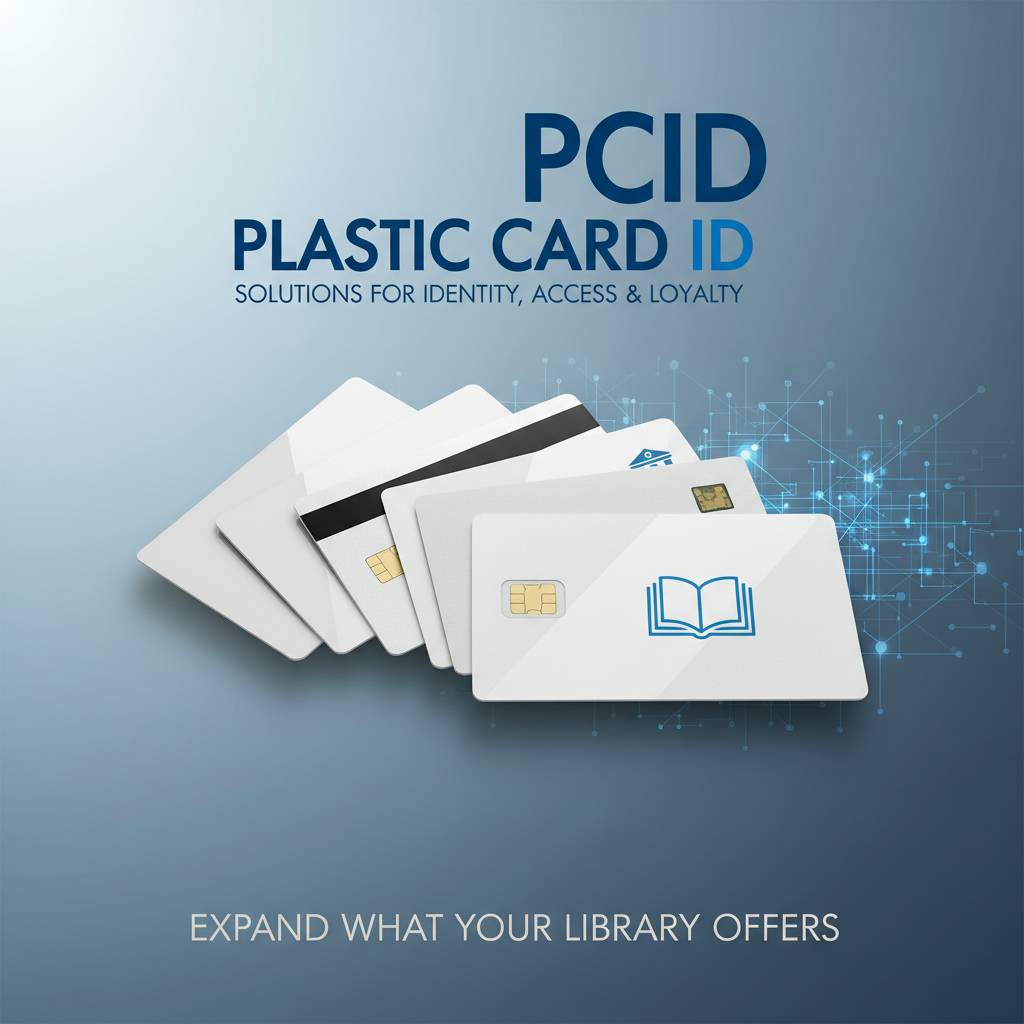 The modern library is not just a book-lending institution. It is a community hub offering digital access, event spaces, maker labs, after-school programs, and partner organization services. The card that represents membership in that experience can be more than a basic barcode card. Plastic Card ID offers specialty card options that let libraries create credentials worthy of what they actually offer.
Specialty does not necessarily mean expensive. Even a clear frosted card stock or a colored PVC base can dramatically elevate the perceived value of a library membership card. Patrons who feel proud of their card are more likely to keep it, display it, and think of the library as an institution worth engaging with regularly.
Clear and Frosted Plastic Cards
Clear and frosted blank plastic cards offer a striking visual alternative to standard white stock. A barcode or patron number printed on a frosted card has a premium, professional appearance that communicates institutional quality. For libraries that issue tiered membership levels - standard, premium digital access, or partner organization credentials - clear and frosted cards create instant visual differentiation that patrons notice and appreciate.
These cards print using the same in-house equipment as standard white stock. The frosted surface accepts dye-sublimation printing cleanly, and the resulting cards are every bit as durable as their standard counterparts. Libraries have used frosted stock for staff ID badges, event volunteer credentials, and library foundation donor recognition cards with excellent results.
Colored Card Stock for Program Differentiation
Pre-colored blank PVC cards let libraries create instant visual sorting systems without printing a background color on every card. Issue yellow cards for youth program members, blue for adult cardholders, and red for staff ID - the visual system works at a glance, speeds up circulation desk operations, and reduces the ink consumption of your card printer simultaneously.
Colored stock is available in a range of standard colors from CPE, with quantities that work for both small branch programs and large centralized systems. It is a deceptively simple operational upgrade that libraries consistently find valuable once they implement it.
Buyer Tips: Selecting the Right Blank Card Specification
- Match coercivity to your ILS: Confirm whether your library management software and hardware require HiCo or LoCo magnetic stripe cards before ordering.
- Verify card thickness: Most card printers are calibrated for 30 mil CR80 cards. Using non-standard thickness can cause feed errors and printer damage.
- Consider surface coating: Glossy-coated cards produce sharper photo IDs; matte-coated cards reduce glare and fingerprinting on frequently handled cards.
- Test RFID compatibility: If your library uses contactless terminals, verify the chip frequency (125 kHz vs. 13.56 MHz) matches your reader hardware.
- Order sample packs first: When switching card stock suppliers or trying a new card type, request samples to test print quality and encoder compatibility before committing to bulk quantities.
How Library Card Programs Scale With Plastic Card ID as a Long-Term Partner
A library's card program is not a one-time purchase decision. It is an ongoing operational commitment that evolves as patron populations grow, technology upgrades, and program offerings expand. The difference between a supplier relationship and a strategic partnership becomes obvious over time - one fills orders, the other helps programs grow intelligently.
CPE works with library clients across the full lifecycle of their card programs. That means helping a new branch library set up its first in-house printing operation, assisting an established system in migrating from magnetic stripe to contactless RFID credentials, and supporting a municipal library network as it scales from hundreds to tens of thousands of active cardholders.
Starting Small: Programs From 50 Cards a Month
Not every library needs industrial volume. A small specialized library, a school library expanding to a plastic card system, or a library branch in its first year of operation may only need 50-100 cards per month. Plastic Card ID accommodates those programs without minimums that make small-scale purchasing impractical. Starting small and scaling up is a completely viable path, and the team is experienced in helping libraries grow their programs over time.
The initial investment in a basic card printer and a modest supply of blank cards is genuinely accessible. Libraries in this category often find that the in-house card printing setup they start with serves them reliably for five or more years before an upgrade is warranted. Good equipment and quality blank stock go a long way on a measured budget.
Scaling to Mass Production for Large Municipal Systems
At the other end of the spectrum, large urban library systems issuing tens of thousands of cards annually have entirely different requirements. High-throughput printers, bulk blank card orders, centralized encoding and personalization workflows, and multi-branch distribution logistics all come into play. CPE has the catalog depth and operational experience to support programs at this scale without missing a beat.
Bulk card pricing makes large-volume programs economically strong. The per-card cost at scale drops to a point where even premium card types - magnetic stripe, RFID, laminated - become cost-effective compared to outsourced card production. Libraries running at this volume often find that bringing card production fully in-house saves $15,000-$40,000 annually compared to vendor-printed card orders.
Card Affixing, Mailing, and Fulfillment Services
Some library systems prefer to mail new patron cards rather than requiring an in-person pickup. Plastic Card ID offers card affixing and mailing services that allow libraries to outsource the fulfillment piece entirely. Cards can be affixed to welcome letters, inserted into card carriers, and mailed directly to new patron addresses - reducing front-desk workload and extending library access to patrons who cannot easily visit in person.
Card carriers and protective sleeves are also available for libraries that issue cards at the circulation desk and want to present them with a professional, polished appearance. These small details reinforce the value of library membership in ways that patrons consciously and subconsciously register. Presentation matters, even for a library card.
Frequently Asked Questions About Blank Plastic Cards for Library Cards
Libraries researching blank plastic card programs often arrive with the same core questions. What follows addresses the most common ones directly, based on real conversations with library administrators across the United States.
What Is the Standard Card Size and Thickness for Library Cards?
The industry standard is the CR80 format: 3.375 inches by 2.125 inches, at 30 mil (0.030 inch) thickness. This matches the ISO 7810 ID-1 specification and is the same size as a standard credit card or driver's license. Virtually all consumer and commercial card printers are designed around this standard, and all of CPE's blank card offerings are available in CR80 format. The 30 mil thickness provides the durability libraries need without being too rigid for normal wallet use.
Some specialty applications use 20 mil cards for keychain-sized credentials or thicker 40 mil cards for high-durability applications, but for standard library patron cards, 30 mil CR80 is the correct specification in nearly every case.
Do I Need Magnetic Stripe Cards, Barcode Cards, or RFID Cards?
The answer depends entirely on the technology your library management system uses for patron account lookup. Most traditional ILS platforms encode patron data on a magnetic stripe, and HiCo magnetic stripe blank cards are the appropriate choice for those systems. Libraries using barcode-based lookup can print patron barcodes directly onto standard blank white cards using any quality card printer. Libraries upgrading to contactless check-in and access control should explore RFID or proximity card options.
If you are unsure which specification matches your system, the team at CPE can help you confirm compatibility before you place an order. Reaching out to 800.835.7919 with your ILS software name and current hardware setup is the fastest way to get a definitive answer.
How Many Cards Should I Order at Once?
Order quantity depends on your monthly issuance rate and storage capacity. A reasonable starting point is a three-to-six month supply based on your current patron registration volume. Ordering too few means frequent reorders and potential stock-outs during busy enrollment periods; ordering too many ties up budget in inventory. For most small-to-mid-size library programs, an initial order of 500-2,000 blank cards covers the first quarter comfortably and allows you to dial in your actual consumption rate before committing to larger bulk pricing.
Bulk orders significantly reduce the per-card cost, so libraries with predictable high volume should absolutely explore pricing at the 5,000, 10,000, and 25,000 card tiers. The savings compound meaningfully over a full year of card production.
Ready to build a better library card program? Contact Plastic Card ID today and speak with a card program specialist who understands exactly what libraries need.
Call 800.835.7919 now and let Plastic Card ID put 25 years of card program experience to work for your library.
Previous Page