How Long Do Blank Plastic Cards Last?
Table of Contents []
- How Long Do Blank Plastic Cards Last? Everything Plastic Card ID Customers Need to Know
- Magnetic Stripe Cards: Does the Stripe Outlast the Card?
- RFID and Smart Chip Cards: Longevity Beyond the Card Surface
- Blank Card Storage: Maximizing Shelf Life Before You Print
- Card Accessories That Extend Useful Life in the Field
- Specialty Cards: Durability at the Premium End of the Spectrum
- Partner With Plastic Card ID for Cards Built to Go the Distance
How Long Do Blank Plastic Cards Last? Everything Plastic Card ID Customers Need to Know
Pull a plastic card from your wallet right now. Chances are, it still looks sharp. The magnetic stripe reads cleanly, the surface hasn't cracked, and the print hasn't faded into oblivion. That staying power is not accidental - it is engineered. When businesses ask how long blank plastic cards last, the answer is more nuanced and more impressive than most expect.
Standard CR80 PVC cards - the ISO 7810-compliant 30-mil cards that serve as the backbone of employee badge programs, loyalty card systems, membership wallets, and access control setups - are built to outlast the programs that use them. Under normal handling conditions, a quality blank PVC card can last anywhere from three to ten years, sometimes longer. The variables that determine exactly where on that spectrum your cards land are worth understanding before you order your next batch.
The Core Material: What PVC Cards Are Actually Made Of
Polyvinyl chloride - PVC - is the industry standard for a reason. It's rigid enough to maintain shape, flexible enough to resist snapping, and chemically stable enough to hold printed graphics and encoded data for years. The 30-mil thickness (roughly 0.76mm) of a standard CR80 card is not arbitrary; it matches the dimensions used across virtually every card printer, card reader, and card slot in professional use.
Composite cards, which blend PVC with polyester, push durability even further. These are common in high-use applications like casino player cards or hotel key cards where the card passes through readers dozens of times per week. For most blank card applications, however, standard PVC delivers outstanding longevity without the added cost of composite materials.
Environmental Factors That Affect Card Lifespan
Heat is the silent enemy of plastic cards. Leaving cards on a dashboard in direct summer sunlight, storing them near heating vents, or running them through a dryer (it happens more than you'd think) can warp even a high-quality card within minutes. Ideal storage conditions sit between 65 and 75 degrees Fahrenheit, away from direct UV exposure and humidity extremes.
Moisture matters too, though PVC is inherently water-resistant. The real risk is not the card surface itself but the printed graphics or the adhesive layers in laminated cards. Cards stored in damp environments over long periods can experience delamination - where the protective overlay begins to separate from the card core. Keeping blank cards in sealed packaging until they are ready to print or issue is a best practice that pays off.
Physical Wear and Everyday Handling
Cards that live in wallets rub against keys, coins, and other cards constantly. Cards used as access credentials get swiped, inserted, tapped, and occasionally dropped. The surface of a PVC card is more resilient than it looks, but abrasion accumulates. A card that gets swiped through a magnetic reader fifty times a week will age differently than a membership card tucked in a loyalty wallet and used twice a month.
Blank cards - those not yet printed - are actually in their most durable state. They have no ink layers to scratch, no laminate to peel. Once printed, the durability of the finished card depends significantly on whether a laminate overlay was applied and how thick it is. High-traffic ID cards benefit enormously from 1-mil laminate overlays that protect the printed surface.
| Card Type | Typical Use Frequency | Estimated Lifespan |
|---|---|---|
| Blank CR80 PVC (stored) | Unused / inventory | 10 years |
| Employee ID / Badge | Daily swipe/tap | 3-5 years |
| Loyalty / Membership Card | Weekly use | 5-7 years |
| Gift Card | Occasional use until depleted | 2-4 years |
| Hotel Key Card | Multiple swipes daily | 1-3 years |
| Casino Player Card | Frequent reader insertion | 2-4 years |
Magnetic Stripe Cards: Does the Stripe Outlast the Card?
Magnetic stripe cards introduce a second lifespan variable beyond the card body itself. The stripe - whether HiCo (high-coercivity) or LoCo (low-coercivity) - is a magnetic layer bonded to the back of the card. Its longevity depends on both the quality of the stripe and the conditions it encounters in daily use.
HiCo stripes, encoded at 2750 Oersteds, are significantly more resistant to accidental erasure from magnetic fields than their LoCo counterparts. If your cards are going to encounter cash register environments, magnetic clasps on bags, or proximity to other magnetic equipment, HiCo is almost always the right choice. LoCo stripes (at 300 Oersteds) are better suited for short-term applications like hotel key cards where cards are reprogrammed frequently anyway.
HiCo vs. LoCo: A Practical Comparison
The coercivity rating of a magnetic stripe determines how much magnetic force it takes to alter or erase the data stored on it. High-coercivity stripes require a stronger magnetic field to write - and therefore a stronger field to accidentally erase. For most business loyalty programs, access systems, and ID applications, HiCo is the standard choice and the one CPE recommends for programs expecting more than a few months of active use.
LoCo has its place. Hotel keycards are the classic example - the card is programmed at check-in, used for a few days, and reprogrammed or discarded at checkout. There is no expectation of long-term magnetic data stability, and LoCo works perfectly for this temporary-access model. Knowing the difference means choosing wisely and not overpaying for features you do not need.
Protecting Magnetic Stripe Data Over Time
Even a pristine HiCo stripe can degrade if stored improperly. Keep bulk card inventory away from magnetic fields, and never store cards directly against magnetic closures or magnetic name badge holders. When shipping or storing large quantities, the cards in the middle of a stack are well-protected; it is the top and bottom cards that face the most exposure risk.
Readers themselves can also accelerate stripe wear. Dirty card reader heads - contaminated with dust, card residue, or debris - act like sandpaper on the stripe surface. Regular reader maintenance with cleaning cards is one of the most overlooked but most impactful ways to extend the usable life of your magnetic stripe cards.
When to Replace Rather Than Repair
There is no practical way to restore a worn magnetic stripe. Once the data encoding becomes inconsistent or the stripe physically degrades to the point where readers fail, replacement is the only path forward. The good news: with high-quality HiCo cards in moderate-use programs, you may go three to five years before hitting that threshold.
Contact 800.835.7919 to discuss the right magnetic stripe specification for your specific program - the investment in the right stripe type upfront avoids costly re-issuance campaigns down the road.
RFID and Smart Chip Cards: Longevity Beyond the Card Surface
Proximity cards and RFID smart cards add an electronic layer to the longevity equation. The card body remains standard PVC, but embedded within it is an antenna coil and - in smart card configurations - a microchip. How long does that internal technology last? Longer than most people assume.
RFID inlays embedded in cards typically carry read/write cycle ratings in the hundreds of thousands. MIFARE DESFire chips, for instance, are specified for up to 500,000 write cycles and a data retention period of 10 years or more. For most access control applications - even in busy commercial environments - the card body will experience more physical wear than the embedded technology will experience functional degradation.
Proximity Cards in Access Control Systems
125kHz proximity cards used in standard access control setups are passively powered - they carry no battery, no charging requirement, and no moving parts. The lifespan of a prox card is almost entirely determined by its physical condition. Cards that crack, warp, or get exposed to strong electromagnetic interference may fail before the internal technology would have. Protecting the card body is, in effect, protecting the access credential.
Organizations running large access control programs often replace cards on a scheduled basis - every three to five years - not because the technology fails but because employee turnover and security protocols require regular credential refreshes. Bulk ordering blank proximity cards allows HR and security teams to maintain a ready inventory for immediate issuance.
Smart Chip Cards and Data Retention
Contact smart chips - the gold-padded chips visible on the card face - are rated for thousands of insertion cycles. In high-volume applications like transit passes or building access where cards are inserted into contact readers repeatedly, the physical contact pad can show wear before the chip itself fails. Contactless smart cards avoid this entirely, relying on RF communication rather than physical metal-to-metal contact.
For organizations running closed-loop smart card programs - facility management, campus ID systems, event credentialing - the data retention specifications of cards like MIFARE DESFire EV2 and EV3 make them effectively lifetime credentials within any reasonable program cycle. CPE carries a full range of RFID and proximity card options to fit both budget and technical requirements.
Casino and Hospitality Card Durability Considerations
Casino player cards represent one of the most demanding card use cases. They pass through slot machine readers and table game terminals constantly, are carried loose in pockets and purses, and are sometimes subjected to spills and rough handling. Composite PVC-polyester blends are the material of choice in casino environments precisely because they handle this abuse without cracking or delaminating over extended periods.
Hotel key cards, by contrast, are intentionally designed as short-lifecycle items. RFID hotel keys that tap against a door reader a dozen times per stay are low-wear applications, and the LoCo or RFID variants used in hospitality are optimized for quick reprogramming rather than multi-year endurance. Understanding the use case drives the right product selection every time.
Blank Card Storage: Maximizing Shelf Life Before You Print
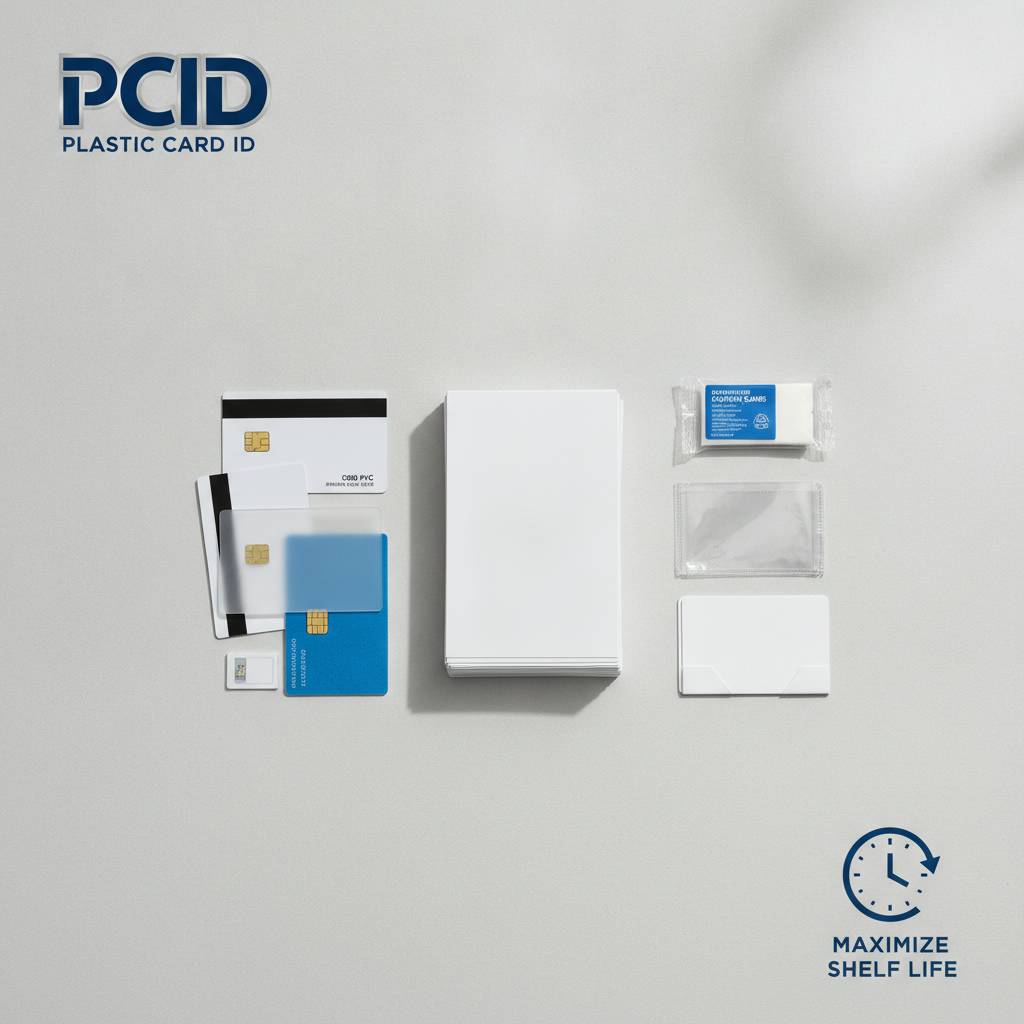 Here is a question that does not get asked often enough: how long can blank cards sit in inventory before their quality degrades? The answer, under proper storage conditions, is reassuringly long. Blank PVC cards stored correctly can maintain print-ready quality for five to ten years or more. The key is in how they are kept.
Cards are typically shipped in sealed, wrapped stacks. Keeping them in that sealed packaging until they are needed is the simplest and most effective storage strategy. Once opened, cards should be stored in a clean, temperature-controlled environment away from direct light, dust, and humidity. Cards that have absorbed moisture may cause feeding issues in card printers and can affect how well ink and ribbons bond to the card surface.
Best Practices for Bulk Card Inventory
- Store cards flat, never on edge, to prevent warping under their own weight over time.
- Keep sealed packages away from windows, heat vents, and HVAC exhaust zones.
- Maintain ambient storage temperature between 65-75 degrees Fahrenheit.
- Avoid storing near strong magnetic sources if cards include magnetic stripes.
- Rotate stock using first-in, first-out principles for high-volume programs.
- Inspect cards visually before loading into printers to catch any packaging damage early.
Organizations that maintain standing inventory of blank cards - particularly those running monthly ID badge cycles or seasonal loyalty program refreshes - benefit from ordering in quantities that balance cost savings against practical storage capacity. CPE can help you determine optimal order quantities based on your program cadence.
How Printer Ribbons Affect Final Card Longevity
The blank card is the foundation, but the finished card's durability is also shaped by what goes onto it. Dye-sublimation ribbons used in Evolis, Zebra, and Fargo card printers produce images that are embedded into the card surface rather than sitting on top of it. This results in graphics that resist smearing, scratching, and fading far better than inkjet-printed alternatives.
Overlay panels in ribbon configurations apply a clear protective coating over the printed surface in a single pass. This overlay is the front-line defense against UV fade, surface scratching, and moisture. Cards printed with full-panel overlay ribbons can maintain vibrant color and sharp text for four to seven years in typical use - a compelling argument for not cutting corners on ribbon quality.
Cleaning Kits and Reader Maintenance
The interaction between a card and a reader is bidirectional - a dirty reader degrades the card just as a worn card can contaminate a reader head. Cleaning card kits use IPA-saturated cards in standard card size to run through reader mechanisms, clearing debris and residue that accumulate with normal use. Running a cleaning card through your printer and readers every 1,000 cards (or monthly in light-use environments) meaningfully extends both card and equipment lifespan.
This is not a minor maintenance footnote. Organizations that neglect reader cleaning find themselves misattributing card failures - assuming the cards are worn out when the real culprit is a reader head coated with weeks of card residue. Cleaning kit consumables are a small investment against the cost of premature card replacement programs.
Card Accessories That Extend Useful Life in the Field
The card itself is only one part of the equation. How cards are carried, stored, and handled in the field dramatically affects how long they remain functional and presentable. Card accessories - sleeves, holders, carriers, and lanyards - are not just organizational conveniences. They are durability tools.
A card inserted into a polypropylene sleeve is insulated from direct contact with keys, coins, and other cards in a wallet or bag. The sleeve absorbs the surface scratches that would otherwise accumulate on the card itself. For cards that need to look professional throughout their entire lifespan - executive ID badges, VIP membership cards, premium loyalty cards - card sleeves are an inexpensive way to preserve first-impressions quality for years.
Card Carriers and Mailing Solutions
For programs where cards are mailed to recipients - loyalty program launches, membership renewals, gift card distributions - the card carrier serves double duty as protective packaging and branded communication vehicle. Cards affixed to carriers arrive flat, unscratched, and ready to use. The carrier creates the first impression; the card sustains it.
CPE offers card affixing and mailing services that take the operational complexity out of card distribution programs. Rather than managing envelope stuffing and label printing in-house, businesses can outsource the fulfillment entirely and receive tracking confirmation that cards reached their recipients. For programs scaling into the thousands of cards per month, this service alone represents significant labor savings.
Lanyards, Badge Reels, and Holders
ID badges worn on lanyards face a different set of wear patterns than wallet cards. The card swings freely, gets flipped around, and accumulates surface contact throughout the workday. Rigid badge holders prevent direct surface-to-surface contact, while badge reels allow controlled extension for swiping without removing the card from the holder entirely.
For high-security environments where ID cards must be visible and readable at all times, clear rigid badge holders with belt clips or lanyard loops maintain card visibility while protecting the printed surface from the elements. This is particularly relevant for construction sites, healthcare facilities, and outdoor events where cards face environmental exposure that would accelerate wear in unprotected configurations.
Specialty Cards: Durability at the Premium End of the Spectrum
Not all cards are created equal - and for certain applications, premium materials are not just a status statement but a functional necessity. Metal cards in stainless steel, brass, and gold deliver durability that simply cannot be matched by any polymer-based alternative. A metal card handled daily for a decade will show character, not failure.
Clear and frosted PVC cards occupy the middle ground between standard white stock and metal. They maintain the flexibility and printer-compatibility of standard PVC while offering a visual distinctiveness that positions the issuing brand as design-forward. Frosted cards have become increasingly popular for premium loyalty programs, executive membership cards, and high-end retail gift cards where brand differentiation at the point of presentation matters.
Metal Cards: Built to Last Indefinitely
Stainless steel, brass, and gold-finished metal cards represent the absolute upper tier of card durability. They do not crack, warp, or fade. They cannot be demagnetized accidentally. They make a sound and a weight in a recipient's hand that communicates value before a single word is read. For premium club memberships, VIP programs, and executive credentials, the durability conversation is essentially moot - these cards are built to last indefinitely.
The tradeoff with metal cards is cost and flexibility. They are heavier, they require compatible card reader configurations for any magnetic or chip-encoded variants, and they are a meaningful investment per card compared to standard PVC. For the right program, however, the ROI manifests in customer retention, brand perception, and the simple fact that recipients never throw away a metal card.
Clear and Frosted Cards for High-Impact Programs
Clear PVC cards allow businesses to let the card's background - whether a dark-colored insert, a full-color printed design, or a minimalist negative-space approach - become part of the design itself. Frosted cards diffuse light across the card surface, creating a soft visual texture that distinguishes them immediately from glossy white stock cards in any wallet.
Both clear and frosted cards carry the same fundamental durability profile as standard PVC. The material difference is optical, not structural. They can be printed on compatible dye-sublimation printers and encoded with the same magnetic stripe and RFID options available on standard stock. For organizations that want their card program to be noticed and remembered, clear and frosted cards deliver a visual punch that standard white stock simply cannot replicate.
Custom Die-Cut Shapes and Unique Formats
Standard CR80 dimensions dominate the market because they fit universal readers, wallets, and holders. But specialty programs sometimes benefit from non-standard shapes - mini cards, key tags, custom-contoured business card alternatives, or branded die-cut forms that echo a company's logo or product silhouette. These specialty formats carry the same PVC durability characteristics as standard cards in a form factor that commands attention.
Die-cut and specialty format cards are best suited for applications where they will not be inserted into standard card readers - marketing leave-behinds, event credentials worn on lanyards, or collectible loyalty tokens. For these use cases, the card is as much a marketing artifact as a functional credential, and its physical durability is part of what makes it worth keeping.
Partner With Plastic Card ID for Cards Built to Go the Distance
The question of how long blank plastic cards last does not have a single answer - it has a range of answers shaped by material selection, use environment, handling conditions, storage practices, and program design. What remains consistent across all of those variables is the value of starting with a high-quality card from a supplier that understands your application.
Plastic Card ID has spent over 25 years and more than 50 million cards learning exactly what separates a card program that performs reliably from one that generates constant re-issuance headaches. That experience is what CPE brings to every conversation - not just products, but program intelligence that helps clients make smart decisions from the first order forward.
The Right Card for the Right Program
Choosing between HiCo and LoCo magnetic stripes, standard and composite PVC, RFID proximity and smart chip, or standard and specialty formats is not guesswork when you work with a partner who has seen virtually every use case across virtually every industry. The right specification choice upfront saves significantly on replacement costs, reader maintenance, and program disruption over the life of the program.
Whether your program runs 50 cards a month or scales into tens of thousands, CPE has the inventory depth, product range, and fulfillment capability to support it without requiring you to manage multiple vendors. From blank card stock to printed ribbons to cleaning kits to card affixing and mailing - everything ships from one source.
Card Printers That Match Your Program Scale
Longevity is not just about the cards - it is about the printing system too. Evolis, Zebra, and Fargo card printers each offer different throughput, ribbon efficiency, and lamination capabilities that match different program scales. A small HR department issuing a few hundred employee badges per year has different needs than a retail chain launching a national loyalty program.
CPE helps match printer specifications to program requirements, ensuring that the investment in printing equipment performs reliably for years. Paired with the right ribbon, the right cleaning protocol, and quality blank card stock, a well-chosen card printer becomes the engine of a card program that runs smoothly for the long term.
Start Your Program or Refresh Your Supply Today
Ready to build a card program that lasts? Whether you are starting from scratch or scaling an existing program, Plastic Card ID has the products, expertise, and fulfillment capabilities to make it seamless. Call 800.835.7919 to speak with a card specialist today.
From blank CR80 stock to advanced RFID smart cards, from single ribbon packs to high-volume printing systems - Plastic Card ID is your one-stop source for plastic card programs that perform. Do not settle for cards that wear out before your program does. Call 800.835.7919 now and let us help you get it right.
Previous Page