Custom vs Pre-Printed Blank Cards - Which Is Better?
Table of Contents []
- Custom vs Pre-Printed Blank Cards: Which Is Better for Your Business? - Plastic Card ID
- Understanding the Core Difference Between Blank and Custom Printed Cards
- Cost Analysis: Blank Cards vs Custom Pre-Printed Cards Over Time
- Card Type Matters: Not Every Card Works the Same Way
- Choosing the Right Card Printer for an In-House Blank Card Program
- Buyer's Guide: How to Decide Between Blank and Custom Pre-Printed Cards
- Why Plastic Card ID Is the Right Partner for Your Card Program
Custom vs Pre-Printed Blank Cards: Which Is Better for Your Business? - Plastic Card ID
Here is a question that comes up constantly among operations managers, HR directors, event coordinators, and retail owners alike: should you order custom pre-printed cards or stock up on blank plastic cards and handle printing in-house? The answer is not as simple as picking one over the other. It hinges on volume, flexibility, timeline, and how much control you want over your card program day to day.
Both approaches work. Both have genuine strengths. But depending on your organization's size, printing infrastructure, and the pace at which your card design changes, one path tends to deliver measurably better results. This guide breaks it all down with real-world context so you can make a confident, informed decision.
| Factor | Blank Plastic Cards | Custom Pre-Printed Cards |
|---|---|---|
| Upfront Cost | Lower per-card cost | Higher per-card cost (setup fees may apply) |
| Design Flexibility | Total control, change anytime | Fixed design per print run |
| Lead Time | Cards on hand immediately | Production and shipping time required |
| Personalization | Print on demand, name by name | Variable data printing available |
| Best For | Ongoing, high-turnover programs | Large, stable, brand-consistent campaigns |
| Minimum Quantities | Low - even small batches work | Often higher minimums for cost efficiency |
Understanding the Core Difference Between Blank and Custom Printed Cards
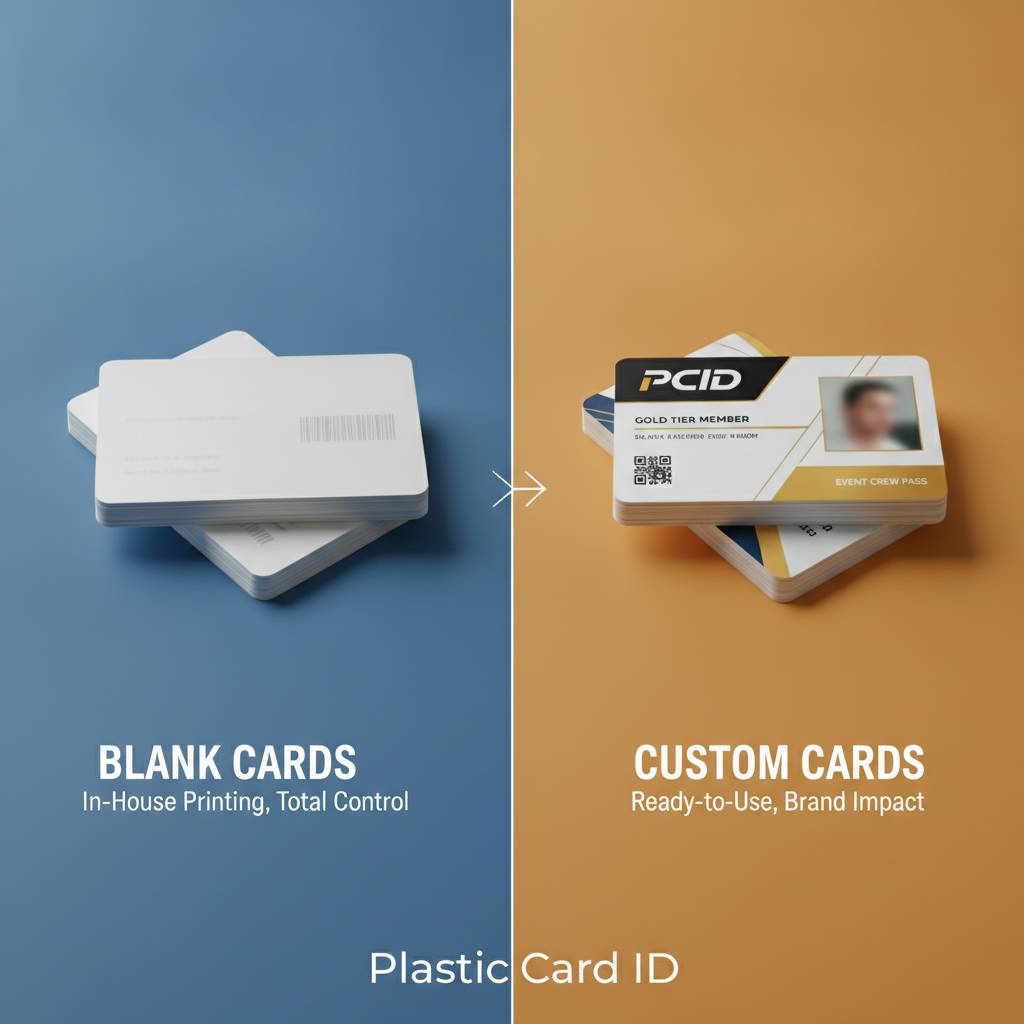
A blank CR80 plastic card is, at its most basic, a clean slate. It conforms to the ISO 7810 standard - 3.375 inches by 2.125 inches, 30 mil thick - and can be plain white PVC, colored stock, frosted, or clear. The blank card becomes whatever you need it to be once a card printer and your own design software are in the picture. Employee badge, loyalty card, access credential, event pass - same card, completely different identity depending on what gets printed or encoded.
Custom pre-printed cards flip that model. A professional print run produces finished cards - complete with your logo, brand colors, card numbers, barcodes, or magnetic stripe data - ready to distribute right out of the box. No in-house printer required, no ribbon costs, no printer maintenance. For organizations that lack card printing equipment or that need enormous quantities with pixel-perfect consistency, pre-printed cards are often the more practical path.
What Blank Cards Actually Give You
Think about a mid-sized gym with rotating membership tiers and frequent promotional periods. Their loyalty structure changes seasonally, new members join daily, and they occasionally want to issue temp passes to trial visitors. Stocking a supply of blank PVC cards and running an in-house Evolis or Zebra card printer means never waiting on a print run to respond to demand. Cards go out the same day they are needed.
Blank cards also allow for individual personalization at scale - printing a member's name, photo, card number, and membership tier right on the card as each person enrolls. That level of responsiveness is difficult to replicate with a pre-printed card model without significant variable-data printing costs. For programs with frequent membership changes, blank cards plus an in-house printer is often the smarter operational choice.
What Custom Pre-Printed Cards Actually Give You
Retail gift card programs are where pre-printed cards tend to shine brightest. A retailer rolling out a holiday gift card campaign wants thousands of cards with sharp, professional, full-color graphics - their logo, seasonal imagery, and brand identity front and center. That kind of full-bleed, vibrant print quality comes from a professional print run, not from a desktop card printer using dye-sublimation ribbon.
Pre-printed cards eliminate the need for staff to operate printing hardware, manage ribbon supplies, and maintain printer heads. For organizations that do not run cards continuously - schools issuing ID cards once a year, venues printing event credentials for a single conference - investing in a card printer may not make financial sense. A one-time or annual custom print run solves the need cleanly without ongoing equipment overhead.
When the Answer Is Actually Both
Plenty of savvy businesses use both approaches simultaneously - and for good reason. A hotel chain, for example, might order pre-printed loyalty membership cards in bulk with consistent branding, while also keeping blank cards on hand for hotel key cards that need to be encoded in-house at check-in. A corporate campus might pre-print visitor badge stock with their logo but print individual names and access levels on demand when visitors arrive.
The hybrid approach is more common than most buyers realize, and it is worth thinking about your card program in terms of which card types have stable designs versus which ones need to change frequently. That distinction alone often clarifies exactly where to use pre-printed cards and where blank stock makes more operational sense.
Cost Analysis: Blank Cards vs Custom Pre-Printed Cards Over Time
Cost comparisons between these two models are rarely as straightforward as the per-card price suggests. Blank cards are cheaper upfront - sometimes significantly so - but the total cost of ownership includes a card printer, ribbons, maintenance, and staff time. Custom pre-printed cards carry higher per-card costs but shift all production responsibility to the supplier. Running the numbers over a realistic time horizon matters enormously here.
For a business printing 200 cards per month, the math tends to favor the in-house blank card model within the first year of operation assuming they already own or can reasonably acquire a card printer. For a business that only needs cards twice a year in batches of 5,000 or more, pre-printed cards almost certainly win the cost argument. Volume and frequency are the two variables that determine which model is truly more economical.
Printer Investment and Ongoing Ribbon Costs
Entry-level card printers from respected brands like Evolis, Zebra, and Fargo typically range from $500-$1,200 for single-sided models. Full-color, dual-sided printers with encoding capabilities sit in the $1,500-$3,500 range. Ribbon costs depend on print volume - a 250-card color ribbon might cost $30-$65, bringing per-card ribbon costs to roughly $0.12-$0.26. When combined with blank card costs, total per-card production costs often land well below pre-printed card pricing at scale.
Cleaning kits and routine maintenance are a real but manageable cost that often gets overlooked in initial planning. Keeping a card printer running cleanly prolongs print head life and reduces costly repair calls. CPE stocks cleaning kits alongside ribbons and blank card inventory so clients can manage everything from one supplier without sourcing maintenance supplies separately.
Minimum Order Quantities and Run Economics
Custom pre-printed cards typically require higher minimum order quantities to achieve cost efficiency - often 250-500 cards at the low end, with significantly better per-card pricing at 1,000, 5,000, or 10,000 units. That works beautifully for stable programs where the design will not change and the quantity is predictable. It becomes a problem when you order 5,000 cards and then rebrand six months later, leaving a stockpile of outdated inventory.
Blank cards sidestep the obsolescence problem entirely. You never have a warehouse of cards that are suddenly useless because a phone number changed, a logo was updated, or a membership tier was restructured. For fast-moving organizations, that flexibility has measurable economic value that does not show up in a simple per-card cost comparison.
Hidden Costs on Both Sides
- Custom pre-printed cards: Setup fees for first-time artwork, rush production charges, shipping costs on large orders, storage space for bulk inventory
- Blank cards with in-house printing: Printer purchase or lease, ribbon and cleaning supply costs, staff training time, occasional printer servicing
- Both models: Card carriers, sleeves, and mailing services if cards are being distributed by post
- Encoding costs for magnetic stripe, RFID, or smart chip functionality may apply to either model depending on supplier and program needs
- Replacement card costs when cards are lost, damaged, or updated - blank card programs handle this faster and often more cheaply
Understanding where costs actually accumulate in your specific operation helps avoid the trap of choosing a model that looks cheaper on paper but creates workflow friction or unexpected expenses in practice. CPE works through these details with clients as a strategic partner, not just a card vendor.
Card Type Matters: Not Every Card Works the Same Way
 The blank vs. custom pre-printed debate shifts depending on what kind of card you are dealing with. A basic white PVC loyalty card is a very different product than a proximity access control card or a MIFARE DESFire smart card. Technology built into the card changes the equation significantly, and it is worth understanding which card types lend themselves to each fulfillment model.
Magnetic stripe cards - both HiCo and LoCo varieties - are commonly available as blank cards that organizations encode in-house with a magnetic stripe encoder integrated into their card printer. Smart chip cards and RFID proximity cards, however, often require more specialized encoding equipment and may be better supplied pre-encoded depending on the application. Knowing your technology requirements is step one in choosing the right fulfillment path.
Loyalty and Membership Cards
Loyalty programs are one of the highest-volume use cases for blank cards. Retailers, restaurants, salons, fitness clubs, and service businesses that run ongoing loyalty programs need a steady, affordable supply of cards that can be issued quickly and personalized to individual members. Blank loyalty cards combined with an in-house printer create a seamless enrollment experience - customers walk out with a personalized card the same day they sign up.
The impact of plastic loyalty cards over paper punch cards is not subtle. Plastic cards live in wallets. Paper cards get lost, soggy, and forgotten. Programs that make the switch to plastic consistently report higher redemption rates and stronger customer retention. When retailers upgrade from paper to plastic gift and loyalty cards, sales increases in the 35-50% range have been documented repeatedly across different retail categories.
ID Cards, Employee Badges, and Access Credentials
Employee ID and access credential programs are among the most compelling use cases for blank cards with in-house printing. Staff turnover, contractor access, new hire onboarding - these are not predictable events that lend themselves to waiting on an outside print run. A blank card inventory and a reliable card printer means a new badge can be issued in minutes.
For access control applications involving proximity cards or smart chips, the card itself typically arrives with encoding already in place from the manufacturer - but the visual identity layer (employee photo, name, department, access tier) can still be printed in-house using a compatible card printer. This hybrid approach is standard practice in corporate and campus security programs across the country.
Event, Hospitality, and Specialty Cards
Event credentials, hotel key cards, and casino player cards tend to favor different models. Hotel key cards need to be encoded at check-in for each individual guest - a perfect in-house blank card application. Casino player cards, on the other hand, are often pre-printed with casino branding in high-quality full color and encoded with player tracking data either at the casino or in advance. Specialty options like clear plastic cards, frosted stock, custom die-cut shapes, and luxury metal cards in stainless steel, brass, or gold are generally ordered as custom pre-printed products given the manufacturing complexity involved.
If you are running a one-time conference or trade show, pre-printed event credentials with your event branding are often the right call. If you are managing a recurring event series with variable attendee lists, blank stock that gets printed as registrations come in gives you much better agility and fewer waste cards at the end of each event.
Choosing the Right Card Printer for an In-House Blank Card Program
If the blank card path makes sense for your organization, printer selection becomes one of the most consequential decisions in building your card program. The right printer for a 50-cards-per-month HR department looks nothing like the right printer for a retail chain issuing thousands of loyalty cards per week. Getting this match right from the start avoids expensive equipment upgrades down the road.
CPE carries printers from three industry-leading brands: Evolis, Zebra, and Fargo. Each brand has distinct strengths depending on volume requirements, encoding needs, and budget parameters. Understanding those differences helps buyers invest in equipment that genuinely fits their operation rather than overspending on capabilities they will not use or underspending and hitting limitations quickly.
Evolis Printers: Elegance and Reliability for Mid-Volume Programs
Evolis card printers have earned a strong reputation for print quality and ease of use, particularly in environments where card printing is done by staff who are not IT specialists. Models like the Primacy and Zenius series handle single-sided and dual-sided printing cleanly, with intuitive ribbon loading and straightforward driver software. For programs printing 50-500 cards per month, Evolis printers consistently deliver outstanding results without demanding significant technical overhead.
Evolis also offers retransfer printing options for cards that require edge-to-edge color coverage or that involve smart chip windows and other surface irregularities. The Avansia retransfer printer is a particularly strong choice for organizations that need professional-grade output competitive with offset print quality. For buyers who contact CPE at 800.835.7919, guidance on matching the right Evolis model to your specific volume and encoding needs is part of the standard consultation process.
Zebra and Fargo Printers: Workhorses for Higher-Volume Environments
Zebra card printers - particularly the ZC series - are designed for durability and high throughput. Organizations printing thousands of cards per month in demanding environments benefit from Zebra's robust construction, fast print speeds, and extensive encoding options including magnetic stripe, smart card, and contactless technology. Zebra printers integrate smoothly into enterprise card management systems, making them a natural fit for corporate HR departments, universities, and government agencies.
Fargo printers, manufactured by HID Global, are particularly well regarded in the access control and security credentialing space. The Fargo HDP series uses retransfer printing technology to produce ID cards with exceptional clarity and durability - a critical attribute when cards need to withstand daily handling, weather exposure, and proximity to access readers over a multi-year lifespan. For high-security applications, Fargo's lamination options add another layer of card durability and anti-tampering protection.
Ribbons, Supplies, and Keeping Your Printer Running
A card printer is only as good as the supplies feeding it. Using off-brand or incompatible ribbons is one of the most common ways organizations accidentally damage their print heads - an expensive repair that proper ribbon discipline almost entirely prevents. CPE stocks OEM and compatible ribbons for Evolis, Zebra, and Fargo printers alongside cleaning kits designed to keep print mechanisms in peak condition.
Stocking a small supply inventory - a few ribbon boxes, a cleaning kit, and a supply of blank cards to avoid last-minute rush orders - is a best practice that saves both money and operational stress. Running out of ribbon on a Monday morning when a new hire starts is the kind of problem that is entirely preventable with modest supply management discipline.
Buyer's Guide: How to Decide Between Blank and Custom Pre-Printed Cards
If you have made it this far and still feel uncertain which direction to go, you are in good company. Most buyers find that the decision clarifies quickly once they work through a few structured questions about their program's actual operating characteristics. The goal is not to find the "right answer" in the abstract - it is to find the right answer for your specific situation.
Below is a practical framework that CPE uses when consulting with new clients. Running through these questions honestly tends to surface the right model within minutes.
Key Questions to Ask Before You Order
- How many cards do you expect to issue per month, and how predictable is that volume?
- How often does your card design change - seasonal updates, rebranding, new tiers or services?
- Do you need to personalize individual cards with names, photos, or unique numbers?
- Do you currently own a card printer, or would this purchase require acquiring one?
- How quickly do you typically need to issue cards - same day, within a week, or on a planned schedule?
- Is your card design stable and your volume large enough to justify a professional print run?
- Do your cards require encoding - magnetic stripe, RFID, smart chip, or proximity technology?
A business that answers "daily personalization, same-day issuance, frequent design changes" to those questions should almost certainly be running a blank card program with an in-house printer. A business that answers "stable design, twice-yearly orders, no personalization needed" should probably be ordering custom pre-printed cards. Most programs fall somewhere in between - which is exactly where CPE helps clients build a card program that blends both approaches intelligently.
Common Mistakes to Avoid
Ordering too many pre-printed cards with a design that then changes is the single most costly mistake in this space. Setting up a custom print run for 10,000 cards only to rebrand your company six months later leaves you with expensive, unusable inventory. If your organization is in any kind of transition - new ownership, rebranding, service restructuring - blank cards almost always make more sense until things stabilize.
On the blank card side, underestimating ribbon consumption and running out of supplies at a critical moment creates entirely avoidable operational headaches. Build a supply buffer into your procurement cycle and treat ribbon restocking like any other critical consumable in your operation - not an afterthought. The per-card production cost math only works in your favor if your printer is actually running reliably.
FAQ: Common Questions About Blank vs Custom Cards
Can I get blank cards with a magnetic stripe already on them? Yes - blank HiCo and LoCo magnetic stripe cards are a standard product available in quantity. You encode the stripe data in-house using a card printer with encoding capability. This is one of the most popular blank card configurations for loyalty, membership, and access programs.
What is the minimum quantity for custom pre-printed cards? Minimums vary by product type and complexity, but many programs can be set up starting at 250-500 cards. For specialty products like clear cards, metal cards, or custom die-cut shapes, minimum quantities may be higher. Contacting CPE directly provides the most accurate picture for your specific card specifications. Reach the team at 800.835.7919 for a fast, no-pressure consultation.
Why Plastic Card ID Is the Right Partner for Your Card Program
There is a meaningful difference between a supplier who ships you a box of cards and a partner who helps you build a card program that actually works. Plastic Card ID has spent over 25 years on the partner side of that equation, working with more than 100,000 customers and supplying over 50 million cards to businesses of every size and industry across the United States.
The catalog runs deep - blank white PVC, colored stock, frosted, clear, magnetic stripe in HiCo and LoCo, RFID and proximity cards, MIFARE DESFire smart cards, casino player cards, hotel key cards, luxury metal cards, and the full Evolis, Zebra, and Fargo printer lineup alongside every supply and accessory those programs require. Whether you are printing 50 cards a month or managing mass production in the tens of thousands, the infrastructure and expertise to support your program is here.
A True One-Stop Shop for Card Programs of Any Scale
Sourcing blank cards from one supplier, ribbons from another, cleaning kits from a third, and card carriers and mailing services from somewhere else creates unnecessary complexity and opens up gaps in your supply chain. CPE stocks everything a card program needs in one place - from the card itself to the printer that personalizes it, the ribbon that runs through it, the cleaning kit that keeps it printing cleanly, and the card carrier or sleeve that protects the finished product during distribution.
Card affixing and mailing services are available for programs that need finished cards distributed directly to cardholders - a significant convenience for loyalty programs, membership organizations, and associations that mail welcome packages or annual renewals. Eliminating that fulfillment step from internal operations frees up staff time for higher-value work.
Expert Guidance Without the Sales Pressure
Not every card vendor takes the time to understand what a client actually needs before recommending a product. CPE built its reputation on a different approach - asking the right questions first, understanding the operational context, and making recommendations that genuinely serve the client's program rather than simply moving inventory. That philosophy is what turns first-time buyers into long-term partners who have been ordering from the same source for years or decades.
Whether you are building your first card program from scratch, upgrading outdated equipment, expanding a loyalty program to new locations, or simply looking for a more reliable supplier for cards and supplies you are already buying elsewhere, the conversation starts the same way: with your needs, not a product pitch. Reach out to the team at Plastic Card ID today.
Ready to build a smarter card program? Call Plastic Card ID at 800.835.7919 and let our team help you find the right cards, printers, and supplies for exactly what you need - no guesswork, no overselling, just the right solution for your program.
Previous Page